
A Newly Identified Body-to-Brain Circuit for Regulating Inflammation

Post by Shahin Khodaei

The takeaway

Communication between the brain and the body plays a key role in the immune response: information about bodily inflammation is delivered to the brain, which can subsequently adjust inflammation in the body to an appropriate level.

What's the science?

Inflammation, a component of innate immunity, is an important part of the body’s response to damage or pathogens. Several studies have shown that the brain can detect the state of inflammation in the body and that neurons can modulate inflammation through their activity. However, the pathways by which the brain regulates bodily inflammation are still not well understood. This week in Nature, Jin and colleagues published a study that identified: 1) specific populations of neurons that carry information about the state of inflammation in the body to the brain, and 2) specific populations of neurons in the brain that respond to this information to ramp up or dampen inflammation in the body.

How did they do it?

To cause inflammation in mice, the authors injected them with lipopolysaccharide (LPS) – a component of bacterial cell walls that is recognized by immune cells as a signal for pathogens. In response, these cells release protein messengers known as cytokines, which can be pro-inflammatory (heighten inflammation) or anti-inflammatory (reduce inflammation). 

The authors then had two major goals: to determine which neurons respond to inflammation and to determine how the activity of these neurons shapes the inflammatory response.

For their first goal, the authors used imaging techniques to find out which neurons are activated after LPS, and pro- or anti-inflammatory cytokines. They then used single-cell RNA sequencing to map the genes that are expressed by these neurons, to find markers to identify them.

To manipulate the activity of neurons, the authors used the genetic technology of designer receptors exclusively activated by designer drugs or DREADDs. Depending on the type of DREADD (excitatory vs. inhibitory) inserted into cells, the authors can selectively increase or decrease the activity of sub-populations of neurons. In conjunction, the authors used another genetic technology called TRAP (targeted recombination in active populations), which allowed them to express DREADDs only in neurons that were involved in inflammation. This approach lets them manipulate the activity of inflammation-responsive neurons.

What did they find?

Using their imaging techniques, the authors found a population of neurons in the brainstem that was activated by LPS-triggered inflammation. These neurons received information about bodily inflammation from the vagus nerve. The authors found two distinct populations of vagal neurons: one responding to pro-inflammatory cytokines and expressing the genetic marker TRPA1, and the other to anti-inflammatory cytokines and expressing the genetic marker CALCA. In this way, vagal neurons transmit information regarding the inflammatory state to the brainstem.

How does manipulating the activity of these neurons affect the inflammatory response? Using DREADDs, increasing the activity of brainstem neurons was anti-inflammatory, while inhibiting their activity during LPS injection led to much higher inflammation. Similarly in the vagus nerve, increasing the activity of either the TRPA1 or the CALCA subpopulations had an anti-inflammatory effect. Remarkably, the authors further showed that in a mouse model of deadly inflammation, activating this body-brain circuit using DREADDs significantly reduced the likelihood of death.

What's the impact?

This study identified a specific body-to-brain circuit that regulates inflammation. By monitoring the levels of pro- and anti-inflammatory cytokines in the body, this circuit monitors the inflammatory response and regulates inflammation levels as needed. In the future, targeting this system may provide new strategies for treating diseases that involve dysregulation of the inflammatory response.
Access the original scientific publication here. 

Investigating the Organization of Brain Tumor Cells Using New High-Resolution Technologies

Post by Natalia Ladyka-Wojcik

The takeaway

Using new technologies for studying the spatial architecture of gliomas reveals both local and global organization that are largely driven by hypoxia (i.e., when oxygen is not sufficiently available at the tissue level), providing critical insights for the future of cancer treatment research.

What's the science?

Glioma is a type of cancer that starts as a growth of cells in the brain or spinal cord, rapidly invading and destroying healthy surrounding tissue. Critically, gliomas are characterized by a very complex spatial architecture, making it difficult to determine the organization of their cell types and cellular states. Until recently, histopathology – or the examination of cancerous tissue under a microscope – was the dominant method for studying cell types and cellular states of gliomas, but histopathology lacks the granularity to fully capture the spatial architecture of gliomas. New technological developments have been made in spatial transcriptomics, a molecular profiling method allowing researchers to measure all gene activity in a tissue sample. When paired with advances in the study of proteins (i.e., proteomics), researchers are enabled to measure all gene activity in a tissue sample, offering new opportunities to map the complex spatial architecture of gliomas. This week in Cell, Greenwald and colleagues profiled glioma tissue samples using these new technologies to develop a framework for systematically describing the spatial organization of gliomas.

How did they do it?

The authors investigated glioma samples from patients who had undergone tumor resection across multiple hospital sights, and whose tumors ranged in their specific location in the brain as well as in their key biomarkers. These samples were frozen by liquid nitrogen for preservation and then profiled using spatial transcriptomics within one week. Broadly, the goal of spatial transcriptomics is to count the number of transcripts of a gene at distinct spatial locations in a tissue. More specifically, the authors used a commercialized transcriptomics technique, called “Visium”, to spatially profile the glioma samples at a high level of spatial granularity. This allowed the authors to investigate not only the patterns of organization across gliomas but also to determine to what degree the spatial location of gliomas affects the diversity of cellular states.

What did they find?

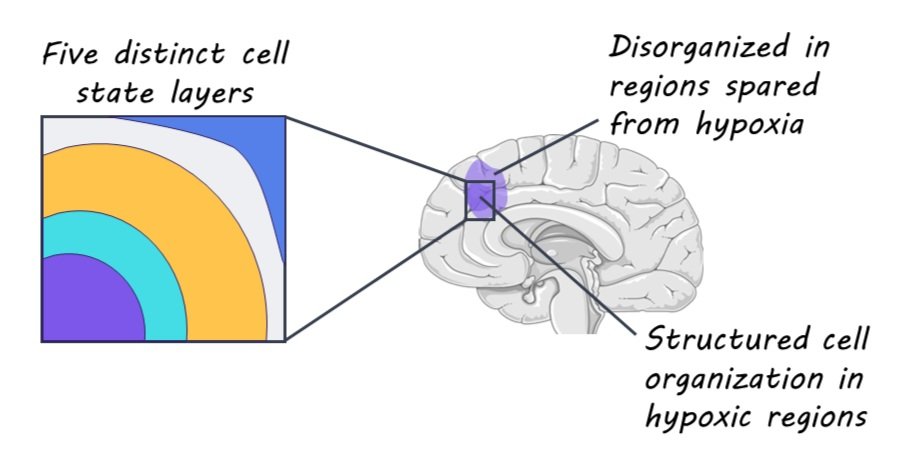
The authors identified three key modes of glioma organization, each respectively focused on 1) the local environment of glioblastoma tumors, 2) the pairing of cellular states across tumors, and 3) the global architecture of the tumors. The first key mode of glioma organization that the authors found is that cells tend to be surrounded by other cells in the same state, forming local environments that are highly homogeneous in configuration and gene expression. This finding suggests that spatial location plays an important role in the regulation of the cell state. The second key mode of glioma organization that the authors reported had to do with how pairs of states are arranged across multiple scales. That is, pairs of cellular states or gene expression patterns tend to be consistently associated with each other across different scales within the tumor tissue. Importantly, understanding these state-to-state associations across different spatial scales can help us to better understand the developmental processes of gliomas. Finally, the third key mode of glioma organization that the authors found is related to global arrangement of tissue layers. Specifically, the authors detected five distinct layers, with cell states in each layer being associated with the same layer or adjacent ones. Critically, the authors discuss that hypoxia might drive the organizational characteristics of glioma tumors such that regions spared from hypoxia are actually relatively disorganized in comparison.

What's the impact?

This study is the first to characterize both local and global organizational features of glioma tumors at a highly granular level using new advances in spatial transcriptomics and proteomics. The three key organizational modes identified in this study provide critical insights into how hypoxia drives the spatial architecture of gliomas, which in turn can support the development of targeted treatments for glioblastoma.  

Access the original scientific publication here.

Antibody Therapy Slows Symptoms in Rapidly Progressing Parkinson’s Disease

Post by Baldomero B. Ramirez Cantu

The takeaway

Treatment with the monoclonal antibody Prasinezumab slows the progression of motor deficits in individuals with Parkinson's disease, particularly in subpopulations characterized by rapid progression.

What's the science?

Parkinson's disease (PD) is a progressive neurological disorder characterized by tremors, stiffness, and impaired movement due to the loss of dopamine-producing neurons in the brain. Monoclonal antibody treatments involve the use of antibodies that target specific proteins implicated in disease processes, promoting clearance of pathological agents, and offering a promising avenue for targeted therapeutic intervention. Recently, the use of monoclonal antibody therapy has shown promise for the treatment of Alzheimer’s disease, however, these treatments remained relatively unexplored for Parkinson's disease. This week in Nature Medicine, Gennaro Pagano and colleagues published an article exploring the impact of the monoclonal antibody Prasinezumab on the progression of motor symptoms in PD.

How did they do it?

Researchers analyzed data collected during the Trial of Prasinezumab in Early-Stage Parkinson’s Disease or PASADENA study, which involved screening 443 individuals, with 316 ultimately enrolled. Participants were randomly assigned to receive either a placebo or varying doses of Prasinezumab (1,500 mg or 4,500 mg).

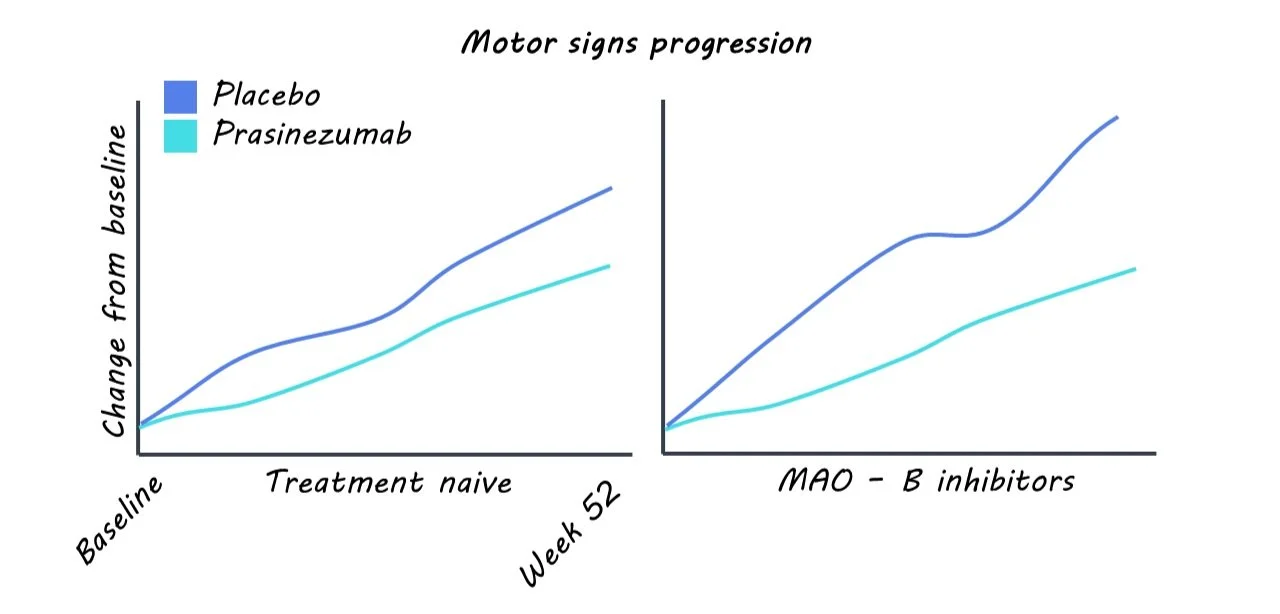
The progression of motor signs was assessed using the Movement Disorder Society Unified Parkinson's Disease Rating Scale (MDS-UPDRS) Part III score, a tool for evaluating the severity of motor symptoms in PD patients. This assessment was conducted over 52 weeks, allowing for longitudinal tracking of changes in motor function. Subpopulations were defined based on factors such as the participants’ use of monoamine oxidase B (MAO-B) inhibitors, Hoehn and Yahr stage, presence of rapid eye movement (REM) sleep behavior disorder, and motor subphenotypes.

Linear regression models were employed to analyze the relationship between Prasinezumab treatment and the progression of motor signs within each subpopulation. These analyses were adjusted for potential confounding variables, such as concurrent drug usage and genetic susceptibilities.

What did they find?

Participants in rapidly disease-progressing subpopulations exhibited a greater benefit from Prasinezumab treatment compared to those in non-rapidly progressing subpopulations. Specifically, individuals treated with MAO-B inhibitors at baseline showed a more pronounced treatment effect, as evidenced by a greater reduction in the progression of motor signs compared to individuals who did not receive the monoclonal antibody treatment. Similarly, participants with more advanced disease stages, as indicated by higher Hoehn and Yahr stage, also demonstrated a more favorable response to Prasinezumab treatment.  

These findings show that Prasinezumab is effective at slowing the progression of motor deficits in Parkinson's disease, and appears to have differential effects based on the underlying characteristics of patients, with greater benefits observed in subpopulations characterized by more rapid disease progression.

What's the impact?

This study identified a treatment capable of slowing down the progression of motor symptoms in PD, specifically in the subpopulation experiencing rapid progression. Research like this is critical to developing effective therapies for alleviating motor symptoms in individuals with PD.