Inflammatory Effects of Trem1 are Associated with Risk of Developing Alzheimer’s Disease

Post by Shireen Parimoo

The takeaway 

Trem1 is a receptor protein found in macrophages – a type of white blood cell – that increases in older age and has pro-inflammatory effects. Deletion of Trem1 reduces inflammation by increasing mitochondrial metabolism and rescues cognitive deficits associated with aging and Alzheimer’s disease, such as memory loss. 

What's the science?

Myeloid cells like microglia and macrophages are critical for optimal brain and immune functioning. Alzheimer’s disease (AD) is characterized by pathology including the accumulation of amyloid protein and neurofibrillary tangles. Research has identified many families of genes that are associated with an increased risk of developing Alzheimer’s disease (AD). In aging mice, a receptor expressed on myeloid cells-1 (Trem1)  has pro-inflammatory effects that lead to higher rates of cognitive decline and greater amyloid accumulation. However, the exact role of Trem1 in AD is presently unclear. This week in Nature Neuroscience, Wilson and colleagues investigated the cellular mechanisms by which Trem1 regulates myeloid cell functioning and its effects on memory in typical aging and AD.

How did they do it?

The authors performed a series of experiments on several mouse models. The first included old and young wildtype mice and mice with deletion of both Trem1 alleles (Trem1-/-), which allowed them to identify the baseline effects of Trem1 deletion on myeloid cell functioning. Here, flow cytometry was used to look at Trem1 expression in myeloid cells of wildtype and mice with deleted Trem1 alleles. Next, inflammatory markers in plasma, peripheral macrophages, and the brain were quantified and compared to performance on spatial and object recognition memory tasks. The authors then used RNA sequencing to compare the differences in microglial and macrophage gene expression between the groups. Finally, as energy metabolism is important for regulating inflammatory responses, they investigated the effects of Trem1 deletion on macrophage metabolism by characterizing the expression of mitochondrial genes in the mouse models.

The second group consisted of mouse models of AD (i) without Trem1 deletion, (ii) with deletion of a single Trem1 allele, and (iii) with deletion of both Trem1 alleles. These AD mouse models enabled the authors to determine how Trem1 deletion affects the cellular responses of microglia and macrophages to amyloid burden and its effect on memory. As before, they measured Trem1 expression, inflammatory responses, memory performance, and mitochondrial metabolism. Finally, to determine whether Trem1 is implicated in human AD, the authors used human frontal cortex tissue from controls and patients with AD to quantify Trem1 levels and to examine the relationship between Trem1 and disease severity. 

What did they find?

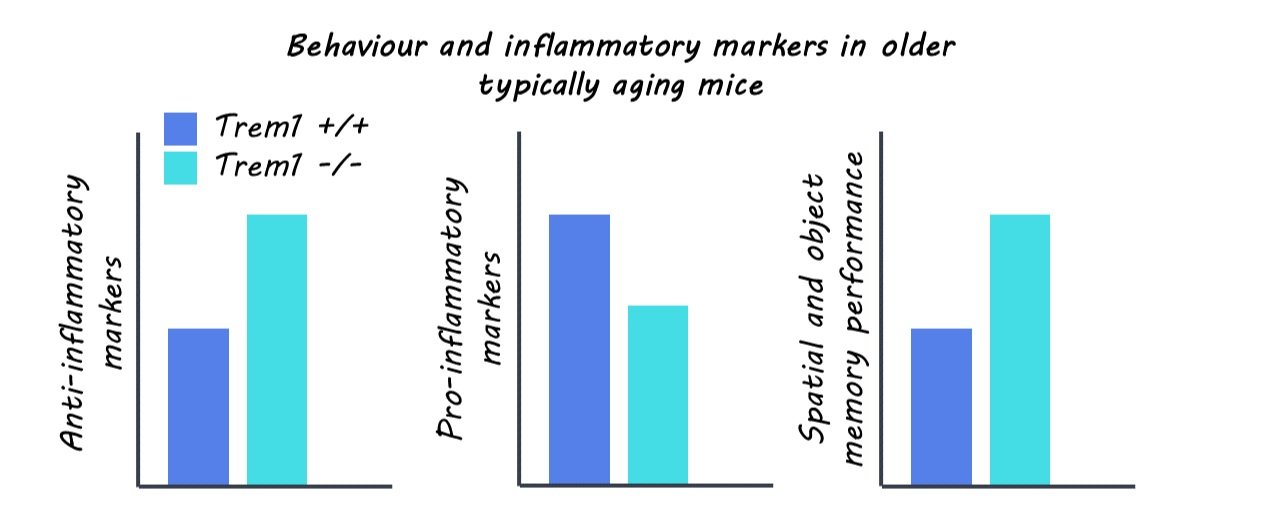
Older wildtype mice had elevated Trem1 expression when compared to younger wildtype mice, as well as higher levels of inflammatory markers in plasma. Mice with Trem1 deletion, however, showed similar levels of plasma and brain inflammatory proteins as the younger mice. Anti-inflammatory markers in macrophages were lower in older than younger mice while pro-inflammatory markers showed the opposite pattern. Within the older group, mice with the deletion of both Trem1 alleles had higher anti-inflammatory and lower pro-inflammatory markers, better spatial and object memory performance, and different gene expression profiles of proteins associated with mitochondrial metabolism and inflammatory regulation in peripheral macrophages compared to the wildtype mice. Together, these results suggest that in typical aging, Trem1 expression negatively affects memory through pro-inflammatory mechanisms while Trem1 deficiency has neuroprotective effects.

Trem1 expression was higher in post-mortem brains of humans who had AD than those who didn’t, and elevated levels of Trem1 were associated with more advanced stages of AD. In mouse models of AD, mice with and without Trem1 deficiency had similar amyloid burden as well as similar levels of Trem1 in microglia. Compared to AD mice with both Trem1 alleles deleted, the deletion of only a single Trem1 allele rescued memory performance. Trem1 deletion in AD was also associated with lower inflammatory markers in the blood, indicating that the increased presence of Trem1 in aging has adverse effects on cognition due to increased inflammatory responses in AD, irrespective of amyloid burden. 
What's the impact?

This study is the first to demonstrate the role of Trem1 signaling in the risk of developing Alzheimer’s disease. The finding that Trem1 expression increases with age and promotes inflammation via metabolic pathways provides an avenue for future research to develop treatments targeting those specific pathways. 
Access the original scientific publication here.

Different Patterns of Gene Mutation in Neurons and Glia During Aging

Post by Lani Cupo

The takeaway

Neurons and glia show different patterns of gene mutations during the aging process in humans, suggesting different processes may underlie age-related genetic mutations in different cell types. 

What's the science?

The underlying cellular and molecular mechanisms contributing to the process of typical aging (in the absence of disease) are still poorly understood. While aging-related genetic mutations in neurons have been investigated, glia, responsible for everything from providing brain structure to maintaining homeostasis, represent more than half of the cellular content of the brain and have yet to be examined for gene mutations in the aging process. This week in Cell, Ganz and colleagues present a characterization of mutations in neurons and oligodendrocytes (glia that produce myelin in the brain), finding different patterns of mutations between the two cell types.

How did they do it?

The authors extracted oligodendrocytes from the prefrontal cortex of 13 deceased individuals aged 0.4 - 83 years and accessed genome data from the neurons of 19 individuals (12 of whom overlapped with their oligodendrocyte donors). They used a method called single-cell whole-genome sequencing to identify the genetic code of these cells individually. Then, they used an algorithm to automatically identify two types of mutations in the genomes of the cells: single-cell whole-genome sequencing (sSNVs) and small insertions and deletions (indels). sSNVs occur when a single nucleotide is switched for another, and are acquired over the lifespan, rather than being inherited. Indels refer to insertions or deletions of nucleotides in the genome. With these data, the authors first estimated annual rates of accumulation of both sSNVs and indels. They also examined where in the genome the mutations occurred. Finally, they compared the patterns of mutations they observed with genomes from a database of tumor cells.

What did they find?

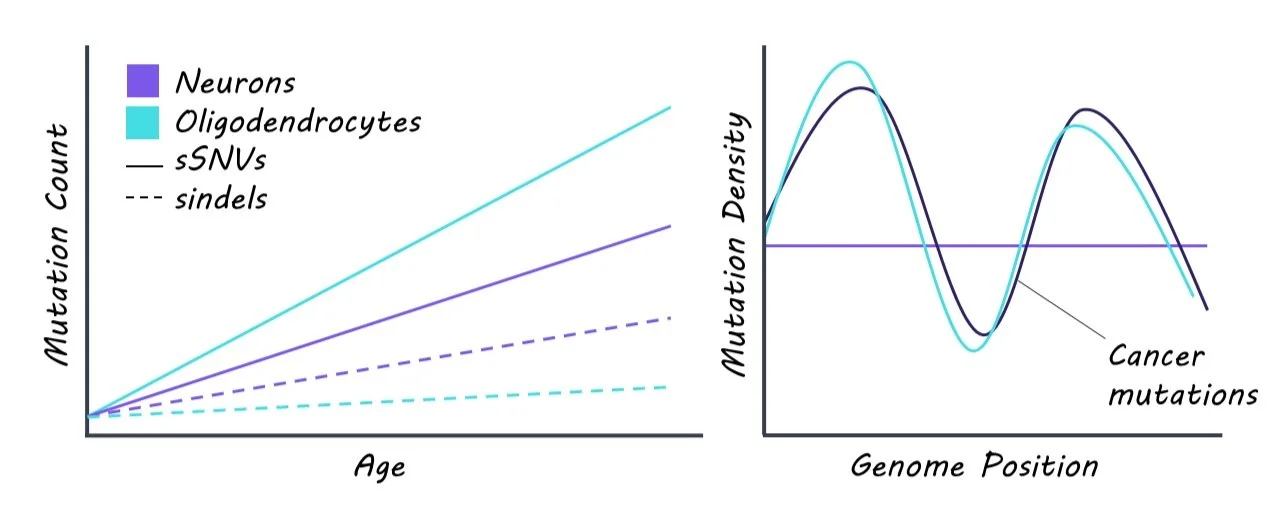
The authors found that oligodendrocytes exhibited higher rates of sSNV accumulation, but lower rates of indel accumulation compared to neurons. Deletions of nucleotide base pairs were more common than insertions in both cell types, but there were also differences in the kinds of deletions between the cell types. Oligodendrocytes mostly showed deletions of a single base pair whereas neurons showed deletions of 2-4 base pairs or 1 base pair insertion compared to the glial cells. At birth there was no significant difference between sSNVs or indels between cell types, suggesting that the changes were acquired over the lifespan and relevant to aging. The fact that profiles of mutations differed between cell types provided evidence that different mechanisms underlie aging between cell types. 

The authors also found opposite patterns in the placement of mutations between cell types. Mutations in oligodendrocytes were found to be more prevalent in intergenic regions, or parts of the genetic code that are not transcribed into proteins. In contrast, mutations in neurons were found to be more prevalent in regions in genes - regions that are transcribed into proteins. As a result of the placement, mutations in neurons were also found to have more of a functional effect on the cell. When comparing the mutation profiles of oligodendrocytes and neurons to cells from tumors, the authors found that densities of sSNVs in oligodendrocytes correlated with those in all cancer types, but neuronal mutations did not correlate with mutations in cancer cells, suggesting the mechanism contributing to mutations in glia cells, but not neurons, may be related to tumor formation.

What's the impact?

For the first time, this study compares genetic mutations in oligodendrocytes and neurons throughout the typical aging process. They found differences in the type and placement of mutations between cell types, suggesting different mechanisms contribute to the mutations. In time this may help us identify the specific mechanisms underlying what goes wrong in aging and neurodegenerative diseases.

 Access the original scientific publication here.

A Mobile Messaging Intervention Can Improve Depression Symptoms in Older Adults

Post by Lila Metko

The takeaway

Adequate mental health care for older adults is a growing concern in low and middle-income countries. A new mobile messaging intervention, developed to combat this issue, was able to help older adults with depressive symptoms in Brazil by improving their condition to a less depressed state.

What’s the science?

Given that 69% of the world's older population live in low and middle-income countries, and that the healthcare workers in these countries are already overstretched with a heavy workload, a virtual yet efficacious option for mental health treatment is needed. This week in Nature Medicine, Scazufca and colleagues assess the effectiveness of a mobile messaging intervention in older adults with depressive symptoms, that uses two techniques called psychoeducation and behavioral activation. Psychoeducation is a specific way of educating patients about their condition, which can have a therapeutic value to them. Behavioral activation is the encouragement of the individual by their mental health provider to engage in a constructive activity like going for a walk in nature or calling a good friend. 

How did they do it?

The researchers recruited 603 participants who were over the age of 60, experienced depressive symptoms, and had access to WhatsApp mobile messaging. These participants were recruited from underprivileged areas in a major metropolitan region of Sao Paulo, Brazil. Participants were randomly separated into two groups, an intervention arm, and a control arm. The intervention arm participants received a self-help mobile-based intervention developed based on the principles of psychoeducation and behavioral activation. Forty-eight WhatsApp messages in either video or audio format (depending on the message) were sent to the participants so that they received a message twice a day, four days a week for six weeks. The audio messages were 3 minutes long, and contained fictional characters who discussed symptoms of depression and potential interventions, mentioning fictional situations of interventions that had been beneficial in the past. The visual messages were summary diagrams designed to reinforce the audio message content. The control group received only one six-minute message that briefly discussed symptoms of depression and how to manage them.

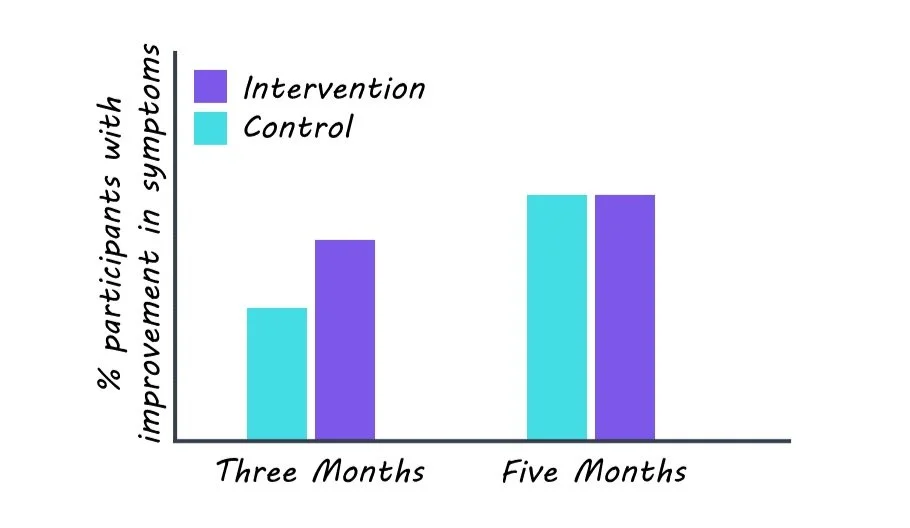
Participants’ level of depressive symptomology was measured at baseline, three months after the intervention, and five months after the intervention. The two measures assessed related to symptomology were: improvement in depressive symptomology and reduction in depressive symptomology. Improvement in depressive symptomology constituted having a score on the depressive symptom questionnaire below a specific value and reduction in depressive symptomology constituted having a reduction in their depressive symptomology questionnaire score by at least 50%.   

What did they find?

Participants in the intervention arm had improvement and reduction in depressive symptomology at three months but not at five months. A complier average causal effect (CACE) analysis indicated that, for the three-month time period, as the number of messages opened by the participants increased (compliance), so did the effect of the intervention.

What’s the impact?  

Many low and middle-income countries such as Brazil have a treatment gap for mental health. This is especially concerning due to the growing population of older adults, and the need for mental health care. Roughly 30% of Brazilian older adults in low-resource settings experienced symptoms that could indicate clinical depression. This research indicates that self-help interventions for depression are feasible and efficacious in low and middle-income populations.

Access the original scientific publication here.