Early Psychedelic Use Linked to Lower Risk of Psychotic Symptoms

Post by Baldomero B. Ramirez Cantu

The takeaway

Adolescents who have tried psychedelics may show a reduced likelihood of developing psychotic symptoms, but familial factors like a history of bipolar disorder or schizophrenia could influence the connection between psychedelics and manic symptoms.

What's the science?

Psychedelics represent a class of substances known for their relatively safe profiles and non-habit-forming nature, capable of inducing profoundly altered states of consciousness. Despite these characteristics, there's a notable gap in understanding the relationship between psychedelic use, particularly among teenagers, and psychiatric symptoms. This week, Simonsson et al. addressed this gap by publishing a study in JAMA Psychiatry, aiming to unravel the intricate interactions between adolescent naturalistic psychedelic use and the emergence of psychotic or manic symptoms.

How did they do it?

The study leveraged data from the Swedish Twin Registry, consisting of a longitudinal analysis of Swedish twins and their parental figures from age 9 onwards, with follow-up assessments at ages 15, 18, and 24. At age 15, a robust sample exceeding 16,000 twins provided detailed insights into their psychedelic usage patterns and reported manifestations of psychosis and manic symptoms. In tandem, polygenic scores were employed to probe potential genetic predispositions to schizophrenia and bipolar disorder.

Statistical analyses, including sophisticated linear regression models, were then employed to scrutinize the relationship between psychedelic use and mental health outcomes. Notably, adjustments were made for confounding variables such as concurrent drug usage and genetic susceptibilities. Using these analyses, the study aimed to elucidate the nuanced associations between psychedelic usage and mental health outcomes.

What did they find?

A drug-adjusted statistical analysis revealed fewer psychotic and manic symptoms among psychedelic users. This shift in association persisted across various additional adjustments to statistical models. Furthermore, exploring familial confounding unveiled compelling insights. Monozygotic twins who reported psychedelic use exhibited a noteworthy divergence from their non-user cotwins. Specifically, they showcased a lower prevalence of psychotic symptoms, a finding consistent across both unadjusted and drug-adjusted analyses. This suggests a potential protective effect of psychedelic use against the development of psychotic symptoms within genetically identical pairs. This points to the necessity for further investigation to understand the underlying mechanisms at play.

Additionally, gene-environment interactions shed light on nuanced associations between psychedelic use and mental health dynamics. While no significant group differences emerged for genetic vulnerability to schizophrenia or bipolar disorder in relation to psychotic symptoms, interactions were observed for manic symptoms. Significant associations surfaced between psychedelic use and genetic vulnerability to both schizophrenia and bipolar disorder, underscoring the multifaceted nature of these relationships.  

What's the impact?

This research has significant implications for public health policy and interventions concerning adolescent psychedelic use. By uncovering the intricate relationship between naturalistic psychedelic use and psychiatric symptoms, particularly in light of familial factors, the study provides valuable insights for policymakers, educators, and mental health professionals. These findings can inform evidence-based strategies for harm reduction, substance use prevention, and targeted psychiatric interventions.
Access the original scientific publication here.

Could a Vaccine Prevent the Onset of Parkinson’s Disease?

Post by Rebecca Hill

The takeaway

a-Synuclein, a protein that misfolds and clumps in Parkinson’s disease, can’t be targeted normally by our immune systems. A genetically modified protein can be used to vaccinate against these malfunctioning proteins and trigger an immune response that delays symptoms of Parkinson’s. 

What's the science?

Parkinson’s is caused by the misfolding and clumping of a-Synuclein (a-syn) proteins. Since we produce a-Synuclein proteins naturally, when they malfunction, our immune systems are unable to recognize and destroy them. HET-s is a protein found in a fungus that is completely unrelated to a-syn proteins in Parkinson’s. This week in Brain, Pesch and colleagues attempted to genetically modify HET-s proteins to create a vaccine against a-syn that could prevent the progression of Parkinson’s disease.

How did they do it?

Using mutagenesis, a technique that alters DNA at specific locations, the authors changed the surface of HET-s in a way that could be identified by our immune system. This caused HET-s proteins to resemble the a-syn proteins that malfunction in Parkinson’s disease. They injected these altered HET-s proteins into mice as a vaccine to train their immune system to be able to recognize and destroy malfunctioning a-syn. They injected mice every two weeks for eight weeks and then collected blood plasma samples to analyze. The authors then injected both vaccinated and unvaccinated mice with a-syn proteins either in their brains or in their stomachs to simulate two types of Parkinson’s disease. The authors also tested mice behaviorally to examine motor strength performance. 

What did they find?

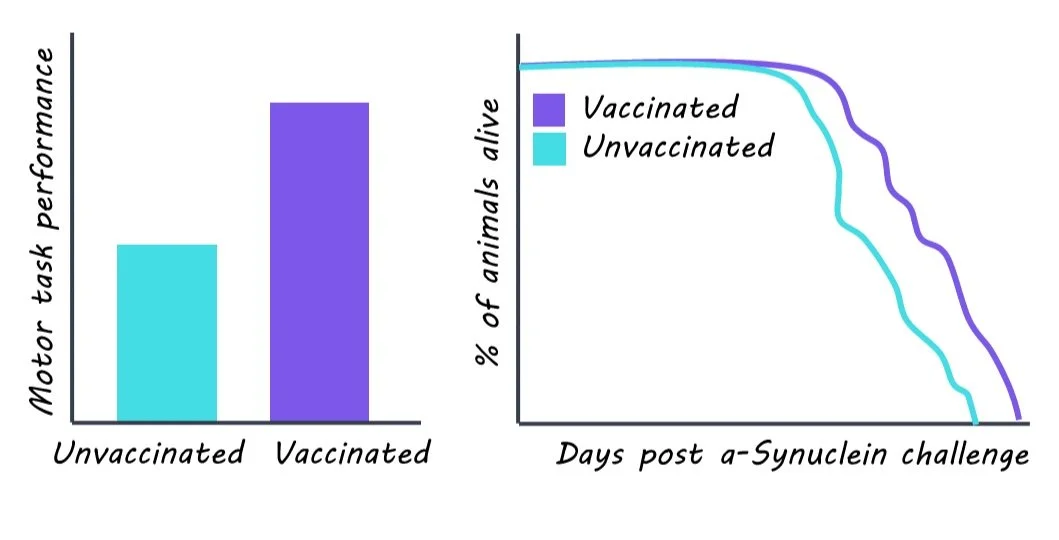
Mice vaccinated with modified HET-s proteins survived 8% longer than controls when a-syn was injected into their brain and survived 22% longer than controls when a-syn was injected into their body. The authors found antibodies for the a-syn proteins in the vaccinated mice, which shows that the vaccines can lead to a better immune response to the progression of Parkinson’s disease. For both the mice that had a-syn injected into their brain or their body, vaccinated mice performed better on behavioral tests than unvaccinated mice. This means that vaccination led to better motor ability after a longer period. 

What's the impact?

This study is the first to show that vaccination with engineered proteins can trigger an immune response that will delay Parkinson’s disease progression. Since Parkinson’s disease usually occurs in older adults, any delay in symptom progression could significantly impact a patient’s health outcomes. With the development of vaccines such as this, the quality of life may be significantly improved for people as they age. 

Identifying Aging Subtypes with Machine Learning

Post by Lani Cupo

The takeaway

Three patterns of brain aging were identified in a large dataset of cognitively normal adults by a semi-supervised machine-learning algorithm: one subtype associated with typical aging, one with vascular factors, and one with higher levels of brain atrophy. The patterns were associated with different genetic backgrounds, lifestyle risk factors, and later cognitive decline. 

What's the science?

The process of aging is associated with many changes in neuroanatomy, some of which emerge before noticeable pathology, such as cognitive impairment or memory loss. Variables such as genetic background, demographics, and lifestyle factors can impact these neuroanatomical changes. Identifying subtypes of age-related changes early on could help clinicians to identify and intervene in pathological aging processes, however, early changes may be subtle and require large datasets to accurately identify. This week in JAMA Psychiatry, Skampardoni and colleagues investigated whether there are aging subtypes.

How did they do it?

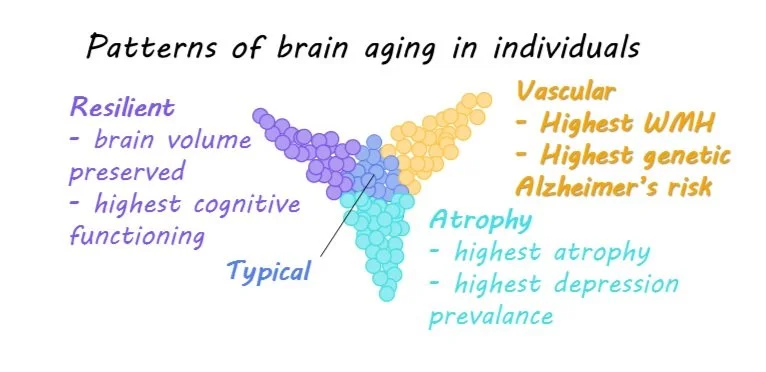
By pooling data from 11 neuroimaging studies, the authors assembled 58,113 scans from 27,402 individuals aged 45-85. They used several metrics to assess brain health including regional volume and white-matter hyperintensity (WMH) volume (a measure of changes in the brain vasculature). First, the authors used principal component analysis (a data reduction technique) to identify participants with the lowest atrophy levels at each age group (45-55, 55-65, 65-75, and 75-85). This “resilient aging” group (A0) was used as a reference to identify subtypes of aging. Then, the authors used a machine learning algorithm known as Semi-Supervised Clustering via Generative Adversarial Networks (Smile-GAN) to identify subtypes with different trajectories of aging relative to A0. The subgroups were first identified in each age group but then assessed for consistency in trajectories across age groups. Then, the subgroups were compared for differences in genetics, clinical, and cognitive features. A subset of the full dataset included longitudinal data, allowing the authors to examine whether the identified groups were associated with long-term outcomes.

What did they find?

The authors identified three subtypes of aging consistent across the age groups. The first group, A1, showed mild atrophy mostly localized near the Sylvian fissure (the noticeable sulcus, or crease, that can be seen when viewing a brain from the side). The second group, A2, was associated with hypertension, showed greater atrophy, and had the highest burden of WMH. The third group, A3, showed more severe and dispersed atrophy across the brain and was associated with greater cognitive decline. Because group A1 was the largest with the least severe atrophy, it was considered typical aging. Older individuals in both groups A2 and A3 showed worse cognitive scores than groups A0 and A1, with A2 showing more cardiovascular risk factors and genetic risk factors for Alzheimer’s Disease, and group A3 showing the greatest levels of depression. Of note, these cognitive differences were still considered “sub-threshold”, as the included participants had no diagnosis. Groups A2 and A3 showed the greatest longitudinal cognitive decline, with group A2 showing the greatest progression of WMH.

What's the impact?

This study identified generalizable subtypes of aging identifiable from mid-life. By highlighting two trajectories of atypical aging and characterizing them in terms of cognitive, lifestyle factors, and genetic phenotypes, as well as long-term outcomes, this study shows groups that may be differentially susceptible to neurodegenerative disorders.

 Access the original scientific publication here.