Firing in Rhythm: Simultaneous Ripples Across Distant Brain Regions Facilitate the Integration of Brain Signals

Post by Rachel Sharp

The takeaway

When high-frequency brain waves, known as “ripples”, occur simultaneously across different brain regions, they help integrate signals between these regions through coordinated neural activity. These findings support the hypothesis that ripples play an important role in helping our brains combine complex information across distant brain regions.

What's the science?

How do individual elements of a neural event occurring at different locations across the brain unify into a cohesive mental experience? The “binding-by-synchrony” hypothesis suggests that high-frequency ripples synchronize across brain regions, forming integrated networks of neural activity. Ripples have been shown to synchronize, and have even been shown to organize cell firing in rodents, but the impact of synchronized rippling across distant brain regions in humans is still unknown. This week in PNAS, Verzhbinsky and colleagues test the impact of simultaneous rippling on the integration of neural signals across different brain areas in humans. To do this, the authors used implanted microelectrodes spanning distances of up to 16mm (a US dime is 17.9 mm in diameter) in regions of the cortex used to execute movements and process language.

How did they do it?

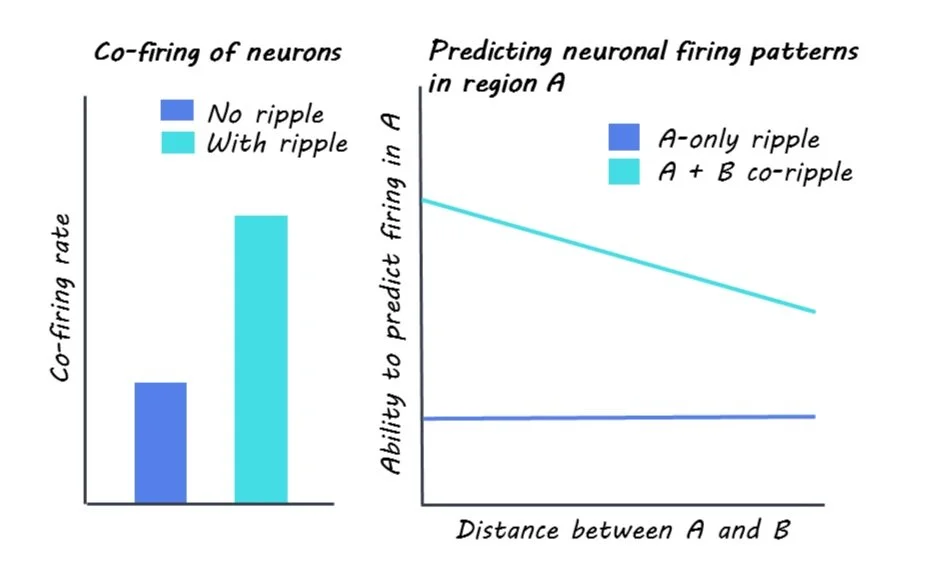
The authors implanted four Utah Arrays (a group of 96 microelectrodes with the ability to record spatially accurate neural activity) into the cortex of three participants. They then recorded activity from these electrodes for each patient, over several hours, during both wake and sleep, and analyzed how selected neurons changed their firing rates in response to ripple activity detected by neighboring electrodes. After collecting the full recordings from each participant, the authors analyzed the rate at which ripples co-occurred, whether or not co-firing increased across brain regions when those regions were co-rippling, and whether co-rippling neurons across different regions were better able to predict the firing patterns of other neurons, compared to non-co-rippling neurons. To examine this, they categorized individual neurons as either “predicting drivers (B)” or “predicted targets (A)”. They measured the extent to which firing patterns in B neurons predicted observed firing patterns in A neurons when the surrounding neurons were co-rippling.

What did they find?

The authors found that brain regions that experienced co-rippling also experienced greater integration of neural firing across patients, brain regions, and brain states (wake vs. sleep). They also found that neurons were more likely to fire in synchrony with co-occurring ripples, which was correlated with the ability of neurons to predict another neuron’s firing patterns. This finding supports the idea that networks of neurons distributed across different brain regions synchronize through simultaneous high-frequency ripples. Neurons in co-rippling regions are more likely to fire together, and to exhibit predictive firing patterns. Ultimately, their findings supported the “binding-by-synchrony” hypothesis, showing evidence for networks of co-firing neurons across brain regions, enhanced by simultaneous ripple activity. 
What's the impact?

This study found that simultaneous ripples improve connections between both nearby and distant neurons in the human brain. These ripples were able to organize firing across large groups of neurons, showing the importance co-occurring ripples may have on integrating complex neural events, even when they occur in different brain regions. This integration of neural events helps us achieve complex cognition, organize our thoughts, and make appropriate decisions. Understanding the biological mechanism that drives neural integration gives us another clue to deciphering the puzzle of complex human perception and cognition.
A New Way Forward: Psychedelic Therapy for the Treatment of Mental Illness

Post by Laura Maile 

The need for effective treatments for mental illness

An estimated 26% of adults in the United States suffer from depression, anxiety, or other related mental health disorders, and around 20% of patients don’t respond to standard treatments. Major depressive disorder (MDD) is a substantial public health burden, with an estimated $210 billion burden every year in the US alone. Drug treatments for MDD usually require weeks to reach effective levels, and many who take such treatments do so indefinitely. Along with the adverse side effects reported for many drugs used to treat depression and anxiety, the cost burden to patients and the public highlights the critical need for improved treatments. 

What are psychedelics?

There are many synthetic and naturally occurring substances categorized as “psychedelics,” which are defined by their ability to alter consciousness, perception, cognition, and mood, usually through action at serotonin receptors. Classic psychedelics including psilocybin, mescaline, N, N-dimethyltryptamine (DMT), and lysergic acid diethylamide (LSD) bind to a variety of receptors, but exert their psychoactive effects by binding to a specific type of serotonin receptor, the 5-HT2A receptor, which is mostly located on excitatory neurons in the cortex. Binding to these specific serotonin receptors leads to intracellular signaling cascades that ultimately lead to synaptic plasticity and increased activity of neurons in regions of the brain associated with cognition, attention, emotion regulation, and sensory perception. Scientists don’t yet fully understand the specific mechanisms that lead to the acute effects of the psychedelic experience, nor the long-term effects of their use in treating mental health disorders.  

What’s the current state of research on psychedelic psychotherapy?

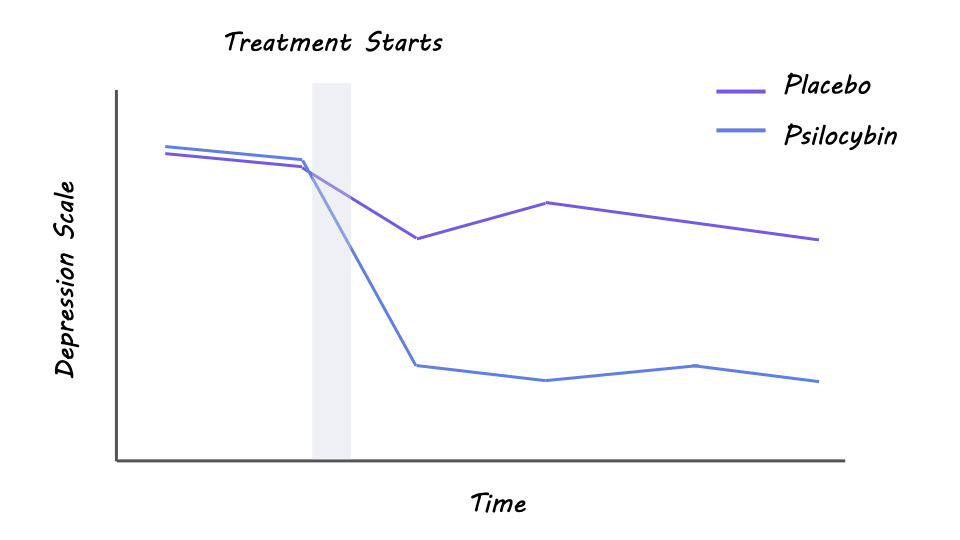
There have been several studies that support the high therapeutic potential of psychedelics in the treatment of depression, anxiety, alcohol-use disorder, substance-use disorder, and post-traumatic stress disorder. Evidence comes from both surveys of psychedelic self-administration and small-scale clinical investigations with controlled administration and medical supervision, usually in conjunction with psychological support or therapy before, during, and after the treatment sessions. In 2021, Davis and colleagues published a randomized clinical trial of 24 participants with MDD, showing that just two treatment sessions of psychotherapy-assisted administration of psilocybin led to significant improvement in symptoms in 71% of participants, and full remission in 54% of participants one month later. Ross and colleagues demonstrated similar findings in another small-scale randomized placebo-controlled trial focusing on the treatment of anxiety and depression in cancer patients. In this study, between 60-80% of patients saw continued relief from anxiety and depression symptoms 6.5 months following a single dose of psilocybin combined with psychotherapy. Another study published in 2022 by Holze and colleagues tested the effects of LSD psychotherapy in 42 participants with anxiety, both with and without a life-threatening illness. In this study, participants experienced two treatment sessions with LSD and two with placebo, and most experienced reduced anxiety and depression symptoms 16 weeks later. Overall, this research suggests that psychedelic therapy can be effective in treating mental illness, even after just a couple of treatments.

Results from a randomized clinical trial (von Rotz et al., 2022)

What does the future look like?

Recent studies in rodents indicate that some of the beneficial effects of psychedelics for depression treatment may depend on the TrkB receptor, not serotonin receptors. More research is needed to understand further the mechanism of action that underlies the beneficial effects of psychedelics. One concern regarding psychedelic therapy is the potential side effects - more research is needed to determine whether existing psychedelic drugs can be chemically altered to target receptors that will limit the hallucinogenic effects while maintaining the beneficial antidepressant effects. While past clinical trials have indicated the potential benefits of using psychedelics to treat mental illness, additional large-scale randomized clinical trials are needed to ensure the safety and efficacy of using various psychedelic drugs for treatment-resistant depression, anxiety, and other mental illnesses, especially for individuals already taking medications like antidepressants. These include studies on 5-MeO-DMT, a component of Sonoran Desert Toad venom that produces an intense psychedelic experience that lasts between 5-20 minutes, which is much shorter than the hours-long effects of LSD and psilocybin.  

The takeaway

Reviews of many recent clinical studies indicate that psychedelics have huge potential as an alternative treatment for depression, anxiety, and other mental health disorders. When administered in a safe environment in combination with psychotherapy, psychedelics can result in long-term reductions in depression and anxiety symptoms, with few adverse effects reported. More large-scale clinical trials are needed to assess the safety and efficacy of these treatments in a more diverse pool of patients. The research and development of approved psychedelics is an important ongoing effort that may have substantial impacts on the personal, social, and economic burdens of mental health disorders worldwide.    

References +

Carhart-Harris et al. Psylocibin with psychological support for treatment-resistant depression: an open label feasbility study. 2016. The Lancet Psychiatry.

Davis AK et al. Effects of Psilocybin-Assisted Therapy on Major Depressive Disorder: A Randomized Clinical Trial. 2021. JAMA Psychiatry.

DiVito AJ et al. Psychedelics as an emerging novel intervention in the treatment of substance use disorder: a review. 2020. Mol Biol Rep.

Holze F et al. Lysergic Acid Diethylamide-Assisted Therapy in Patients With Anxiety With and Without a Life-Threatening Illness: A Randomized, Double-Blind, Placebo-Controlled Phase II Study. 2022. Biological Psychiatry.

Kocak, D.D., Roth, B.L. Examining psychedelic drug action. 2024. Nat. Chem.

McClure-Begley et al. The promises and perils of psychedelic pharmacology for psychiatry. 2022. Nat Rev Drug Discov.

Moliner R et al. Psychedelics promote plasticity by directly binding to BDNF receptor TrkB. 2023. Nature Neuroscience.

Ross S et al. Rapid and sustained symptom reduction following psilocybin treatment for anxiety and depression in patients with life-threatening cancer: a randomized controlled trial. 2016. J Psychopharmacol.

Von Rotz et al. Single-dose psilocybin-assisted therapy in major depressive disorder: a placebo-controlled, double-blind, randomised clinical trial. 2022. eClinical Medicine.

The Organization of Abstract Brain Regions Like Sensory Brain Regions May Facilitate Information Flow

Post by Lani Cupo 

The takeaway

Brain regions previously thought to be solely responsible for abstract processes, such as memory, can be organized like brain regions involved in sensory perception - detecting the world around us through our senses. This might indicate that information is being transferred between regions of the brain involved in sensory processing and abstract processes like memory. 

What's the science?

Certain brain regions are known to be involved in external perception (e.g. vision), while others are associated with more abstract processes (e.g. memory). How information is communicated between these two types of processes is still an open question in neuroscience, especially since the neural code (or how the information is represented by neurons) for both systems is thought to be different. This week in Nature Neuroscience, Steel and colleagues use functional magnetic resonance imaging (fMRI) in humans to provide evidence for a way in which the perceptual and abstract processes may interact.

How did they do it?

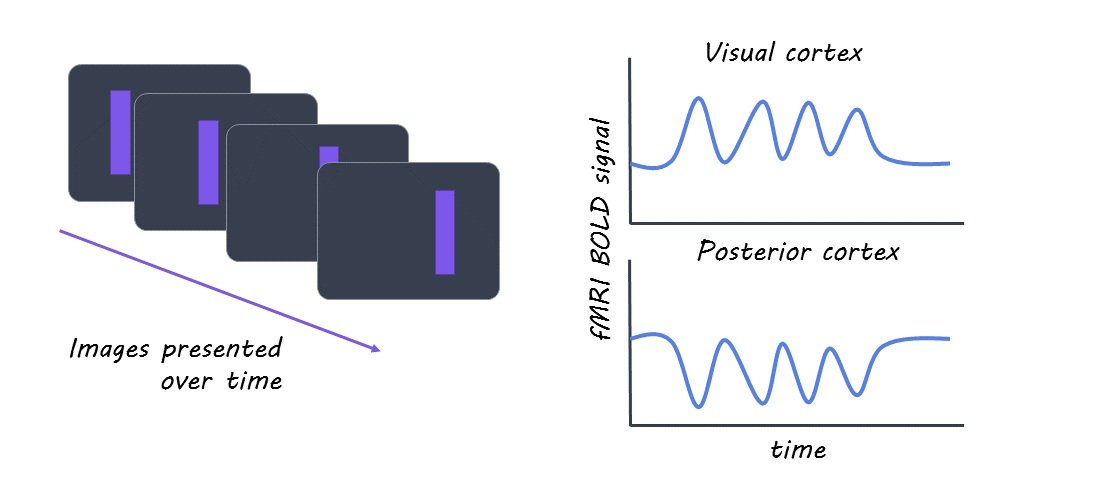
Visual information is well known to have a retinotopic representation in the primary visual cortex, meaning that the neurons in this brain region are arranged corresponding to the region of the eye’s retina that they respond to. In this study, the authors first sought to determine whether the retinotopic organization of neurons exists not only in regions responsible for sensory processes as expected, but also in regions responsible for abstract processes. To do this, they acquired fMRI data from the entire cortex while participants viewed visual stimuli, to model populations of neurons associated with a retinotopic organization. They could also determine whether the neural responses to the stimulus that follow a retinotopic pattern were positive (greater than baseline) or negative (less than baseline). The authors also examined the ratio of positive to negative activations and identified brain regions outside of the visual cortex that showed a retinotopic pattern. Second, because they hypothesized that retinotopic activation outside of the visual cortex was related to memory, they had participants complete a memory task to test whether the ratio of positive to negative activity changed between the regions. Finally, the authors tested whether the same patterns of activity were observed in tasks more applicable to the real world that might activate both sensory and memory regions, by showing participants images of places that they were familiar with.

What did they find?

First, in addition to the expected retinotopic organization of the primary visual cortex (a key region for sensory perception), the authors found a retinotopic organization of neurons in higher-order regions of the brain involved in abstract cognitive processes. This is important because it has generally been theorized that only the primary visual cortex is organized corresponding to the retina. Specifically, during the perceptual task, brain activity was reduced in some memory areas (e.g. lateral parietal cortex), whereas in visual regions, activity increased in response to a stimulus. These findings suggested this inverse retinotopic organization may be associated with information transfer between perceptive and memory regions, so the authors next conducted imaging during a memory task. Consistent with this hypothesis, they observed opposite activation patterns, when comparing the perceptual and memory tasks. That is, they saw positive activations within retinotopic memory regions and negative activation in sensory regions. Finally, when they presented the participants with familiar scenes, the authors found the opposing interaction between sensory and memory regions persisted. This suggests that their findings are likely replicable in real-world scenarios and extend beyond the artificial and highly controlled laboratory settings of the first two experiments.

What's the impact?

This study provides additional evidence for a retinotopic organization of memory regions and suggests contrasting activity in memory and visual regions may be responsible for information transfer between sensory and higher-order regions. The findings further the understanding of how sensory and non-sensory brain regions communicate.

Access the original scientific publication here.