Neurogenesis During Pregnancy Influences Maternal Behavior

Post by Laura Maile 

The takeaway

Adult neural stem cells (NSCs) contribute to brain plasticity throughout life. During different phases of pregnancy, NSCs differentiate into distinct subtypes of olfactory bulb neurons, influencing maternal behavior. 

What's the science?

The adult mouse brain contains stem cells that are influenced by environmental changes and can differentiate into distinct cell types. Physiological states such as hunger and satiety are known to influence specific regional populations of adult NSCs. Pregnancy induces changes in several brain areas including the ventricular subventricular zone (V-SVZ), which contains neural stem cells (NSCs) that differentiate into olfactory bulb neurons and show increased proliferation at certain stages of pregnancy. It’s unknown, however, whether pregnancy and other physiological states can control specific populations of NSCs and whether there’s a functional outcome on brain plasticity and behavior. This week in Science, Chaker and colleagues investigated how distinct neural stem cells respond to pregnancy to produce specific olfactory bulb neurons that influence the behavior of mothers around the time of birth. 

How did they do it?

Using GFAP and Ki67 in mice, the authors labeled and quantified proliferating NSCs in the V-SVZ on different days of gestation and post-pregnancy. Next, they injected pregnant females with a thymidine analog on specific days of pregnancy to label newly born neurons and then analyzed their olfactory bulbs three weeks later when the labeled neurons would be integrated. This allowed them to determine whether specific populations of NSCs differentiate into distinct cell layers and subtypes of olfactory bulb neurons. To understand whether the newly differentiated olfactory bulb neurons were long-lasting past weaning (i.e., when the mice are separated from the mother), they quantified the surviving cells again 30 days post analog injection. They next performed spatial transcriptomics to characterize the genetic profiles of olfactory bulb layers that experience neurogenesis (i.e., growth of new neurons) during and after pregnancy. They then focused on one cluster that was enriched in mothers during pregnancy to determine what neuronal markers were associated with pregnancy. To determine the function of the transiently increased pregnancy-associated neurons, the authors measured their survival when maternal care was disrupted by prematurely removing pups, cross-fostering with new pups, or exposing mothers or virgin mice to pup nest odor. Finally, they conducted olfactory behavior tests in mothers during pregnancy who had specific populations of olfactory bulb interneurons depleted or maintained. 

What did they find?

The authors discovered that distinct regions of the V-SVZ showed activity and proliferation on specific days during pregnancy. This indicates that there are both temporally and spatially dynamic patterns of differentiation controlled by the phase of pregnancy of the adult mouse.  After injecting a thymidine analog on specific gestation days, they found that pregnancy induces neurogenesis in discrete sublayers of the olfactory bulb and that these new neurons become functionally integrated into the existing circuitry. Once pups began feeding on solid food and required less maternal care, however, the olfactory bulb showed decreased numbers of these newborn neurons, and nearly all of them disappeared by weaning. This confirms that pregnancy induces transient neurogenesis at specific stages of the perinatal period. Spatial transcriptomics revealed clusters of neurons corresponding to olfactory bulb layers, that showed upregulation in certain genes at specific time points, indicating the spatial and temporal control of neurogenesis in response to pregnancy.
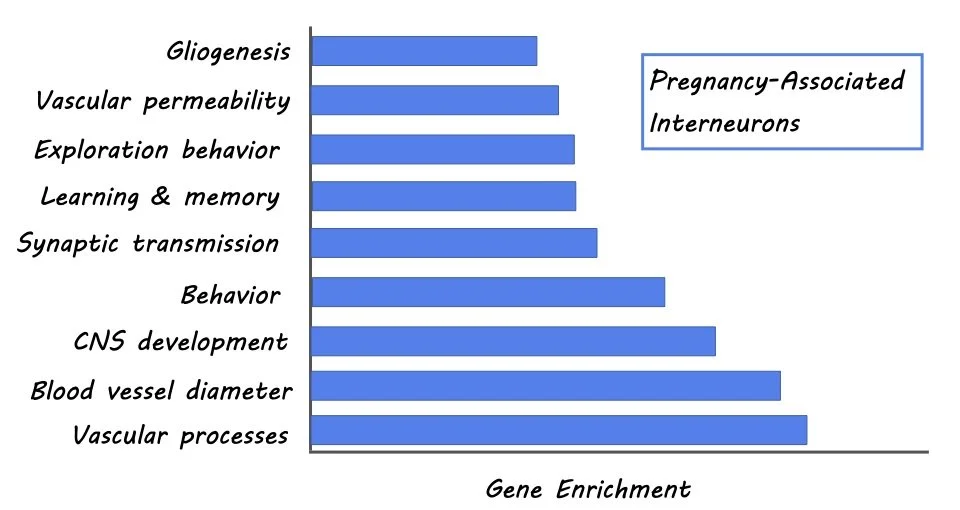
When pups were removed from maternal care prematurely, certain interneurons were correspondingly lost early. Similarly, when cross-fostering with news pups, some pregnancy-related interneurons survived, while others were lost. The neurons lost shared genetic profiles and location in olfactory layers. Additionally, specific interneuron populations were rescued when mothers were exposed to new pup nest odor, and others were not, indicating the necessity of pup odor for the survival of pregnancy-related neurons. Loss of one type of pregnancy-related interneuron reduced the ability of mothers to discriminate between their own pups and new pups. This shows that pregnancy-related neurogenesis is important for own pup odor recognition, but not for general olfactory function. Loss of different types of interneurons decreased pup exploration index, suggesting that pregnancy-related neurogenesis is important for pup odor sensitivity during early motherhood. 

What's the impact?

This study demonstrated that neural stem cells can generate specific populations of neurons to help pregnant mothers prepare for maternal care. Different physiological states, such as hunger, satiety, and pregnancy, can influence adult neurogenesis to suit transient needs and influence behavior, according to environmental and physiological changes. 
Access the original scientific publication here. 

The Relationship Between Sleep, Circadian Rhythms, and Neuronal Myelination

Post by Meredith McCarty 

The takeaway

Myelination is pivotal for neuronal function and is altered in many neurodegenerative disorders including multiple sclerosis (MS). In this study, the authors find that myelination development and maintenance are dependent on the circadian transcription factor Bmal1

What's the science?

Myelination is the process by which neurons are encased in a myelin sheath, providing metabolic support and increased signaling efficiency of the neuron. Myelination is maintained by oligodendrocyte cells, which produce myelin sheaths for neurons throughout the central nervous system. Oligodendrocyte precursor cells (OPCs) are the precursor for oligodendrocytes, yet not much is known about their development and regulation. 

Bmal1 is a transcription factor involved in circadian rhythm regulation, and recent research has found the disruption of Bmal1 to be correlated with changes in OPC function. This week in Neuron, Rojo and colleagues investigate the role of Bmal1 in myelination processes, and how these dynamics are related to sleep disruption and circadian cycles. 

How did they do it?

To study the relationship between circadian rhythms, Bmal1 dynamics, and myelination throughout development, the authors conducted several genetic and behavioral experiments in mouse models. 

The mouse models used in this study were wild-type (i.e., normal) mice and mice that had the Bmal1 transcription factor knocked out from the OPC cells specifically (OPC-specific Bmal1 knockout mice). To quantify changes in OPC proliferation at different experimental time points, the authors injected a tag to measure DNA proliferation called EdU. To understand the role of Bmal1 in OPC regulation, the authors performed RNA-sequencing and circadian rhythmicity assessment on OPC cells from mice at varying experimental time points. The authors then quantified physical changes in myelination throughout the central nervous system using transmission electron microscopy (TEM) as well as tests of the integrity of the blood-brain barrier in wild-type and mice without Bmal1

To quantify changes in mouse behavior, the authors used measures of gait, stride length, and working memory. To study the role of sleep deprivation in Bmal1 function, the authors altered the mouse sleep/wake cycles and recorded during wake and sleep from implanted EEG electrodes. To probe the regulation of remyelination during adulthood, the authors quantified morphological complexity in older mice and performed a focal demyelination procedure in wild-type mice and mice without Bmal1. Lastly, the authors analyzed human genetic data to study the relationship between the risk of MS and sleep fragmentation. 

What did they find?

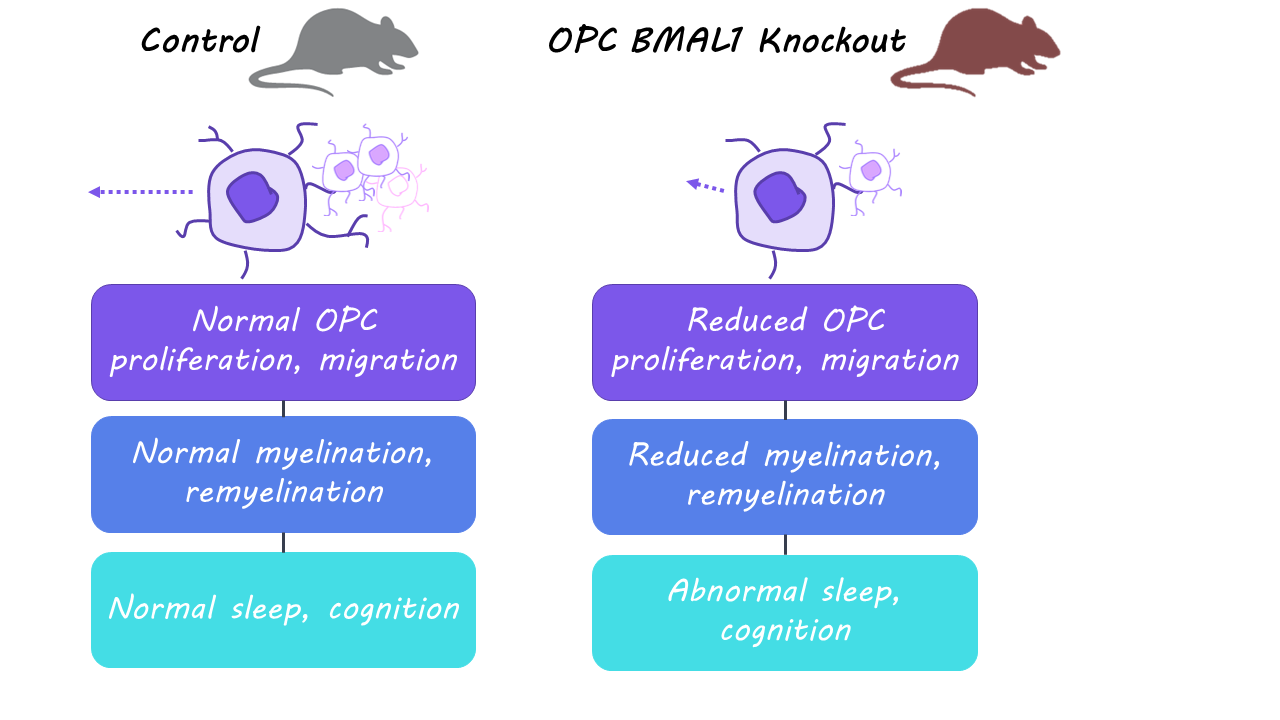
The authors found changes in OPC proliferation depending on the circadian rhythm. Additionally, mice without Bmal1 exhibited decreased OPC density and physical complexity in the corpus callosum (the white matter connecting the left and right hemispheres of the brain), but not in other brain regions. The authors also found a significant reduction in OPCs throughout cortical and subcortical brain regions in the developing brains of mice without Bmal1, suggesting reduced OPC migration in these mice. The authors next used RNA sequencing to compare genes expressed in OPCs at different time points in the circadian cycle and found that 10% of genes were rhythmically expressed in OPCs. This suggests that Bmal1 regulates OPC dynamics in specific brain regions at specific points in development and during the circadian rhythm. 

When measuring changes in myelination using transmission electron microscopy (TEM), the authors found the corpus callosum to have thinner myelination in mice without Bmal1 relative to wild-type mice. The authors found no differences in the integrity of the blood-brain barrier in mice without Bmal1-KO. Next, when the authors used a novel object recognition task to assess whether these changes in myelination altered the behavior of mice without Bmal1, they found deficits in working memory, stride length, and gait. suggesting that Bmal1 disruption and altered myelination results in behavioral and cognitive effects.  

EEG recordings during sleep deprivation experiments revealed mice without Bmal1  exhibited disrupted sleep and altered recovery from sleep deprivation relative to wild-type mice. The authors next compared the effect of Bmal1 disruption in early versus later developmental time points, quantifying changes in OPC morphology and migration. They found that Bmal1 knockout in adolescence led to significant disruption of OPC density and complexity. Interestingly, Bmal1 knockout in adulthood led to disrupted remyelination, but no changes in OPC density. 

What's the impact?

In this study, the authors find that Bmal1 regulation is tightly linked with circadian rhythms and the maintenance of myelination throughout specific regions of the mouse central nervous system. Interestingly, the authors note that since sleep disruption is associated with an increased risk of MS in humans, this novel evidence has implications for the treatment of demyelinating disorders like MS. Future research is necessary to clarify the relationship between MS and sleep in human studies.

Access the original scientific publication here.

The Developmental Trajectories of Prosocial Behavior and Empathy Diverge from Childhood into Adolescence

Post by Shireen Parimoo

The takeaway

Prosocial behavior increases as children develop into adolescents, whereas parental reports of empathy show increases until late childhood followed by gradual declines in early adolescence. Brain activity in regions associated with feeling socially included, such as the ventral striatum and medial prefrontal cortex (mPFC), predicts future prosocial behavior in children. 

What's the science?

Empathy and prosocial behavior – social behavior that benefits others more than it benefits us – are important for forming and maintaining meaningful social connections. Prosocial behavior often involves empathy, as adopting someone else’s perspective makes it easier to act prosocially towards them. As empathy and perspective-taking develop throughout childhood, older children exhibit more prosocial behavior than younger children. Adolescents, on the other hand, show more cooperative prosocial behavior but less helping behavior.

The difference between children and adolescents may be explained by the developmental trajectory of brain regions supporting different aspects of prosocial behavior. For instance, a socio-cognitive network underlying perspective-taking, which includes the mPFC, may show a different developmental pattern than a socio-affective network that includes regions like the ventral striatum that support emotional processing. To distinguish between these possibilities, new work in NeuroImage by van der Meulen and colleagues investigated the neural mechanisms underlying the developmental trajectories of prosocial behavior and empathy from middle childhood to early adolescence.

How did they do it?

Children aged 7-13 years old participated in a longitudinal study that took place over five years. Data from three sessions were collected, with each session taking place 2-2.5 years apart. At each session, children played the prosocial cyber ball game which consisted of three other virtual players who tossed a ball to each other. In the Fair Game round, each player received the ball an equal number of times whereas in the Unfair Game round, player two (P2) only received the ball once from the other virtual players. Prosocial behavior was defined as the ratio of tosses from the participant to P2 in the Unfair compared to the Fair Game round. Parents also completed a questionnaire at each session reporting their child’s prosocial behavior and empathy toward others.

Functional MRI was used to record brain activity during the game at each session, except for the Fair Game round during T1. The authors examined whole-brain activity during the Unfair Round as well as activity in the socio-cognitive (temporoparietal junction, precuneus, posterior superior temporal sulcus, and mPFC) and in the socio-affective brain regions (anterior insula, ventral striatum, and dorsal anterior cingulate cortex ). Specifically, they contrasted the difference in brain activity during prosocial behavior (i.e., passing the ball to P2 during the Unfair Round) with non-prosocial behavior (i.e., passing the ball to the other players during the Unfair Round). Additionally, the authors examined brain activity associated with feeling socially included, that is, when the participant received the ball from P1 and P3 compared to when they did not receive the ball.

The authors used mixed effects statistical modeling to study the longitudinal change in 1) parental reports of prosocial behavior and empathy, 2) prosocial behavior during the cyber ball game, 3) brain activity associated with prosocial behavior and social inclusion, and 4) associations between prosocial behavior and brain activity.

What did they find?

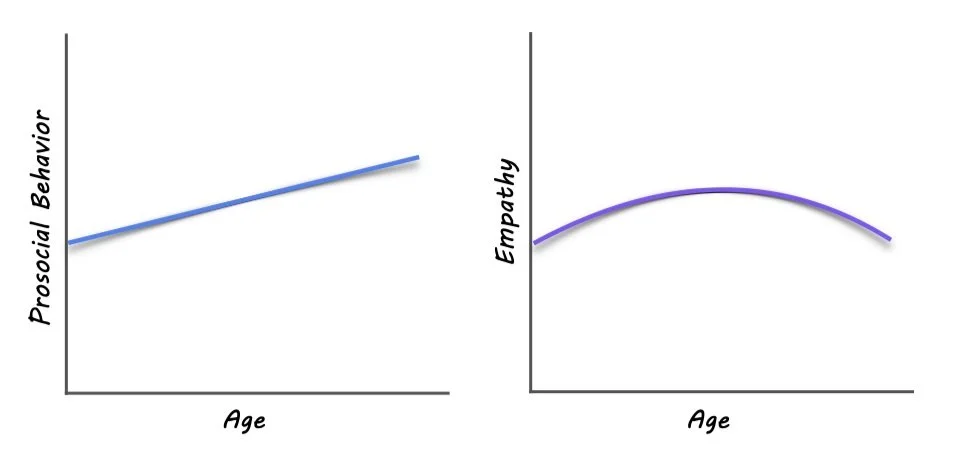
Prosocial behavior from both the parental reports and the cyber ball game showed linear increases with age. Empathy, on the other hand, increased from middle to late childhood before showing a gradual decrease into early adolescence. Interestingly, empathy was positively correlated with parental reports of prosocial behavior but not with the prosociality measured by the cyber ball game. At the whole-brain level, no brain area showed greater activation during prosocial behavior at T1 and T2, while mPFC and visual regions showed increased activation at T3 (i.e., in early adolescence). Additionally, there was a gradual increase in ventral striatal activity with age until late childhood, after which it stabilized. However, changes in neural activity over time were not related to changes in prosocial behavior. Together, these results suggest that the neural correlates of prosocial behavior become more prominent during late childhood in socio-affective regions and during early adolescence in socio-cognitive regions.

Social inclusion was linked with more widespread activation in regions of the socio-affective and socio-cognitive networks. The dorsal anterior cingulate cortex, insula, ventral striatum, and the precuneus showed a U-shaped trajectory, with a reduction in activation from middle to late childhood followed by an increase in activity into early adolescence. Thus, in contrast to prosocial behavior, neural correlates of social inclusion are most apparent in middle childhood and adolescence. Notably, there was a negative relationship between changes in neural activity and changes in prosocial behavior. Specifically, a stronger decrease in mPFC and ventral striatal activity during social inclusion was related to greater increases in prosocial behavior over time. Altogether, these findings highlight how the neural and cognitive processes underlying social inclusion interplay with prosocial behavior over the course of development.

What's the impact?

This study found that prosocial behavior and empathy follow different developmental trajectories as children transition into adolescence. The finding that the regions sensitive to social inclusion predict prosocial behavior over time paves the way for future research to investigate the mental processes these regions facilitate in order to support prosocial behavior. 

Access the original scientific publication here.