
The Potential of Brain Stimulation During Sleep to Enhance Memory Function

Post by Meredith McCarty

The importance of sleep

Sleep is essential for humans and all living species. Despite being a period of apparent vulnerability during daily life, the maintenance of sleep throughout evolution suggests that sleep is fundamental for neural and bodily function. Sleep deprivation can lead to numerous deficits including altered attention, memory, and learning (Krause et al., 2017).  

While humans spend about a third of their lifetimes asleep, the duration and nature of our sleep differ from that of our nearest primate relatives. Humans spend less time asleep than other primates, and relatively more time is spent in rapid eye movement relative to non-REM sleep (Nunn & Samson, 2018). There are many interesting theories as to the evolutionary origin of such changes in sleep quality and duration (see Nunn et al., 2016 for review), and increasing evidence for the essential role of sleep in memory consolidation. 

Memory consolidation during sleep

Memory consolidation describes the process by which information learned from the environment is transferred from temporary short-term memory into more distributed and permanent long-term memory. There is growing evidence that slow-wave sleep (SWS), a period of non-REM sleep marked by low-frequency, high-amplitude brain waves, is pivotal for memory consolidation (Klinzing et al., 2019).  

During SWS, cortical and subcortical regions, namely the hippocampus, thalamus, and neocortex, exhibit distinct patterns of neural oscillations (Ngo et al., 2020). These dynamics are described as thalamo-cortical spindles, hippocampal ripples, and cortical slow oscillations (Latchoumane et al., 2017). Hippocampal ripples, or brief periods of synchronized oscillatory activity, are thought to facilitate communication between the hippocampus and cortical and subcortical regions (Todorova & Zugaro, 2020; Brodt et al., 2023). 

The neural mechanism by which these dynamics may enable memory consolidation is through phase-locking of brain activity between different brain areas, enabling the transmission and nesting of neural signals between brain regions. Animal research has shown that when hippocampal ripples are disrupted, memory consolidation is impaired (Ego-Stengel & Wilson, 2010).

Can memory be enhanced during sleep?

Studies investigating what happens when we disrupt SWS in human and non-human animals have shown that disruption of oscillatory dynamics during SWS can lead to deficits in memory tasks.  But what about the possibility of enhancing memory through sleep?

In a recent study, Geva-Sagiv and colleagues performed closed-loop brain stimulation during sleep in human patients implanted with intracranial electrodes (Geva-Sagiv et al., 2023). The participants performed a cognitive memory task, by which memory accuracy was compared following natural sleep and sleep during which closed-loop stimulation was precisely applied during active phases of SWS. They found enhanced sleep spindles and synchronized spiking between interconnected brain regions following stimulation SWS. Additionally, stimulation during SWS correlated with improved memory accuracy in the behavioral task. These data suggest that the synchronized brain activity during SWS can be increased via external stimulation, correlating with enhanced memory consolidation.  

What’s next?

Sleep-related memory enhancement has enormous implications for clinical application. Sleep deprivation is incredibly detrimental to human health, for both the brain and the body. Insight from sleep research can enable improved treatment for the effects of sleep deprivation and insomnia, as well as the many disorders where sleep disruption occurs. Further research will help to progress our understanding of sleep-related memory enhancement, and how it can be used to make an impact in the future.

References +

Krause et al., 2017. The sleep-deprived human brain. Nature Reviews Neuroscience.

Nunn & Samson, 2018. Sleep in a comparative context: Investigating how human sleep differs from sleep in other primates. American Journal of Physical Anthropology.

Nunn et al., 2016. Shining evolutionary light on human sleep and sleep disorders. Evolution, Medicine, and Public Health.

Klinzing et al., 2019. Mechanisms of system memory consolidation during sleep. Nature Neuroscience.

Ngo et al., 2020. Sleep spindles mediate hippocampal-neocortical coupling during long-duration ripples. eLife.

Latchoumane et al., 2017. Thalamic Spindles Promote Memory Formation during Sleep through Triple Phase-Locking of Cortical, Thalamic, and Hippocampal Rhythms.

Todorova & Zugaro, 2020. Hippocampal ripples as a mode of communication with cortical and subcortical areas.

Brodt et al., 2023. Sleep-A brain-state serving systems memory consolidation. Neuron.

Geva-Sagiv et al., 2020. Augmenting hippocampal-prefrontal neuronal synchrony during sleep enhances memory consolidation in humans. Nature Neuroscience.
The Role of Serotonin in Postnatal Plasticity in the Brain

Post by Trisha Vaidyanathan

The takeaway

There is a brief window after birth in which the brain corrects mistakes formed during embryonic development. This window of rewiring is dependent on serotonin and is negatively affected by preterm birth.

What's the science?

Proper wiring of neuronal circuits is critical for brain function and the brain has a remarkable ability to adapt to errors made during development in a process called neuronal plasticity. However, little is known about the timing of this plasticity or what neuronal signals regulate the process. This week in Proceedings of the National Academy of Sciences (PNAS), Sinclair-Wilson and colleagues investigated how the brain corrects for an embryonic developmental error that prevents sensory neurons in the thalamus from reaching their correct targets in the cortex.

How did they do it?

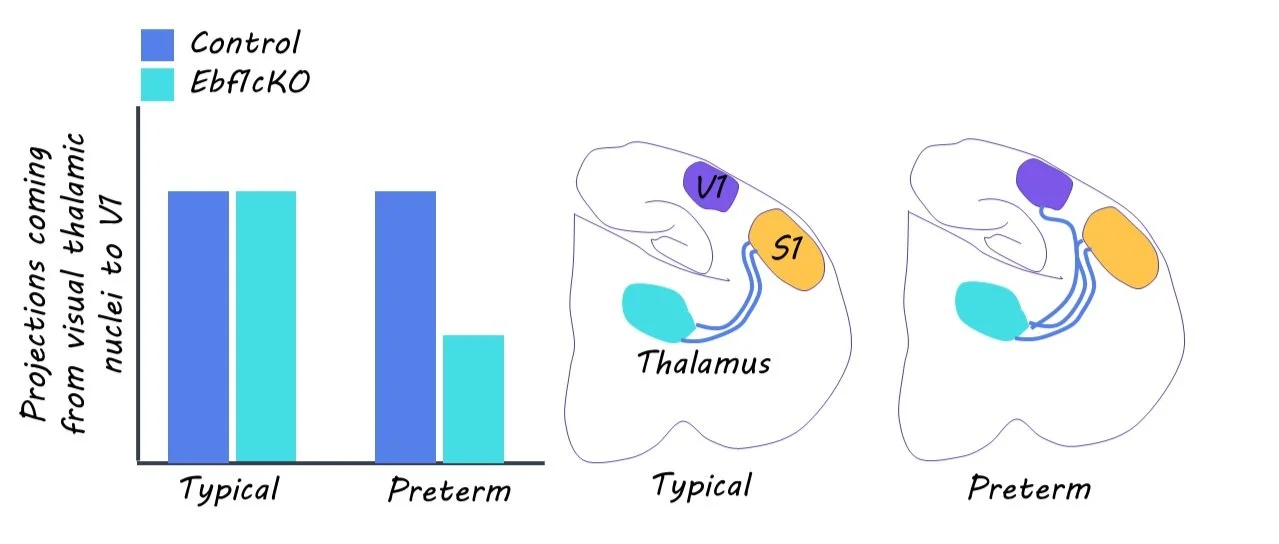
The authors used a powerful genetic mouse model (Ebf1cKO mice) that disrupts the ability of thalamic sensory neurons from finding their appropriate cortical target — a process that would typically occur during embryonic development. As a result of this mutation, somatosensory thalamic neurons invade the visual cortex instead, while visual thalamic neurons never reach their cortical target. Interestingly, it has previously been shown that these embryonic errors in Ebf1cKO mice are corrected postnatally.

To examine appropriate wiring of sensory circuits, the authors used retrograde labeling to quantify how many visual cortex inputs came from the appropriate visual area of the thalamus, rather than the incorrect somatosensory region of the thalamus. In a subset of their experiments, the authors also used in situ hybridization to visualize molecular markers of cortical regions in individual neurons, revealing the sharpness of boundaries around the visual and somatosensory cortex.

First, the authors performed retrograde labeling at successive postnatal developmental ages and identified the specific time window in which the embryonic errors of the Ebf1cKO mice were corrected. Next, the authors induced preterm labor in pregnant Ebf1cKO mice with the drug mifepristone to ask whether preterm birth affected the window of plasticity and ability to correct wiring deficits. Lastly, the authors gave mice pharmacological drugs to either increase or decrease serotonin levels to investigate the hypothesis that serotonin – which prematurely decreases after preterm birth – regulates postnatal plasticity in Ebf1cKO mice.

What did they find?

First, the authors observed that Ebf1cKO embryonic deficits were corrected early in postnatal development, by postnatal day 2. Although sensory thalamic regions in Ebf1cKO mice underwent significant cell death, ultimately the surviving axons were able to find their correct cortical targets and the sensory cortical areas were structurally and functionally intact. This revealed a brief window for postnatal plasticity shortly after birth.

Second, the authors found that inducing preterm birth in Ebf1cKO mice impaired postnatal plasticity. Preterm Ebf1cKO mouse pups still had visual cortex inputs that originated in somatosensory regions of the thalamus, while at the corresponding postnatal day, full-term Ebf1cKO mice had correctly rewired. This demonstrated that preterm birth negatively affects postnatal plasticity and could impact healthy postnatal development

Lastly, the authors investigated the hypothesis that serotonin, which prematurely decreases in preterm offspring, is necessary for postnatal plasticity. The authors found that daily administration from postnatal day 1 to 3 of a serotonin synthesis inhibitor (parachlorophenylalanine; decreases serotonin levels) impaired plasticity in full-term Ebf1cKO mice, resulting in sensory wiring and cortical boundaries that resembled the preterm Ebf1cKO mice. When the authors administered a selective serotonin reuptake inhibitor (SSRI, fluoxetine) that increases serotonin levels, they were able to rescue the plasticity in preterm Ebf1cKO mice, allowing the sensory thalamic neurons to reach their correct cortical targets and form sharp cortical area boundaries. This revealed that serotonin is a key component of the signaling that underlies postnatal development and the negative impacts of preterm birth.

What's the impact?

This study identified a brief window of plasticity that allows for the correction of errors in embryonic development, and that this window is negatively affected by preterm birth in a serotonin-dependent fashion. Together, this work provides critical insight into the effect of birth timing on brain development and sheds light on potential therapeutic tools that could be used to rescue developmental defects.

Access the original scientific publication here

Taking a Closer Look at the Ventricular System

Post by Lani Cupo

What is the ventricular system?

Ventricles are cavities deep within the brain, filled with cerebrospinal fluid (CSF). The presence of ventricles in the brain was first recorded in the 3rd century BCE by Greek physicians Herophilos and Erasistratus (Mortazavi et al., 2013). Their belief that core functions of the brain were produced by the ventricles persisted into the 16th century when Leonardo da Vinci performed the first ventriculography by injecting molten wax into the ventricles of an ox (Mortazavi et al., 2013). The dominant theory at the time attributed individual cognitive functions to the three identified ventricles: imagination, reasoning, and memory, respectively (Mortazavi et al., 2013; da Mota Gomes, 2020). Over centuries, the idea that the ventricles were the seat of the soul was abandoned, but the ventricular system is still of great interest to neuroscientists and neurologists today.

In human brains, the ventricular system is comprised of four CSF-containing cavities, with channels between them. These include two lateral ventricles (one in each hemisphere of the brain), the third ventricle (located at the center of the head), and the fourth ventricle (located between the brainstem and the cerebellum). The CSF that fills the ventricles is produced by the choroid plexus, a network of specialized cells that line the ventricles. Three layers of cells, or meninges, line the ventricles, and in many areas, these provide a barrier between the ventricles and the vasculature called the blood-brain barrier (BBB), while in some regions of the third and fourth ventricles, this barrier is ineffective or entirely absent, allowing free communication between the ventricles and the bloodstream (Mortazavi et al., 2013).

What does the ventricular system do?

The ventricular system fulfills several important roles in the brain. Much of its function resembles that of the hematopoietic circulatory system (responsible for producing and transporting blood cells), including transporting nutrients and waste. It also protects the brain against physical trauma and plays an important role in brain development (Lowery et al., 2010; Segal et al., 2001). 

The brain, unlike other organs, lacks a lymphatic drainage system to remove waste that accumulates as a result of cellular metabolism (Segal et al., 2001). Instead, waste slowly drains into the CSF through the ventricles, and eventually into the vasculature to be processed elsewhere in the body. In parallel, nutrients essential for proper brain function like ascorbate, vitamin B12, and thymidine can only enter the brain through the CSF (Segal et al., 2001). Thus, the ventricles help to maintain homeostasis in the brain. CSF provides protection to the brain. Not only does it help cushion blows, it also reduces the weight of the brain (from ~1500g to 50g), decreasing pressure on sensitive structures at the base of the brain (Segal et al., 2001).

Finally, the ventricles are critically involved in neurodevelopment. The early stages of the ventricles are formed in the first month of human development, when the layer of cells that becomes the brain folds, creating a tube that will go on to form the brain and spinal cord (Lowery et al., 2010). The regions of tissue surrounding the ventricles are the birthplace of cortical neurons (Duy et al., 2021). Stem cells located adjacent to ventricles divide - some becoming neurons - and then migrate away from the ventricles to form the layers of the cortex (Duy et al., 2021). There is also evidence that the choroid plexus may regulate neural stem cell behavior, but this topic requires further investigation at stages across the developmental process (Bitanihirwe et al., 2022). 

How can we study the ventricles?

Since da Vinci injected wax into the ventricles of the ox, there have been major developments in how scientists study the ventricles. One of the main techniques used to study ventricular anatomy is neuroimaging. Magnetic resonance imaging (MRI) can be used to accurately measure the volume of ventricles across the lifespan. In human fetuses, the size of the lateral ventricle is most commonly first measured with ultrasound (Alluhaybi et al., 2022). A lumbar puncture can also be conducted to extract CSF and measure levels of proteins, sugars, and cells (Hrishi et al., 2019). Finally, the pressure within the ventricles can be monitored with a probe inserted into the skull. This is especially useful in studying pathologies of the ventricles. 

What can go wrong with the ventricles?

Enlarged ventricles (also known as ventriculomegaly) have been recorded in both neurodevelopmental and neurodegenerative disorders. Hydrocephalus is a neurological disorder characterized by ventriculomegaly. In newborns, it can arise after an infection or bleeding in the brain, however, sometimes there is no known cause (Duy et al., 2021). CSF can accumulate in the brain, causing an enlargement of ventricles that can push and squeeze brain tissue and increase pressure within the skull. In these cases, surgery can remove excess CSF to decrease the pressure, which can help rescue some of the poor cognitive outcomes in children. Unfortunately, some cases of ventriculomegaly occur without any increased pressure, and in these cases diverting CSF does not seem to rescue downstream effects (Duy et al., 2021).

In contrast, ventriculomegaly in neurodegenerative disorders, such as Alzheimer’s Disease, occurs passively as the brain tissue atrophies and CSF begins to take up space where the tissue degrades (Apostolova et al., 2013). While there is variance in ventricular volume in the healthy adult population, enlarged ventricles have also been associated with various neuropsychiatric disorders, including Schizophrenia, bipolar disorder, and depression. 

What is still unknown about the ventricles?

The brain’s ventricles have been investigated for centuries, but there are still many open questions about their function and role in development and degeneration. For example, how CSF content may impact behavior or mood is not well understood, with little information present in the scientific literature (Orts-Del’Immagine et al., 2017). Further, we need to understand how fluid moves between the blood and CSF, and how fluid buildup occurs in different types of hydrocephaly. Treatments for hydrocephaly are also lacking, and more research is needed to develop therapies. There’s an opportunity to better understand the choroid plexus, it’s role in neurodevelopment, and how hormones regulate the secretion of CSF that influences brain function. Lastly, the blood-brain barrier is a key area to focus to learn more about in the development of therapies that can be administered through the CSF and absorbed into the brain. Even as neuroscientists uncover mysteries related to the tissues of the brain, future studies may also shed light on the negative spaces between tissue, contributing to a deeper understanding of the entire organ.

References +

Orts-Del’Immagine A, Wyart C. Cerebrospinal-fluid-contacting neurons. Curr Biol. 2017;27: R1198–R1200.

Apostolova LG, Babakchanian S, Hwang KS, Green AE, Zlatev D, Chou Y-Y, et al. Ventricular enlargement and its clinical correlates in the imaging cohort from the ADCS MCI donepezil/vitamin E study. Alzheimer Dis Assoc Disord. 2013;27: 174–181.

Hrishi AP, Sethuraman M. Cerebrospinal Fluid (CSF) Analysis and Interpretation in Neurocritical Care for Acute Neurological Conditions. Indian J Crit Care Med. 2019;23: S115–S119.

Alluhaybi AA, Altuhaini K, Ahmad M. Fetal Ventriculomegaly: A Review of Literature. Cureus. 2022;14: e22352.

Bitanihirwe BKY, Lizano P, Woo T-UW. Deconstructing the functional neuroanatomy of the choroid plexus: an ontogenetic perspective for studying neurodevelopmental and neuropsychiatric disorders. Mol Psychiatry. 2022;27: 3573–3582.

Lowery LA, Sive H. Totally tubular: the mystery behind function and origin of the brain ventricular system. Bioessays. 2009;31: 446–458.

da Mota Gomes M. From the wax cast of brain ventricles (1508-9) by Leonardo da Vinci to air cast ventriculography (1918) by Walter E. Dandy. Rev Neurol. 2020;176: 393–396.

Mortazavi MM, Adeeb N, Griessenauer CJ, Sheikh H, Shahidi S, Tubbs RI, et al. The ventricular system of the brain: a comprehensive review of its history, anatomy, histology, embryology, and surgical considerations. Childs Nerv Syst. 2014;30: 19–35.

Duy PQ, Rakic P, Alper SL, Butler WE, Walsh CA, Sestan N, et al. Brain ventricles as windows into brain development and disease. Neuron. 2022;110: 12–15.