
Taking a Closer Look at the Ventricular System

Post by Lani Cupo

What is the ventricular system?

Ventricles are cavities deep within the brain, filled with cerebrospinal fluid (CSF). The presence of ventricles in the brain was first recorded in the 3rd century BCE by Greek physicians Herophilos and Erasistratus (Mortazavi et al., 2013). Their belief that core functions of the brain were produced by the ventricles persisted into the 16th century when Leonardo da Vinci performed the first ventriculography by injecting molten wax into the ventricles of an ox (Mortazavi et al., 2013). The dominant theory at the time attributed individual cognitive functions to the three identified ventricles: imagination, reasoning, and memory, respectively (Mortazavi et al., 2013; da Mota Gomes, 2020). Over centuries, the idea that the ventricles were the seat of the soul was abandoned, but the ventricular system is still of great interest to neuroscientists and neurologists today.

In human brains, the ventricular system is comprised of four CSF-containing cavities, with channels between them. These include two lateral ventricles (one in each hemisphere of the brain), the third ventricle (located at the center of the head), and the fourth ventricle (located between the brainstem and the cerebellum). The CSF that fills the ventricles is produced by the choroid plexus, a network of specialized cells that line the ventricles. Three layers of cells, or meninges, line the ventricles, and in many areas, these provide a barrier between the ventricles and the vasculature called the blood-brain barrier (BBB), while in some regions of the third and fourth ventricles, this barrier is ineffective or entirely absent, allowing free communication between the ventricles and the bloodstream (Mortazavi et al., 2013).

What does the ventricular system do?

The ventricular system fulfills several important roles in the brain. Much of its function resembles that of the hematopoietic circulatory system (responsible for producing and transporting blood cells), including transporting nutrients and waste. It also protects the brain against physical trauma and plays an important role in brain development (Lowery et al., 2010; Segal et al., 2001). 

The brain, unlike other organs, lacks a lymphatic drainage system to remove waste that accumulates as a result of cellular metabolism (Segal et al., 2001). Instead, waste slowly drains into the CSF through the ventricles, and eventually into the vasculature to be processed elsewhere in the body. In parallel, nutrients essential for proper brain function like ascorbate, vitamin B12, and thymidine can only enter the brain through the CSF (Segal et al., 2001). Thus, the ventricles help to maintain homeostasis in the brain. CSF provides protection to the brain. Not only does it help cushion blows, it also reduces the weight of the brain (from ~1500g to 50g), decreasing pressure on sensitive structures at the base of the brain (Segal et al., 2001).

Finally, the ventricles are critically involved in neurodevelopment. The early stages of the ventricles are formed in the first month of human development, when the layer of cells that becomes the brain folds, creating a tube that will go on to form the brain and spinal cord (Lowery et al., 2010). The regions of tissue surrounding the ventricles are the birthplace of cortical neurons (Duy et al., 2021). Stem cells located adjacent to ventricles divide - some becoming neurons - and then migrate away from the ventricles to form the layers of the cortex (Duy et al., 2021). There is also evidence that the choroid plexus may regulate neural stem cell behavior, but this topic requires further investigation at stages across the developmental process (Bitanihirwe et al., 2022). 

How can we study the ventricles?

Since da Vinci injected wax into the ventricles of the ox, there have been major developments in how scientists study the ventricles. One of the main techniques used to study ventricular anatomy is neuroimaging. Magnetic resonance imaging (MRI) can be used to accurately measure the volume of ventricles across the lifespan. In human fetuses, the size of the lateral ventricle is most commonly first measured with ultrasound (Alluhaybi et al., 2022). A lumbar puncture can also be conducted to extract CSF and measure levels of proteins, sugars, and cells (Hrishi et al., 2019). Finally, the pressure within the ventricles can be monitored with a probe inserted into the skull. This is especially useful in studying pathologies of the ventricles. 

What can go wrong with the ventricles?

Enlarged ventricles (also known as ventriculomegaly) have been recorded in both neurodevelopmental and neurodegenerative disorders. Hydrocephalus is a neurological disorder characterized by ventriculomegaly. In newborns, it can arise after an infection or bleeding in the brain, however, sometimes there is no known cause (Duy et al., 2021). CSF can accumulate in the brain, causing an enlargement of ventricles that can push and squeeze brain tissue and increase pressure within the skull. In these cases, surgery can remove excess CSF to decrease the pressure, which can help rescue some of the poor cognitive outcomes in children. Unfortunately, some cases of ventriculomegaly occur without any increased pressure, and in these cases diverting CSF does not seem to rescue downstream effects (Duy et al., 2021).

In contrast, ventriculomegaly in neurodegenerative disorders, such as Alzheimer’s Disease, occurs passively as the brain tissue atrophies and CSF begins to take up space where the tissue degrades (Apostolova et al., 2013). While there is variance in ventricular volume in the healthy adult population, enlarged ventricles have also been associated with various neuropsychiatric disorders, including Schizophrenia, bipolar disorder, and depression. 

What is still unknown about the ventricles?

The brain’s ventricles have been investigated for centuries, but there are still many open questions about their function and role in development and degeneration. For example, how CSF content may impact behavior or mood is not well understood, with little information present in the scientific literature (Orts-Del’Immagine et al., 2017). Further, we need to understand how fluid moves between the blood and CSF, and how fluid buildup occurs in different types of hydrocephaly. Treatments for hydrocephaly are also lacking, and more research is needed to develop therapies. There’s an opportunity to better understand the choroid plexus, it’s role in neurodevelopment, and how hormones regulate the secretion of CSF that influences brain function. Lastly, the blood-brain barrier is a key area to focus to learn more about in the development of therapies that can be administered through the CSF and absorbed into the brain. Even as neuroscientists uncover mysteries related to the tissues of the brain, future studies may also shed light on the negative spaces between tissue, contributing to a deeper understanding of the entire organ.

References +

Orts-Del’Immagine A, Wyart C. Cerebrospinal-fluid-contacting neurons. Curr Biol. 2017;27: R1198–R1200.

Apostolova LG, Babakchanian S, Hwang KS, Green AE, Zlatev D, Chou Y-Y, et al. Ventricular enlargement and its clinical correlates in the imaging cohort from the ADCS MCI donepezil/vitamin E study. Alzheimer Dis Assoc Disord. 2013;27: 174–181.

Hrishi AP, Sethuraman M. Cerebrospinal Fluid (CSF) Analysis and Interpretation in Neurocritical Care for Acute Neurological Conditions. Indian J Crit Care Med. 2019;23: S115–S119.

Alluhaybi AA, Altuhaini K, Ahmad M. Fetal Ventriculomegaly: A Review of Literature. Cureus. 2022;14: e22352.

Bitanihirwe BKY, Lizano P, Woo T-UW. Deconstructing the functional neuroanatomy of the choroid plexus: an ontogenetic perspective for studying neurodevelopmental and neuropsychiatric disorders. Mol Psychiatry. 2022;27: 3573–3582.

Lowery LA, Sive H. Totally tubular: the mystery behind function and origin of the brain ventricular system. Bioessays. 2009;31: 446–458.

da Mota Gomes M. From the wax cast of brain ventricles (1508-9) by Leonardo da Vinci to air cast ventriculography (1918) by Walter E. Dandy. Rev Neurol. 2020;176: 393–396.

Mortazavi MM, Adeeb N, Griessenauer CJ, Sheikh H, Shahidi S, Tubbs RI, et al. The ventricular system of the brain: a comprehensive review of its history, anatomy, histology, embryology, and surgical considerations. Childs Nerv Syst. 2014;30: 19–35.

Duy PQ, Rakic P, Alper SL, Butler WE, Walsh CA, Sestan N, et al. Brain ventricles as windows into brain development and disease. Neuron. 2022;110: 12–15.
An Immune Pathway Drives Aging-Related Neurodegeneration and Cognitive Impairment

Post by Soumilee Chaudhuri

The takeaway

Chronic inflammation, a hallmark of underlying immune processes, is implicated in the aging process. A specific immune signaling pathway called cGAS-STING that detects the presence of DNA in cells, plays a critical role in driving chronic inflammation and functional decline during aging.

What's the science?

Natural aging is characterized by decreased organismal fitness, increased susceptibility to various diseases, and the compromise of multiple homeostatic mechanisms that interplay to balance human health. Chronic inflammation is a widely recognized factor contributing to aging and subsequent brain changes. Previous research has shown that the cyclic GMP–AMP synthase (cGAS) stimulator of interferon gene (STING) signaling pathway, or the cGAS-STING pathway, is a hallmark of aging. However, there is unclear evidence as to whether this pathway directly contributes to cellular senescence (i.e., irreversible cell cycle arrest) and age-related inflammation and dysfunction. The cGAS-STING pathway is a critical component of the innate immune system (i.e., the first immunological defense mechanism of the body) that functions to detect the presence of cytosolic DNA and, in response, trigger expression of inflammatory genes that can lead to senescence. This week in Nature, Dr. Gulen and colleagues investigate the cGAS-STING signaling pathway and show that suppression of STING reduces aging-related inflammation and improves function in multiple tissues.

How did they do it?

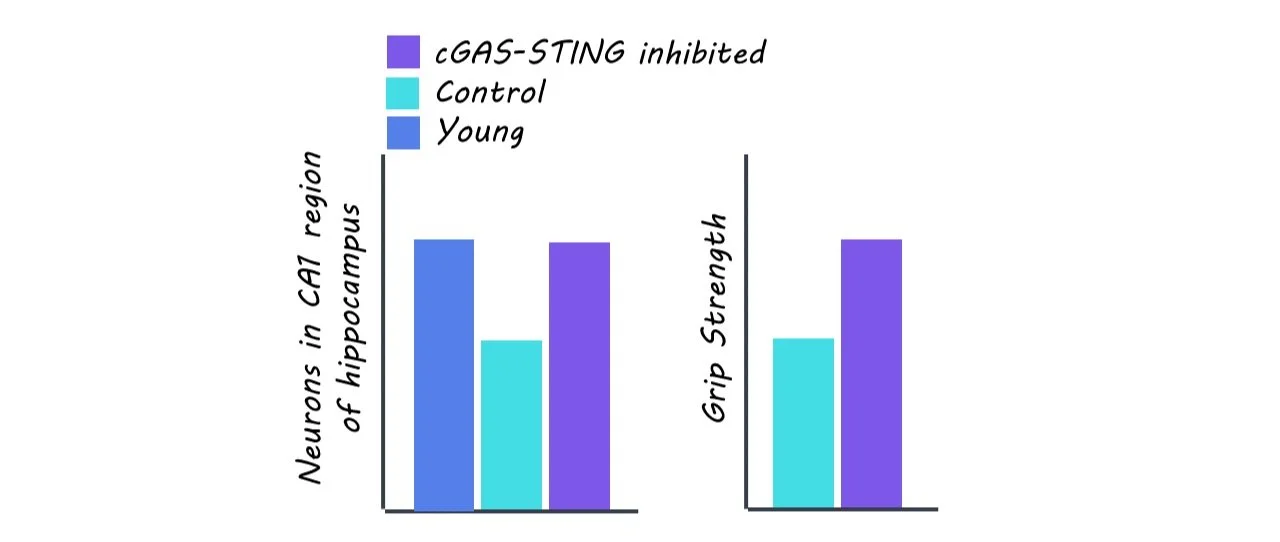
The researchers used a series of robust molecular biology, biochemistry, and transcriptomics approaches in preclinical models of aged mice to uncover the direct impact of the cGAS-STING pathway on aging and neurodegeneration. Aged mice used in this study were either designated into the control group (no genetic changes in mice) or the experimental group (had a deletion of the STING protein). To test the effect of STING inhibition, mice underwent the Morris Water Maze test, fear conditioning tests, grip strength tests, and others to understand the change in spatial & associative memory and physical strength conferred by STING inhibition. Immunohistochemistry of mice tissue and obtained human tissues were used to visualize the microglial cellular patterns through RNA extraction and consequent bulk and single-nuclei RNA sequencing. The authors also used primary cell culture and intracellular DNA imaging to understand the effect of damaged mitochondrial DNA in eliciting inflammation-driven pathways in aging and neurodegeneration. 

What did they find?

The authors showed that in naturally aged mice, cGAS-STING signaling contributes to a robust Type I Interferon (Type I IFN) response in brain cells and facilitates neuronal loss and cognitive impairment. They also found that beyond the cGAS and Type I IFN programs, there is a microglial gene expression program that might, synergistically or additively, contribute to similar neurodegeneration and could be a shared feature in many neurodegenerative diseases. This was important in highlighting the critical role of microglial-cGAS-STING signaling in mediating neurodegeneration. Furthermore, it was discovered that Tumor Necrosis Factor (TNF), a key neurotoxic factor, controlled the response of microglial cGAS-STING signaling and impacted other brain cells such as oligodendrocytes and astrocytes. Lastly, the authors blocked the STING protein in aged mice and were able to suppress inflammatory responses in senescent cells and tissues, leading to improvements in tissue function in the periphery as well as the brain. Animals receiving STING inhibitors displayed significant enhancements in spatial and associative memory and affected physical function with improved muscle strength and endurance.

What's the impact?

This study is the first to establish cGAS-STING as a significant driver of aging-related inflammation, neuron loss, and neurodegeneration in microglial communities in the brain. Further, this pathway facilitates a neuroimmune crosstalk mechanism in astrocytes and oligodendrocytes that could mediate senescence and neurodegeneration in the brain. This research opens avenues for further clinical research and therapeutic characterization of cognitive decline in neurodegenerative disorders like Alzheimer’s Disease (AD), Amyotrophic Lateral Sclerosis (ALS), or Frontotemporal dementia (FTD). 

Access the original scientific publication here

The Link Between Phantom Ear-Ringing and the Brain’s Emotion Centers

Post by Anastasia Sares

The takeaway

Tinnitus is a condition of hearing sound in the absence of any external stimulus, usually a ringing, hissing, or roaring. Though it was initially thought to be purely a hearing disorder related to noise exposure and other physical factors, scientists have discovered surprising connections to emotional and psychological health.

Recently in the International Journal of Molecular Sciences, Singh and colleagues reviewed the literature linking tinnitus to the limbic system: a collection of structures located deep in the brain with functions like spatial memory, threat processing, motivation, and stress. These limbic system connections may explain why tinnitus is related to other aspects of mental health.

What is tinnitus?

There are two prominent theories about the causes of tinnitus. In the first one, lack of auditory input causes the fibers that normally carry auditory signals to fire spontaneously, generating waves of activity that have no outside source. In the second theory, reduced input leads to a lack of inhibition in key auditory areas, which causes an overall increase in auditory signals despite no external sound. In short, in the absence of stabilizing auditory input, brain regions processing sound start to behave differently, going so far as to “invent” signals and interpret them as sound.

Both of these theories highlight the fact that auditory information passes through multiple structures in the brain. Because so many brain regions are involved, there is also the potential for those brain regions to influence the experience of tinnitus. In fact, the experience of tinnitus encompasses both the phantom sounds as well as a person’s reaction to those sounds (conscious or subconscious).

How is the limbic system involved?

We’ll focus on a few prominent brain regions that have been studied in relation to tinnitus.

The hippocampus: this region is tightly tied to the auditory system since auditory information helps with spatial navigation, and the hippocampus is also responsible for long-term auditory memories. Brain scans of people with tinnitus show a decrease in the size of the hippocampus, and activity in the hippocampus can help predict the unpleasantness of people’s tinnitus experience. Since noise exposure can cause noticeable changes in the hippocampus, it may be a key intermediate region in the pathway from noise exposure to tinnitus.

The amygdala: the amygdala is involved in fear and other emotional processing; it also has a strong connection to regions that regulate incoming auditory information. Activity in the amygdala may be a key part of the process that causes stress and negative emotions to intensify the experience of tinnitus.

The nucleus accumbens and anterior cingulate cortex: These are structures involved in motivation, reward, and addiction, and they work against each other. The nucleus accumbens acts to arouse us and orient our attention to both pleasant and unpleasant stimuli, and more neural activity in this area seems to aggravate tinnitus. The anterior cingulate, on the other hand, can help us control and filter out unpleasant auditory stimuli, working against tinnitus symptoms. If this pathway is weakened, it would provide less filtering and thus, stronger symptoms.

The basal ganglia: The basal ganglia are small regions deep in the brain that form a hub for much of the brain’s activity. How the basal ganglia are involved in tinnitus is somewhat unclear, but there are some dramatic examples of how either stroke or deep brain stimulation in these regions can significantly reduce tinnitus.

What's the impact?

Effective treatments for tinnitus are few and far between, and there is no gold standard. Knowing that limbic regions are involved in creating or exacerbating these symptoms, we can make better guesses at what therapies might work, like drugs that target limbic areas primarily, or deep-brain stimulation in the basal ganglia. Hopefully, more limbic-system-focused therapies are on their way.

Access the original scientific publication here.