Understanding How Decisions Are Terminated

Post by Kulpreet Cheema

The takeaway

Little is known about how decisions are terminated and translated into actions or plans. This study provides evidence that the superior colliculus (SC), a midbrain structure involved in eye movements and orienting behaviors, plays a crucial role in terminating decisions.  

What's the science?

Previous research has shed light on how the brain accumulates evidence before reaching a decision. This process can be modeled as a stochastic drift-diffusion process or bounded random walk. Neurons in the lateral intraparietal area (LIP) have been shown to accumulate noisy evidence during decisions. However, how this process is terminated and translated into a specific action is still unknown. The SC is known for its role in generating eye movements, and is directly coupled to the LIP; the LIP projects to the SC and the SC projects back to LIP via the thalamus. In a study published in Neuron, researchers investigated the role of SC in applying a decision threshold to the accumulation of evidence represented in the LIP.

How did they do it?

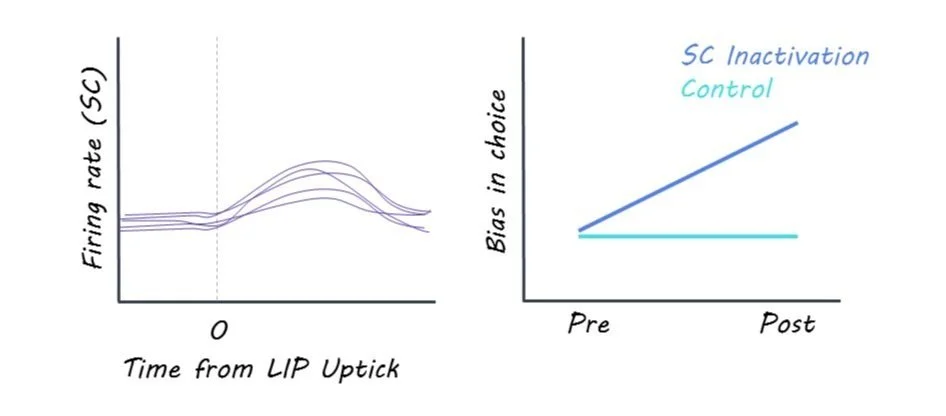
The researchers recorded simultaneous neural activity in the LIP and SC while monkeys performed a motion-discrimination task. In the motion discrimination task, the monkeys were trained to make eye movements based on the direction of a moving stimulus. Researchers used high-density multi-channel electrodes to capture the firing rates of functionally similar neurons in both areas during the decision process. To directly test the involvement of the SC in decision termination, researchers performed focal inactivation by temporarily inactivating the SC using small muscimol injections. They analyzed behavioral measures and neural recordings from the LIP during SC inactivation.

What did they find?

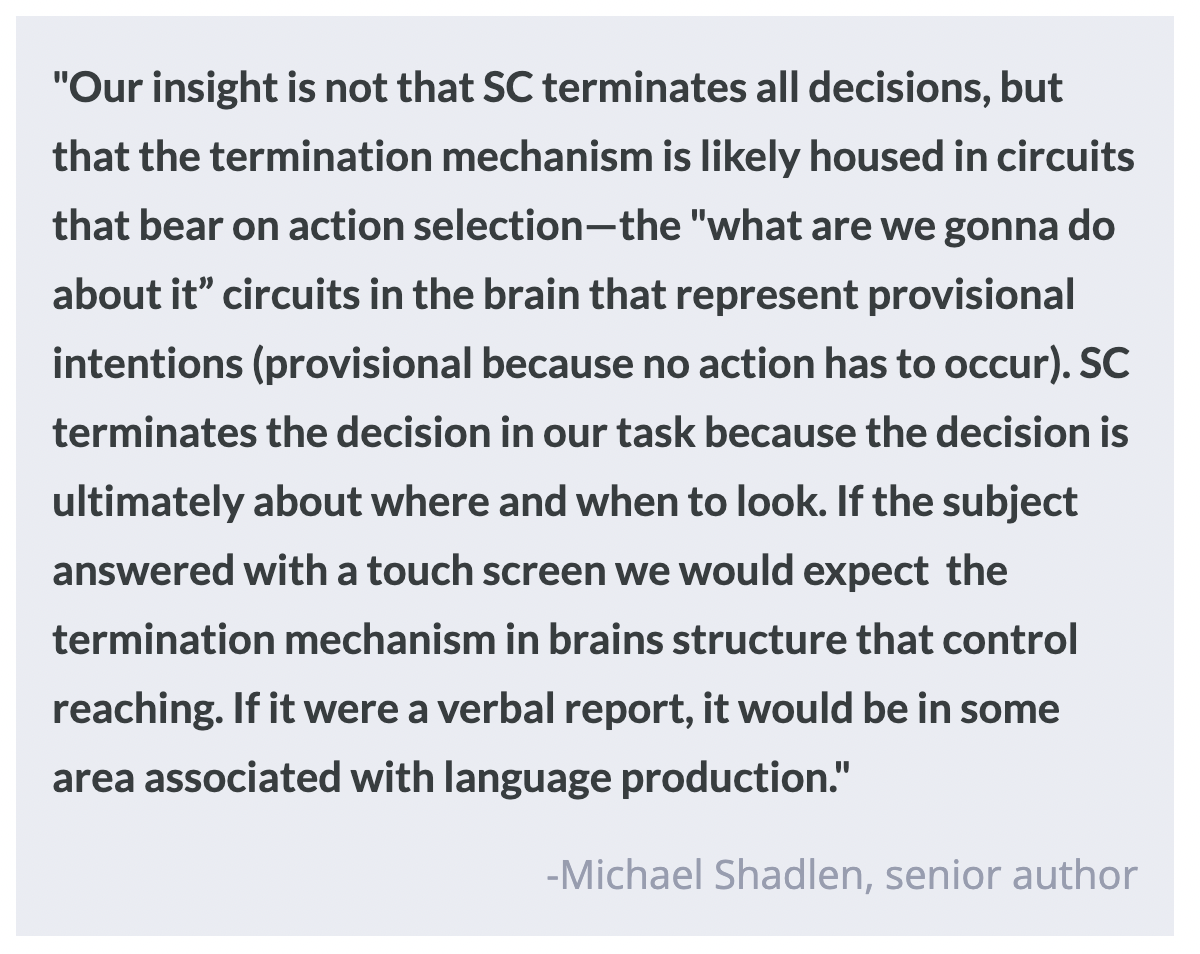
Researchers found evidence that the LIP and SC exhibited different dynamics during decision-making, and that the SC implements the decision threshold. The researchers observed that bursts of activity in the SC terminated the decision process, as opposed to the accumulation signals in LIP. The bursts in the SC were triggered by upticks in excitatory input and were associated with the termination of the decision. When the SC was inactivated, the termination mechanism was impaired, leading to slower, biased decisions and prolonged evidence accumulation in LIP. These findings suggest that, while evidence may accumulate in the LIP during decision-making, decision termination occurs in an area responsible for action selection; in this case, the SC, as the decision is about moving the eyes.
What's the impact?

This study sheds light on how the brain makes decisions and transforms evidence into actions. Understanding how decisions are terminated is crucial for comprehending the entire decision-making process. By identifying the role of the SC in decision termination, the study highlights the importance of a region known for action selection in decision termination. The findings have implications for understanding decision-making processes in humans and other primates. 
Connectivity Between the Amygdala and Frontal Cortex Predicts Youth Depression Treatment Response

Post by Baldomero B. Ramirez Cantu

The takeaway

Connections between the frontal cortex and the amygdala in the brain have shown potential in identifying depression in young individuals, and their responsiveness to standard behavioral and pharmacological treatments for depression.

What's the science?

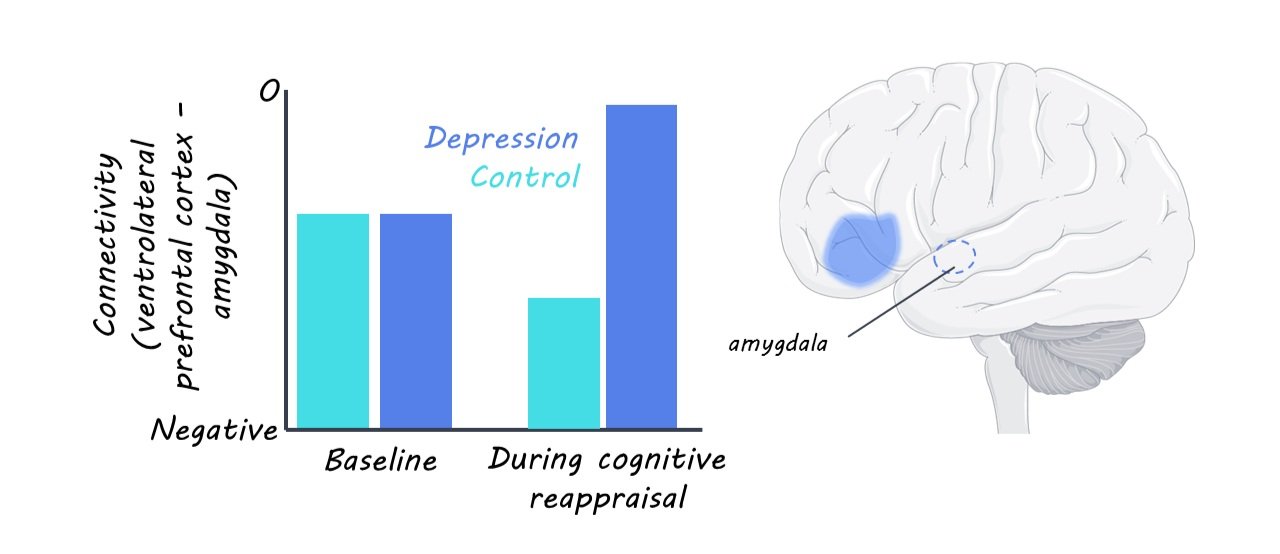
Youth depression is commonly characterized by difficulties in emotional regulation and a decline in interest in activities. Although there are numerous pharmacological and behavioral interventions available, only approximately 70% of youths exhibit positive responses to treatment, and a substantial portion (40-60%) do not achieve remission even after treatment. The neurobiology and brain systems underlying youth depression are still not comprehensively understood. In a recent study published in Biological Psychiatry, Kung et al. explore whether the dynamics of the frontoamygdalar pathway during cognitive reappraisal (i.e. recognizing and reinterpreting negative thought patterns) can help predict the effectiveness of first-line depression treatments.

How did they do it?

The authors used functional magnetic resonance imaging (fMRI) and dynamic causal modeling to map frontoamygdalar effective connectivity during a cognitive reappraisal task and assess its association with depression diagnosis and treatment response.

They recruited a cohort of 107 young individuals diagnosed with mild to severe depression and 94 healthy individuals in a control group. The participants underwent fMRI scans while they performed cognitive reappraisal tasks to examine the neural connections between the frontal cortex and the amygdala. In these tasks, images that could elicit negative emotions were shown, and participants were asked to use reappraisal strategies to reinterpret the images. The fMRI data were then analyzed to measure the strength and dynamics of the frontoamygdalar pathway during these tasks. The researchers also collected information on the participants' engagement with a clinical trial, including the type of interventions received and their treatment response. Statistical analyses were performed to investigate the relationship between frontoamygdalar effective connectivity, treatment response, and depression diagnosis in youth.

What did they find?

The authors’ results indicate that frontoamygdalar effective connectivity can serve as a predictive factor for youth depression and treatment response. Those in the control group more successfully used reappraisal strategies versus those with depression. Participants with stronger inhibitory connections between the frontal cortex and the amygdala demonstrated a lower likelihood of having a depression diagnosis. Weaker excitatory frontoamygdalar connectivity was associated with positive responses to standard depression treatments. These findings highlight the importance of understanding and targeting the neural circuits involved in regulating negative emotion for optimizing treatment outcomes in youth with depression.

What's the impact?

This study enhances our understanding of youth depression by investigating frontoamygdalar effective connectivity as a potential biomarker for depression and treatment response, offering the possibility of personalized and more effective interventions for young individuals. Ultimately, it holds promise for improving outcomes and quality of life for youth with depression.

Access the original scientific publication here.

How Social Sensitivity Affects Adolescent Learning

Post by Rebecca Hill

How is adolescent learning different?

Adolescence, a period from ages 10-24, is a transformative time when most people are extremely sensitive to peer influence and their own emotions. Learning during adolescence may be different than learning during childhood or adulthood, since adolescents are more sensitive to their social environment. This sensitivity could contribute to adolescents’ vulnerability to developing mental health issues.

How is the adolescent brain different?

Adolescents report more frequent and intense emotions than adults and experience more complex emotions than children. Self-consciousness and embarrassment, as well as the desire to be liked, peak during this time. These heightened emotions are most often and most strongly experienced in social settings. Adolescents have more activity in areas of their brain involved in emotional processing such as the amygdala and the hippocampus, which help them respond to social cues. Social exclusion also causes adolescents to respond with more neural activity than children.

During adolescence, learning can be heightened in some situations. We more easily remember this time period than memories from childhood or later adulthood. Older adolescents (16-18) learn more efficiently than younger adolescents (11-16). This stage is critical for learning a second language, developing taste in music, and sociocultural learning. So how is learning in adolescence affected by this social and emotional sensitivity? First, let’s take a step back and introduce two types of learning that happen in adolescence.

What is associative learning?

Associative learning, or learning to associate two unrelated things to each other, can be easier to study experimentally than other types of learning. There are two main types of associative learning:

1)    Pavlovian learning: when you learn one stimulus is associated with another stimulus, leading to the first stimulus becoming associated with the response to the second stimulus. Also known as classical conditioning. An example is a dog learning that a bell chiming means it will soon get fed dinner and begins to get hungry just when hearing the bell.

2)    Instrumental learning: when you learn a stimulus is associated with a response, which is then either rewarded or punished. This leads to the stimulus itself causing a change in the response levels. Also known as operant conditioning. An example is a mouse learning that a light turning on means that it should press on a button, which will be rewarded with food.

Learning happens in several stages. During acquisition, the association between stimuli and responses is formed. After a learning test is over and the stimuli stops being rewarded or punished, extinction occurs and the response to the stimulus is “unlearned”. Researchers use these techniques to better understand how learning is affected by social sensitivity in adolescence.

What are the advantages and disadvantages of social sensitivity?

Many studies have tried to understand human emotional sensitivity by drawing comparisons with adolescent rats. One associative learning experiment found that adolescent rats were more affected by social rewards than drug rewards when compared to adult rats. In humans, adolescents were motivated by all positive peer feedback, even from the least reinforcing peer, while children and adults responded only to the most positive peer feedback. Taken together, this means that social contact, even in the smallest amounts, can be a strong reward for adolescents.

On the other hand, adolescents continue to respond to social threats, even after the initial threat is gone, long after children and adults stop responding. This presents the issue that social punishments impact adolescents much more than children or adults. In addition to this, adolescents are worse at instrumental learning - when behaviors are strengthened or weakened based on whether they are reinforced or punished - than adults, even though they are more sensitive to social stimuli. As adolescents become adults, they get better at social learning, despite being more sensitive to social feedback when they’re younger.

How does this impact adolescent development?

Being able to learn from social cues is crucial, especially during adolescence. Since adolescents show more Pavlovian reward learning, researchers have suggested a connection with addiction vulnerability. It is well known that adolescents are more likely to use drugs or alcohol if their peers do.

While social sensitivity can lead to negative outcomes such as drug addiction, researchers also suggest it can positively impact adolescents as well. For example, while adolescents have higher vulnerability to mental health conditions like anxiety, they are also more affected by social feedback. Exposure therapy, like that used in Pavlovian learning, can be effective at treating anxiety. Because of this, researchers suggest that supportive friends might be better able to help buffer stress since adolescents are particularly influenced by social rewards during associative learning. By studying these effects of social sensitivity on adolescents, we may be able to better treat the mental health and addictive disorders that adolescents are particularly at risk from.

References +

Altikulaç, S., Bos, M. G., Foulkes, L., Crone, E. A., & Van Hoorn, J. (2019). Age and gender effects in sensitivity to social rewards in adolescents and young adults. Frontiers in behavioral neuroscience, 171.

Guyer, A. E., Silk, J. S., & Nelson, E. E. (2016). The neurobiology of the emotional adolescent: From the inside out. Neuroscience & Biobehavioral Reviews, 70, 74-85.

Johnson, D. C., & Casey, B. J. (2015). Extinction during memory reconsolidation blocks recovery of fear in adolescents. Scientific Reports, 5(1), 8863.

Jones, R. M., Somerville, L. H., Li, J., Ruberry, E. J., Powers, A., Mehta, N., ... & Casey, B. J. (2014). Adolescent-specific patterns of behavior and neural activity during social reinforcement learning. Cognitive, Affective, & Behavioral Neuroscience, 14, 683-697.

Knoll, L. J., Fuhrmann, D., Sakhardande, A. L., Stamp, F., Speekenbrink, M., & Blakemore, S. J. (2016). A window of opportunity for cognitive training in adolescence. Psychological Science, 27(12), 1620-1631.

Koppel, J., & Rubin, D. C. (2016). Recent advances in understanding the reminiscence bump: The importance of cues in guiding recall from autobiographical memory. Current directions in psychological science, 25(2), 135-140.

Tang, A., Lahat, A., Crowley, M. J., Wu, J., & Schmidt, L. A. (2021). Children’s shyness and neural responses to social exclusion: Patterns of midfrontal theta power usually not observed until adolescence. Cognitive, Affective, & Behavioral Neuroscience, 21(6), 1262-1275.

Towner, E., Chierchia, G., & Blakemore, S. J. (2023). Sensitivity and specificity in affective and social learning in adolescence. Trends in Cognitive Sciences.

Vink, M., Derks, J. M., Hoogendam, J. M., Hillegers, M., & Kahn, R. S. (2014). Functional differences in emotion processing during adolescence and early adulthood. Neuroimage, 91, 70-76.

Yates, J. R., Beckmann, J. S., Meyer, A. C., & Bardo, M. T. (2013). Concurrent choice for social interaction and amphetamine using conditioned place preference in rats: effects of age and housing condition. Drug and alcohol dependence, 129(3), 240-246.