
Cannabis Use Disorder and its Relation to Affective Mood Disorders

Post by Baldomero B. Ramirez Cantu

The takeaway

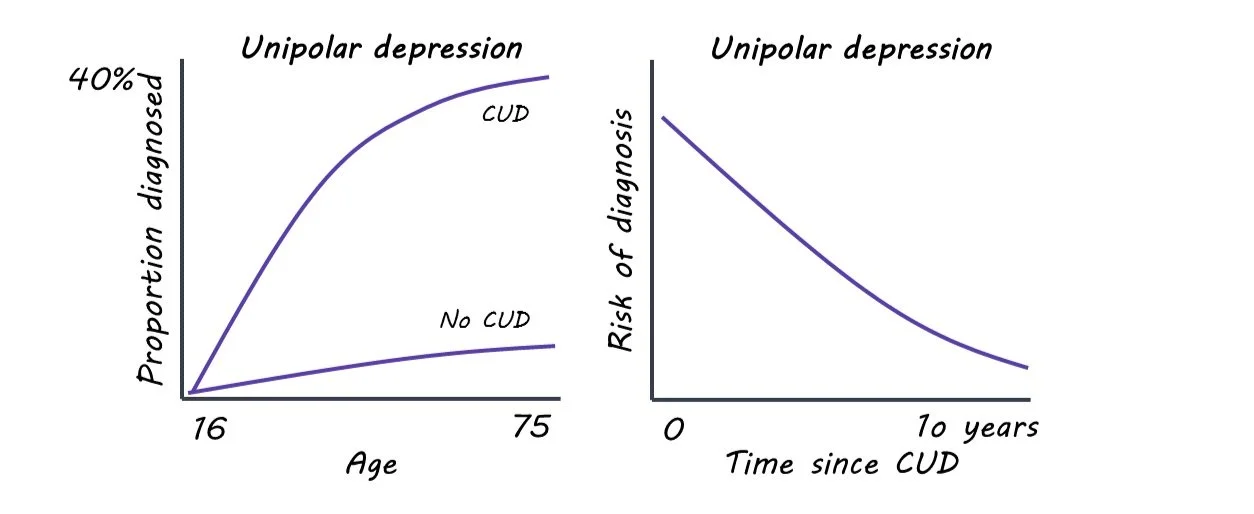
Individuals diagnosed with cannabis use disorder (CUD) were found to have a higher risk of developing any type of unipolar depression and bipolar disorder, including both psychotic and non-psychotic forms.

What's the science?

Cannabis use disorder is characterized by persistent marijuana use despite adverse health and social consequences. The relationship between CUD and psychiatric disorders has long been a subject of debate. While CUD is often observed in individuals with affective mood disorders, the exact nature of this relationship remains unclear. Specifically, it raises the question: Does cannabis use disorder contribute to the development of affective mood disorders, or do pre-existing affective mood disorders increase the likelihood of CUD? This week in JAMA Psychiatry, Jefesen et al. investigate whether there is an association between cannabis use disorder and an increased risk of two types of mood disorders: psychotic and non-psychotic unipolar depression, as well as bipolar disorder.

How did they do it?

The authors utilized longitudinal data from nationwide Danish health registers to address their questions. These registers provided valuable information, including basic demographic data (such as date of birth, age, and vital status), psychiatric and substance use information, and data on parental factors. A total of 6,651,765 individuals were included and followed up over 119, 526, 786 person-years (50.3% female; 49.7% male).

The authors collected additional data on variables such as alcohol use disorder (AUD), substance use disorder (SUD), sex, country of birth, parental history of CUD, AUD, and SUD, parental affective disorders, and highest level of parental education. Information on affective mood disorders and their psychotic features was obtained from national health registries.

Individuals were included in the study on their 16th birthday or on January 1, 1995, whichever occurred later. To examine the risk of presenting affective disorders based on CUD exposure, the authors employed Cox proportional hazards regression and calculated hazard ratios (HRs). The analysis incorporated appropriate controls to account for confounding factors related to the use and abuse of other substances and the influence of other variables on hazard rate changes. In essence, Cox proportional hazards regression allowed the researchers to assess the relationship between cannabis exposure and the probability or risk of developing affective disorders, as reflected in the hazard ratios.

What did they find?

Among individuals diagnosed with cannabis use disorder (CUD), 40.7% also received a diagnosis of unipolar depression. The majority (96.1%) of these cases were classified as non-psychotic unipolar depression, while a smaller proportion was classified as psychotic unipolar depression (3.9%). After adjusting for factors such as sex, alcohol use disorder (AUD), substance use disorder (SUD), birthplace, parental CUD, SUD, AUD, and affective mood disorders, the analysis revealed that individuals with CUD had a higher risk of developing any type of unipolar depression compared to those without a record of CUD (HR 1.84). Elevated risks were also observed for both psychotic depression (HR 1.97) and nonpsychotic depression (HR 1.83).

Furthermore, the study found that 14.1% of individuals diagnosed with CUD eventually received a diagnosis of bipolar disorder. The majority (90.2%) of these cases were diagnosed with nonpsychotic bipolar disorder, while 9.8% were diagnosed with psychotic bipolar disorder. The increased risk of bipolar disorder following a CUD diagnosis was observed in both men and women. The highest risk of bipolar diagnosis occurred within the first 6 months after a CUD diagnosis, but the risk remained elevated even after 10 or more years following the diagnosis.
What's the impact?

Cannabis is one of the most prevalent psychoactive substances globally, and has witnessed legalization and regulation in numerous countries over the past few decades. Gaining a comprehensive understanding of the associated risks and impacts is crucial for informing policy decisions on cannabis regulation and educating the general population about its potential risks.

Access the original scientific publication here.

How is Visual Learning Affected by Social Context?

Post by Meredith McCarty

The takeaway

Altered brain activation and functional connectivity occurs, and performance improves, when people perform a basic visual perception task in a social context versus alone.

What's the science?

Social context and cooperative behaviors are essential features of daily life, and have been found to facilitate learning abilities. However, there is a gap in understanding the neural mechanisms by which social context enhances learning. Prior recent work has revealed that cortical regions important for social cognition, including the dorsolateral prefrontal cortex (dlPFC), show increased activation during high-level learning tasks, such as value-based learning. Additionally, it has been shown that neural responses in early visual cortical (EVC) regions are modulated by visual perceptual learning tasks, though the precise extent of this modulation remains unclear. Therefore, it is essential to understand the dynamics in these early visual and higher cortical areas, and how this activity is modulated by social context and motivation. This week in Current Biology, Zhang and colleagues investigate the role of social context on improved visual perceptual learning, and the neural dynamics correlated with this process.

How did they do it?

To measure changes in visual perceptual learning, the authors had participants perform an orientation discrimination task, where they indicated whether the orientation of the presented visual stimuli differed from each other. Their perceptual accuracy was tested on the first and last day of the experiment, with 6 days of training sessions between them. To assess the influence of social context on performance in this task, participants were separated into two groups: single groups, in which the participants performed the task alone, or dyadic groups, where they were paired with another participant and could monitor their partners’ performance. Of the 135 total participants, three experimental cohorts were selected. For Experiment 1, participants were divided into single and dyadic training groups, and performed the novel orientation discrimination task. This enabled the comparison of task performance accuracy due to social context. For Experiment 2, the performance of one partner in each dyadic training group was altered, either enhanced with additional single training days, or worsened due to visual stimuli being presented in white noise. For Experiment 3, participants performed the single or dyadic tasks while undergoing functional magnetic resonance imaging (fMRI), which quantifies changes in neural activation and connectivity measures across task conditions.

What did they find?

The behavioral results of Experiment 1 revealed a greater performance and faster learning rate for participants in the dyadic training program. This indicates that monitoring their social partner’s performance facilitated individual performance. When the performance of a partner in the dyadic group was either enhanced or worsened in Experiment 2, the authors found this partner manipulation to significantly alter the paired subject’s behavioral performance. When analyzing neural dynamics via fMRI imaging in Experiment 3, authors found several interesting changes across dyadic and single training groups. First, they found significant clustering of neural activity in bilateral parietal cortex (PL), left dorsolateral prefrontal cortex (dlPFC), as well as regions of early visual cortex (EVC). They implemented a decoding analysis to measure how well stimulus orientation could be decoded via neural activations, and found significant increases in the decoding accuracy of EVC activation in the dyadic group, implying a refinement of cortical responses to trained orientations in early visual cortices.

The authors then utilized a Physiological Interaction (PPI) analysis as a measure of functional connectivity between regions, and found that dyadic groups showed enhanced connectivity between EVC and left dlPFC, and EVC and bilateral PL activation. These data suggest that the interplay between early visual and higher order social cortical regions may be responsible for the refined orientation representations in early visual cortex, and subsequent improved behavioral performance.

What's the impact?

The results of this study suggest that social facilitation enhances visual learning, and is correlated with enhanced function connectivity between early visual and frontal cortices. Visual perceptual learning tasks are often utilized in therapeutic contexts to improve long-term visual abilities. The possibility of enhancing this visual learning non-invasively via social facilitation has useful implications in therapeutic contexts for individuals with neuro-ophthalmic disorders (altered function in parts of the brain devoted to vision). 

Access the original scientific publication here.

Predicting Chronic Pain States in Humans

Post by Lani Cupo

The takeaway

The authors developed a neural biomarker to predict chronic pain in patients, with the goal of facilitating diagnosis and treatment of neuropathic pain.

What's the science?

Neuropathic chronic pain (e.g. after a stroke or amputation of a limb) is the cause of great suffering in patients, however it can be difficult to develop objective biomarkers to aid diagnosis and treatment. It is also still not fully clear how brain activity changes with fluctuations in chronic pain levels, and how these changes differ from activity associated with acute pain. This week in Nature Neuroscience, Shirvalkar and colleagues presented a neural biomarker for chronic pain using implanted electrodes in patients, successfully predicting pain ratings.

How did they do it?

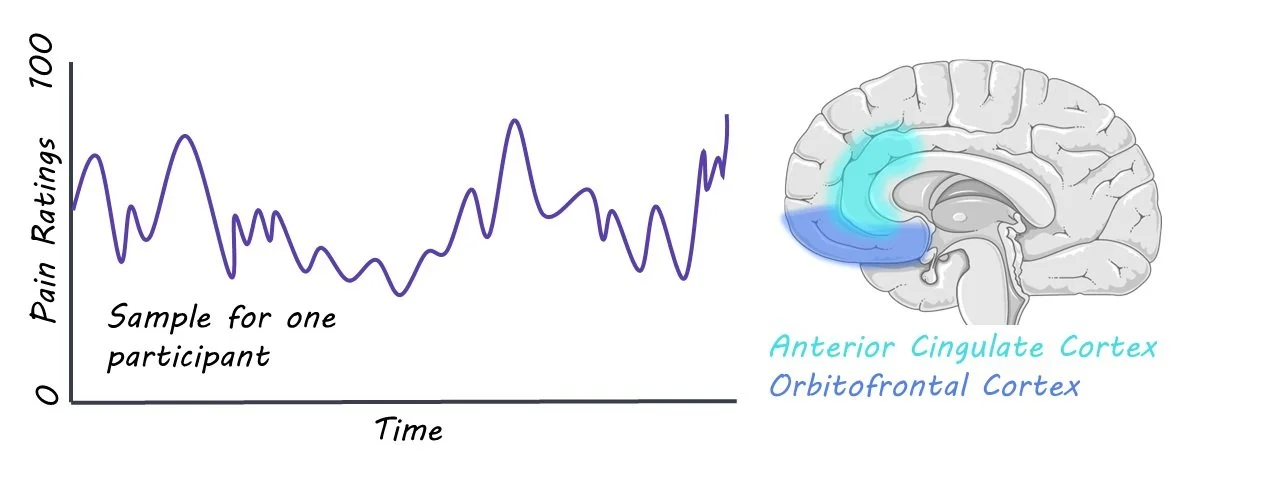
The authors enrolled four adult participants in their study (two women), three of whom had post-stroke chronic pain, and one who had phantom limb pain. The authors implanted electrodes into two brain regions important in the processing of pain: the orbitofrontal cortex (OFC) and anterior cingulate cortex (ACC). The study took place over 2.5 - 6 months, during which time participants were asked to record their pain at least 3 times per day. After recording their pain rating (which was inherently subjective, as pain is by definition a subjective, individualized experience), they pushed a button on a remote control which triggered a 30 second recording from the implanted electrodes. This in-depth recording method allowed researchers to track fluctuations in pain over the day as well as over the weeks.

Next, the authors trained a machine learning model to predict subjective pain scores with the neural activity from the implanted electrodes. They compared models trained on data from only one brain region versus models combining data from both electrodes to see which brain region best predicted chronic neuropathic pain.

Finally, the authors sought to compare the neural mechanisms underlying chronic pain with those underlying acute pain in a laboratory experiment. They brought the patients into the lab and presented thermal stimuli (heat at five different temperatures) to both the most painful part and side of the body and the same region on the other side. During the experiment, they recorded neural activity from the electrodes and trained a machine learning algorithm to predict subjective acute pain ratings on the neural activity alone.

What did they find?

First, the authors observed patients had diurnal fluctuations in pain levels (over the 24-hour period), however, they also found cycles of pain in some participants every 3 days. Second, the authors successfully trained an algorithm (linear discriminant analysis) to classify subjective pain states as high vs. low. For three participants, the best prediction resulted in combining data from the ACC and OFC, however, overall the best subregion to predict neuropathic pain was the contralateral OFC — the OFC on the opposite brain hemisphere of the perceived pain. For example, if pain was felt in the left leg, the right OFC was the most effective region to predict pain. The results were stable across the months of the study, suggesting the model was robust in its predictions. Finally, the authors successfully trained a model to distinguish high-vs-low pain states in the acute pain experiment, but importantly, only models that included data from the ACC were successful, unlike the chronic pain state. This suggests the ACC is more centrally involved in acute pain, rather than chronic pain

What's the impact?

This study is the first to successfully predict subjective recordings of chronic pain from intracranial recordings over a period of months. In time, their findings may be used to develop patient-specific metrics to aid in diagnosis of chronic pain states. Further, implanted electrodes may be used to stimulate regions integral to chronic pain processing, reducing the pain that patients experience and improving their quality of life.  

Access the original scientific publication here