Neurons in the Brainstem Modulate Pain Sensation

Post by Baldomero B. Ramirez Cantu

The takeaway

This study provides evidence that neurons located in the medulla oblongata are involved in modulating pain sensation. These neurons exert their inhibitory effects through a tract that connects the cortex and spinal cord, regulating the perception of pain.

What's the science?

The detection of stimuli that could be perceived as painful typically begins with nociceptive neurons in the peripheral nervous system, which transmit signals to higher brain centers to produce an appropriate sensory response. However, the perception of pain is not fixed and can be modulated to suit a specific context. For example, individuals may exhibit a higher pain tolerance while pursuing a goal, or a lower pain tolerance while a particular region of the body is undergoing repair following an injury. The medulla is thought to play a role in top-down pain modulation. This week in Nature Neuroscience, Gu and colleagues elucidate the mechanisms by which neurons in the ventrolateral medulla (VLM) play a role in modulating pain sensation via the locus coeruleus-spinal cord (LC-SC) pathway.

How did they do it?

The authors used a variety of techniques to probe the role of the medulla oblongata in pain sensation and regulation in adult mice. First, the authors used the neural activity marker c-Fos to confirm the activation of neurons in the ventrolateral medulla (VLM) in response to painful stimulation with capsaicin, the active component of chili peppers. They then used multiple-label immunohistochemistry staining and viral vector tracing to further characterize the identity and connectivity of the pain-responding neuronal population found in the VLM. Next, the authors used viral vectors to express a fluorescent calcium indicator, GCaMP6, in VLM neurons, which allowed them to observe neuronal activity in-vivo using fiber photometry. Finally, the authors used chemogenetics (DREADDs) and optogenetics to manipulate neural activity in these circuits.

What did they find?

The authors observed an increase in c-Fos expression in the caudal VLM following capsaicin stimulation. Double-label immunohistochemistry revealed that neurons labeled for tyrosine hydroxylase, a crucial enzyme in the synthesis of neurotransmitters such as dopamine, were also labeled for c-Fos. Further analysis confirmed their molecular identity as noradrenergic and dopaminergic neurons. Anterograde viral tracers injected in the spinal cord showed no projections to the noradrenergic neurons of the cVLM, supporting the role of the cVLM in supraspinal processing of painful stimuli. In-vivo fiber photometry showed that cVLM-TH neurons responded to various noxious stimuli including capsaicin, noxious heat, and noxious mechanical pinch, indicating their preference for noxious stimuli.

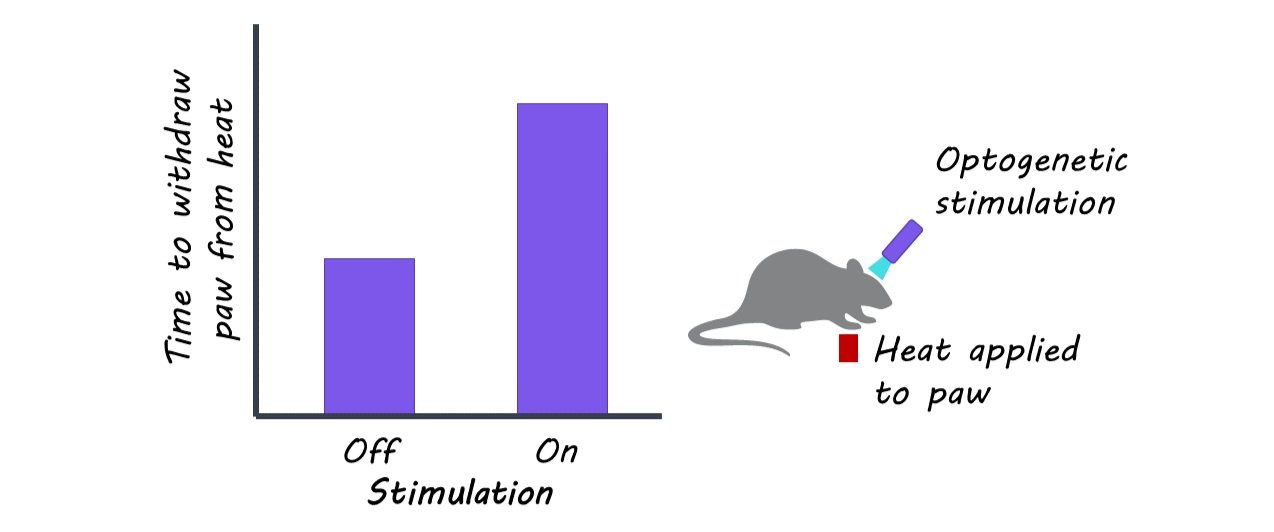
Modulating the activity of cVLM-TH neurons modified mice’s behavioral response to noxious stimuli. Specifically, chemogenetic activation of cVLM-TH neurons led to a suppression of responses to heat-detection tests. Conversely, chemogenetic suppression of the activity of cVLM-TH neurons resulted in a reduction of the latency of withdrawal responses in heat-detection tests, suggesting that these neurons normally provide inhibition to this nociceptive response. In other words, inactivating cVLM-TH neurons caused the mice to withdraw from a heating plate earlier, while activating them delayed their withdrawal. These findings were recapitulated using optogenetic manipulation of the neurons. 
Viral tracing revealed that cVLM-TH neurons project strongly to the locus coeruleus (LC), a major source of norepinephrine release, and a brain region long implicated in exerting analgesic effects via its projections to the spinal cord. To further understand the connectivity between cVLM-TH and LC neurons, the authors employed a combination of viral tracing, photometry, and electrophysiological techniques. Activation of cVLM-TH neurons using several modalities revealed responses in LC-SC neurons that project to the spinal cord. These findings suggest that cVLM-TH neurons modulate nociceptive signals via their connections with LC-SC neurons in the spinal cord. The authors then conducted an experiment to investigate the role of norepinephrine in the cVLM-TH mediated analgesic effects. They blocked norepinephrine transmission while chemogenetically activating the cVLM and observed that there was an increase in heat sensitivity. These activation and subsequent inactivation manipulations provide evidence for the involvement of norepinephrine released by LC neurons in the analgesic effects mediated by cVLM-TH.

What's the impact?

This study contributes to the understanding of the neural basis of pain and could inform the development of new analgesic treatments. Overall, this study has the potential to have a significant impact on the field of pain research. 
Decoding the Neural Signature of Reward

Post by Leanna Kalinowski

The takeaway

Researchers have established a whole-brain machine-learning model that can predict the brain’s response to different levels of reward.

What's the science?

Our actions towards positive and negative outcomes are often dependent on the brain’s ability to process rewarding and punishing stimuli. Dysregulations in the brain’s reward processing system are therefore a hallmark sign of many neuropsychiatric disorders, including substance use disorders. Previous researchers have developed mathematical models that can predict how the brain responds to rewarding and punishing stimuli; however, these models often rely on the activity from single brain regions, making it difficult to generalize their findings. This week in NeuroImage, Speer and colleagues ran a series of reward tasks and developed a whole-brain machine learning model to predict the brain’s response to reward.

How did they do it?

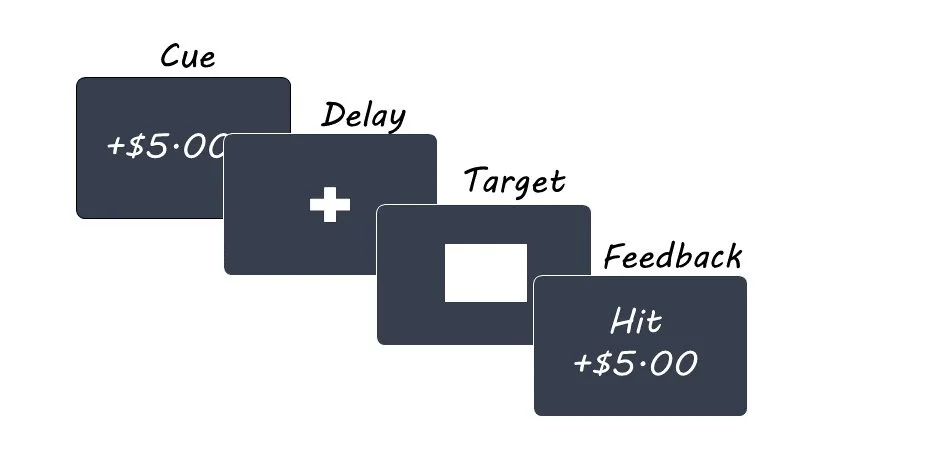
To establish the machine learning model (referred to as the Brain Reward Signature or BRS), the researchers administered the Monetary-Incentive-Delay task to 40 participants. Each trial began with a cue phase, where participants are shown a cue that signals the monetary reward or punishment associated with the trial (potential reward of 5€, potential loss of 5€, or no monetary outcome). Following a brief delay, they were asked to press a button when a target square appeared for a limited amount of time. Depending on the trial cue and their accuracy in pressing the button, they were then informed as to whether they lost or gained money. Participants underwent 108 trials of this task, with brain activity being simultaneously measured using functional magnetic resonance imaging (fMRI).

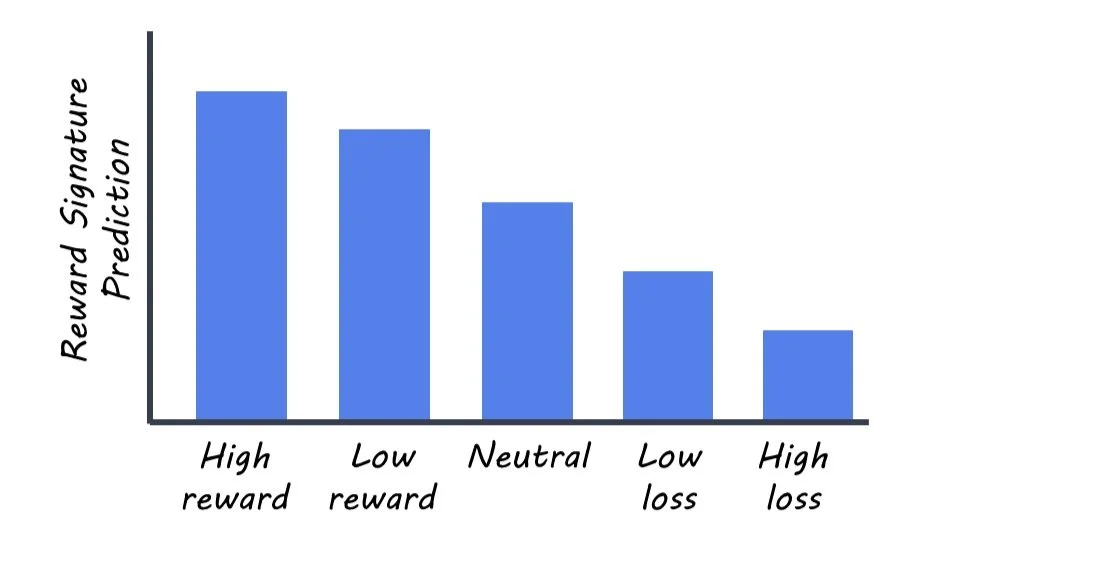
To test the accuracy of their BRS model, the researchers then applied it to results from a publicly available dataset that used a slightly different version of the Monetary-Incentive-Delay task. In this task, everything but the cues were the same as before; instead of being shown one of three cues, the participants were shown one of five cues (potential reward of 5€, potential reward of 1€, potential loss of 5€, potential loss of 1€, or no monetary outcome).

To test whether their BRS model is specific to the neural signature of reward and not other emotional responses (i.e., disgust), the researchers then applied it to a newly developed Disgust-Delay Task. In this task, participants were asked to press a button when a target rectangle appeared and then were given feedback on whether they hit or missed the target. Then, if they hit the target, they were shown a neutral image; if not, they were shown a disgusting image. Participants completed 72 trials of this test, again with brain activity being measured using fMRI.

What did they find?

The researchers first found that their BRS model could predict the neural signature of monetary rewards versus losses in the Monetary-Incentive-Delay task with high accuracy. Brain regions critical to the BRS were often brain regions previously associated with monetary or reward-related tasks in previous studies (as identified by the NeuroSynth database). When testing the accuracy of their model on a dataset that used an expanded version of the task, the researchers found that it not only could predict monetary rewards versus losses but also could predict the magnitude of rewards and losses. When testing whether their model was specific to the neural signature of reward, the researchers found that their model could predict unsuccessful versus successful trials from the Disgust-Delay task (i.e., a non-monetary reward), but it could not predict neural differences in viewing a neutral versus disgusting image (i.e., a non-reward emotional response).

What's the impact?

This BRS model can successfully and accurately predict the magnitude of rewards and losses across different samples and tasks. Further, this model is specific to reward and not generalizable to other emotional responses (e.g., disgust). As this model is trained on full-brain responses, it is much more generalizable and reproducible than previous models that were trained on specific brain regions.

Access the original scientific publication here.

Inflammation in the Brain Drives Neurodegeneration in Tauopathy

Post by Elisa Guma

The takeaway

Neurodegeneration and tauopathy, but not amyloid deposition, are associated with increased immune markers in the brain of humans and mouse models. Importantly, reducing inflammation in mouse models is associated with a decrease in disease progression. 

What's the science?

Alzheimer’s disease is characterized by the deposition of amyloid-B plaques and intracellular tau neurofibrillary tangles in the brain, together with brain atrophy. Interestingly, regional patterns of brain atrophy mirror regional patterns of tau accumulation, but not amyloid deposition in the brain. While the pathology of Alzheimer’s disease remains to be fully elucidated, evidence suggests that the immune system may play an important role in disease pathology. This week in Nature, Chen and colleagues investigate the relationship between the immune system and neurodegeneration in two different mouse models of Alzheimer’s disease, one with amyloid-B deposition and the other with tauopathy, to better understand the contribution of the immune system to each of these hallmark features of the disease.

How did they do it?

The authors compared the immune system function in the brains of two transgenic mouse models, one with amyloid-B-deposition and the other with tauopathy, both created by crossing transgenic mice with human-APOE-knock-in mice. The authors performed single-cell RNA sequencing of immune cells from the meningeal and parenchymal lining surrounding the brains of male mice. They also performed immunohistochemical analyses of the parenchyma to characterize further the presence of T cells, microglia, and antibodies in both mouse models. To compare the findings in the mouse models to human Alzheimer’s disease, they performed the same immunohistochemistry experiments on brain samples of patients with Alzheimer’s disease at different levels of disease severity.

Next, the authors wanted to understand the specific role of several immune modulators in the immune response to tauopathy. They tested each of these by administering a neutralizing antibody to the mice. The first one they tested was IFN-gamma, a cytokine that can augment the immune response. The second one was T cells, and the third was the programmed cell death protein 1 (PDCD1), an immune checkpoint for T cells. They then evaluated the immune profile, accumulation of phosphorylated tau in the brain, and behavior. 

What did they find?

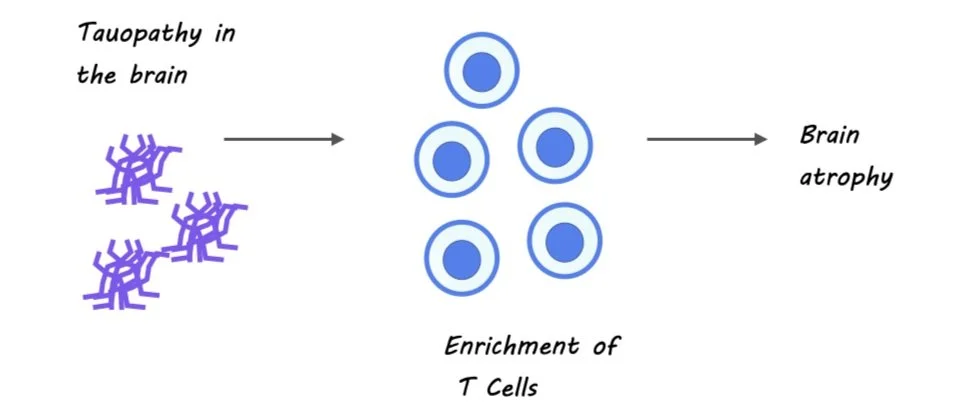
First, the authors found that only mice with tau pathology showed brain atrophy at 9.5 months of age, with regional patterns mirroring human disease. The authors found that 9.5-month-old tau mice had an increased presence of adaptive immune cells, including T cells, dendritic cells, and macrophages in their parenchyma and meninges compared to amyloid mice. Immunohistochemistry of the parenchyma confirmed that tau mice had elevated levels of T cells, enriched for INF-gamma transcripts, and microglia compared to amyloid mice. Importantly, similar elevations in T cell number were observed in the brain of humans with Alzheimer’s disease, particularly in regions with more tauopathy.

Next, the authors found that anti-IFN-gamma treatment resulted in attenuated brain atrophy in tau mice. Similarly, the T cell depletion treatment resulted in decreased brain atrophy, and a reduction in the overall number of microglia, suggesting that T cells in the brain of tau mice can indeed augment the number of microglia. Furthermore, T cell depletion improved performance on several memory tasks (short-term, hippocampal- and amygdala-dependent), and resulted in a decrease of phosphorylated tau (the conformation that allows it to accumulate into fibrils), resembling that of earlier disease stages. Blockade of PCDC1 also led to a decrease in tau-mediated neurodegeneration and p-tau staining. These data suggest that a reduction in immune mediators in the brain can attenuate some of the key features associated with disease progression in Alzheimer’s disease.

What's the impact?

This study suggests that tauopathy and neurodegeneration are linked to an immune system signature of activated microglia and T cells and that a reduction in the presence of these immune markers can delay disease progression. These mechanistic insights may aid in identifying therapeutic targets for preventing or slowing down neurodegeneration in Alzheimer’s disease. While these findings are compelling, the experiments were mostly performed in male mice - the need to replicate these findings in female mice is of paramount importance.