How Habitual Checking of Social Media Changes the Adolescent Brain

Post by Christopher Chen

The takeaway

Social media use has become nearly universal among American teenagers but its possible effects on adolescent brain development remain unclear. A new study indicates that habitual checking of social media may be disrupting the normal development of brain circuits linked to reward processing and cognitive control in the young adult brain.

What's the science?

The brain undergoes drastic changes during adolescence, particularly in regions associated with motivation, reward processing, and cognitive control. Furthermore, the maturation of these regions allows for developmentally normative neural and behavioral responses to social feedback. With its use of immediate feedback in the form of “likes” or notifications as well as its widespread use in adolescent populations, exploring how habitual social media use affects social feedback-based networks in the adolescent brain is more relevant than ever. In a recent article in JAMA Pediatrics, Maza et al. investigate differences in brain activity levels in regions associated with social feedback in adolescents who habitually check social media. 

How did they do it?

The experiment looked at approximately 200 students aged 12-13 from three middle schools in rural North Carolina. First, experimenters had the students self-report how often they checked three social media sites (Facebook, Instagram, and Snapchat). Based on this data, the participants were divided into three groups based on their rate of checking social media: habitual, moderate, and non habitual. Experimenters then used functional brain imaging (fMRI) to measure brain activity of participants during a Social Incentive Delay task, a cognitive task designed to measure anticipation of social feedback. Following initial measurements, the students took part in the same experiment each year for the next two years.

Following the completion of the study, experimenters compiled and combined data from both the Social Incentive Delay task and fMRI imaging to measure activation levels of specific brain regions from each participant during the cognitive task. They then used these individual datasets to make a general linear regression model measuring the change in brain activity levels in all three groups over time.  

What did they find?

From their generalized linear regression models, experimenters found that brain activation patterns were significantly different in habitual and non habitual checkers of social media. Interestingly, these patterns were most distinct in brain regions linked to social feedback: the insular and prefrontal cortex, ventral striatum, and amygdala. Habitual social media checkers showed a decreased sensitivity to social anticipation at 12 years of age.

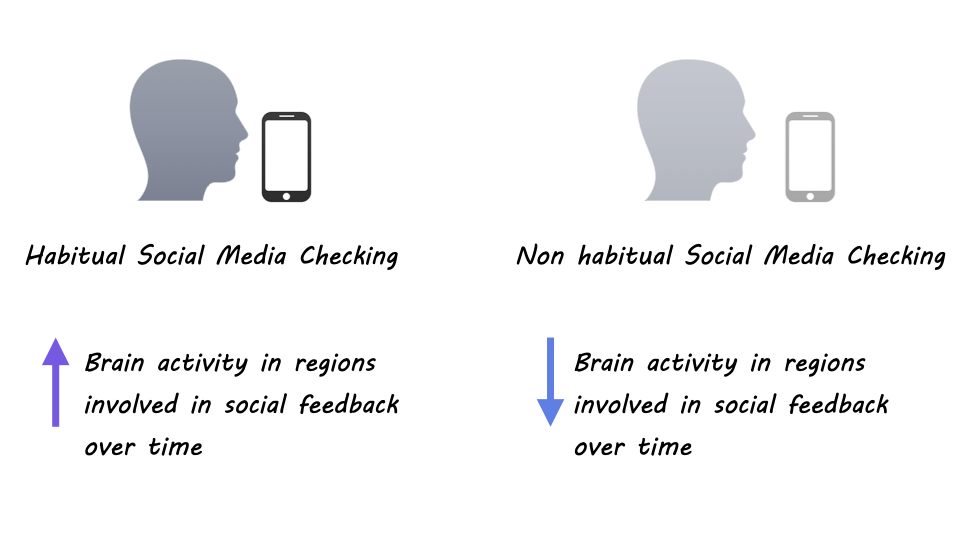
In habitual checkers of social media, linear regression models revealed an increase in brain activity during social anticipation across all four brain regions over time. In non habitual and moderate checkers of social media, linear regression models revealed the opposite: brain activity decreased in all four regions. These divergent results in brain activity changes in habitual and non habitual checkers of social media suggest high social media usage impacts developmental trajectories of neural circuits linked to social feedback and cognitive control.
What's the impact?

The negative functional consequences – if any – of these increases in brain activity in habitual checkers of social media are unclear. Whether the rate of social media usage directly causes or is simply correlated to these neurological changes also remains to be seen. However, this study is the first to show distinct differences in brain development in adolescents who habitually check social media, suggesting that social media is indeed changing the young adult brain.     
Access the original scientific publication here.

Social Health and Brain Reserve as Protective Factors for Dementia

Post by Megan McCullough

The takeaway

Good social health in older adults was associated with slower cognitive decline over time and higher cognition levels at baseline. High brain reserve, a measure of the brain’s resilience to damage, was also associated with slower cognitive decline suggesting that social health and brain reserve may be indicators of the propensity of an individual to develop dementia.

What's the science?

Although there are no current pharmacological treatments for dementia prevention, numerous social risk factors have been identified, indicating that dementia prevention may be possible. Previous research has shown that social support, social engagement, and other social health behaviors may be linked to a reduced risk of dementia development. Additionally, the brain reserve model of dementia suggests that individuals with more neurons or increased synaptic density are less at risk of cognitive deterioration. Although the social health model and brain reserve model both suggest protective factors against the effects of dementia, the interaction between these two models has not been investigated. This week in Annals of Neurology, Marseglia and colleagues aimed to investigate the interaction of social health and brain reserve on cognitive changes in a cohort of dementia-free older adults.

How did they do it?

Participants included 368 Swedish adults over the age of 60 who did not have dementia. These participants were followed for 12 years to assess the interactions between social health, brain reserve, and cognition over time. At the baseline assessments, a social health score was generated for each participant; this score was created from a questionnaire about social connections and social support. The authors also used magnetic resonance imaging (MRI) data to assess volumes of grey matter, white matter, and cerebrospinal fluid in each individual. These volumes were totaled and used as a measure of brain reserve. Cognitive function tests were administered throughout the study to assess different facets of cognition including episodic and semantic memory. Statistical analysis including one-way ANOVA, linear mixed-effect models, and stratified analyses were then run to explore the relationships between social health and brain reserve in the context of cognitive function.

What did they find?

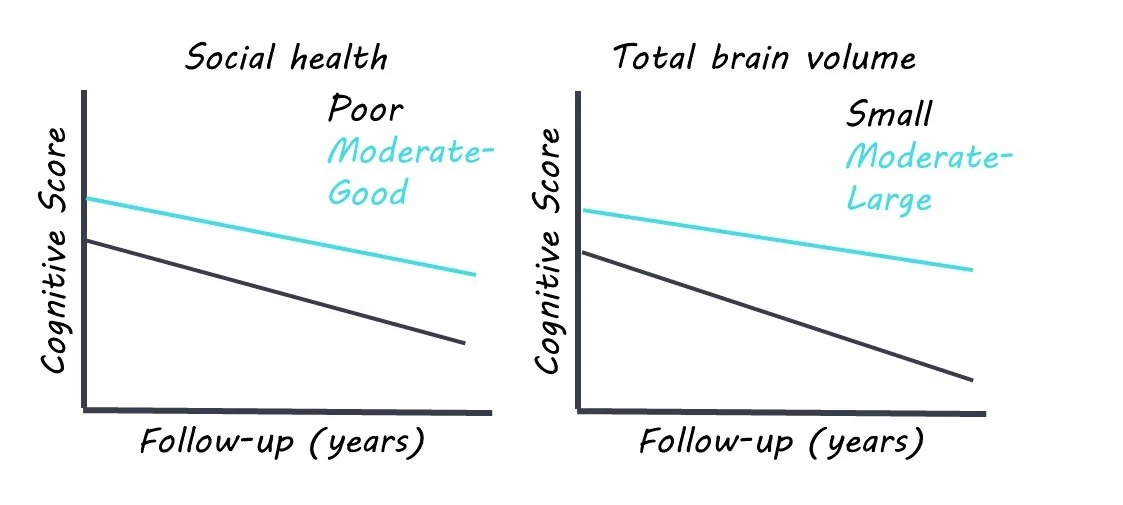
The authors found that moderate to good social health and high brain reserve was associated with high cognitive performance and slower rates of cognitive decline over time. The statistical analyses that examined the interplay between these two factors showed that good social health was associated with higher cognition levels only in individuals who exhibited moderate to large brain reserves. This suggests that there are multiple protective factors that interact in slowing or preventing the development of dementia.

What's the impact?

This study found that a healthy social life and high levels of brain reserve are protective factors against age-related cognitive decline. Specifically, good social health can protect against cognitive decline in individuals with high levels of brain reserve. This research shows the relevance of promoting healthy social lives for individuals at risk of developing dementia. 

Access the original scientific publication here

How Aversive Memories Are Stored and Retrieved

Post by Leanna Kalinowski

The takeaway

Researchers have found that neuronal ensembles in one brain region recruit presynaptic neurons in other regions during the retrieval of aversive memories. 

What's the science?

Each of our memories is stored in neuronal ensembles – sparse groups of co-active neurons – across multiple different brain regions. Previous research has shown that the allocation of memories to these brain regions is not a random process; it is dependent on the level of CREB protein expressed within individual neurons. However, it is unclear how these cross-region connections are organized at the time of learning to ensure that the neuronal ensembles from different brain regions are coordinated when the memory is retrieved. This week in Neuron, Lavi and colleagues tested whether allocating aversive memories to neurons in one brain region impacts memory allocation in interconnected brain regions in mice.

How did they do it?

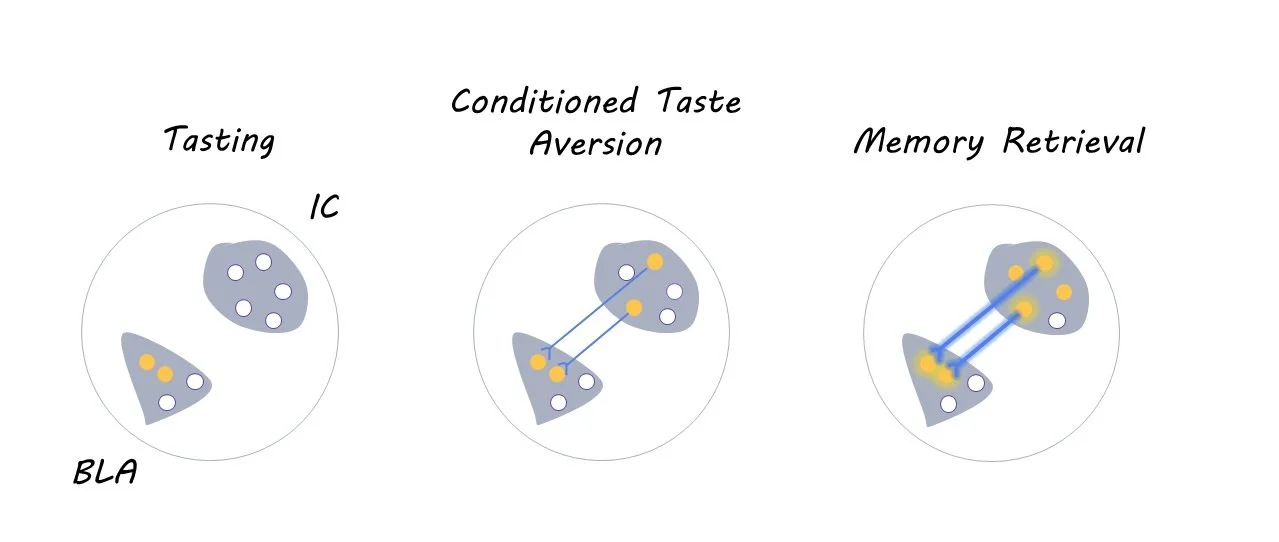
First, the researchers injected mice with a combination of three viruses into the basolateral amygdala (BLA; experiment 1) or insular cortex (IC; experiment 2), which are two interconnected brain regions that are crucial for conditioned taste aversion memories. The first virus carried the CREB gene, which biases the allocation of memories to a random subset of neurons within the injected brain region. The second virus was the rabies virus coupled with mCherry (a fluorescent marker), which allows researchers to visualize the location of presynaptic neurons that project to the injected region via retrograde tracing. The third virus encoded TVA, which is a protein that is essential for the rabies virus to travel to presynaptic neurons.

Four days after the viral injections, the mice underwent a conditioned taste aversion task, which teaches mice to associate a particular taste with an aversive stimulus (i.e., illness). During the habituation phase of this task, which lasted three days, mice received a daily water ration for 30 minutes per day from two tubes. Then, on the following day, the plain water was replaced with sugar water, and the mice were subsequently treated with an injection of lithium chloride. This injection induced feelings of illness, thereby leading mice to develop a learned aversion to sugar water. Aversion to sugar water was then tested three days later, after which their brains were collected and analyzed for neural activity using c-fos immunohistochemistry

To test whether these effects extend to other senses beyond taste (i.e., hearing), the researchers then injected the same three viruses into the BLA of a new cohort of mice and subsequently subjected them to an auditory fear conditioning task. In this task, mice were trained to associate an auditory stimulus (14kHz tones) with a foot shock. Aversion to the auditory stimulus was then tested three days later, after which their brains were collected and analyzed in the same manner as above.

What did they find?

Overall, the researchers found that the allocation of aversive memories in one brain region leads to the retrograde activation of presynaptic neurons (i.e., the target neuron sends a signal back to the presynaptic neuron) in other brain regions during memory allocation and retrieval. Specifically, using CREB to allocate taste aversion memories to the BLA leads to the recruitment of presynaptic neurons in the IC. This pattern was also observed in the opposite direction (i.e., allocating taste aversion memories to the IC leads to the recruitment of neurons in the BLA), suggesting that a bidirectional relationship between these two brain regions is necessary for coordinating taste aversion memory retrieval. Similar coordination was observed between the BLA and auditory cortex during auditory fear conditioning, demonstrating that these effects extend to other senses beyond taste aversion

What's the impact?

This study uncovered the mechanisms that underlie cross-regional memory allocation and retrieval, particularly for aversive memories. These results may pave the way in better understanding how cross-regional memory coordination is disrupted in neurological and psychiatric diseases. 

Access the original scientific publication here.