Deep Brain Stimulation in Alzheimer’s Disease

Post by Lincoln Tracy

The takeaway

New research suggests targeting the intersection of the fornix and the bed nucleus of the stria terminalis with deep brain stimulation may have promising results in Alzheimer’s disease.

What's the science?

Alzheimer’s disease is a common and highly debilitating neurodegenerative disorder. Numerous attempts to modify the disease have had limited success. Following the success of deep brain stimulation (DBS) in treating other conditions such as Parkinson’s disease, targeting the fornix has been trialed in Alzheimer’s disease. However, the benefits of deep brain stimulation to the fornix are yet to be conclusively proven, with patients reporting inconsistent results. This week in Nature Communications, Rios and colleagues explored how variation in DBS electrode placement influenced its effectiveness, thereby identifying brain structures and fiber tracks associated with optimal outcomes.

How did they do it?

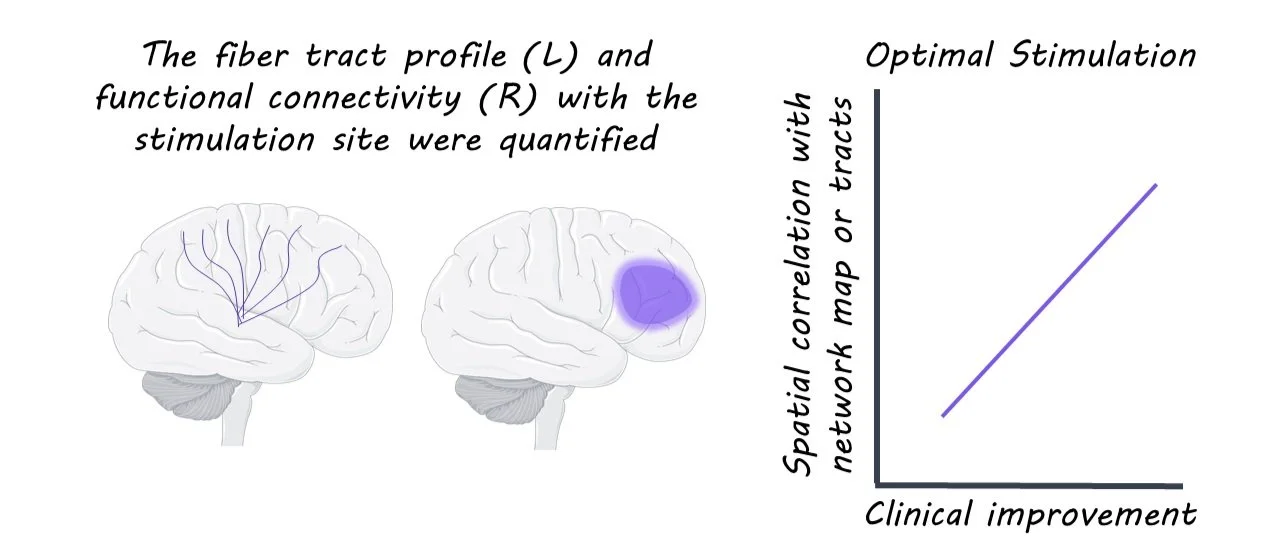
The authors undertook a post-hoc analysis of data collected from 46 individuals with mild Alzheimer’s disease (23 females, mean age 67 years) from seven international centers who received DBS to the fornix between 2007 and 2019. First, they aimed to determine which white matter fiber tract stimulation was associated with maximal clinical improvement by performing DBS fiber filtering on a normative connectome obtained through a whole-brain diffusion scan. Second, they undertook a voxel-wise mapping analysis to identify target coordinates for an optimal DBS sweet spot that can be targeted during surgery. Finally, they used DBS network mapping to identify regions functionally connected with optimal stimulation volume sites, by generating a fingerprint of functional connectivity seeding to estimate the whole-brain response to optimal DBS. Patients were pseudorandomly split into training and hold-out cohorts for each component as a means of cross-validation.

What did they find?

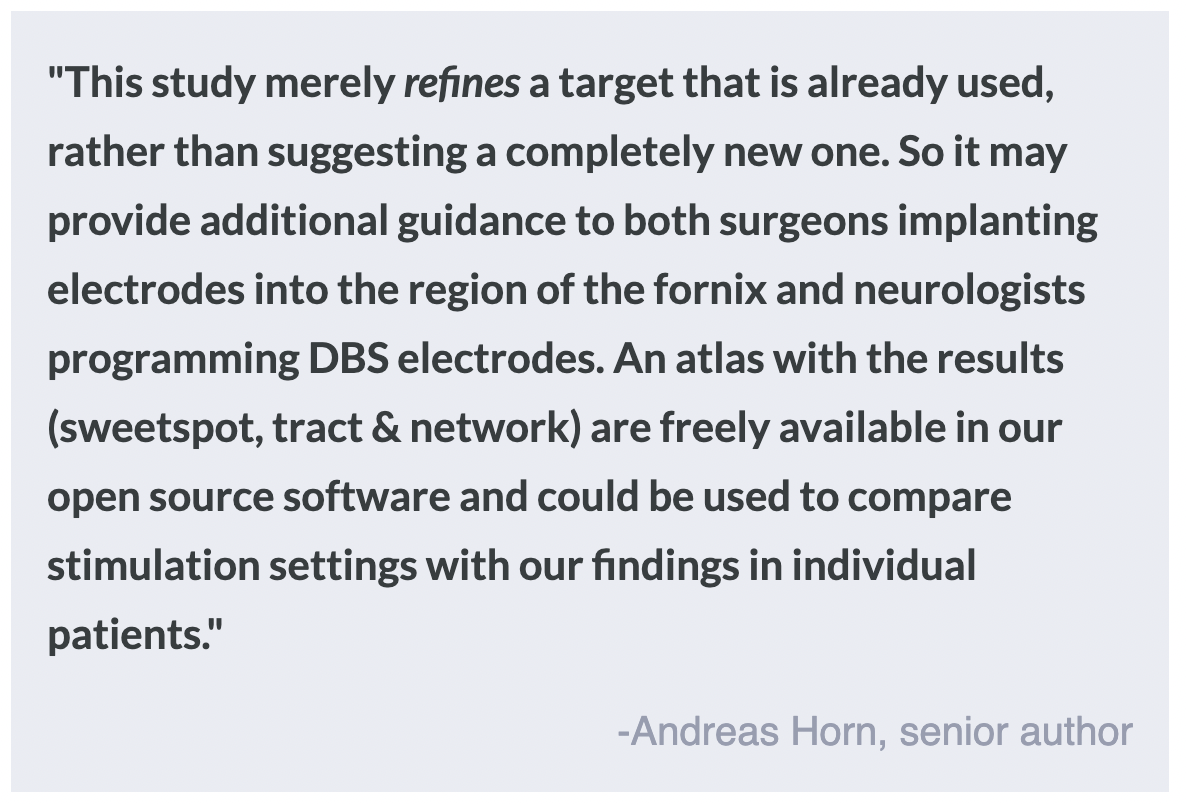
First, the authors identified that stimulating specific white matter tracts in the circuit of Papez and the stria terminalis resulted in optimal clinical improvement. Second, they found the intersection of the fornix and the bed nucleus of the stria terminalis was the optimal stimulation site on a localized voxel level, suggesting that targeting DBS more superiorly and medially than the currently used target may result in better clinical outcomes. Finally, functional connectivity to the precuneus, prefrontal regions, cingulate, thalamus, basal ganglia, and insula were most strongly correlated with the optimal response following DBS.

What's the impact?

These findings provide a framework for the neural mechanisms involved in successful DBS of the fornix, giving the opportunity to influence and improve surgical targeting and stimulation optimization for future trials in Alzheimer’s disease patients. Further research is required to determine other optimal stimulation parameters beyond electrode placement. Utilizing these findings could result in improved and more consistent clinical benefits for millions of individuals affected by Alzheimer’s disease. 

The Development and Accuracy of Time Perception

Post by Lani Cupo

The adage “time flies when you’re having fun” may be a cliché, but most people would agree that their favorite activities seem to fly by, while events they dread seem to pass by slowly. Holding a plank, for example, for 90 seconds may feel like forever while browsing social media for ten minutes can pass in the blink of an eye. How does our time perception develop and how accurate are we in perceiving time?

How does the perception of time develop?

Time perception is an essential part of human life and survival and infants begin learning about time from birth. Psychological studies demonstrate that infants can detect changes in repetitive sequences of stimuli at predictable intervals. For example, in a study from the 1970s, infants placed in a dark room were exposed to light every 20 seconds for 4 seconds, triggering a constriction in their pupils. After a learning phase, their pupils continued to constrict after 20 seconds, even when the light did not change, suggesting the infants already have an internal mechanism for keeping track of time. The emotion of surprise can be measured in infants by assessing their gaze because they will spend more time looking at surprising events. Using this approach, researchers found longer gaze time when event duration changed (such as the puppet opening its mouth for 4 seconds instead of 2), further suggesting that infants keep track of the passage of time and recognize when the duration of a rhythmic event changes.

An infant’s sense of time develops over childhood. Children and adults are able to successfully judge when a second stimulus matches the duration of the first, and accuracy at this task improves between the ages of 3 and 10. A “time bisection” has been used to measure time perception. In this task, participants learn two “anchor” stimuli, one short and one long, and are then exposed to new stimuli of various lengths. Participants must decide which “anchor” stimuli match the novel stimuli most. This allows researchers to study participants’ sense of time. Newborns can differentiate between stimuli with ratios of 1:2 (such as 5 seconds and 10 seconds), but older infants (10 months) can distinguish between more difficult ratios of 2:3 (such as 6 seconds and 9 seconds). While some adults can distinguish closer ratios, there is considerable inter-subject variability. These findings suggest that our time perception abilities improve throughout the first decade of life.

As children get older, they develop explicit knowledge of the concept of time. Time distortions, like perceiving the passage of time as slower or faster than in reality, are more common among young children. One potential explanation is that an explicit understanding of time is linked to several other psychological processes which are still being developed in children. For example, working memory capacity increases between childhood and adulthood, which may contribute to decreased time distortions. In fact, a recent study associated both working memory capacity and concentration capacity with improved performance on a time bisection task across ages. This suggests as the capacity for working memory develops, so does the precision of time perception. As children develop cognitive capabilities, they become less susceptible to time distortions. Some experiments suggest the accuracy of time perception peaks in adolescence when compared to children and adults.

How accurate is our time perception?

Recent research suggests that healthy adults may perceive time as passing slower than it actually does, which may not be a bad thing. Compared to patients with orbitofrontal cortex lesions and borderline personality disorder, healthy participants in one study overestimated the duration of 60 and 90-second time intervals, whereas the patient groups were much more accurate. Results of this study suggest individuals with greater impulsivity or frustration perceive time as moving more quickly than neurotypical individuals.

There is some evidence to suggest that time perception is subject to Weber’s Law, which states that the noticeable change in a stimulus is a constant related to the original value of the stimulus. For example, if you start with a one-pound weight and add another one-pound weight, the difference between the weights will be drastic. However, if you start with a fifty-pound weight, adding another pound will be much less noticeable. In the same way, adding two seconds to a duration of ten seconds is noticeable, however adding two seconds to a duration of 90 seconds may not be.

But, if healthy adults perceive time as passing more slowly than it really does, what is the explanation for “time flying by”? Emotions and time are also intricately connected. For example, research shows that emotional events that sustain our attention speed up time, while more neutral events that are emotionally distracting can slow down our perception of time. Research has also shown that while shorter time increments, such as hours, days, or weeks were perceived similarly across ages, decades were seen as passing more quickly with age. One explanation could be that pressures and responsibilities increase with age, such as professional activities and family duties. Further, time often seems to pass more slowly during periods of learning, which are often concentrated before the mid-20s. However, there are certain limitations to using interviews to understand the perception of time, such as the limited experience younger participants have with “past decades.” 

Additionally, approach vs. withdrawal motivation has been implicated in altering the perception of time. One study examined the impact of movie viewing on time perception, finding scary movies slowed down time perception, but sad movies did not. This suggests that some emotions like fear, eliciting motivation to withdraw, could serve as an evolutionary advantage in slowing down time perception, giving people more time to react to dangerous situations.

Experimental stimuli in research have been shown to impact time perception. In the laboratory, the modality of a presented stimulus impacts the assessment of duration. For example, visual stimuli are judged to be shorter than equal-length auditory stimuli. The reason behind this discrepancy is still subject to debate, however, one hypothesis is related to a theory about the internal representation of time. The model relies on an internal clock mechanism with a “pacemaker”, switch, and accumulator. While trying to keep track of the time the switch is flipped, the pacemaker ticks time by, and these ticks are summed in the accumulator. However, in this model, ticks accumulate more quickly for auditory stimuli than visual stimuli.

What brain regions underly systems of time perception?

One recent hypothesis links the perception of time with motor processes, as time perception provides important information on when and how to move. Functional magnetic resonance imaging (fMRI) acquired during visual and auditory rhythm tasks revealed temporal processing was associated with activity in premotor regions, the supplementary motor areas (SMA), as well as the basal ganglia. Regardless of the duration estimated, other studies have provided evidence for the role of the preSMA, the anterior cingulate cortex, the premotor cortex, and the basal ganglia. It’s also been suggested that activation of these regions measured with fMRI during time perception can be associated with different aspects of the internal clock, with the basal ganglia and SMA involved in time-keeping and more frontal regions recruited for attention, regardless of the task. Further, the insula is known to be involved in the emotional aspects of time-keeping and is thought to support the mediation between emotion and time perception.

What’s next?

Time perception begins at a young age, but the concept of external time is established over the span of childhood. As we age, how we perceive the passage of time continues to change. Lifestyle and life events can impact time perception, however more temporary changes, such as emotional state also impact how quickly time seems to pass. More research is needed to solidify theories surrounding time perception and to better determine causal links between our internal and external environments and how we perceive time. Further, research is needed to understand the real-world implications of how time perception can affect our everyday lives. Ultimately, time perception is a dynamic process that evolves and changes over the lifespan, and we still have a lot to learn about how the brain processes and experiences time.

References +

Carvalho MP de, Machado A, Vasconcelos M. Temporal Bisection Procedure. In: Vonk J, Shackelford T, editors. Encyclopedia of Animal Cognition and Behavior. Cham: Springer International Publishing; 2019. pp. 1–4.

Droit-Volet S. Time perception in children: a neurodevelopmental approach. Neuropsychologia. 2013;51: 220–234.

Coull JT, Droit-Volet S. Explicit Understanding of Duration Develops Implicitly through Action. Trends Cogn Sci. 2018;22: 923–937. Pan Y, Luo Q-Y. Working memory modulates the perception of time. Psychon Bull Rev. 2012;19: 46–51.

Droit-Volet S, Hallez Q. Differences in modal distortion in time perception due to working memory capacity: a response with a developmental study in children and adults. Psychol Res. 2019;83: 1496–1505.

Siu NYF, Lam HHY, Le JJY, Przepiorka AM. Time perception and time perspective differences between adolescents and adults. Acta Psychol. 2014;151: 222–229.

Delistraty CC. Why a Healthy Person’s Perception of Time Is Inaccurate. The Atlantic. 16 Mar 2015. Available: https://www.theatlantic.com/health/archive/2015/03/why-a-healthy-perception-of-time-is-inaccurate/387469/. Accessed 16 Dec 2022.

Berlin HA, Rolls ET, Iversen SD. Borderline personality disorder, impulsivity, and the orbitofrontal cortex. Am J Psychiatry. 2005;162: 2360–2373.

The Editors of Encyclopedia Britannica. Weber’s law. Encyclopedia Britannica. 2020. Available: https://www.britannica.com/science/Webers-law

Haigh A, Apthorp D, Bizo LA. The role of Weber’s law in human time perception. Atten Percept Psychophys. 2021;83: 435–447.

Robison E. Why Does Time Seem to Speed Up with Age? Scientific American. 1 Jul 2016. doi:10.1038/scientificamericanmind0716-73 Wittmann M, Lehnhoff S. Age effects in perception of time. Psychol Rep. 2005;97: 921–935.

Droit-Volet S, Meck WH, Penney TB. Sensory modality and time perception in children and adults. Behav Processes. 2007;74: 244–250. Droit-Volet S, Fayolle SL, Gil S. Emotion and time perception: effects of film-induced mood. Front Integr Neurosci. 2011;5: 33.

Schubotz RI, Friederici AD, von Cramon DY. Time perception and motor timing: a common cortical and subcortical basis revealed by fMRI. Neuroimage. 2000;11: 1–12.

Pouthas V, George N, Poline J-B, Pfeuty M, Vandemoorteele P-F, Hugueville L, et al. Neural network involved in time perception: an fMRI study comparing long and short interval estimation. Hum Brain Mapp. 2005;25: 433–441.

Ferrandez AM, Hugueville L, Lehéricy S, Poline JB, Marsault C, Pouthas V. Basal ganglia and supplementary motor area subtend duration perception: an fMRI study. Neuroimage. 2003;19: 1532–1544.

Wencil EB, Coslett HB, Aguirre GK, Chatterjee A. Carving the clock at its component joints: neural bases for interval timing. J Neurophysiol. 2010;104: 160–168.


Does the Placebo Effect Work When You Know It’s a Placebo?

Post by Christopher Chen

The takeaway

Placebos can provide emotional and physiological benefits, but their use raises ethical questions due to the use of deception. New evidence suggests off-label placebos (OLPs) which do not rely on deception, may also have positive health benefits.

What's the science?

Placebos are a form of patient treatment that have no inherent therapeutic value (e.g., sugar pills, saline injection). However, studies time and time again have validated a “placebo effect,” where people who take placebos may still undergo physiological changes that enhance overall health. For example, functional brain imaging reveals placebos can modulate brain circuits associated with emotional regulation and pain, resulting in a painkilling effect. However, ethical concerns surround the use of traditional placebos because they are given to patients who believe the placebo has therapeutic value. To avoid this, researchers have turned to the use of open-label placebos (OLPs), or placebos that patients know have no therapeutic value. Recent studies show patients taking OLPs report symptomatic relief from maladies like depression, anxiety, and irritable bowel syndrome. However, whether OLPs elicit neurological changes like conventional placebos remains unclear. In a recent article in Neuropsychopharmacology, Schaefer et al. reveal that people taking OLPs exhibited enhanced activity in regions associated with emotional regulation and pain, suggesting OLPs do elicit neurological changes even when people know they are placebos.

How did they do it?

Researchers ran two experiments: one tested the effects of OLPs on participant mood and the other tested OLP effects on brain activity. In the first experiment, participants were divided into two groups. One group was told a nasal spray they were taking was an OLP and potentially had health benefits, while the other group was told the nasal spray was a necessary part of the experiment. Following the administration of the nasal spray, both groups went through the same visual task of ranking a series of pictures depicting neutral images or images designed to elicit strong negative feelings. Following the presentation of each picture, participants described their emotional state. The second experiment played out similar to the first, but participants were instead shown the images while inside an MRI (magnetic resonance imaging) machine undergoing an fMRI protocol designed to gauge blood flow as a measure of brain activity. In this experiment, the description of emotional state was given after the MRI portion was complete.

What did they find?

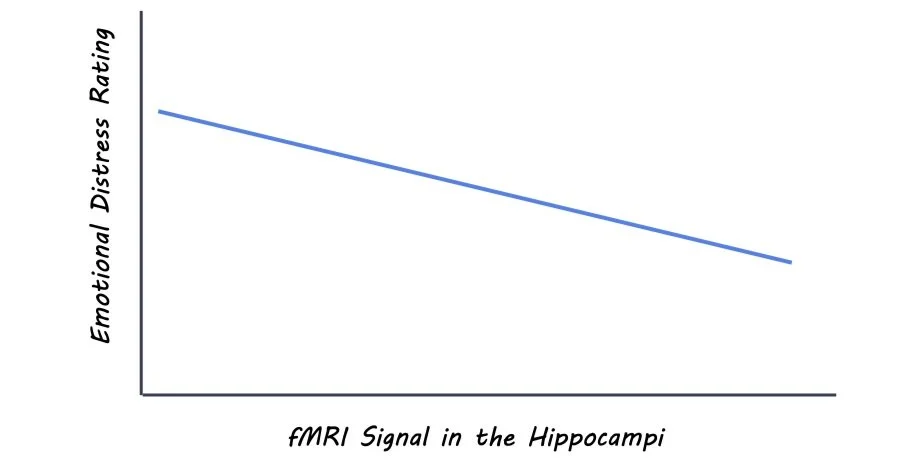
In the first experiment, researchers found that participants from both groups responded similarly to the neutral images, but that participants who were told of the health benefits of OLPs reacted less strongly to the emotional images, suggesting placebos can still help people emotionally regulate even when they know it is a placebo. The second experiment went a step further, showing that the OLP group had greater activation in two regions also known to be activated by traditional placebos, the periaqueductal gray (PAG) and anterior cingulate cortex (ACC). Interestingly, there were two additional key differences in the neural signature of OLPs: 1) activation in the hippocampus, a brain region not known to be activated by normal placebos, and 2) no activation in the prefrontal cortex, a region known to be activated in normal placebos.

What's the impact?

The present study reveals that OLPs elicit activation patterns in the brain that are distinct from patterns associated with traditional placebos. The authors suggest that the lack of PFC activation in OLP treatments may indicate that the PFC is somehow linked to brain processing of deception. The activation of the hippocampus in OLP treatment but not conventional placebo treatments may also indicate how removing deception from the placebo effect may activate more hippocampal-driven processing of emotion and pain. While more research is needed to further validate these findings, this work suggests that the placebo effect holds, even when we know it’s a placebo.