Advancing Our Understanding of Attention

 Post by Megan McCullough

The takeaway

Maps of brain networks involved in attention in humans, generated from functional connectivity analysis, show that subcortical brain structures are essential to both the dorsal attention network and the ventral attention network. This furthers our understanding of the neural correlates of attention, as previous research has mostly focused on the role of the cortex in attention.

What's the science?

Attention — the cognitive task that involves the selection of relevant information for processing — is marked by two distinct attentional networks, the dorsal attention network (DAN) and the ventral attention network (VAN). The DAN is involved in the top-down voluntary orientation to stimuli while the VAN is involved when attention is involuntarily oriented to stimuli. Previous research has focused on these regions in the context of the cortex, but recent electrical recording research, behavioral observations, and animal research have shown the crucial role of subcortical structures in the neural workings of attention. This week in Communications Biology, Alves and colleagues examined the subcortical anatomy of attention networks by aligning functional maps of the DAN and VAN.

How did they do it?

Functional maps of attention networks were drawn from fMRI (functional magnetic resonance imaging) datasets from the Human Connectome Project. The authors utilized resting-state functional analyses to map the subcortical involvement of the DAN and VAN. This technique involves the use of fMRI while the participants are resting in the MRI scanner to generate maps that show the subcortical structures involved in each of the networks. These connectivity maps were then overlayed to examine which subcortical structures were relevant to both networks. The authors then spatially correlated the identified projections with known maps of expression of different receptors and transporters within the brain. This co-mapping of functional and structural data with neurochemical data was done to understand the neural correlates of attention more deeply.

What did they find?

The authors found that subcortical structures such as the pulvinar, superior colliculi, the head of the caudate nucleus, and a group of brainstem nuclei are involved with both attention networks. When the neurochemical data was examined, the authors found that projections in the brainstem nuclei were correlated spatially with acetylcholine nicotinic receptors, serotonin receptors, and dopamine receptors. This builds on previous research that has linked nicotinic receptors with attention. The authors also found that VAN and DAN structural connectivity maps were specific to the right side of the brain.

What's the impact?

This study found that subcortical structures and connectivity are essential in attentional processes. This research builds on previous work that has mostly focused on attention in the context of the cortex. With a stronger model of the VAN and DAN, further research can expand on attention both across species and across brain pathologies. 
 Access the original scientific publication here

Understanding Ketamine-Induced Dissociation

Post by Leanna Kalinowski

The takeaway

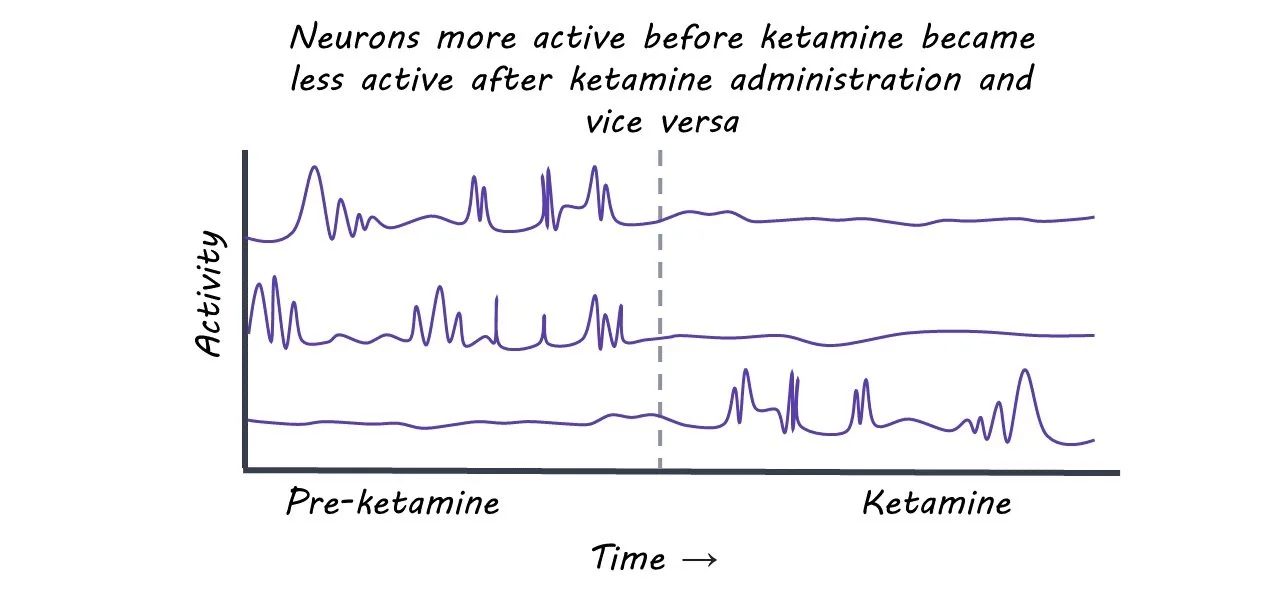
Ketamine-induced dissociation is driven by a “switch” in neuronal activity in the neocortex, where previously inactive neurons become active and previously active neurons become inactive.

What's the science?

Dissociation is an altered state of consciousness that is marked by feelings of disconnect from one’s thoughts, memories, feelings, or internal sense of self while experiencing vivid, internally generated experiences. It can naturally occur during periods of extreme stress or trauma, or it can emerge following treatment with psychedelics or ketamine. There is increasing interest in uncovering the neural mechanisms that underlie dissociation following ketamine treatment, which has been coined a “dissociative anesthetic”. However, the neural underpinnings of ketamine-induced dissociation are currently unknown. This week in Nature Neuroscience, Cichon and colleagues uncovered the neural activity that underlies ketamine-induced dissociative-like behaviors in mice.

How did they do it?

The researchers used in vivo two-photon microscopy, which is an imaging technique that allows for neural activity to be visualized in live mice. First, mice were bred to express GCaMP6f in their excitatory neurons, which is a fluorescent marker of calcium activity that causes neurons to light up when they are active. Next, the mice underwent surgical implantation of a transparent window into their skull, which allows for unobstructed visualization of the brain region of interest. Then, the brain was imaged by mounting the mice into a head stabilizer and recording images through the transparent window using a two-photon microscope.

They were interested in imaging the primary somatosensory cortex (S1), which is responsible for processing somatosensory (e.g., touch, pain) perception and is highly implicated in dissociation. Neuronal activity in the S1 was first measured at baseline. Following a single injection of ketamine, neuronal activity in the S1 was measured again, and differences in each neuron’s activity level were calculated. Mice also underwent a battery of behavioral tests to measure dissociative-like behaviors: (1) the tail suspension test, where dissociation was marked by a reduction of escape behaviors and the presence of a vertical head twitching motion, (2) the marble burying test, where dissociation was marked by fewer marbles buried, (3) the adhesive removal test, where dissociation was marked by an increased time to remove a piece of adhesive from their snout, and (4) the failed forelimb withdrawal test, where dissociation was marked by a failure to withdraw their paw in response to an air puff. 

What did they find?

The researchers found that the neurons that were highly active at baseline became less active following ketamine administration, while a subset of neurons that had low activity at baseline became more active following ketamine administration. These neuronal changes were accompanied by dissociative-like behaviors in mice. This effect was mirrored in additional brain regions that were later measured -- including the primary motor cortex (M1), secondary motor cortex (M2), and retrosplenial cortex -- suggesting that this ketamine-induced switch of neuronal activity is uniform across excitatory neurons in the neocortex.

What's the impact?

This study found that ketamine-induced dissociation is driven by a switch in activity between active and inactive neurons. Results from this study may help us better understand the neurological underpinnings of dissociation not only following ketamine exposure but also in psychiatric disorders where dissociation is a symptom (e.g., schizophrenia). 

From Repressed Memory to Dissociative Amnesia

 Post by Anastasia Sares

The takeaway

In the 1990s, there was heated scientific debate about whether people could recover “repressed” memories, or whether therapists were instead inducing false memories in their patients. One might assume this debate has been resolved, but it has cropped up under differing forms into the late 2010s, especially when it comes to deciding whether to admit such memories as testimonies in court. These kinds of recovered memories can exist in specific situations, but unreliable memories are also possible.

From repression to dissociation

The term “repressed memory” has generally fallen out of favor; however, the fifth edition of the Diagnostic and Statistical Manual for Mental Disorders (DSM 5) uses the term “dissociative amnesia” and defines a variety of dissociative disorders. This reflects the consensus of the scientific community, that traumatic memories—particularly, those that are very intense and experienced early in life—can be forgotten for a period of time, at least consciously (for example, of a woman who had a traumatic experience in an elevator and now refuses to take an elevator, though she does not know why). Studies that follow up with abuse victims whose childhood trauma history is recorded (medical record, etc.) find that some do indeed forget about their abuse and later remember it, and their recovered memories are just as reliable as those that were remembered continuously from the time of trauma.

Testing false memory in the lab

Now, this is not to deny the fact that memories can be unreliable. For example, when participants are presented with a list of related words, like “bed” “tired” “yawn” and then when asked to recall the words, they may include “sleep,” which was related to the other words on the list but not actually presented. When people are asked leading questions about whether or not they have experienced something, they may agree they have experienced it, even if they did not. Some recent evidence has shown that certain types of therapies (like Eye Movement Desensitization and Reprocessing also known as EMDR) can make people more prone to these sorts of errors. In addition, people with specific mental illnesses, such as dementia, schizophrenia, or Korsakoff syndrome may confabulate, or invent memories.

What's the impact?

As with many debates, there is at least a grain of truth on both sides. Both false and genuinely recovered memories can exist. Dissociative amnesia related to trauma or abuse is most likely to happen to people who experienced intense trauma at a young age. A person’s memory of an event, regardless of its status as “repressed,” would be bolstered by external evidence of that event in court. In the end, each case must be treated with its own unique sensitivity and scrutiny.

References +

  1. Brand, B. L., Dalenberg, C. J., Frewen, P. A., Loewenstein, R. J., Schielke, H. J., Brams, J. S., & Spiegel, D. (2018). Trauma-Related Dissociation Is No Fantasy: Addressing the Errors of Omission and Commission in Merckelbach and Patihis (2018). Psychological Injury and Law, 11(4), 377–393. https://doi.org/10.1007/s12207-018-9336-8
  2. Ghetti, S., Edelstein, R. S., Goodman, G. S., Cordòn, I. M., Quas, J. A., Alexander, K. W., Redlich, A. D., & Jones, D. P. H. (2006). What can subjective forgetting tell us about memory for childhood trauma? Memory & Cognition, 34(5), 1011–1025. https://doi.org/10.3758/BF03193248
  3. Houben, S. T. L., Otgaar, H., Roelofs, J., & Merckelbach, H. (2018). Lateral Eye Movements Increase False Memory Rates. Clinical Psychological Science, 6(4), 610–616. https://doi.org/10.1177/2167702618757658
  4. Lorente-Rovira, E., Santos-Gómez, J. L., Moro, M., Villagrán, J. M., & Mckenna, P. J. (2010). Confabulation in schizophrenia: A neuropsychological study. Journal of the International Neuropsychological Society, 16(6), 1018–1026. https://doi.org/10.1017/S1355617710000718
  5. Otgaar, H., Howe, M. L., Patihis, L., Merckelbach, H., Lynn, S. J., Lilienfeld, S. O., & Loftus, E. F. (2019). The Return of the Repressed: The Persistent and Problematic Claims of Long-Forgotten Trauma. Perspectives on Psychological Science, 14(6), 1072–1095. https://doi.org/10.1177/1745691619862306
  6. Williams, L. M. (1995). Recovered memories of abuse in women with documented child sexual victimization histories. Journal of Traumatic Stress, 8(4), 649–673. https://doi.org/10.1002/jts.2490080408