
How Mozart is Helping People with Epilepsy

Post by Christopher Chen

The health benefits of music

For thousands of years, music has been used to improve health and well-being. As far back as ancient Greece, records indicate that philosophers/physicians like Hippocrates and Pythagoras extolled the ways playing music to their patients improved the mind and body. In modern times, clinical research has shown that playing music to people with Alzheimer’s disease improves performance on cognitive-based tasks and that pairing music therapy with medication reduces schizophrenic symptoms more than medication alone. 

Using music to help reduce epileptic seizures

Music helps reduce seizure activity in patients with epilepsy. Epilepsy, a brain disorder affecting over 50 million people worldwide, is a brain condition characterized by seizures that if left untreated, can sometimes cause permanent brain damage. Seizures are the result of two events in the brain: 1) high-frequency bursts of action potentials (in neurons), and 2) hypersynchronization of a neuronal population. While most patients with epilepsy can live a normal life with the help of anticonvulsants, roughly 30% have a form of drug-resistant epilepsy. While these patients may eventually find a suitable combination of medications to control seizure activity, music therapy has been used as a non-pharmacological strategy for decades.

However, while studies have shown a range of music types can help reduce seizure activity in epileptics, one song has been shown to have the most robust anticonvulsant effect: Mozart’s K.448 sonata. First reported in 1998, this finding sparked a wave of similar studies across a diverse range of epilepsy types and clinical subjects, with the data largely recapitulating this “Mozart Effect.”

However, using music to help patients with epilepsy is not consistently beneficial. Despite the success of interventions involving the “Mozart Effect”, it is still unclear why it specifically helps reduce seizure activity. And while studies have shown K.448 decreases overall seizure activity, the effect is not universal and in at least one study, there was an increase in seizure activity in ~20% of the patients.  

To further complicate things, there is a rare form of epilepsy called musicogenic epilepsy where musical stimuli actually cause seizures. Though the condition is rare (affecting roughly 1 in 10,000,000 people), seizures in patients with musicogenic epilepsy may follow exposure to specific types of music, a specific type of instrument, or even thinking about music. Studies examining patients with this type of epilepsy indicate there is an emotional component to the seizures, suggesting the seizures may not be directly caused by the music itself but rather in combination with the emotional component associated with it.  

Disentangling music’s role in epilepsy

Researchers are slowly learning more about the biological bases of music’s effects on epileptic seizures. Due in large part to the complex interactions between music and the brain, it has been difficult to determine the science behind music’s effects on epileptic seizures. There has been substantial progress, though, in outlining the basic principles as to why music – and Mozart’s music specifically – can help reduce seizure activity.

Some of the most fascinating findings come from studies comparing Mozart’s music to music from other classical composers. In one study comparing Mozart with music from the German composer Richard Wagner, researchers found that Mozart’s music was more harmonic and repetitive than Wagner’s, suggesting that repetitive and organized structures may have anti-epileptic effects. In a study comparing Mozart and Beethoven, researchers found the brain waves generated by listening to Mozart’s music resembled brain waves from a healthy brain state and were starkly different than the waveforms generated by seizures (Beethoven’s music elicited brain waves more like those found in a seizure state). Thus, listening to Mozart may put the brain in a “healthier” state and protect it against seizures.

Perhaps the most actionable insights come from studies involving dopamine, a neurotransmitter (chemical) in the brain well-known for its role in mood enhancement. Studies have found that several forms of epilepsy have been linked to low dopamine levels in a part of the brain called the striatum. Compellingly, studies have found that in healthy subjects, listening to music induces the release of dopamine into the striatum. Thus, when patients with epilepsy listen to music, this flood of dopamine into the striatum may be helping maintain sufficient levels of dopamine to prevent seizures. 

The future of sound-related strategies to reduce seizure activity in epileptics

The interest in music’s ability to reduce symptoms of epilepsy has led researchers to investigate how other sound-related therapies may reduce seizures in epileptics. One such strategy is using targeted, low-intensity ultrasound. Delivered directly to the scalp, ultrasound treatments have been shown to reduce seizure activity in preclinical and several small, clinical populations. Researchers believe the soundwaves may be altering the physical properties of neurons associated with the seizures, resulting in a reorganized neuronal structure more closely resembling that in a healthy brain. Some drawbacks include overheating of the scalp and the costs associated with the treatment, and the treatment’s efficacy in larger clinical studies remains to be determined.

As for Mozart? His work remains very much involved in current research, with a recent article showing K.448 may be reducing seizure activity in patients via the brain’s higher-order association networks. So even with the introduction of modern anticonvulsant techniques such as ultrasound, epileptics may still benefit from a healthy dose of Mozart.  

References +

Brackney et al. Complementary and Alternative Medicine: The Mozart Effect on Childhood Epilepsy—A Systematic Review. The Journal of School Nursing (2017).

Ferreri et al. Dopamine modulates the reward experiences elicited by music. Proceedings of the National Academy of Sciences (2018).

Fischer et al. Long-Known Music Exposure Effects on Brain Imaging and Cognition in Early-Stage Cognitive Decline: A Pilot Study. Journal of Alzheimer’s Disease (2021).

Hughes et al. The ‘Mozart Effect’ on the Epileptiform Activity. Clinical EEG and Neuroscience (1998).

Jia et al. The effectiveness of adjunct music therapy for patients with schizophrenia: A meta-analysis. Psychiatry Research (2020).

Liang et al. Application of Music Therapy in General Surgical Treatment. BioMed Research International (2021).

Lin et al. Non-invasive ultrasonic neuromodulation of neuronal excitability for treatment of epilepsy. Theranostics (2020).

Maguire, M. Music and epilepsy: A critical review. Epilepsia (2012).

Maguire, M. Wired for sound: The effect of sound on the epileptic brain. Seizure: European Journal of Epilepsy (2022).

Quon et al. Musical components important for the Mozart K448 effect in epilepsy. Scientific Reports (2021).

Rafiee et al. Music in epilepsy: Predicting the effects of the unpredictable. Epilepsy and Behavior (2021).

Stegemann et al. Music Therapy and Other Music-Based Interventions in Pediatric Health Care: An Overview. Medicines (Basel) (2019).

How Mindfulness-Based Interventions Compare to Escitalopram as a Treatment for Anxiety

Post by Baldomero B. Ramirez Cantu

The takeaway

Recently, mindfulness-based practices have become popular as potential treatments for psychiatric disorders. This study shows that a mindfulness-based intervention can be just as effective at reducing anxiety symptom severity as escitalopram, an anti-anxiety drug.

What's the science?

Anxiety disorders are remarkably debilitating and affect millions of individuals around the world. These disorders are complex and patients tend to respond differently to similar treatments. For example, some patients experience significant improvement from pharmacological interventions while others experience no improvement in their anxiety and suffer from debilitating side effects while taking the exact same drug and dosage. Today, it remains unclear what effective alternatives exist for those who are not responsive to drug-based treatments or psychotherapy for anxiety disorders. This week in JAMA Psychiatry, Hoge and colleagues assessed how mindfulness-based stress reduction (MBSR) compared to escitalopram in reducing anxiety symptom severity.

How did they do it?

The authors recruited adult patients diagnosed with generalized anxiety disorder, social anxiety disorder, panic disorder, or agoraphobia for a randomized clinical trial. Eligible patients were invited to attend an in-person evaluation with a physician where their baseline anxiety severity was measured using the CGI-S scale. This scale ranks anxiety severity from not anxious at all (CGI-S = 1) to severely anxious (CGI-S = 7) and was used to measure patient anxiety severity throughout the study. Next, the patients were randomly assigned to either the mindfulness-based (MBSR) or escitalopram intervention groups. 

1) MBSR Intervention: Patients in the MBSR group participated in an 8-week-long protocol consisting of weekly 2.5-hour sessions, a day-long weekend retreat, and daily 45-minute at-home exercises. All activities focused on meditation and mindfulness-based techniques or theory. 2) Escitalopram Intervention: Patients in this group started with 10 mg daily oral doses of escitalopram and in the absence of problematic side effects increased to 20mg daily doses at week two of the protocol. Patients received medication management visits at weeks 1, 2, 4, 6, and 8 of the 8-week protocol.

The authors performed a noninferiority analysis to compare the effects of MBSR versus escitalopram on patient anxiety severity by analyzing the changes in anxiety severity (CGI-S)  relative to baseline anxiety severity levels.

What did they find?

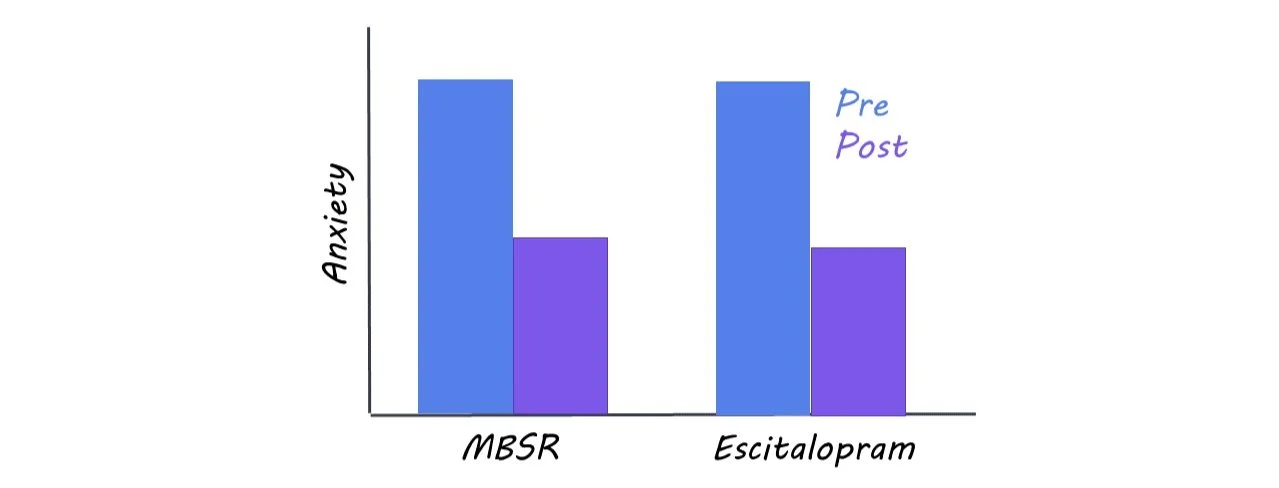
Analysis of patient outcomes after successful completion of the protocol showed that mindfulness-based stress reduction was in fact noninferior to escitalopram. Upon completion of the protocol, the difference between the average reduction in anxiety severity of the MBSR group (Mean CGI-S Reduction = 1.35) and the escitalopram group (Mean CGI-S Reduction = 1.43) was only -0.07 points. This indicates that the difference in the decrease in symptom severity between the two groups was not statistically significant. Individually, however, each treatment did produce a significant reduction in symptoms of anxiety. These results show that both treatments were successful in ameliorating the severity of anxiety symptoms and suggest that some degree of equivalence exists between these two treatments.

What's the impact?

This study is the first to show that mindfulness-based stress reduction can be just as effective as pharmacological interventions. This is important because it positions mindfulness-based stress reduction as a valid alternative to pharmacological treatment for anxiety disorders.

The Impact of Science Communication on Public Perceptions and Beliefs about Contested Scientific Topics

Post by Megan McCullough

The takeaway

Scientific-consensus communication can be a useful tool for making known to the public what the current opinion on scientific topics is among experts, even for contested topics such as global warming and genetically modified foods. This form of scientific communication increased the public’s perception of scientific consensus and belief in scientific facts regarding contested topics.

What's the science?

Inaccurate beliefs can prevent people from taking the necessary steps to tackle certain important societal challenges. Science communication strategies seek to bridge the gap between the scientists who conduct research with the public that benefits from scientific discoveries. One such strategy is scientific-consensus communication, which aims to convey a high level of agreement among scientists on a given topic to the public. Previous research shows that this communication strategy can be a valuable tool for updating personal beliefs about current topics. It is unclear, however, how effective consensus communication is in helping the public understand scientific facts about controversial topics. This week in Psychological Science, Stekelenburg and colleagues aimed to investigate the effects of scientific-consensus communication on public perceptions of scientific consensus and personal beliefs in facts regarding controversial science topics. 

How did they do it?

The authors conducted a meta-analysis on 43 randomized experiments that investigated the effect of scientific-consensus communication on perception and beliefs. The topics presented in the studies were either climate change, genetically modified food, or vaccination. These topics were chosen because public opinion about these topics varies, and the current relevance of these topics led to there being multiple experiments for the authors to analyze. The authors collected articles using electronic databases, examined the reference lists of articles, and contacted authors to ask for other studies. The authors then ran meta-analyses to determine the effects of consensus communication on public perception and beliefs both between topics and overall. Meta-analysis was run because it is an effective research tool; it puts together all the data from multiple experiments to determine the strength of the relationship between variables. The meta-analyses yielded numerous effect sizes, which communicate the strength of the effect of consensus communication on perceptions of consensus and belief in facts related to the three scientific topics.

What did they find?

The authors found that exposing individuals to the current opinion among scientists on contested scientific topics has a positive effect on perceptions of the consensus and on belief in scientific facts. The effect of scientific-consensus communication was more impactful on perception than on personal beliefs. The authors found this result across the three topics; however, since there were limited studies included about vaccination beliefs, there were no conclusions drawn regarding this topic.

What's the impact?

This study found that communicating the current opinions of scientists regarding even contested scientific topics strengthens public perceptions about this consensus as well as belief in facts regarding these topics. This suggests that this is an effective science communication strategy for informing the public about contested science topics such as global warming and genetically modified foods. Effective science communication is a powerful tool for educating the public about scientific topics so that they make informed choices in the future. 

Access the original scientific publication here