Age-Related Neurodegeneration in Huntington’s Disease is Associated with Impaired Autophagy

Post by Leanna Kalinowski

The takeaway

Age-related neurodegeneration in people with Huntington’s disease is associated with an inhibition of autophagy in neurons, which is when old cells are recycled in order to regenerate new cells. 

What's the science?

Huntington’s disease (HD) is an inherited neurodegenerative disorder that is characterized by uncontrollable movements, emotional and behavioral problems, and cognitive decline. Symptoms of HD progressively get worse over time, however, it is unclear how getting older drives the onset of neurodegeneration in people with HD. This week in Nature Neuroscience, Oh and colleagues examined the underlying mechanisms of age-related neurodegeneration by reprogramming cells from HD patients into medium spiny neurons.

How did they do it?

The researchers used cell reprogramming to convert fibroblasts (non-neural cells that contribute to the formation of connective tissue) into medium spiny neurons (MSNs), which are the primary neurons that degenerate in people with HD. The reprogrammed cells were from three groups of patients: (1) patients with HD who show symptoms (“symptomatic HD MSNs”), (2) patients with HD who do not yet show symptoms (“pre-symptomatic HD MSNs”), and (3) age-matched patients who do not have HD (“controls”).

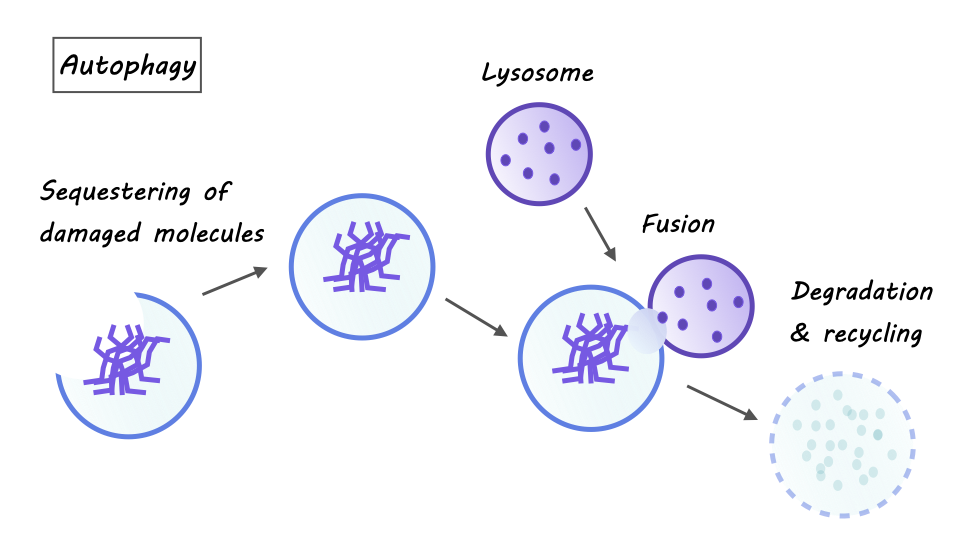
After reprogramming these cells, they tested the hypothesis that symptomatic and pre-symptomatic MSNs exhibit differences in autophagy, which is the body’s process for recycling damaged cells to regenerate new ones. They measured several markers of autophagy (e.g., the number of autophagosomes) and compared them across each group of MSNs. Then, to directly test the impacts of autophagy on HD symptomology, they treated cells with substances to inhibit or enhance autophagy and measured subsequent levels of MSN degeneration.

They then investigated epigenetic mechanisms that underlie differences in gene expression between pre-symptomatic and symptomatic HD MSNs. First, they conducted chromatin accessibility profiling, which measures how tightly DNA is packed into chromatin and determines how accessible it is for gene transcription (the tighter the DNA is packed, the less accessible it is for transcription). They then probed group differences even further by measuring microRNAs (miRNAs), which inhibit gene expression by preventing translation.

What did they find?

First, they found that, relative to controls and pre-symptomatic HD MSNs, symptomatic HD MSNs have lower levels of autophagy markers. This suggests that autophagy is inhibited in patients with symptomatic HD. Next, they found that inhibiting autophagy in pre-symptomatic HD MSNs increases the degeneration of these cells while enhancing autophagy in symptomatic HD MSNs decreases the degeneration of these cells. This highlights an association between the inhibition of autophagy in patients with HD and subsequent neurodegeneration.  

When evaluating the epigenetic mechanisms of these differences, the researchers found that the genes with reduced chromatin accessibility in symptomatic HD MSNs are genes that are involved in autophagy (e.g., ATG16L1, ATG10). This means that these autophagy genes are more difficult to transcribe in symptomatic HD MSNs, leading to an inhibition of autophagy. These effects are driven by differences in miR-29b-3p, which is an miRNA that inhibits autophagy and promotes the degeneration of MSNs.
What's the impact?

Taken together, these results provide a better understanding of what drives age-related neurodegeneration in HD. Specifically, an increase in miR-29b-3p promotes neurodegeneration by impairing autophagy in patients with symptomatic HD. Results from this study may provide an avenue for the development of therapeutics to slow or even reverse the progression of HD.
Access the original scientific publication here.

Communicating via Video Chat Reduces Inter-Brain Synchrony

Post by Lani Cupo

The takeaway

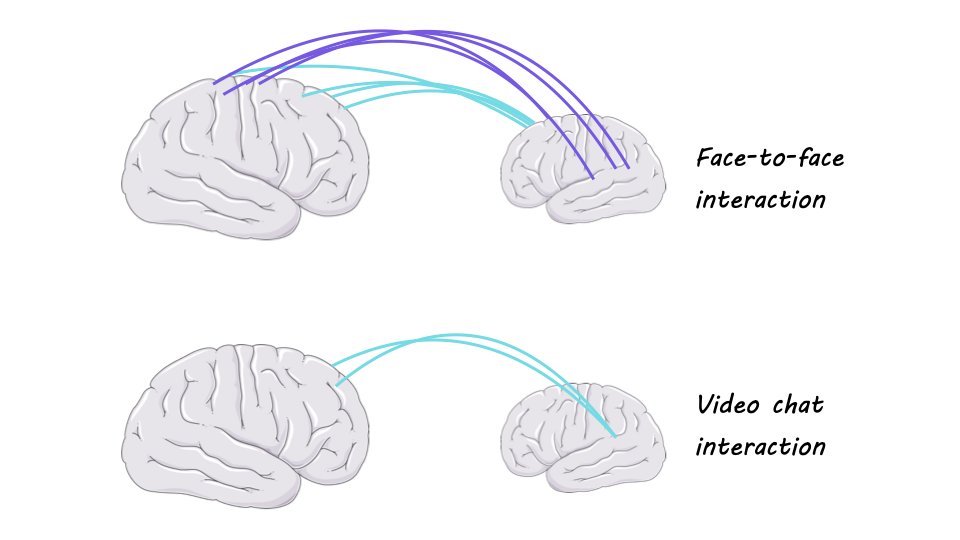
Synchronous brain activity between mothers and their young adolescent children is impacted when they are communicating via video chat compared to face-to-face. While communicating over video chat, there was reduced inter-brain synchrony.

What's the science?

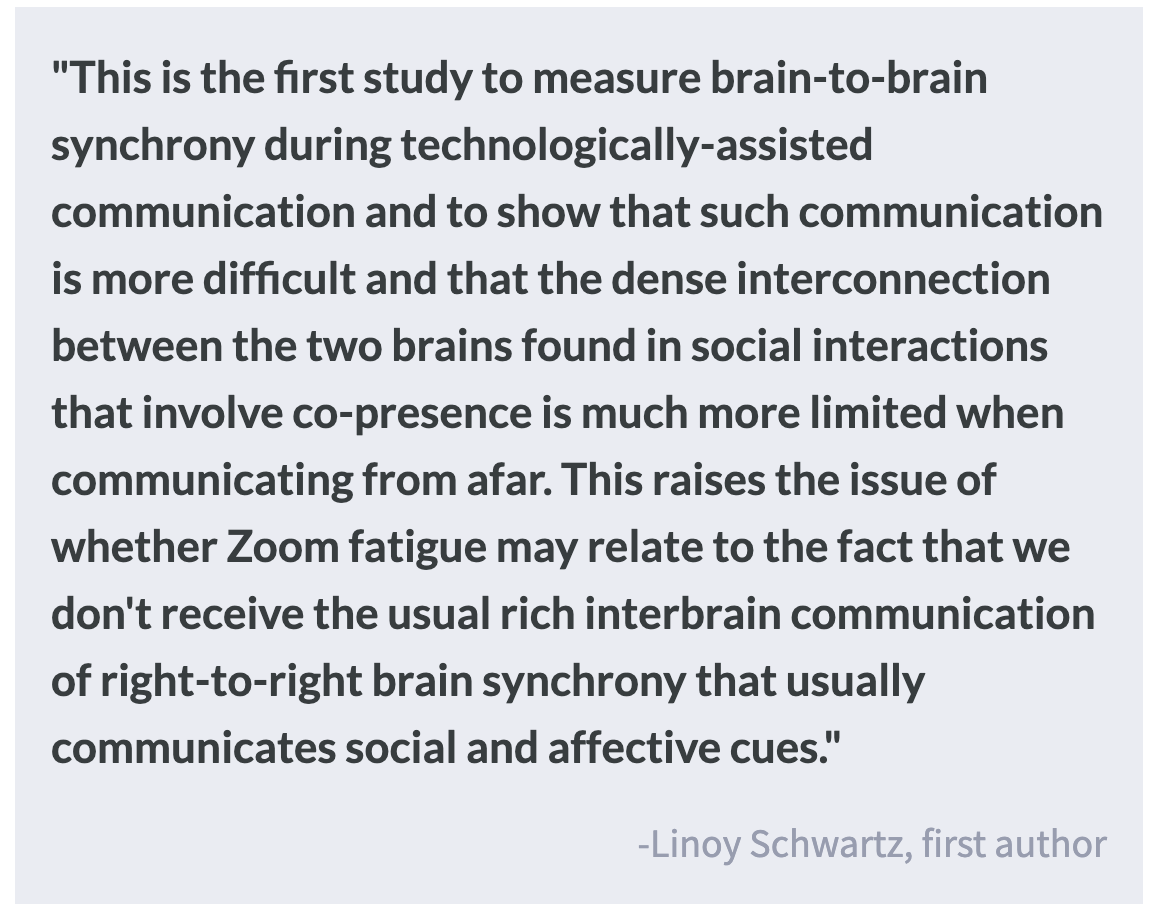
Technologically-assisted communication (i.e. video chat or videoconferencing) has become especially prominent over the past few years as constraints of the COVID-19 pandemic, remote work, and living far from home necessitate people to connect virtually. Many have reported that connections do not feel the same, or that they experience “Zoom fatigue” after long days on video calls, which may be a result of disruptions to the inter-brain synchrony that underlies human social communication. There is mounting concern that children and adolescents may be especially susceptible to the increased exertion of telecommunication, however, more research is required to investigate the impact of technological communication on developing brains. This week in NeuroImage Schwartz and colleagues used electroencephalograms (EEG) on two brains (mothers and their adolescents) during face-to-face and video chat communications, comparing the synchrony between both conditions.

How did they do it?

140 people (70 mother-child pairs) participated in the study, which took place before the COVID-19 pandemic. The authors filmed all sessions and recorded brain activity from participants with EEG during three conditions: rest, where both participants were in the same room, facing a wall, but not interacting, face-to-face, where participants were in the same room, facing each other, and video chat, where participants were in two separate rooms, communicating through a computer screen. In both interaction conditions, the participants were instructed to discuss a positive topic, either planning a camping trip or planning an amusement park visit. The authors recorded EEG from both the mother and child continuously throughout the experiment. They used a previously defined method of calculating inter-brain connectivity (weighted phase lag index), a technique that aims to reduce correlated noise between participants’ brains that may be caused by shared noise sources, such as sensory stimuli. This is especially important for this study because even in a controlled environment, sensory stimuli in the face-to-face condition may be more similar than in the video-chat condition because participants are in the same room with the same noise sources. The authors also investigated behavioral metrics during both interaction conditions using the well-validated Coding Interactive Behavior manual (CIB). Finally, gaze direction was estimated from the video recordings, coded as either to person, to object, aversion, or unfocused.

What did they find?

Compared to baseline, both face-to-face and video chat communication increased inter-brain connectivity, while rest did not. However, inter-brain connectivity was most enhanced in the face-to-face communication condition, compared to the video chat condition. More specifically, the authors examined 36 possible brain connections between the mother and child’s regions of interest (ROIs). Comparing face-to-face to rest connectivity, they found greater inter-brain connectivity in 9 ROI connections. These ROIs could be categorized into four subgroups, most notably a) both homolog and cross-hemisphere linkage between the mother’s frontal and child’s temporal regions, b) mother’s right frontal region connecting with each of the child's ROIs, and c) the child’s temporal region connecting with mother's frontal and temporal regions. Conducting the same analysis between video chat and rest conditions, the authors report only a single significant connection between the mother’s right frontal and the child’s left temporal regions. This pair of analyses underscore the importance of the mother’s right frontal and child’s left temproal connectivity in mother-child social interactions. Comparing the social communication conditions directly, the authors found a significant difference between groups. Finally, during the face-to-face condition, but not the video chat condition, temporal-temporal synchrony was associated with the mother and child looking at each other, and mother-right-frontal-child-left-temporal connection was associated with the child being empathically engaged.

What's the impact?

This study found that social interaction between mother and child induces synchrony between brain activity in both participants, however, the method of interaction impacts connectivity, with greater synchrony during face-to-face interaction than video chatting or rest. These findings lend insight into the neural processes underlying social communication and highlight a need for future studies to investigate how inter-brain connectivity may change with changing technology.

Can Psychedelics Treat Depression?

Post by Anastasia Sares

The takeaway

Recently, there has been rising interest in the possible therapeutic applications of psychedelics. This interest stems from evidence that psychedelic-assisted psychotherapy has been helpful for some people with treatment-resistant depression and other mental health conditions. However, psychedelics can also have negative side effects and require intensive doctor supervision. Thus, scientists are on the hunt for new molecules that might have more therapeutic effects and fewer prohibitive side effects. This week in Nature Neuroscience, Kwan and colleagues reviewed old and new research on the biological mechanisms of psychedelics, providing a resource for future pharmaceutical research.

Getting psychedelics into the brain

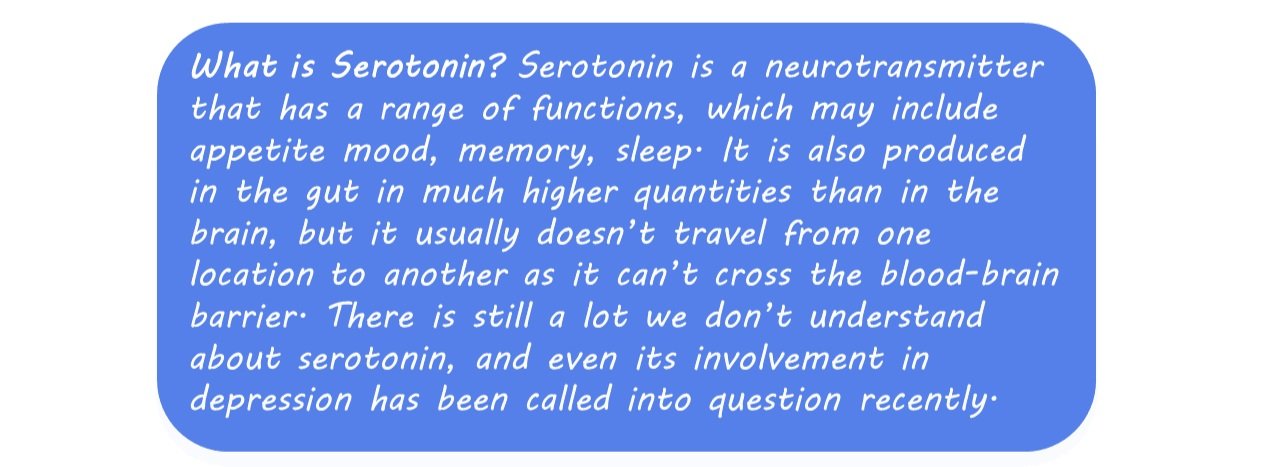
To exert their effects on the brain, psychedelic molecules must first get there. This is not an easy task, as the brain and its surrounding fluid are separated from the rest of the body by the blood-brain barrier. The cells of the blood-brain barrier are bound together by tight junctions that prevent molecules from squeezing between them, as they would in the rest of the body. Instead, molecules wanting to get to the brain must cross into these barrier cells and then back out on the other side. Thus, small molecules that are somewhat soluble in both water and fatty cell membranes are best suited to get into the brain, and psychedelics fit these criteria.

Pretending to be serotonin

Once in the brain, psychedelics bind to serotonin receptors, mimicking the action of serotonin itself. There are two important sites on the serotonin receptor that the psychedelic activates: the binding pocket, which receives the nitrogen end of the psychedelic molecule, and a hydrophobic region (a region that repels water), which lines up with a ring of carbons in the psychedelic molecule. These two regions need to be spanned by a distance of exactly two carbons, or the receptor and the molecule won’t line up. In addition, if the carbon ring is free to spin around relative to the nitrogen, the molecule will be less efficient in binding to the receptor, so rigid structures are more effective. LSD is an example of one of these rigid molecules.

What are the effects on neurons?

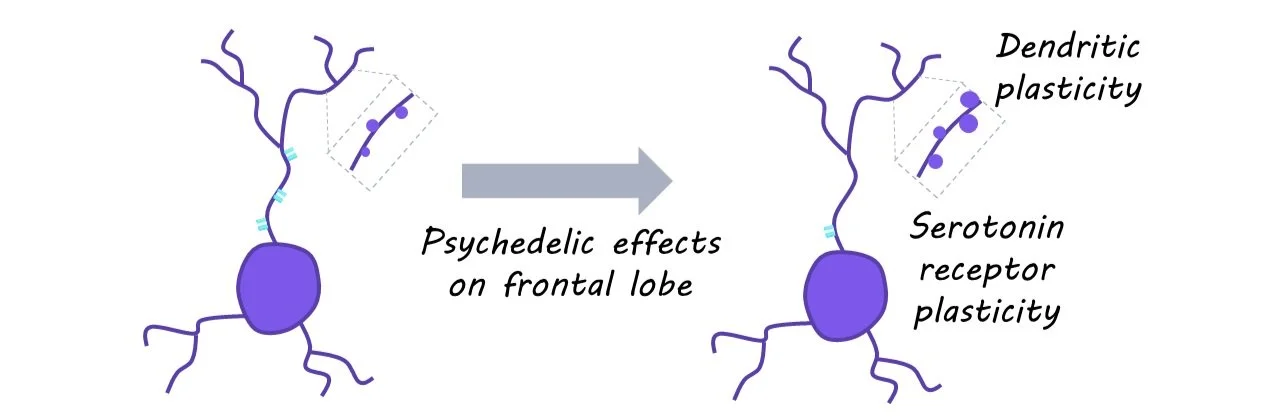
What happens in the brain when a psychedelic activates a serotonin receptor? There are many different serotonin receptors in the brain, some of which increase neuronal firing while others may decrease it. Overall, the effect of a psychedelic in each region of the brain could depend on the ratio of these different types of serotonin receptors. For example, a number of studies have found that activity in the visual pathway is decreased, while others have suggested that activity in the frontal lobe may increase.

Psychedelics can also increase the presence of molecules related to brain plasticity (the ability of the brain to rewire itself). They can also alter the number of neuronal spines (small protrusions from the dendrites that help the neurons make connections) on neurons. This is generally seen as positive and it may be the reason why therapy with psychedelics can help people with treatment-resistant depression: the therapy and plasticity may work together to reshape a person’s thought patterns. However, not all plasticity is good—there can also be maladaptive plasticity, so it will be important to research this phenomenon in more detail.

Finally, psychedelics may also stimulate non-serotonin receptors, changing levels of other neurotransmitters like dopamine or glutamate, and even in some cases causing cardiac problems (as has been reported in chronic MDMA users).

What are the effects on brain networks?

By the time we arrive at the level of brain networks, the exact mechanisms of psychedelics are much less clear. There are multiple, sometimes contradictory, models of psychedelic action. Some common elements include increased connectivity of the thalamus (a deep brain structure involved in controlling input from different senses) and fragmentation of association cortices (linking information from one brain region to another).

Moving forward

To arrive at effective psychedelic-based therapies, scientists must work to understand what exactly about these compounds is therapeutic. Are the hallucinogenic effects completely independent from the pathways that increase neural plasticity (and if so, could we make a non-hallucinogenic molecule that still has therapeutic benefits)? Or, are the hallucinogenic and the therapeutic activity one and the same?