
Thermal Pain Sensitivity is Driven by Circadian Rhythms

Post by Lincoln Tracy

The takeaway

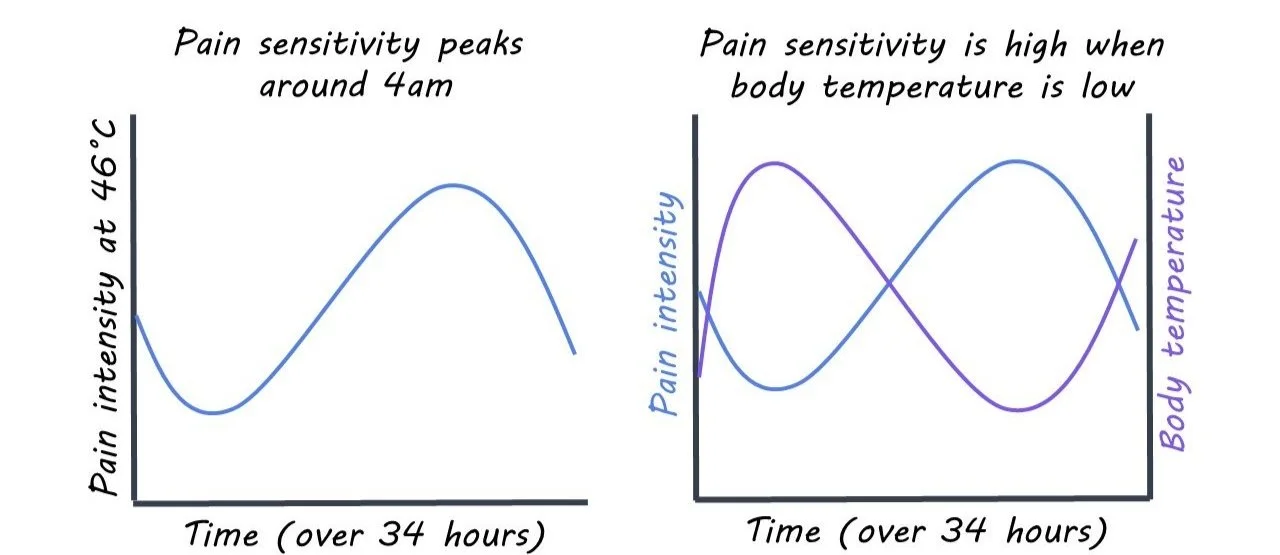
Keeping patients awake for an extended period in a highly controlled environment reveals thermal pain sensitivity is driven by circadian rhythms, with the peak in pain sensitivity occurring between 3:00-4:30 am.

What's the science?

How intense we perceive a painful sensation to be, changes throughout the day. It’s possible this variation is related to our internal circadian clock (or rhythm), but the exact reason is unknown. This week in Brain, Daguet, and colleagues used a highly-controlled constant-routine protocol to determine whether sensitivity to thermal pain displays rhythmic changes over a 24-hour period and assess the specific contributions of the circadian clock and other sleep-related processes to the potential change in thermal pain sensitivity.

How did they do it?

The authors recruited 12 healthy males (mean age 22.7 years) who maintained a regular sleep/wake schedule for three weeks before entering the laboratory to complete the 56-hour experimental protocol. The participants arrived at about 10 am on the first day and familiarized themselves with the dark laboratory environment which was free of external time cues (e.g., clocks, television, and visitors). Participants slept for eight hours in darkness as per their normal sleeping habits. Once they awoke on the second day, participants were kept awake for the next 34 hours until the end of the experiment (approximately 6 pm on day three). Salivary melatonin levels were assessed hourly during the 34-hour awake period; thermal heat pain sensitivity, body temperature, and heart rate were evaluated every two hours. Specifically, the authors tested participants’ heat detection threshold (the point at which they felt a warm sensation), heat pain threshold (the point at which the stimulus became painful), and sensitivity to 42°C, 44°C, and 46°C stimuli at these intervals. The authors then explored if and how pain sensitivity and the collected physiological measures changed over time.   

What did they find?

First, the authors found that pain sensitivity increased with sleep debt, with the 44°C and 46°C thermal stimuli (but not the 42°C stimuli) being rated as more painful the longer the participant was kept awake. This suggests the known relationship between sleep deprivation and pain sensitivity may not apply to lower levels of pain. Second, they found pain sensitivity is driven primarily by circadian rhythms, rather than by sleep pressure. Instead of simply steadily increasing as sleep deprivation increased over the 34-hour time period, the peak in pain sensitivity occurred between 3:00 am and 4:30 am. Third, they found the peak in pain sensitivity occurred at a similar time to the troughs (low point) in body temperature and heart rate (3:00 and 2:00 am, respectively). In addition, pain sensitivity peaked one and a half hours after the peak in melatonin secretion (2:00 am). These findings imply a phase relationship between the circadian components of pain modulation and other physiological rhythms.
What's the impact?

The results of this study demonstrate that pain sensitivity is driven by our circadian timing system and that sleep (deprivation) has less of an influence on pain sensitivity than previously thought. Further research is required to identify the neural pathways linking circadian rhythms to pain perception. These findings suggest the effectiveness of pain relief could be optimized using circadian medicine, administering treatments based on the patient’s internal time.
Access the original scientific publication here.

The Worldwide Prevalence of Temporal Discounting

Post by Megan McCullough

The takeaway

Consistent patterns of temporal discounting were observed in a diverse sample that included participants from 61 countries.

What's the science?

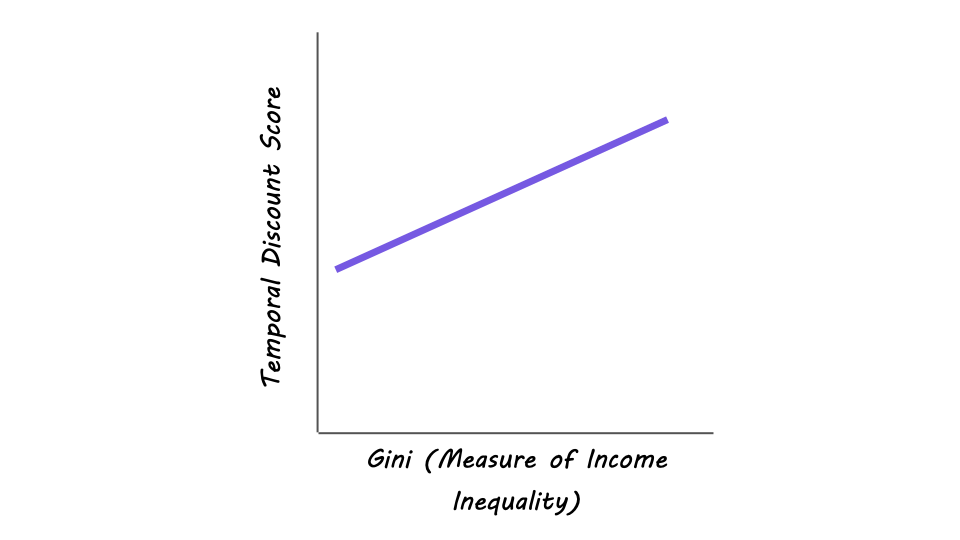
Temporal discounting is a cognitive bias in humans that describes the tendency to choose rewards that will occur immediately rather than rewards that will occur in the future. Previous studies that have examined temporal discounting globally, have found an association between temporal discounting and income inequality – those with lower incomes tend to prefer smaller, immediate gains over larger ones that would occur in the future. Although these studies found consistent results throughout different populations, they have used narrow measurements that have only examined immediate gains compared to future gains. This week in Nature Human Behavior, Ruggeri and colleagues aimed to investigate patterns of temporal discounting around the world using multiple measures of intertemporal choice anomalies (decisions in the short-term that affect the long-term that are not expected).  

How did they do it?

The authors designed an assessment to administer to individuals from 61 countries that measured multiple facets of intertemporal choice anomalies including absolute magnitude, gain-loss asymmetry, delay-speedup asymmetry, and present bias. The authors’ assessment included scenarios in which the participants made decisions regarding receiving rewards now or in the future. Local currencies and value standards were used for each country. The participants then answered questions regarding their financial circumstances.

What did they find?

Overall, the authors found that increased wealth and income at individual and national levels are associated with lower temporal discounting. The data showed a trend that individuals living in countries with a lower gross domestic product (GDP) tended to prefer immediate gains and later payments compared to individuals living in countries with higher GDPs. However, all countries, independent of the economic environment, exhibited some temporal discounting. Temporal discounting also became more common at high levels of inflation. The authors also found higher within-country differences in temporal discounting rates compared to between-country differences, which shows that temporal discounting is a globalizable occurrence.

What's the impact?

This study found that temporal discounting, and the common anomalies associated with it, are present globally. The authors also found consistent patterns of intertemporal choices across the 61 countries examined. This research has policy implications as it demonstrates the effects of economic inequality and inflation on decision-making.

Access the original scientific publication here.

Relating Psychiatric Symptoms and Self-Regulation During the COVID-19 Pandemic

Post by Andrew Vo

The takeaway

Stressors, such as the COVID-19 pandemic, can significantly affect our mental health and cognitive abilities. Individual differences in self-regulation and psychiatric symptoms can make us more vulnerable to the negative impacts of the pandemic.

What's the science?

Self-regulation is a broad construct, comprised of functions like cognitive control and impulsivity, that allows us to behave flexibly and achieve our goals. Impairment in self-regulation has been linked to several psychiatric disorders (e.g., depression, schizophrenia, o­­bsessive-compulsive disorder). Additionally, environmental stressors may also impair self-regulation. One recent stressor that affected us all is the COVID-19 pandemic, which saw increased stress and anxiety by fear of infection as well as social isolation from containment measures, among other factors. Although the pandemic has had clear negative consequences on our mental health, its specific impact on cognitive function remains unclear. This week in Translational Psychiatry, Vaghi et al. investigated how the onset of the COVID-19 pandemic affected the relationship between different dimensions of psychiatric symptoms and changes in self-regulation.

How did they do it?

The authors relied on an already existing dataset in which, before the pandemic (i.e., 2016), participants were administered a battery of 37 cognitive tasks and 22 self-reported surveys that each examined different facets of self-regulation. In this study, a subset of these individuals were contacted again, to complete the same battery, immediately after the onset of the pandemic (i.e., 2020). After the pandemic onset, these subjects also reported their psychiatric symptoms, well-being, and subjective experience of the pandemic. The authors applied a data-reduction analysis to each set of self-regulation measures and psychiatric questionnaires that distilled the different tasks/surveys and psychopathologies into underlying core factors. Then, they studied how individual differences in psychiatric factors affected longitudinal changes in self-regulation pre- and post-pandemic onset.

What did they find?

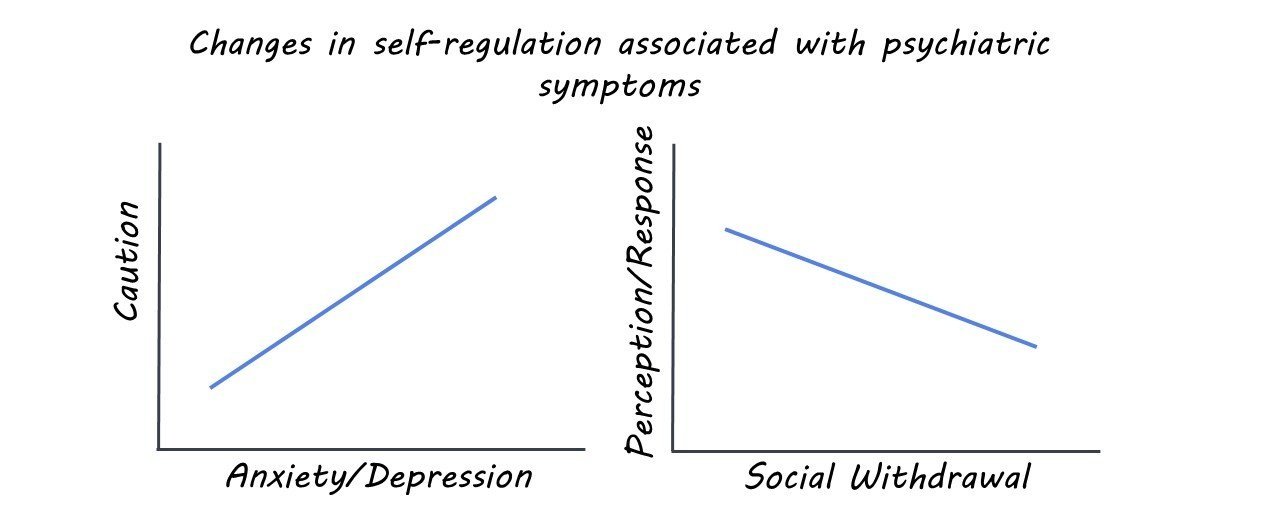
The authors found that individual differences in transdiagnostic psychiatric symptoms were related to longitudinal changes in self-regulation measures (task- and survey-based) following pandemic onset. For example, they observed that, compared to the period preceding the onset of the pandemic, individuals with high levels of depression/anxiety had more cautious behavior as they needed to accumulate more evidence before making a decision. Those who scored high on a social-withdrawal psychiatric factor demonstrated decreases in the perception-response self-regulation factor.

Though a similar longitudinal effect was not observed when considering survey-based factors, such factors did correlate with concurrent psychiatric scores. Specifically, poor emotional control self-regulation factor was related to several psychiatric factors, including Anxious-Depression, Compulsivity, and Social-Withdrawal. Psychiatric factors were also related to subjective effects of the pandemic, as individuals with higher psychiatric scores reported a greater negative impact of the pandemic. 

Finally, the authors tested whether task- or survey-based measures of self-regulation could predict psychiatric symptoms related to the pandemic. They correlated self-regulation factors derived from data collected before (i.e., prospective) or after (i.e., concurrent) pandemic onset with psychiatric factors that were available only after pandemic onset. Whereas survey-based measures could make both prospective and concurrent predictions successfully, task-based measures could not.

What's the impact?

This study showed how individual differences in self-regulation and psychiatric symptoms shape cognitive vulnerabilities to stressors such as the onset of the COVID-19 pandemic. The authors did so by using a comprehensive battery of measures rather than the traditional approach generally limited to a single task or questionnaire. Notably, they examined the effects of a real-life stressor on cognitive function providing greater ecological validity compared to artificial laboratory stressors.

Access the original scientific publication here.