A Subtype of Dopamine Neurons is Vulnerable to Neurodegeneration in Parkinson’s Disease

Post by Shireen Parimoo

The takeaway

Parkinson’s disease is characterized by the loss of dopamine (DA) neurons, with some DA neurons more vulnerable than others. One subtype of DA neurons that strongly express genes that have previously been linked to Parkinson’s disease is most susceptible to degeneration.

What's the science?

Parkinson’s disease (PD) is characterized by the loss of dopamine (DA) neurons in the substantia nigra pars compacta (SNpc). However, neuronal degeneration is not uniform across all subtypes of DA neurons, as some survive late into disease progression while others die early on. The genetic and molecular characteristics of the different DA neuron subtypes that make them selectively vulnerable to PD-related degeneration are not currently known. This week in Nature Neuroscience, Kamath and colleagues performed molecular profiling of DA neurons in the SNpc to identify the subtypes most at risk for degeneration in PD.

How did they do it?

The authors first identified DA and non-DA cells in post-mortem human midbrain slices, as well as the rodent and macaque midbrain, using single-nucleus RNA sequencing. They performed a clustering analysis and compared the presence of certain genes against an existing database to identify different cell types within the midbrain tissue. Within the DA neurons, they quantified the presence of certain molecular biomarkers, such as transcription factors and regulons (set of genes whose expression is controlled by a common regulatory region), to further distinguish between the different DA neuron subtypes. Next, they spatially localized the DA neuron subtypes within the macaque SNpc using Slide-seq (a spatial phenotyping technique) and in the human SNpc using fluorescence imaging. To determine which DA neuron subtypes were more vulnerable to degeneration, the authors compared post-mortem tissue of PD patients and controls. Lastly, they examined the presence of genetic and molecular markers associated with familial and sporadic PD in the different DA neuron subtypes.

What did they find?

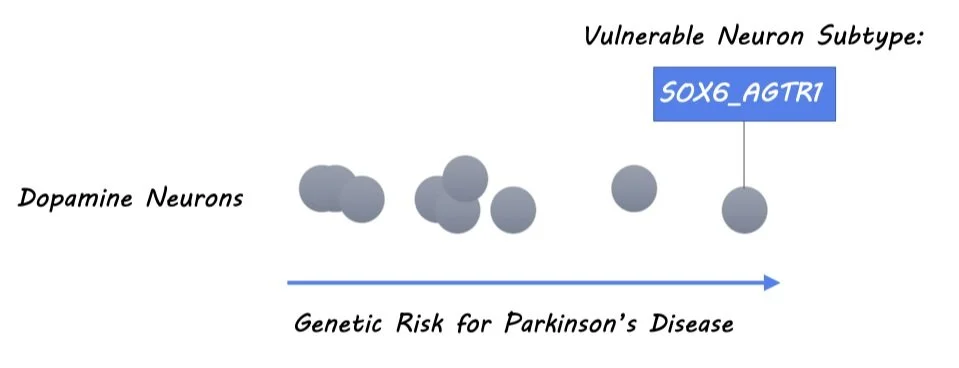
Midbrain cells were grouped into seven categories (e.g., astrocytes, DA neurons, microglia, etc.), within which DA neurons were differentiated from non-DA neurons based on the presence of the Nr4a2 gene. There were two broad classes of DA neurons in the human and macaque midbrains: those that strongly expressed the SOX6 genes and those that strongly expressed the CALB1 genes. The SOX6-expressing neurons – particularly the subtype containing the AGTR1 gene – were primarily localized to the ventral SNpc while the CALB1-expressing neurons were predominantly in the dorsal SNpc. Within the DA neuron subtypes, there was considerable heterogeneity in the expression of transcription factors and regulon activity. This means that different subtypes of DA neurons in both the human and macaque midbrain can be distinguished from one another based on the expression of specific transcription factors.

In PD, SOX6-expressing DA neurons in the ventral SNpc were more vulnerable to neurodegeneration, especially the AGTR1 subtype, compared to CALB1-expressing neurons in the dorsal SNpc. Moreover, the AGTR1 subtype was strongly enriched for genes previously linked to PD by genome-wide association studies. Additionally, this subtype was found to have upregulated genes linked to neurodegeneration in mouse models of PD, which explains their selective vulnerability to PD-related degeneration. Together, these results implicate the SOX-AGTR1 subtype of DA neurons in PD due to the marked presence of genetic markers associated with neurodegeneration.
What's the impact?

The authors profiled DA neurons in the midbrain using single-nucleus RNA-sequencing, which allowed the authors to identify and spatially localize the DA neurons within the substantia nigra pars compacta that are selectively vulnerable to PD-related degeneration. These findings not only strengthen our understanding of the biomarkers associated with PD, but the identification of transcription factors that drive neurodegeneration in PD can additionally inform efforts to develop targeted treatments and therapies.

Access the original scientific publication here.

Brain and Body Signals Synchronize with Eye Contact

Post by Anastasia Sares

The takeaway

The expression “being in sync” with another person is more true than we might think: both brain and body signals can start to synchronize when we make eye contact with someone—even more so if we are close with that person.

What's the science?

Most neuroimaging studies focus on what is happening in a single brain during some computer-based task. But humans are inherently social creatures, and likely respond much differently when face-to-face with another person. Enter hyperscanning: the method of scanning more than one brain at a time during a real interaction. This technique has been used to study musicians playing duets, parent-infant pairs, and more.

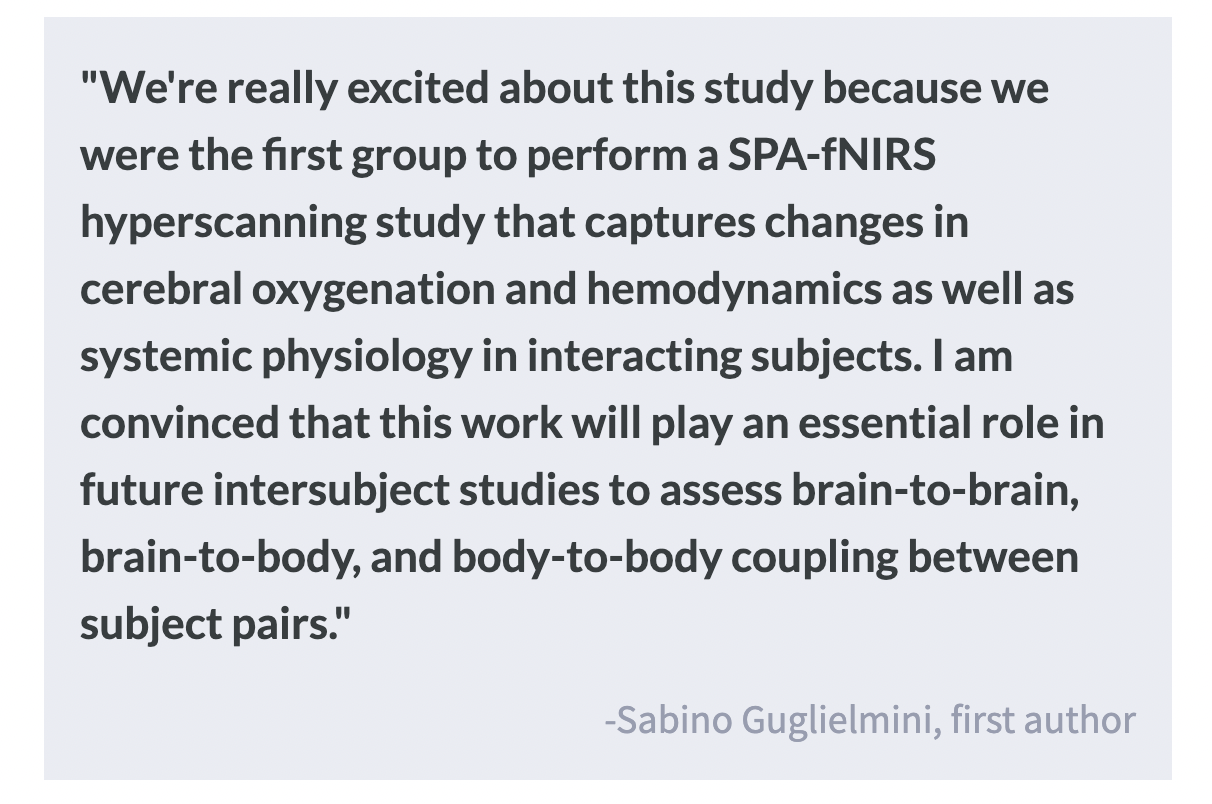
This week in Neurophontonics, Guglielmini and colleagues added physiological signals into a hyperscanning study, monitoring body signals like heart rate and blood pressure between people as they made eye contact.

How did they do it?

The experimental design was simple: seat two people across from each other at a table, first with eyes closed, and then with eyes open and making eye contact, for 10 minutes each. Some of these people knew each other well (siblings or couples), and others less well (colleagues or strangers). The authors used fNIRS (functional Near-Infrared Spectroscopy) to detect blood hemoglobin levels in the brain using infrared light, along with skin conductance, blood pressure, heart rate, etc. They broke down the signals into different frequency bands (fast oscillations, slow oscillations, very slow oscillations). They then lined up the signals for each pair of participants that had interacted to see how well the signals correlated in the eyes-closed versus eye-contact conditions. As a control condition, they compared the signals of people from different testing sessions who had not been paired.

What did they find?

The authors observed more synchronized blood flow in the brain (measured by total hemoglobin levels) during the eye-contact condition, while body temperatures were better synchronized in the eyes-closed condition. Signals from people who had been in the same testing session were more synchronized than the (control) signals of people who had been in different testing sessions. Most measures of synchronization were greater for people who knew each other well, like blood flow in the brain but also in heart rate and diastolic blood pressure. Skin temperature and electrical activity in the skin were also correlated with blood flow in the brain across people.

What's the impact?

This study demonstrates that eye contact results in significant changes in synchronization between individuals. Beyond that, it shows that it is possible to combine physiological data coming from the body with brain blood-flow measures in a hyperscanning experiment, expanding our ideas about what is possible with hyperscanning.

The Neural Correlates of Abrupt Visual Learning

 Post by Megan McCullough

The takeaway

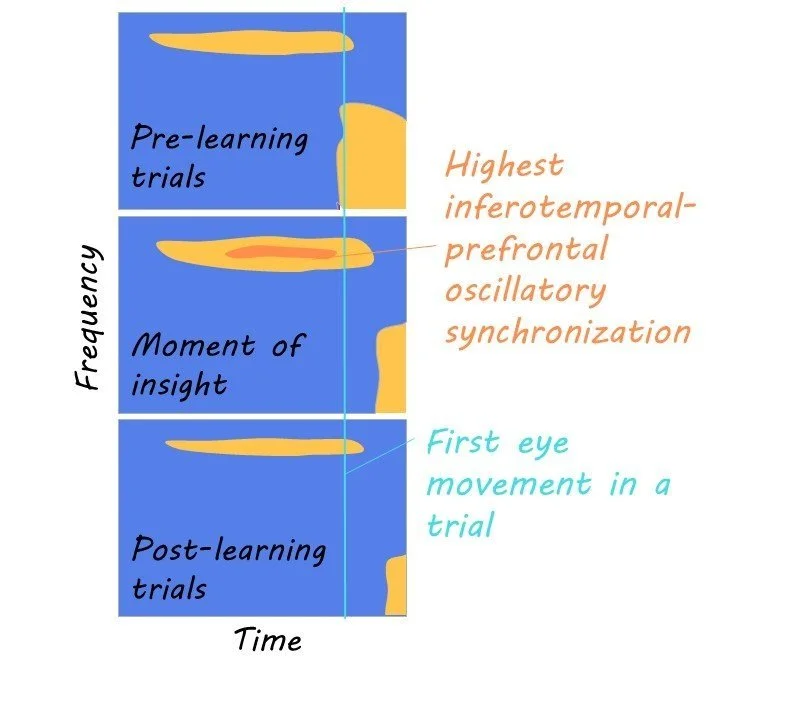
Rapid visual learning, which can be thought of as a moment of insight, is characterized by synchronized neural activity in the inferotemporal and prefrontal cortices.

What's the science?

Although most learning in adult humans requires multiple learning sessions and involves slow changes in the brain, abrupt learning refers to the circumstances in which adults learn after one or only a few exposures to a stimulus. One example of abrupt learning is recognizing a person’s face after one introduction. Previous studies have examined the role of oscillatory synchronization (brainwaves occurring at the same time) in learning over time, but its role in abrupt learning is unknown. This week in Current Biology, Csorba and colleagues aimed to study the role of synchronization of neural activity between the prefrontal (PFC) and inferotemporal (IT) regions in facilitating abrupt learning by recording neuronal activity in non-human primates.

How did they do it?

The authors recorded neuronal activity in the PFC and IT cortex of two adult rhesus macaque monkeys while they participated in an oculomotor foraging task. The task consisted of three phases: the presentation of a scene, a foraging phase, and the reward phase. First, each animal was presented with a natural image. Next, the animals were allowed to explore the image visually. Finally, the animals were rewarded when their gaze reached an unmarked reward zone and the time it took the animals to find the reward zone after being presented with the scene was recorded. This task was chosen because the learning was abrupt, performance improved significantly after only a few trials. To examine the relationship between neural activity in the regions of interest and abrupt learning, the authors measured the relationship between the local field potential (LFP) signals in each area.

What did they find?

The animals learned to recognize the images presented to them and associate them with specific reward areas, showing that this task involved abrupt visual learning. The authors found an increase in synchronization of LFPs in the PFC and IT region around the time the animals had their moment of insight. Furthermore, the synchronized activity in these two brain regions could predict the changes in performance of the monkeys. The data show that the strength of the synchronization was highest around the moment of insight but also carried into the post-learning phases of the task. This coordinated activity appears to link visual inputs with reward outcomes.

What's the impact?

This study uncovered the neural correlates of abrupt visual learning. Because the animals were allowed to freely look at natural images, the results of this study may provide a look into learning that occurs in natural settings outside of a laboratory. This research illustrates the role that coordinated activity between brain regions has in allowing quick visual learning.

Access the original scientific publication here