The Effects of Living in High Crime Neighborhoods on Neonatal Brain Function

Post by Elisa Guma

The takeaway

Living in neighborhoods with high rates of crime has an impact on neonatal brain activity at birth, and this is mediated by maternal psychosocial stress. Weaker neonatal brain connectivity in some areas of the brain is directly associated with higher crime rates.

What's the science?

Maternal exposure to stress and adversity during pregnancy has been shown to impact fetal brain development, with lasting effects in postnatal life. Exposure to adversity may increase mothers’ stress and inflammatory factors, which may cross the placenta and interfere with fetal development. Previous work has found that mothers living in high-crime neighborhoods may not only have an increased risk of being victims of crime (a significant risk factor) but also experience higher levels of psychological stress. This week in Biological Psychiatry, Brady and colleagues investigate the relationship between neighborhood crime and neonatal brain function at birth.

How did they do it?

Mother-infant pairs were recruited as part of a larger birth-cohort study at Washington University in St. Louis. Shortly after birth, fed and swaddled neonates, underwent T2-weighted structural magnetic resonance and resting-state functional imaging. Reliable fetal brain networks were identified and connections between limbic regions (amygdala, hippocampus, thalamus) and frontal networks (anterior default mode network, anterior frontal-parietal network) were examined.

Crime data was obtained from a commercial database with data from law enforcement agencies and sorted into two categories: violent (i.e., crimes committed against persons such as murder, rape, robbery, and aggravated assault) or property crimes (i.e., burglary, larceny, and motor vehicle theft). Maternal addresses at birth were used to determine their block level crime exposure.  

The authors also assessed potential protective actors or additive factors of socioeconomic status, referred to as “advantage”. This included family income relative to household size, insurance status, maternal education, area deprivation index (based on census data ranking neighborhood socioeconomic status based on income, education, employment, and housing quality), and maternal nutrition. At each trimester during pregnancy, measures of psychosocial stress were obtained, including measures of maternal depression, lifetime stressor exposure, and racial discrimination.  

Researchers investigated the effects of prenatal exposure to crime on fronto-limbic connectivity as alterations in their connectivity have been previously associated with violent crime exposure, correcting for “advantage”. Potential mediating effects of maternal psychosocial stress were also investigated.

What did they find?

The authors found that disadvantaged mothers tended to live in areas with higher crime rates, but were widely distributed across both safe and dangerous neighborhoods, whereas advantaged mothers almost exclusively lived in areas with lower crime levels. Additionally, the women living in higher crime neighborhoods had higher psychosocial stress during pregnancy. 

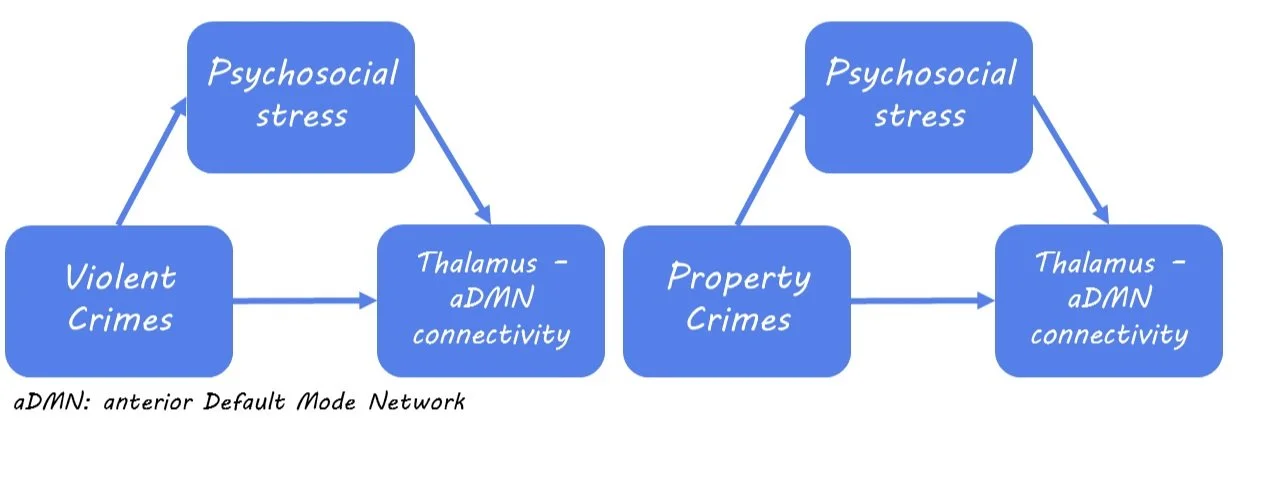
Exposure to violent and property crime during pregnancy, when correcting for “advantage”, was related to weaker connectivity between neonates' thalamus and anterior default mode network. Exposure to violent crime was additionally related to weaker amygdala-hippocampus connectivity. Furthermore, maternal psychosocial stress partially mediated the direct associations between the thalamus and anterior default mode network for both violent and property crimes.
What's the impact?

These important findings indicate that living in neighborhoods with objectively higher violent and property crime rates may have specific effects on neonatal brain function above and beyond those due to living in impoverished areas. Additionally, these effects may be mediated by maternal psychosocial stress associated with these circumstances. The work presented here sheds light on the pervasive, intergenerational effects of crime, which disproportionately impact minority communities. Future work should investigate the long-term impact of this prenatal exposure.

Layer 5 Pyramidal Neurons Contribute to Loss of Consciousness During General Anesthesia

Post by Negar Mazloum-Farzaghi

The takeaway

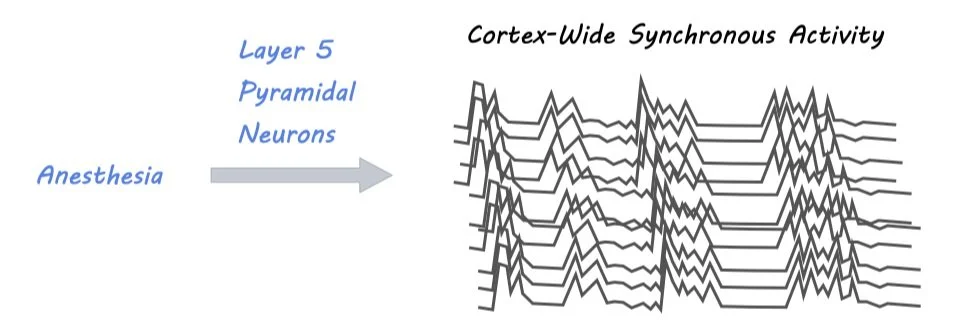
Layer 5 of the brain’s cortex is a major cortical output layer. In mice, synchronous activity across layer 5 pyramidal neurons may contribute to the loss of consciousness during general anesthesia.

What's the science?

The cortex contains six layers, and each layer has distinct neuronal cell types. In particular, L5 is a uniquely organized layer with many recurrent connections. This layer contains excitatory pyramidal neurons which communicate both between cortical areas, and from the cortex to other brain areas. 

All general anesthetics result in a loss of consciousness. However, different general anesthetics often induce loss of consciousness via different modes of molecular action. Despite this, unconsciousness caused by anesthesia is accompanied by common changes in cortical activity. For example, there is a common shift in the power spectrum of cortical activity to lower frequencies during unconsciousness. This shift is thought to be due to an increase in cortical synchrony. Methods used to investigate the common effects of different anesthetics on the cortex lack spatial resolution within the populations of neurons recorded or fail to distinguish cell-type specificity. Thus, in the context of general anesthesia, recording activity from many neurons of a specific type across a wide area of cortex remains to be investigated.

This week in Neuron, Bharioke, Munz and colleagues investigated features of cortical activity in individual cortical cell types that are common across different general anesthetics.

How did they do it?

In this study, the authors used three different general anesthetics: isoflurane (Iso), Fentanyl-Medetomidine-Midazolam (FMM), and Ketamine-Xylazine (Ket-Xyl). To measure spontaneous activity in specific cell types of the cortex, the authors performed in vivo two-photon calcium imaging (a technique used to monitor the activity of distinct neurons in brain tissue) from neurons in the mouse visual cortex, in genetic mouse lines labeling specific cell types. They conducted the imaging in both awake and anesthetized states. Moreover, to identify a common effect of general anesthesia, they compared the neuronal synchrony (correlation of activity of individual neurons with the activity of the remaining population) induced by FMM, Iso, and Ket-Xyl in cell types in L1, L2/3, L4, L5, and L6. Computing neuronal synchrony allows for both periodic (oscillatory) and aperiodic (non-oscillatory) alignment of activity in a neuronal population to be observed.

To further assess changes in neuronal synchrony in cortical cell types, the authors examined neuronal synchrony during the loss of consciousness and the recovery of consciousness. To examine the timing of increases in neuronal synchrony in the visual cortex during the loss of consciousness due to anesthesia administration, the authors compared probability distributions. They also examined the timing of decreases in neuronal synchrony during the recovery of consciousness.

What did they find?

The authors found that a common effect across all anesthetics was high synchrony in L5 pyramidal neurons. Each anesthetic showed different combinations of changes in synchrony and overall activity across cortical cell types (L1, L2/3, L4, and L6), with the exception of L5 pyramidal neurons. In other words, L5 pyramidal neurons were the only cell type to show a consistent increase in synchrony. Finally, the transition time of neuronal synchrony in L5 pyramidal neurons closely matched the transition time of EEG spectral power and motor behaviours that were associated with the loss and recovery of consciousness. This suggests that L5 pyramidal neurons are involved in regulating the loss and recovery of consciousness.

What's the impact?

This study found that during general anesthesia, the cortex shifts from a mode characterized by asynchronous L5 outputs to a mode characterized by synchronous L5 outputs. This change appears to be mediated by L5 pyramidal neurons, which may be involved in regulating the loss and recovery of consciousness.

Gender Biases about Intelligence are Transmitted Across Generations

Post by Lani Cupo

The takeaway

Historically, many cultures have harbored a belief that boys are innately better at mathematics than girls. Being in a classroom with children whose parents subscribe to this belief was found to negatively impacts girls’ performance in mathematics and increase the likelihood that the children adopt this belief.

What's the science?

In many countries worldwide, there is still a strong belief among parents and children that boys are innately better at mathematics than girls, which can negatively impact girls’ enthusiasm and effort for the subject in school, ultimately contributing to a gender imbalance in science, technology, engineering, and mathematics fields. Previous research has shown that middle-school-aged children represent an age group with increased flexibility for updating their beliefs, allowing them to dynamically adapt their belief systems in response to new information. It is still unknown what role parental beliefs hold in impacting the belief systems of children, and how these beliefs are passed on to children. This week in Nature Human Behavior, Eble and colleagues studied how beliefs about gendered math ability transmit from parents to children and peers in randomly-assigned middle-school classrooms in China.

How did they do it?

The researchers employed a quasi-experimental method in which students were randomly assigned to classrooms, as it would be unethical to sort students based on the beliefs of their parents, potentially negatively impacting their academic performance. Participants included 8,057 students in 215 classrooms across 86 middle schools sampled across the 31 provinces of China. Data on parental beliefs came from the China Education Panel Survey (CEPS), which collected data on whether parents of these students believe boys are innately better at math than girls. The belief was held by 41% of parents (despite the fact that girls tend to outperform boys at this level in schooling), with the remaining 59% disagreeing. This measure allows the authors to assign a number to each child (ranging from 0 to 0.833) representing the proportion of the peers’ parents who in each classroom who hold the belief. For each child, a higher value indicates that a greater proportion of the child’s peers’ parents believe boys have greater innate talent than girls for math. The authors examine two potential routes of belief transmission: (1) from peer’s parents to the child or (2) from the peers’ parents to the peer and from the peer to the child.

As outcome variables, the authors first examine whether peers’ parents’ beliefs  affect the beliefs or math ability of a given child. Finally, they study alternative explanations for these two outcomes, investigating peers’ parents’ education level, income, and family background, as well as gender composition and cognitive ability in the classroom.

What did they find?

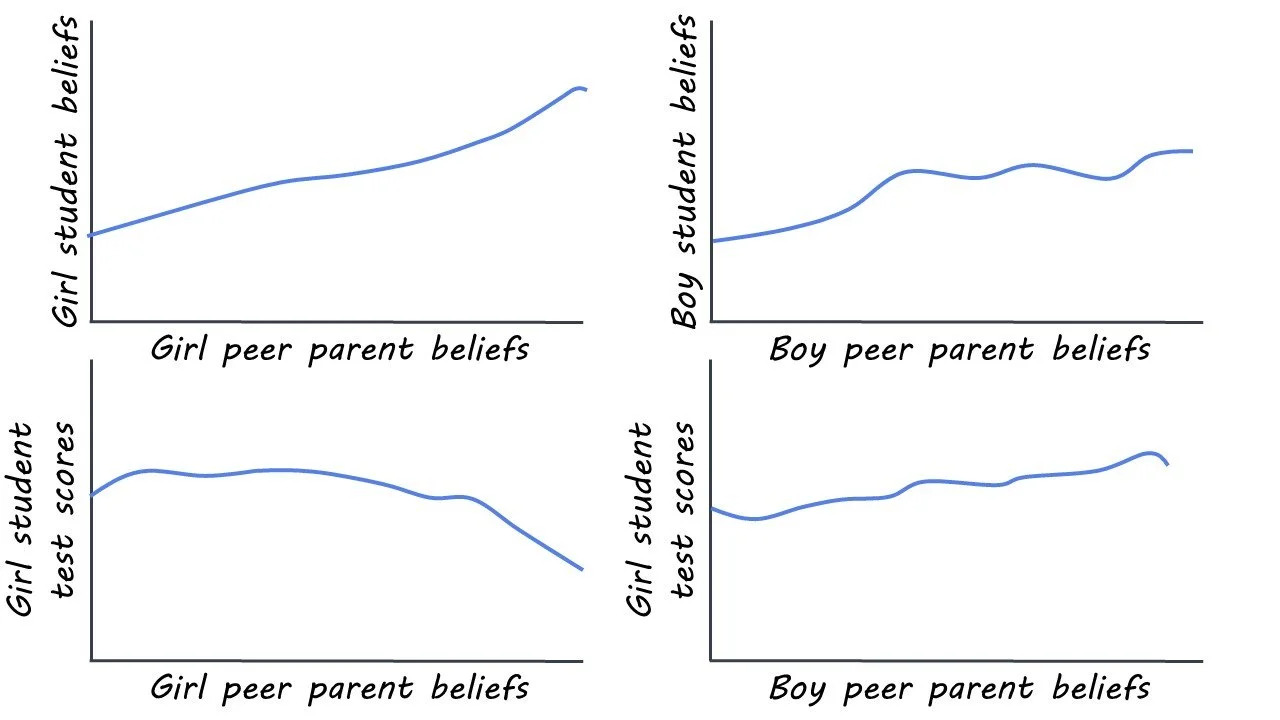
The authors found not only a correlation between a child and their parents’ belief that boys were innately better at math than girls, but also a positive correlation between a child and their peers’ parents belief in the same idea. Of interest, exposure to same-gender peers whose parents hold this belief has a greater likelihood of impacting that child’s belief than exposure to other-gendered peers, meaning if a girl spends more time with another girl whose parents believe boys are better at math than girls, the first girl will be more likely to hold this belief than if she spends time with a boy whose parents have the same opinion. Thus biases are transmitted not only parent-to-child but also from peer parent-to-peer and then peer-to-child. 

Further, following exposure to peer parent beliefs from same-gender peers, the authors show a trending increase in boys' performance on mid-term math exams and a significant decrease in girls' performance on the exams. The authors demonstrate that the findings vary little when additional metrics were included, such as: peers’ parents’ education, income, family background, classroom gender composition, and cognitive ability. This suggests that the findings are a direct result of the children’s peer’s parents beliefs rather than potential confounding variables.

What's the impact?

This study found that parents' beliefs regarding math performance in boys versus girls affect not only their own children’s beliefs, but also the beliefs of their children’s peers. Increased belief in the gender bias is reflected in a similar belief in children in the classroom, as well as a trending effect of worse performance among girls than their male classmates. These findings provide evidence for how beliefs transmit through generations, parent-to-child and peer-to-peer. Ultimately, this article investigates how children form their biases and beliefs at a young age, and demonstrates how these beliefs may impact their academic performance and potentially even future career choices.