A New Treatment for Huntington’s Disease

Post by Leanna Kalinowski

The takeaway

Scientists have uncovered a potential new treatment for Huntington’s disease that lowers the abnormal huntingtin protein levels caused by a mutation in the huntingtin gene.

What's the science?

Gene expression, the conversion of DNA into protein, is a fundamental biological process. It consists of two major steps: transcription, where the instructions that make up DNA are copied and rewired into messenger RNA (mRNA), and translation, where this mRNA is converted into proteins that the body can then use for several different functions. Genetic mutations that lead to abnormal protein levels following translation are responsible for a myriad of disorders, including certain cancers and Huntington’s disease.

Huntington’s disease (HD) is a neurodegenerative disorder with motor, cognitive, and psychiatric symptoms that are caused by a mutation in the huntingtin gene (HTT). This mutation involves a series of three DNA building blocks - cytosine, adenine, and guanine - that typically appear multiple times in a row in a genetic sequence. HTT genes without the mutation repeat this series between 10 and 35 times, while HTT genes with the mutation repeat it up to 120 times. This mutation is then transcribed into abnormal HTT mRNA, which then leads to the translation of an abnormally long HTT protein. Accumulation of this protein in the brain causes brain cells to progressively break down as people with HD get older, and there is currently no cure for this disease. This week in Nature Communications, Keller and colleagues examined whether branaplam, an experimental drug, could alter the HTT gene mutation and slow the progression of HD.

How did they do it?

First, the researchers examined the impact of branaplam on gene expression by exposing brain cells to the drug in vitro (i.e., in a petri dish). After 24 hours, they then used RNA sequencing to measure mRNA expression levels of all genes in the cells, including the HTT gene.

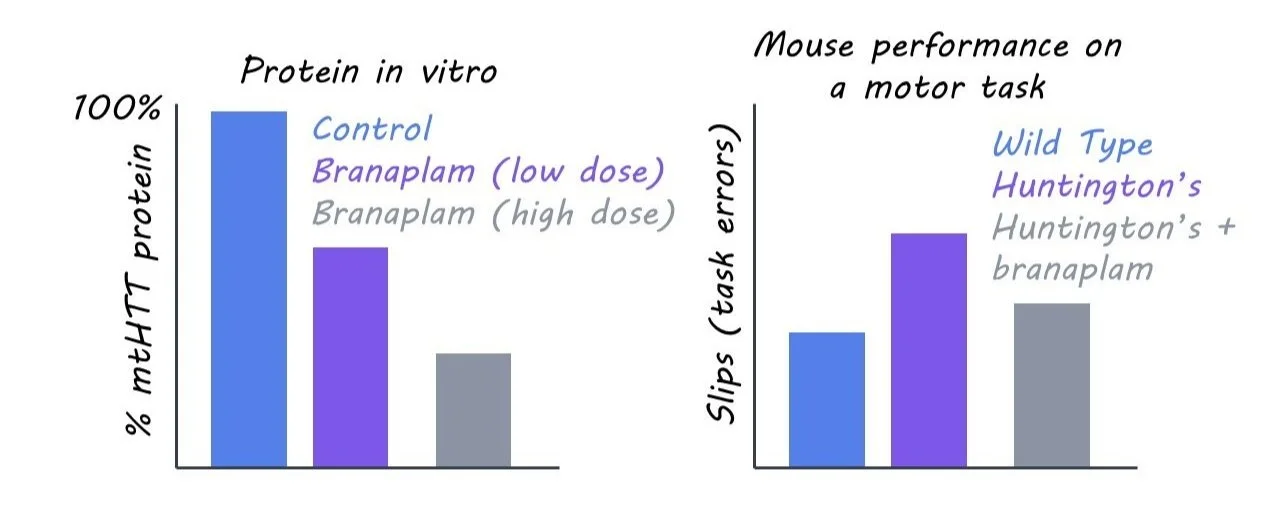
Next, they examined the impact of branaplam on HTT mRNA, HTT protein, and HD motor symptoms in mice that were genetically modified to have HD-like symptoms. The first set of HD mice received branaplam every other day for six days, after which HTT mRNA levels were measured. The second set of HD mice received thrice-weekly doses of branaplam for either one or three weeks, after which HTT protein levels were measured. The final set of HD mice was treated intermittently with branaplam for three months, after which they underwent a motor coordination test.

Finally, they examined the impact of branaplam administration on HTT mRNA in humans by assessing infants enrolled in a separate study on branaplam. These patients received weekly doses of the drug for multiple weeks, after which their blood was drawn and tested for HTT mRNA levels.

What did they find?

First, the authors found that branaplam reduces HTT mRNA levels by impacting RNA splicing, which is a process that naturally happens between transcription and translation. Typically, this process involves the removal of RNA sequences called introns, which leaves behind RNA sequences that are called exons. When branaplam is administered to brain cells, it introduces a new “pseudoexon” into the HTT RNA sequence, which ultimately lowers HTT protein levels following translation. Next, they found that administering branaplam to a mouse model of HD leads to a similar genetic effect, where a pseudoexon is once again introduced to the HTT mRNA transcript and reduces HTT protein levels. These genetic changes also led to decreased motor impairments in HD mice compared to those that did not receive the drug. Finally, they observed a similar effect on HTT mRNA in infants that received the drug.
What's the impact?

Taken together, these results suggest a promising role for branaplam in reducing HTT protein levels by introducing a pseudoexon to its mRNA sequence. This drug not only reduces levels of the protein responsible for the neurodegeneration of brain cells in HD, but also improves motor impairments in a mouse model of HD. Future studies should assess the effectiveness of branaplam in treating symptoms and preventing further neurodegeneration in humans with HD.
The Effect of the COVID-19 Pandemic on Brain Inflammation

Post by Megan McCullough

The takeaway

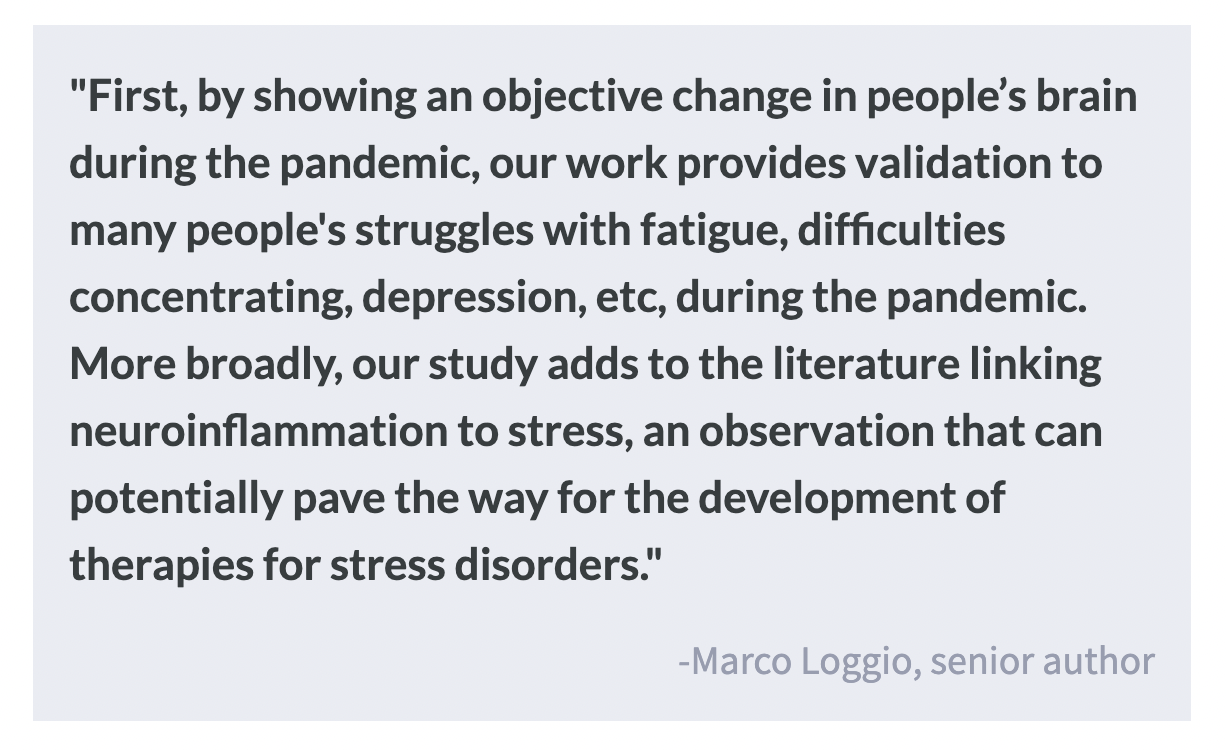
Increased levels of biomarkers associated with neuroinflammation were observed in individuals studied after the beginning of the COVID-19 pandemic, but who had not experienced an infection of Sars-Cov-2.

What's the science?

The COVID-19 pandemic has had far-reaching effects on individuals who have experienced the societal impacts of stay-at-home measures meant to curb the spread of the virus. Previous studies have found an increase in reports of symptoms associated with psychological distress such as brain fog and fatigue since the onset of the pandemic. These psychological symptoms, as observed in various conditions such as fibromyalgia or chronic fatigue syndrome, have been previously linked to neuroinflammation. The effects the pandemic has had on the brain health of individuals who have not been infected with the virus are not well understood. This week in Brain, Behavior, and Immunity, Brusaferri and colleagues aimed to study the effects of the societal impacts of the COVID-19 pandemic on brain health by examining markers of inflammation in the brain.

How did they do it?

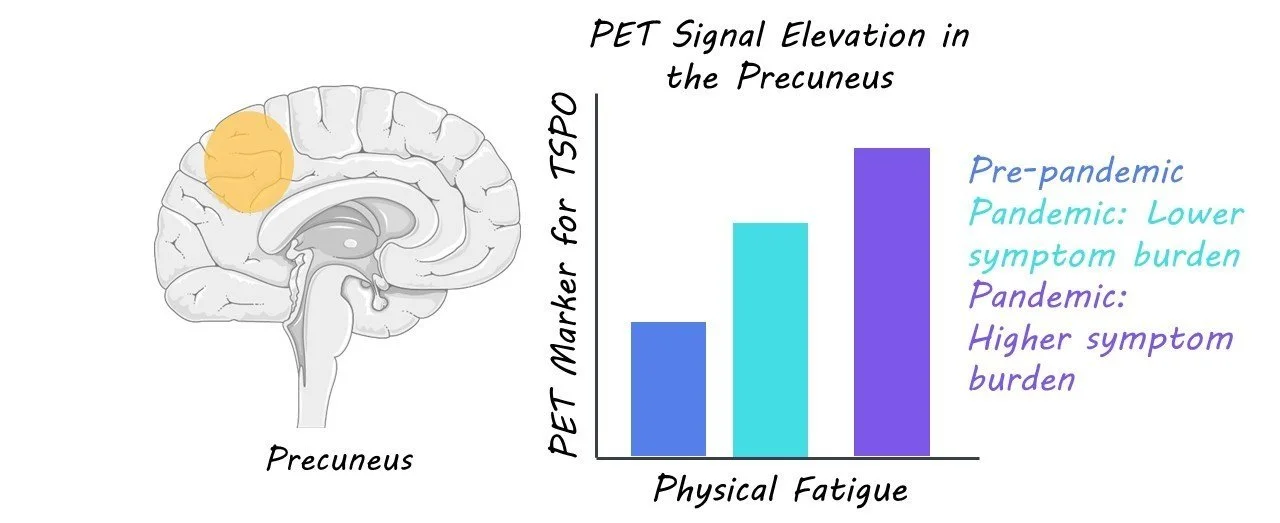
The authors conducted brain imaging on healthy participants studied after the pandemic onset and compared it to data from brain scans on healthy individuals conducted before the pandemic. Positron Emission Tomography and Magnetic Resonance imaging were used to study levels of the 18 kDa translocator protein (TSPO) and myoinositol (mIns). These biomarkers are indicative of an increase in activation of brain glial cells, a response indicative of neuroinflammation. The authors then looked at the link between these neuroinflammatory markers and behavior by administering a questionnaire that assessed impacts of the pandemic on the participants. Levels of TSPO and mIns were then compared between individuals in the pre-pandemic and the post-pandemic groups.

What did they find?

The authors found that participants in the Pandemic group had higher levels of the radiotracer that binds to TSPO in all the studied brain regions compared to participants in the Pre-Pandemic group, even after controlling for a series of factors (including age, vaccination status, etc). The individuals in the Pandemic group also had elevated levels of mINs in the thalamus. Because the participants in the Pandemic group had experienced lockdown orders for two months, these data suggest that neuroinflammation may be linked to experiencing the stresses of lockdown and social distancing requirements. The participants in the Pandemic group reported elevated symptoms of psychological distress such as mood alterations, fatigue, and decreased levels of cognition which have all been previously connected to neuroinflammation.

What's the impact?

This study is the first to show that there is evidence of neuroinflammatory markers in non-infected individuals during the COVID-19 pandemic. These results show that the impact of the pandemic on brain health reaches beyond the impacts of viral infection. These findings also provide a better understanding of the link between pandemic-related stressors and neuroinflammation in the brain. 

Deliberate Errors Enhance Learning

Post by Elisa Guma

The takeaway

Deliberate errors followed by error correction may be a superior method of concept learning compared to errorless learning, particularly in low-stakes contexts.

What's the science?

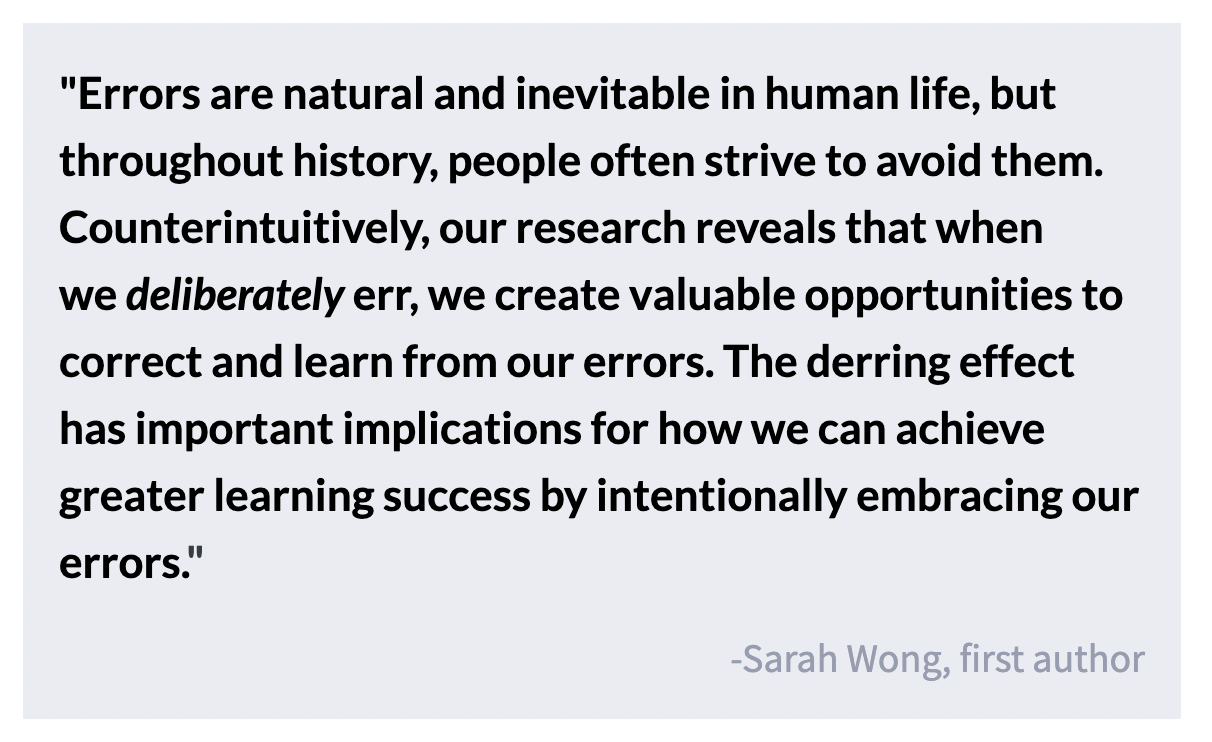
Error commission is an intrinsic part of the learning process, but one that is typically avoided. Interestingly, some empirical work has suggested that making errors can enhance learning in low-stakes contexts. More specifically, there may be learning benefits from deliberately committing and correcting errors even when one already knows the correct answer, as opposed to avoiding errors—referred to as the derring effect. This week in the Journal of Experimental Psychology: General, Wong, and Lim investigated whether deliberate erring improves concept learning. 

How did they do it?

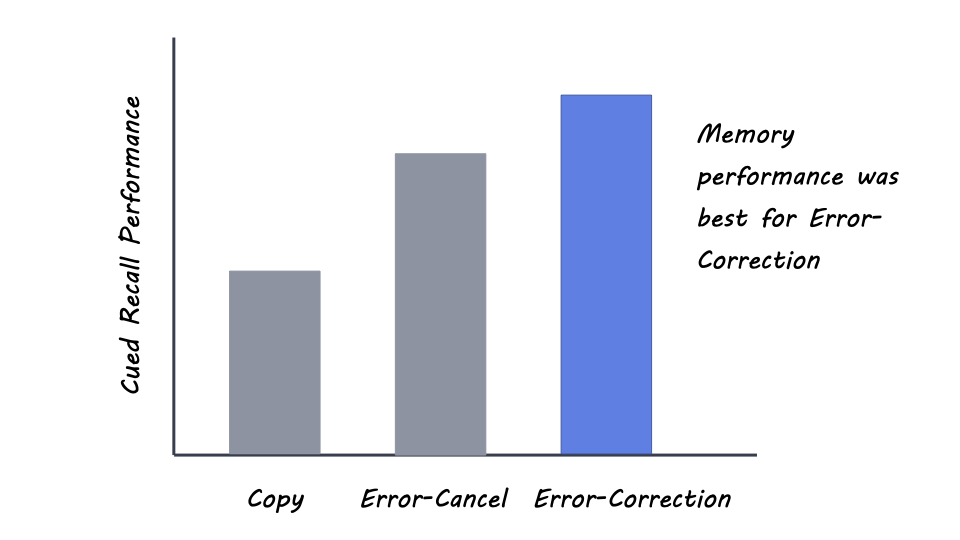
To experimentally test the derring effect, the authors conducted three experiments. In Experiment 1, the authors investigated whether making deliberate errors would enhance the learning of scientific term-definition concepts compared to errorless learning. Participants were asked to learn unfamiliar concepts and told to either error-cancel (deliberate erring in the definition), error-correct (deliberate erring with correction), or to copy the correct definition twice (errorless learning; control condition).

An example of a deliberate conceptual error in the error-cancel condition for the concept: “Cocktail party effect is the selective enhancement of attention to filter out distractions,” is: “Cocktail party effect is the selective enhancement of attention in making sense of distractions.” In the error-correction condition, participants additionally corrected their deliberate error by writing down the actual definition, and in the copy condition, participants wrote down the term-definition concept exactly as it was presented, then copied the key ideas in each concept again.

To assess whether the benefits observed in Experiment 1 were due to the generation of novel responses, the authors performed Experiment 2. The control group elaborated on each concept by generating an alternative conceptually correct definition, then wrote down the actual one (concept-synonym condition). For example, “Cocktail party effect is the increased focus on a particular object (selective enhancement of attention) to filter out distractions.”

Finally, to rule out the possibility that the deliberate erring advantage could be due to more elaboration, the authors ran Experiment 3 with a control group where participants generated a specific example of each concept after writing down the correct definition (concept-example condition). For example, “Cocktail party effect is the selective enhancement of attention to filter out distractions. At a noisy party, Kate was able to focus on what her partner was saying while ignoring other people’s conversations.”

In all experiments, following the learning phase, participants were tested on the definitions they learned. Each response was scored either as correct or incorrect, and errors were also coded into 4 categories: (a) commission errors (i.e., inadequate or incorrect responses that were different from participants’ initial deliberate errors), (b) omission errors (i.e., no response), (c) confusion errors (i.e., responses that gave the definition for another studied concept term instead), and (d) intrusion errors (i.e., in the errorful conditions only, responses that repeated the same deliberate errors that participants had committed during initial study).

What did they find?

In Experiment 1, the authors found that learners performed better when they had deliberately generated incorrect definitions of scientific concepts compared to errorless copying of the definitions, supporting the derring effect. This advantage was even greater when learners were told to correct their deliberate errors. Interestingly, most of the errors at test were commission errors and not intrusion errors, indicating that deliberate erring did not interfere with test performance.

In Experiment 2, the error-cancel and error-correction methods still outperformed the concept-synonym method, providing further evidence for the advantage of deliberate erring even over actively generating alternative correct responses. Finally, in Experiment 3, the authors still found that the error-correction method outperformed the concept-example method, despite the latter being bolstered by a higher degree of elaboration.

What's the impact?

The findings in this study provide compelling evidence for the benefit of deliberate erring in low-stakes learning environments, particularly when one's errors are corrected. This method of learning may improve the processing of the correction after an error has been deliberately made, supporting better memory performance. Future work may investigate the effects of different kinds of deliberate errors across a range of educational materials. For example, teachers could integrate deliberate erring in homework assignments to help students learn better.