
EMDR Therapy: What’s Happening in the Brain?

Post by Anastasia Sares

Eye movements to treat traumatic disorders

In 1989, Francine Shapiro published a technique for treating trauma using eye movements. In the technique, a client will bring a traumatic incident to mind, and recall it while simultaneously following the therapist’s finger as it moves back and forth across their field of vision. A session also includes repeated evaluations of thoughts, emotions, and body sensations surrounding the event. This therapeutic approach came to be known as Eye Movement Desensitization and Reprocessing, or EMDR. Shapiro observed its effectiveness in treating severe post-traumatic stress disorder (PTSD). However, both scientists and the public viewed the technique with skepticism. For starters, it seemed “too easy,” (the words of one patient in Shapiro’s 1989 paper). It didn’t help that it was unclear how the technique worked and that it seemed similar to less scientifically reputable techniques such as hypnosis.

Despite its detractors, EMDR has slowly grown to become one of the preferred treatments for PTSD. Scientists and clinicians have teamed up to run randomized controlled trials, where people are assigned randomly to either EMDR or another treatment condition. These experiments are considered the gold standard for determining a treatment’s efficacy in the medical field, and enough of them have been done that we can now perform meta-analyses, which synthesize all the results from different experiments into one big analysis. The results? EMDR is at least as effective as other well-established treatments like cognitive-behavioral therapy or exposure therapy.

What does EMDR do in the brain?

The main hypothesis developed by Shapiro and colleagues to explain EMDR is called the Adaptive Information Processing model. According to this model, traumatic memories are not fully processed in the brain and create their own maladaptive networks that can be triggered, leading to flashbacks and other unwanted phenomena. EMDR encourages the traumatic memory to be brought up, fully processed, and reconsolidated in a more adaptive manner, integrating it with the rest of an individual’s life experience and diminishing its power to cause fear. Shapiro emphasizes the difference between memory reconsolidation (the hypothesized mechanism for EMDR), and memory extinction (the basis for exposure therapy).

EMDR responsiveness has indeed been linked with memory structures, such as the parahippocampal gyrus, deep in the brain. One study showed that at the start of EMDR therapy, there was greater activation in the frontal cortex (responsible for executive control) and the occipital cortex (responsible for visual stimuli). By the end of therapy, activity had shifted towards the parahippocampal gyrus and parietal lobe. Thus, the idea that eye movements promote memory reprocessing does not seem too far-fetched, but the exact mechanisms of EMDR are still being worked out.

One idea is that eye movements may take space in working memory, giving less “bandwidth” to the traumatic memory and therefore making it less vivid. Another is that they mimic the eye movements of REM sleep (the period of the sleep cycle where memories are consolidated) and thus promote reconsolidation of the traumatic memory. It's important to note here that EMDR can be done with methods other than eye movement, including tapping one’s shoulders on the right and left side or holding buzzers in the hands that vibrate in a right/left pattern. These methods are collectively called bilateral stimulation.

Some research shows that the bilateral stimulation used in EMDR can be effective even in animals who cannot be told the goal of the “therapy.” A recent study showed that when rodents were exposed to lights moving back and forth, their response to a previously fearful stimulus decreased (See a previous BrainPost).

What’s new?

Shapiro never intended EMDR to be applied solely to PTSD, and lately, there have been studies looking at its efficacy for other conditions, such as obsessive-compulsive disorder, psychosis, substance use disorders, and depression. While some results may look promising, there is not yet enough information to run the kind of meta-analyses that have established EMDR’s efficacy for PTSD.

Finally, Otgaar and colleagues have cautioned that undergoing EMDR therapy may change the validity of witness testimony in court, since it is, after all, a form of memory reprocessing, and could affect details of an event as the victim remembers it.

What's the bottom line?

EMDR therapy is a validated, non-pharmaceutical technique for the treatment of PTSD, and perhaps other mental health issues. While we don’t fully understand how it works, it involves memory processing and reconsolidation of previously acquired memories. As with any mental health treatment, make sure you ask a licensed therapist about this technique regarding your own situation.

References +

Jeffries, F. W., & Davis, P. (2013). What is the Role of Eye Movements in Eye Movement Desensitization and Reprocessing (EMDR) for Post-Traumatic Stress Disorder (PTSD)? A Review. Behavioural and Cognitive Psychotherapy, 41(3), 290–300. https://doi.org/10.1017/S1352465812000793

Marsden, Z., Lovell, K., Blore, D., Ali, S., & Delgadillo, J. (2018a). A randomized controlled trial comparing EMDR and CBT for obsessive-compulsive disorder. Clinical Psychology & Psychotherapy, 25(1), e10–e18. https://doi.org/10.1002/cpp.2120

Nardo, D., Högberg, G., Looi, J. C. L., Larsson, S., Hällström, T., & Pagani, M. (2010). Gray matter density in limbic and paralimbic cortices is associated with trauma load and EMDR outcome in PTSD patients. Journal of Psychiatric Research, 44(7), 477–485. https://doi.org/10.1016/j.jpsychires.2009.10.014

Novo Navarro, P., Landin-Romero, R., Guardiola-Wanden-Berghe, R., Moreno-Alcázar, A., Valiente-Gómez, A., Lupo, W., García, F., Fernández, I., Pérez, V., & Amann, B. L. (2018). 25 years of Eye Movement Desensitization and Reprocessing (EMDR): The EMDR therapy protocol, hypotheses of its mechanism of action and a systematic review of its efficacy in the treatment of post-traumatic stress disorder. Revista de Psiquiatría y Salud Mental (English Edition), 11(2), 101–114. https://doi.org/10.1016/j.rpsmen.2015.12.002

Otgaar, H., Houben, S. T. L., Rassin, E., & Merckelbach, H. (2021). Memory and eye movement desensitization and reprocessing therapy: A potentially risky combination in the courtroom. Memory, 29(9), 1254–1262. https://doi.org/10.1080/09658211.2021.1966043

Pagani, M., Di Lorenzo, G., Monaco, L., Daverio, A., Giannoudas, I., La Porta, P., Verardo, A. R., Niolu, C., Fernandez, I., & Siracusano, A. (2015). Neurobiological response to EMDR therapy in clients with different psychological traumas. Frontiers in Psychology, 6. https://doi.org/10.3389/fpsyg.2015.01614

Roberts, B. R. T., Fernandes, M. A., & MacLeod, C. M. (2020). Re-evaluating whether bilateral eye movements influence memory retrieval. PLOS ONE, 15(1), e0227790. https://doi.org/10.1371/journal.pone.0227790

Santarnecchi, E., Bossini, L., Vatti, G., Fagiolini, A., La Porta, P., Di Lorenzo, G., Siracusano, A., Rossi, S., & Rossi, A. (2019). Psychological and Brain Connectivity Changes Following Trauma-Focused CBT and EMDR Treatment in Single-Episode PTSD Patients. Frontiers in Psychology, 10, 129. https://doi.org/10.3389/fpsyg.2019.00129

Shapiro, F. (1989). Efficacy of the eye movement desensitization procedure in the treatment of traumatic memories. Journal of Traumatic Stress, 2(2), 25.

Solomon, R. M., & Shapiro, F. (2008). EMDR and the Adaptive Information Processing Model: Potential Mechanisms of Change. Journal of EMDR Practice and Research, 2(4), 315–325. https://doi.org/10.1891/1933-3196.2.4.315

Talbot, D. (2021). Examination of Initial Evidence for EMDR as a Treatment for Obsessive-Compulsive Disorder. Journal of EMDR Practice and Research, 15(3), 167–173. https://doi.org/10.1891/EMDR-D-21-00004

Valiente-Gómez, A., Moreno-Alcázar, A., Treen, D., Cedrón, C., Colom, F., Pérez, V., & Amann, B. L. (2017). EMDR beyond PTSD: A Systematic Literature Review. Frontiers in Psychology, 8, 1668. https://doi.org/10.3389/fpsyg.2017.01668
The Use of Neuropixels Probes in Humans

Post by Megan McCullough

The takeaway

Neuropixels probes can successfully measure the electrical activity of many neurons at once with high resolution and specificity in humans.

What's the science?

Neuronal electrophysiology is the branch of neuroscience that focuses on the electrical properties of neurons through recording techniques that allow scientists to measure the flow of electricity through the brain. Current techniques used in humans allow researchers either to record only a few neurons per electrode or to measure the combined signal of thousands of neurons. In animal models, recent advances have allowed more specificity in the recording of large groups of neurons. This week in Nature Neuroscience, Paulk and colleagues translate these advances into human research by describing the use of Neuropixels probes to simultaneously record from over 200 individual neurons during neurosurgery in humans.

How did they do it?

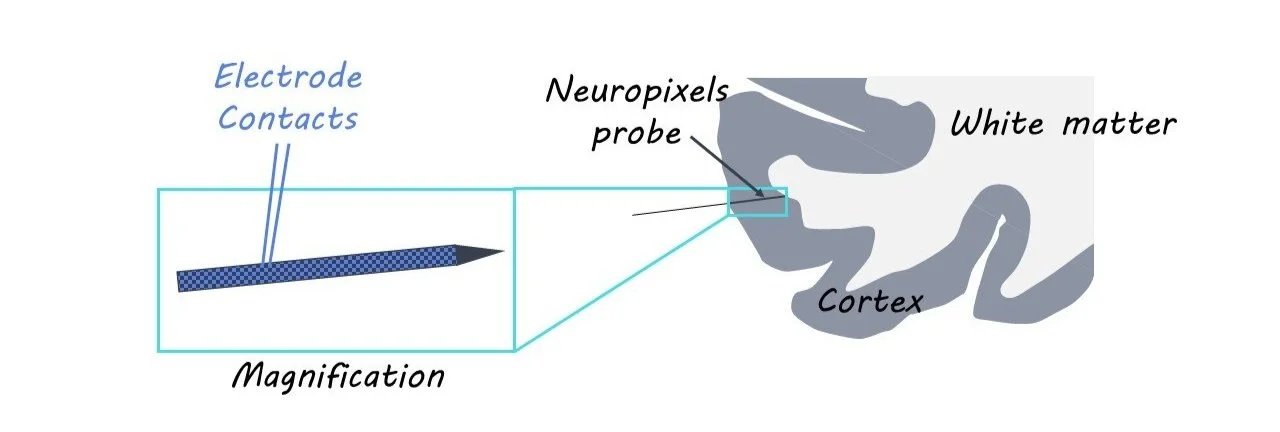
Neuropixels probes, first introduced in 2017, is a silicon array of microelectrodes with microelectrode contacts spaced throughout. It differs from previously used probes primarily because of the high density of electrodes, allowing for more sensitive detection of individual cells. The authors used Neuropixels probes to record electrical activity in the outer layer of the temporal and frontal lobes in three individuals undergoing brain surgery to treat epilepsy or movement disorders. Since this technology was previously only used in animal research, the authors needed to adapt Neuropixels to be used in humans. The use of the original Neuropixels probe was found to be too fragile so the authors developed a thicker variant. They also needed to avoid excessively noisy recordings, and made adjustments to grounding and reference electrodes to carefully control for sources of external electrical noise (e.g. monitors) in a human operating room. These sources of noise would not have typically been present in an animal laboratory environment. Once data was collected, the authors classified the neurons based on waveform type to test the specificity and resolution of the electrical recordings.

What did they find? 

The authors found that adapted Neuropixels probes were able to be used to record spiking activity from neuronal populations in the human cortex in a surgical setting. The authors observed electrical data from up to 200 individual neurons within minutes of inserting the probe – and some of these neurons could be observed via multiple different channels. Because of the closely spaced number of electrodes in the probe, the voltage of each cell generated during action potentials was able to be mapped and then classified. This illustrates that the use of Neuropixels probes can generate high-resolution electrical data previously not available in humans.

What's the impact?

This study is the first to outline techniques for using Neuropixels probes to record brain activity in humans. The use of Neuropixels probes enables high-quality recordings of action potentials from multiple neurons. High-resolution electrical data at the level of single neurons increases our understanding of both cognitive processes and neurological conditions. This research is imperative as it allows for future advancements in understanding the relationship between brain activity at the cellular level and cognitive function. 

The Role of Perceived Control in Stress Management

Post by Elisa Guma

Stress and goal achievement

The ability to cope with and persist through adversity is often associated with success. However, stress may diminish our capacity to cope with difficult tasks or challenges, increasing the likelihood of mental and emotional distress including stress overload and burnout. Exposure to stress is accompanied by a myriad of physiological changes that have both short and long-term effects. These physiological changes likely also influence our psychological state, alter our behaviour, and perhaps prevent us from overcoming obstacles to pursue our goals. Interestingly, the decision to persist can differ when setbacks feel controllable, versus those that are or feel uncontrollable. Perceived control over one’s outcomes can have positive effects on emotion regulation, motivation, and learning, potentially buffering some of the negative effects of stress. 

How does perceived control influence stress management?

Perceived control is the perception that one has the ability, resources, or opportunities to achieve positive outcomes or avoid negative effects through one’s own actions. Perceived control may be further broken down into two strategies: 1) primary perceived control describes the attempt to modify the environment to align with one’s wishes, while 2) secondary perceived control refers to using mental strategies to change one’s wishes to reflect the environment. Typically, a sense of perceived control is associated with the belief that our personal actions control outcomes, and that we have the skill required to enact those actions (internal locus of control), rather than believing that external factors will control the outcome (external locus of control). Research has found associations between perceived control and enhanced emotional well-being or improved ability to cope with stress.

Given the positive benefits on mindset, perceived control is thought to be a key protective factor for well-being in general. Indeed, some studies have found that individuals with higher perceived control over their cardiovascular disease and immunocompetence had decreased risk of physical decline. Although these relationships are likely multifactorial, this mindset may have benefits extending beyond psychological health to physical health as well.

Perceived control and COVID-19

The COVID-19 pandemic has negatively impacted the psychological states of many individuals worldwide, increasing feelings of distress and anxiety. In addition to the physical disease burden that COVID-19 has caused, there are other stressors to consider such as uncertain prognoses, isolation (especially when paired with grief and loss), unfamiliar public health measures, and financial distress, all of which may have substantial and potentially long-lasting effects on mental health. Several recent studies have investigated potential buffers against the stress related to the COVID-19 pandemic. Some evidence from studies conducted in China, the United States, and Norway/Austria/Germany indicate that individuals who believe they have control over their environment and future (i.e., higher internal locus of control) may have better mental health outcomes. Additionally, the latter study also found that individuals who feel as though external factors beyond their control influence their success and failure (external locus of control) were prone to higher levels of anxiety and depression. These associations are likely more nuanced and require more research. However, these initial insights may help to identify certain traits that increase susceptibility to stress. Furthermore, policy makers and public health officials can implement strategies to try and enhance citizens' sense of certainty and control, for example by promoting clear, transparent, and science-backed communication.

Mindfulness as a stress management technique

Given the numerous benefits associated with feelings of perceived control, finding ways to foster perceptions of control may be beneficial. Mindfulness, or the moment-to-moment awareness and acceptance of our feelings and experience, may promote flexibility in responding to a changing environment, rather than relying too heavily on previously learned patterns. Mindfulness practice has been linked to higher levels of both primary and secondary perceived control – helping people to see that there is a possibility to change our environment, or that our perception can be altered. This practice has been associated with numerous other benefits and may help us navigate feelings of distress in uncertain times or stressful situations.

What’s next?

As we navigate a changing world, many will experience varying levels of perceived control. Further, many factors can influence perceived control, such as individual differences, early life experiences, or previous success or reward. More research is needed to better understand the factors that affect perceived control, how feelings of control can change over time, and how they can be fostered to improve stress management.  

References +

  1. Bhanji et al. Perceived Control Alters the Effect of Acute Stress on Persistence. Journal of experimental psychology General (2016).
  2. Compas et al. Perceived Control and Coping with Stress: A Developmental Perspective. Journal of Social Issues (1991).
  3. Daly & Robinson. Psychological distress and adaptation to the COVID-19 crisis in the United States. Journal of Psychiatric Research (2021).
  4. Krampe et al. Locus of control moderates the association of COVID-19 stress and general mental distress: results of a Norwegian and a German-speaking cross-sectional survey. BMC Psychiatry (2021).
  5. Hortop et al. The why and how of goal pursuits: Effects of global autonomous motivation and perceived control on emotional well-being. Motivation and emotion (2013).
  6. Kozela et al. Perceived control as a predictor of cardiovascular disease mortality in Poland. The HAPIEE study. Journal of Cardiology (2015).
  7. Paganini et al. Perceived Control and Mindfulness: Implications for Clinical Practice. Journal of Psychotherapy Integration (2016).
  8. Pfefferbaum & North. Mental health and the Covid-19 pandemic. New England Journal of Medicine (2020).
  9. Wallston. Control Beliefs: Health Perspectives. International Encyclopedia of the Social & Behavioral Sciences (2001).
  10. Wiedenfeld et al. Impact of perceived self-efficacy in coping with stressors on components of the immune system. Journal of Personality and Social Psychology (1990).
  11. Zheng et al. Perceived Control Buffers the Effects of the COVID‐19 Pandemic on General Health and Life Satisfaction: The Mediating Role of Psychological Distance. Applied Psychology Health Well Being (2020).