A Massive 7T fMRI Dataset to Bridge Neuroscience and Artificial Intelligence

Post by Andrew Vo

The takeaway

To understand the complex brain networks that underlie human sensory and cognitive behaviors, enormous amounts of high-quality imaging data are required. The introduction of such a dataset will be invaluable in studying processes such as vision or memory and will bridge the gap between cognitive neuroscience and artificial intelligence.

What's the science?

To successfully understand human brain function, we need to build comprehensive models of how information is processed by the brain. Such models require massive amounts of high-dimensional and context-specific data. However, most existing human brain imaging studies have been limited by small amounts of low-resolution data collected from varying numbers of individuals. This week in Nature Neuroscience, Allen et al. introduced the Natural Scenes Dataset (NSD), a publicly available brain imaging dataset of unprecedented scale and quality.

How did they do it?

The authors recruited eight human participants to contribute to the NSD. Each participant underwent whole-brain 7T functional magnetic resonance imaging (fMRI), during which their brain activity was measured as they viewed thousands of distinct natural scene images. 7T refers to the high magnetic field strength of the MRI scanner. Higher field strengths improve the signal-to-noise ratio and spatial resolution of the collected data, as compared to those data obtained at lower field strengths (consider that most hospital MRI scanners are only 1.5-3T). The participants collectively viewed over 70,000 richly annotated natural scenes across more than 300 scanning sessions held over the course of one year. To ensure participants remained attentive and engaged with the images, the authors simultaneously performed a continuous recognition task that involved indicating if a presented image was previously viewed. The authors carefully evaluated the data quality of the NSD and present initial analyses of the data.

What did they find?

The resulting NSD is the largest of its kind to date. High performance on the continuous recognition task indicated that participants were consistently engaged and attentive while viewing the many thousands of natural scene images. Inspection of the imaging data revealed that the signal-to-noise ratio and estimated brain responses across the brain remained stable across scanning sessions for each participant.

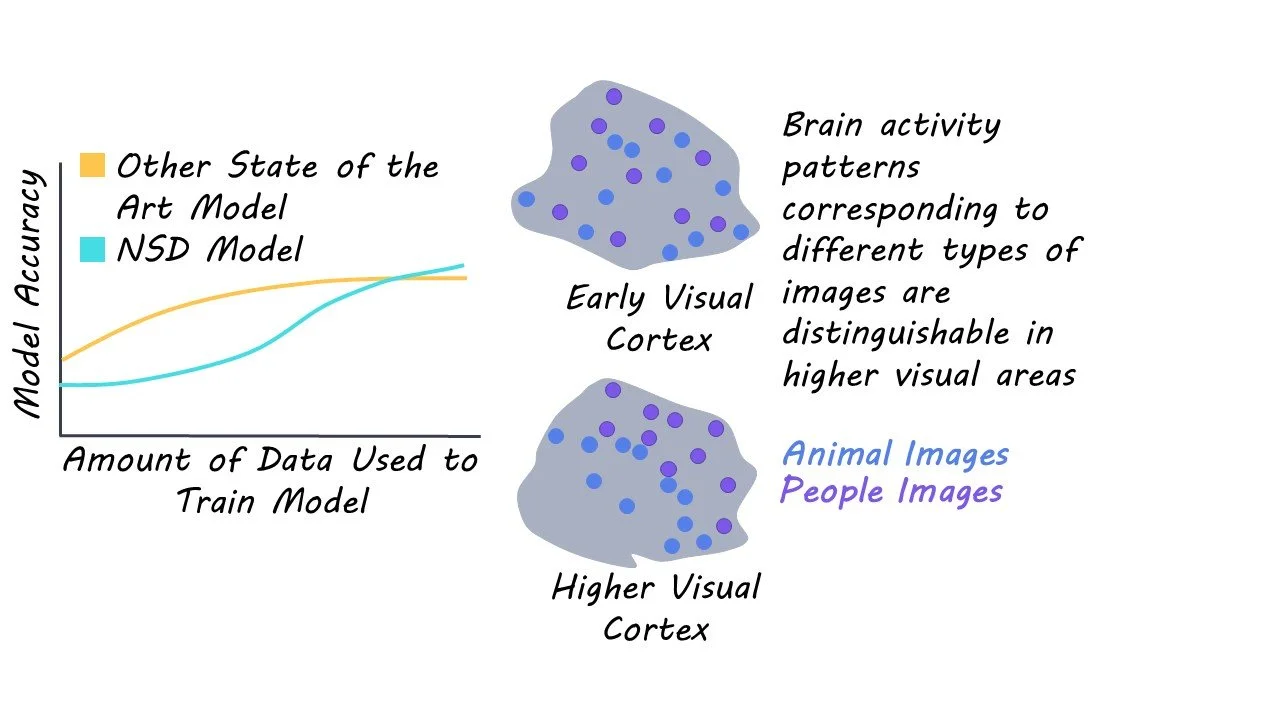
The authors demonstrated two initial applications of the NSD: First, they analyzed patterns of brain responses to the content of natural scenes and observed transformations of semantic representations along the ventral visual pathway. For example, brain patterns associated with people and animals were found in different parts of higher visual areas. Second, they applied machine learning techniques to build and train a deep convolutional neural network to predict brain activity in the brain’s visual areas. The large amount of data afforded by the NSD allowed their models to successfully predict brain activity more accurately than existing state-of-the-art models.
What's the impact?

This report introduces the NSD, a large-scale publicly available brain imaging dataset. The NSD is unique from other resources in terms of its massive scale (i.e., large amounts of data collected from individuals at ultra-high field strength), data quality, and novel analysis techniques. This sharable dataset has wide-ranging applications to the fields of cognitive science, neuroscience, artificial intelligence, and their intersection.
Online Single-Session Interventions Can Help Depressed Teenagers

Post by D. Chloe Chung

The takeaway

Accessible, online single-session interventions that teach coping skills can effectively improve symptoms related to depression in teenagers, especially during the COVID-19 pandemic with heightened teen depression.

What's the science?

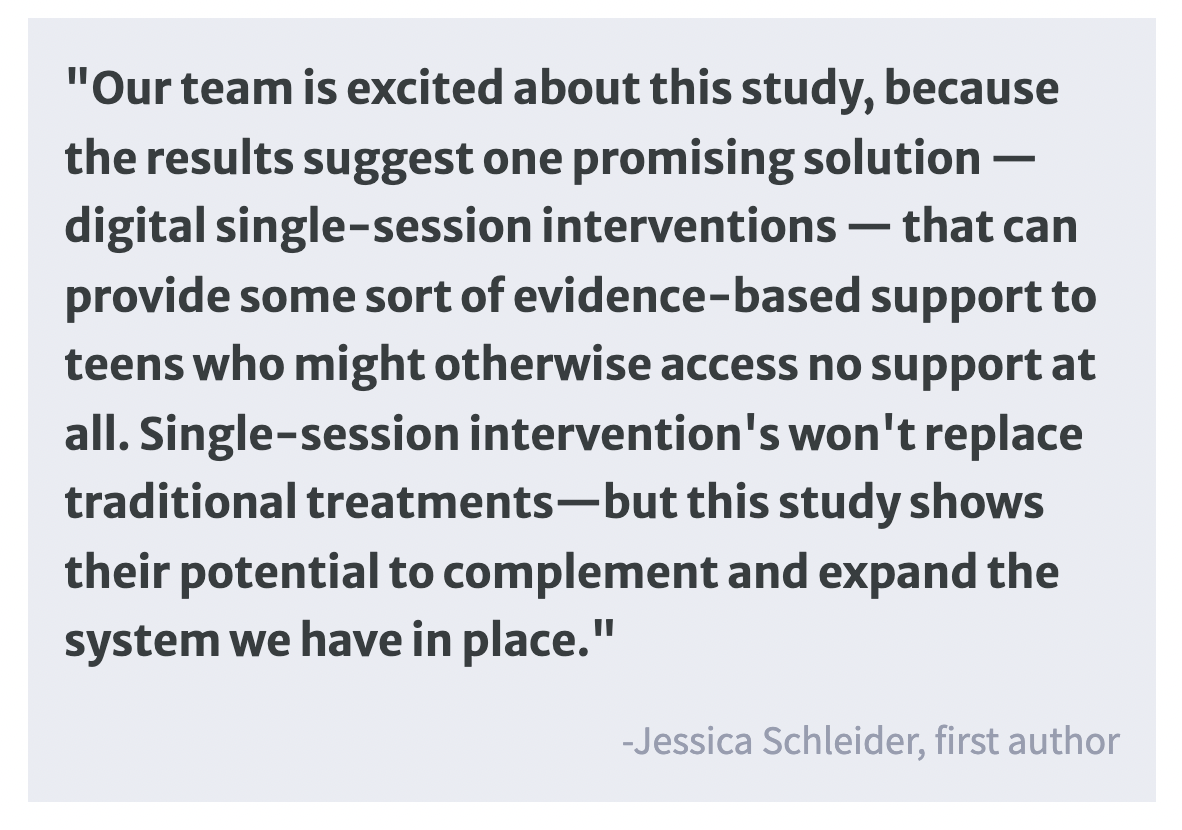
Rates of depression among teenagers soared during the COVID-19 pandemic as they faced social isolation due to school closure and financial difficulties. While teen depression is the major health risk for young people, more than half of depressed teenagers lacked access to professional help even before the pandemic. As many teenagers find it challenging to seek mental healthcare services due to stigma from family or financial reasons, it is important to create effective and accessible platforms to help those in need. Recently in Nature Human Behaviour, Schleider and colleagues showed that accessible, online single-session interventions that teach coping skills can reduce depression in teenagers.

How did they do it?

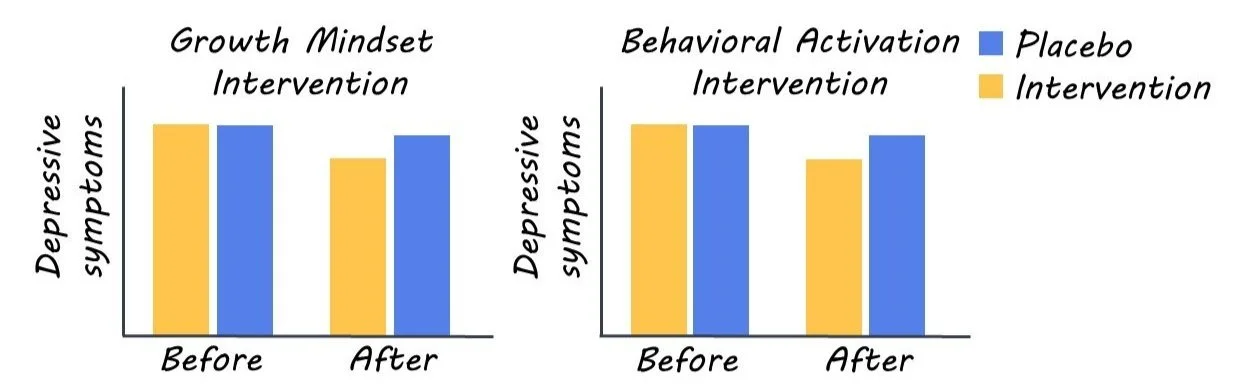
The authors used Instagram advertisements to recruit a diverse group of teenagers (13-16 years old) in the United States who were experiencing depressive symptoms. Recruited teenagers were informed that they would be rewarded up to $20 by participating in the minimal-risk, free, confidential online psychology study. Since depressed teenagers often feel uncomfortable telling their guardians about their mental health problems, the study was approved to waive consent from parents for participation. A total of 2,452 eligible teenagers who completed the baseline survey were randomly assigned with one of three web-based, single-session interventions designed by the authors. The first active intervention (“growth mindset”) teaches the participants that symptoms and personal traits can change. The second active intervention (“behavioral activation”) teaches participants how to adapt behaviors to experience positive sensations such as happiness and accomplishment. The third intervention (“supportive therapy”), that encourages sharing emotions with others, acts a placebo as it does not teach specific coping skills. Each of the self-guided interventions included peer narratives and writing activities taking 20-30 minutes to complete. The participants were asked to complete the follow-up survey three months after the interventions. Both pre- and post-intervention surveys assessed a range of symptoms including depression, anxiety, COVID-19-related trauma, hopelessness, eating behaviors, and perceived sense of agency.

What did they find?

The authors compared the depressive symptoms measured during the baseline survey and the follow-up survey. From this analysis, they found that both “growth mindset” and “behavioral activation” interventions substantially decreased depressive symptoms compared to the placebo session. The degree of reduction in depressive symptoms was similar between groups of each active intervention. Both active interventions also improved other aspects in depressed teenagers. Specifically, three months after these interventions, participants reported decreased hopelessness, decreased restrictive eating, and increased sense of agency. However, when it comes to reducing trauma-related to COVID-19 and anxiety, only the “growth mindset” intervention and not the “behavioral activation” intervention was effective.

What's the impact?

This study has shown that even a single online intervention session can help depressed teenagers who may otherwise have difficulties in seeking accessible professional help. Study results were promising as the access to mental healthcare services is even more limited during the global pandemic. Since the reduction in depressive and other symptoms by these active interventions was modest, depressed teenagers should be provided with more intense and long-term help for sustainable care. Still, this non-traditional, highly accessible mental healthcare service can support teenagers who might otherwise have trouble getting appropriate help.

Memory Strategies Shift How Information is Represented in Prefrontal Cortex Neurons

Post by Lani Cupo

The takeaway

Brain regions encode information differently depending on the memory strategy used. In the lateral prefrontal cortex of monkeys, neural activity shifts in a strategy-dependent manner between individual neurons and populations of neurons.

What's the science?

Humans and other animals use strategies to organize information in order to counteract the limited capacity of working memory and execute complex cognitive processes, however, how this information is represented in neural mechanisms is still poorly understood. These processes rely on the prefrontal cortex, an area that is flexible enough to adapt to the demands of different tasks. However, information can either be represented at the single-neuron level or at the population level, and it can dynamically respond to employed strategies. This week in Neuron, Chiang and colleagues investigated how working memory strategies employed by monkeys impacted neuronal ensemble coding in the lateral prefrontal cortex (LPFC).

How did they do it?

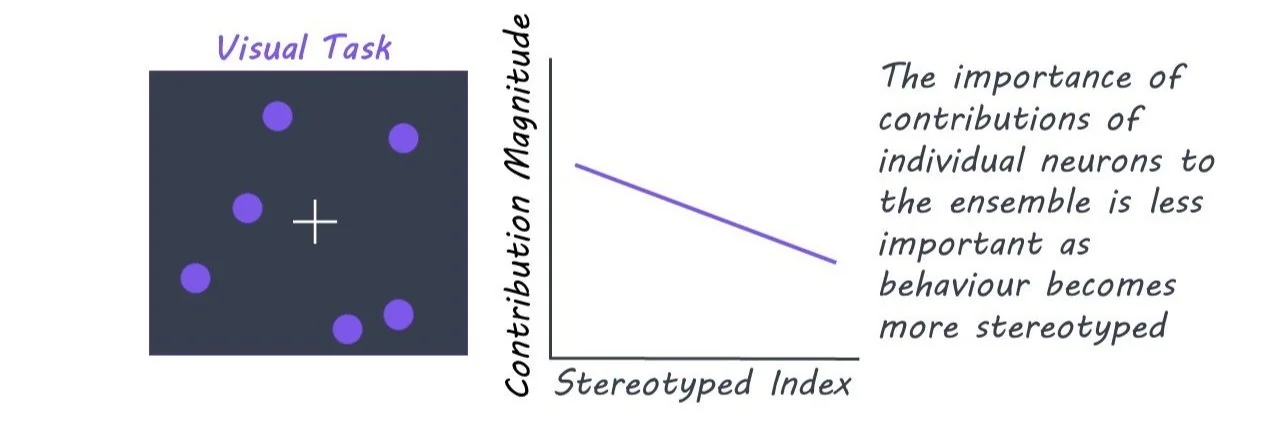
Previous research established that, like humans, monkeys use strategies to exceed the natural limits to working memory (WM) (usually around 4 items). In the present study, two monkeys were presented with a visual task where six identical, colored circles were presented on a screen and the monkeys had to make a saccade (eye movement) to each one only once, returning their eyes to a central point between each selection, remembering which targets they had already visited. The task forced them to remember up to 6 targets in each trial, exceeding the typical capacity of WM and engaging additional mnemonic strategies. Microelectrodes were implanted in the bilateral LPFC of the monkeys to record neuronal activity from groups of about 40 neurons simultaneously during the task, allowing the authors to link neuronal activity to the task performance. To examine the representation of three variables (location of targets, order of saccades, and color of targets), the authors applied a technique known as linear discriminant analysis (LDA) to the neural activity data, allowing them to separate neuronal representations of each variable. In order to understand how each neuron contributed to the population representation of the overall ensemble code, the authors employed a procedure where they removed each unit from their LDA model in turn to see how the overall pattern changed, identifying that neurons contributed differently to encoding at a population level. To examine the impact of sequencing strategies on task performance and the underlying neuronal activity, the authors examined whether the monkeys were likely to visit targets in a similar order across a block (set of trials). When monkeys were more likely to fixate on circles in a specific pattern, the block was given a high stereotyped index (SI), and when there was more diversity in the pattern it was given a low SI. The categorization allowed them to assess whether monkeys were employing a sequencing strategy (high SI blocks), and how this strategy impacted task performance and neuronal firing.

What did they find?

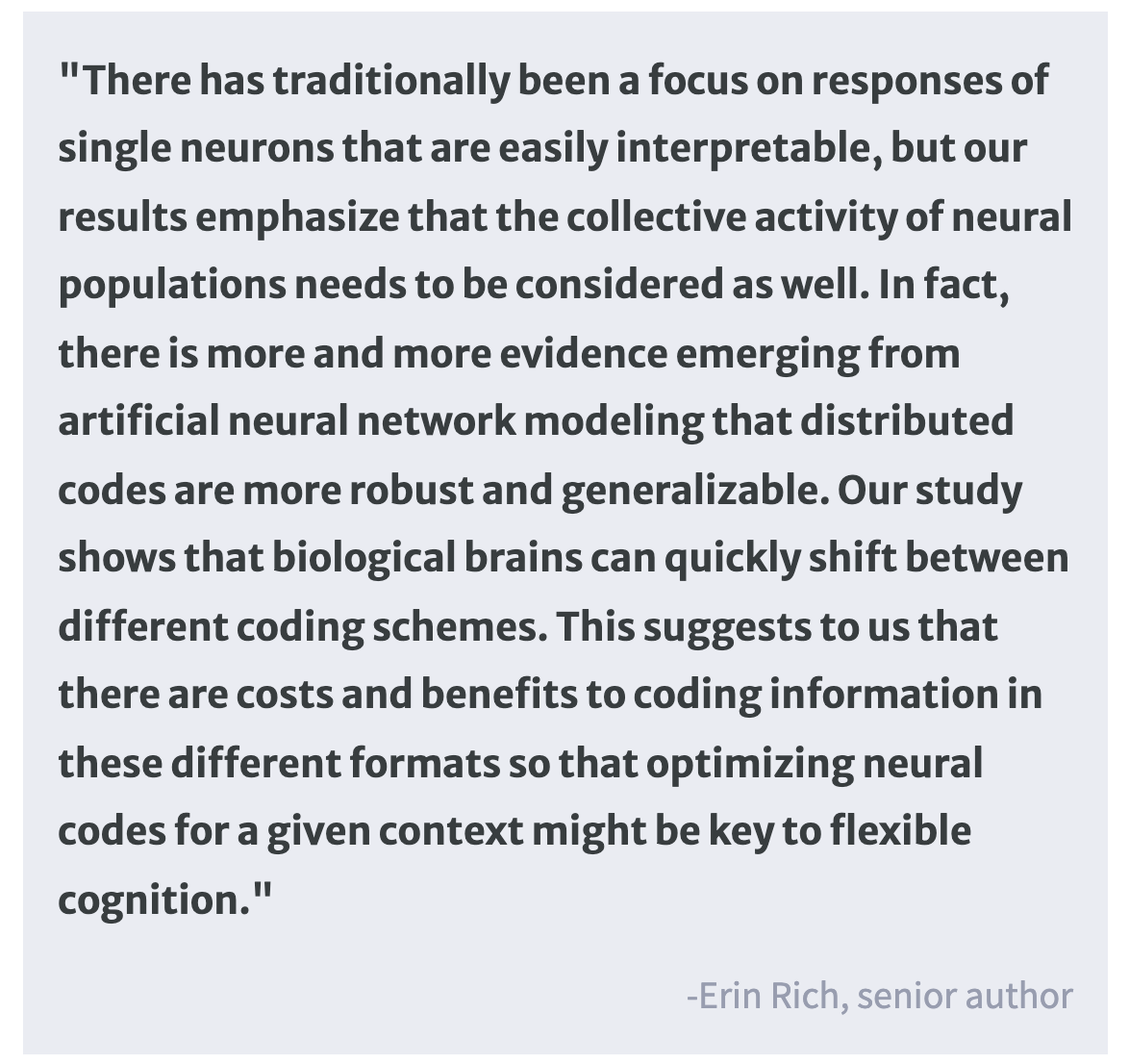
First, reaction times increased across saccades (on later target selection), and monkeys were more likely to fail (look at a target they had already looked at before), suggesting that selections became more difficult, and working memory was being taxed. However, the monkeys performed better on blocks with a higher SI, implying the mnemonic strategy helped compensate for limits to working memory. One of the main findings was that stereotyped behaviors, representing sequencing strategies, were associated with more distributed neuronal encoding in the LPFC. As behavior became more stereotyped, individual neurons contributed less to the ensemble. Overall, when strategies were used and behavior became more routine (associated with better performance on the task), more neurons were recruited, with smaller individual contributions, whereas when behavior was more flexible, fewer neurons were recruited, each contributing more to the signal.

What's the impact?

This study found that using mnemonic strategies improved task performance and altered the underlying representation of the behavior, shifting towards a more distributed pattern of activity with more neurons contributing less individually. These findings provide a new perspective on how information is represented differently on a neuronal level dependent on cognitive strategies employed. This study represents a step for investigations that seek to further uncover the neural mechanisms underlying higher-order cognitive abilities.