Decreased Alertness Influences Brain Activity During Decision-Making

Post by Lincoln Tracy

The takeaway

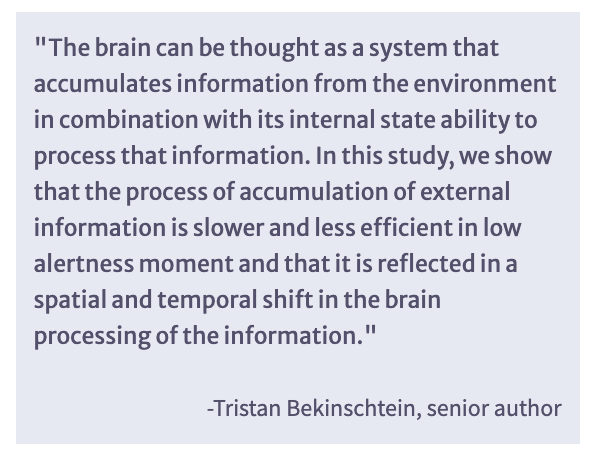
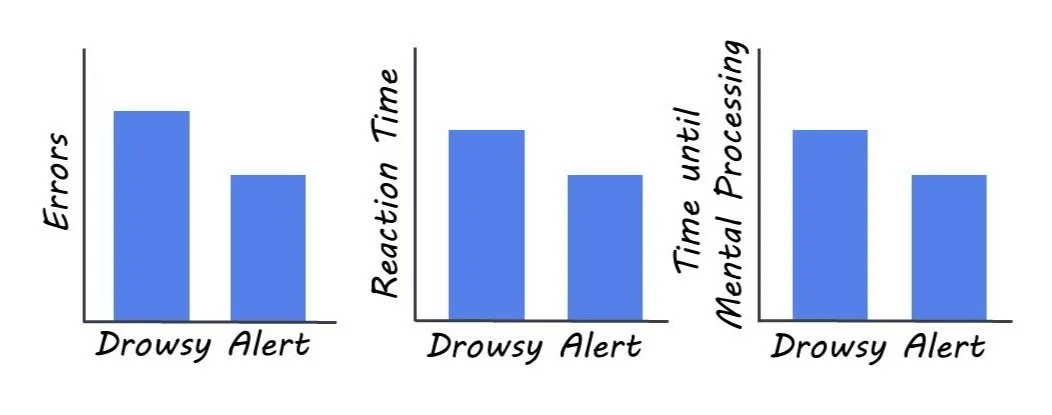
The decisions we make every day are informed by our surrounding environment and internal processes. Being drowsy means we are slower to react to external information, and we react incorrectly more often than when we are alert due to differences in how our brains process the information.  

What's the science?

Humans make countless decisions each day that are informed by external information, prior knowledge, and evidence. However, we have a limited understanding of how changes in alertness impact neural and cognitive processes. This week in The Journal of Neuroscience, Jagannathan Bareham and Bekinschtein used electroencephalography (EEG), behavioral modeling, and an auditory tone localization task to explore how low alertness modulates evidence accumulation-related processes.

How did they do it?

The authors recruited 32 healthy participants (14 males, mean age of 24.5 years), who completed an auditory tone localization task. The task involved listening to a series of guitar chords and indicating whether the sound came from the left or right of their midline. Participants were tested under alert and drowsy conditions. The alert condition was shorter (8 minutes long) and involved participants sitting upright with the lights on and being given specific instructions to stay awake. In contrast, the drowsy session lasted between 1.5 and 2 hours with participants reclined in the dark, given a pillow, and allowed to fall asleep. The number of incorrect responses and reaction times was recorded. Participants wore an EEG cap to record electrical activity in different areas of the brain during the auditory tone localization task.

What did they find?

First, the authors found participants made more localization errors on tones being played on their left-hand side during the drowsy condition compared to the alert condition, confirming the original study from Bareham and colleagues from 2014. Second, they found participants were slower to react during the drowsy condition, meaning the brain required a longer time to process the direction of the auditory tone. Third, they found that the brain activity necessary to decide whether the sounds came from the left or right side was not only less efficient when drowsy, but came later, suggesting a delayed mental process when alertness is decreased. Finally, they found the processing of the auditory began in the frontocentral brain regions before shifting to more central and rear parts of the brain more quickly during the alert condition compared to the drowsy condition, concluding that the brain operated in a different spatial configuration in drowsiness, and at a much later time.

What's the impact?

This study provides new data on how the brain tries to combat decreases in alertness by recruiting additional brain regions to help process external information. These findings shed light on how brain activity tries to adapt to solve problems based on our internal state.

How Has Social Media Impacted Mental Health during COVID-19?

Post by Lani Cupo

Adapting to a virtual world

Since the beginning of the COVID-19 pandemic, people around the world have largely adapted to a virtual lifestyle. Business meetings, holiday gatherings, and doctor’s appointments now take place through video calls. Recent advances in technology afford clear benefits in facilitating the continuation of such activities. In particular, social media services allow people around the world to access information, spend time with their friends, and engage with their professions from the safety of their homes. However, while such services provide some obvious opportunities for mental health care, such as video-calling with therapists or accessing applications designed to help manage personal mental health like meditation apps for example, recent research also reveals the potential risk of social media usage.

The infodemic

Even as the world has adapted to the global pandemic over the past two years, the more insidious growth of the infodemic has risen to public attention. The infodemic is a term coined to refer to the spread of misinformation in the context of disease outbreak, a process that is fueled not only by mainstream media but also social media platforms.

Examining five social media platforms (Gab, Reddit, Instagram, Twitter, and Youtube), one study found relatively similar patterns of behavior in how users engaged with information across platforms. Assessing the spread of information from either mostly questionable or mostly reliable sources (categorized by the independent fact-checking organization media bias/fact-check), the researchers found similar diffusion patterns for reliable and questionable information. Their findings imply there is no discrimination between the reliability of source information when social media users share information with each other.

Some consequences of the infodemic are tangible—for example, the difficulty average consumers have in determining the accuracy of information complicates the interpretation of public health directives. However, in addition to the overt impact, the overload of information can take a toll on mental health. The stressors accompanying both the pandemic and infodemic can exacerbate psychological disorders, especially against a backdrop of increased isolation. The infodemic contributes to public distrust, increased stress, anxiety, and sleep disorders. In a study examining anxiety and sleep disturbance early in the COVID-19 pandemic, one study found that those most at risk were people who were exceptionally vigilant, constantly seeking information (high monitors) as well as people who sought to distract themselves, avoiding threatening information (high blunters). Their findings indicate the need to account for the interaction between social media use and behavior in assessing the impact of the pandemic on mental health.

COVID-19 and mental health

Beyond the direct health effects of the COVID-19 pandemic, it is imperative to consider the long-term, indirect consequences of the disease outbreak (economic instability, extended isolation and lockdown, delayed treatment for other health issues). The aggressive worldwide response to tackling the disease (lock-downs and curfews) has not been succeeded by equally aggressive policy to combat the mental health crisis primed by increased stressors and decreased access to support. Following increased reports of mental health consequences in Europe and China, a study of 10,368 citizens in the United States of America reports rates of high risk for suicidality and depression higher than averages from previous years, with heightened risk in socially vulnerable populations, such as Blacks, Hispanics, women, and younger respondents.

Researchers speculate it is still too early to understand the full brunt of the psychological impact of the COVID-19 pandemic, however, they call for an examination of some consequences that ought to be considered now. These include the fact that those with pre-existing mental health conditions may be at increased risk of exposure to and contraction of COVID-19, the potential of increased anxiety and depressive symptoms in those who did not previously report mental health conditions and the fact that mental health care providers themselves will likely be at heightened risk for contracting the virus, further straining the professional support system. Even as vaccines are developed for the virus and the world learns to adapt to the global presence of the disease, the impact of the psychological consequences is just beginning to be systematically investigated.

What role does social media play?

Several studies have already begun to investigate the potential mediating role of social media usage in the impact of the pandemic on mental health. A study in Chinese citizens revealed increased exposure to social media may increase anxiety or the combination of anxiety and depression in respondents. Another study focused specifically on those who were not infected by COVID-19 and found that while social media usage did not cause mental health issues, it did mediate the experience of traumatic emotions in response to COVID-19 news, increasing reports of stress, anxiety, depression, and vicarious trauma. Nevertheless, many participants also used social media to receive COVID-19 updates and peer support.

Adolescents may be a particularly vulnerable population to the disruption of their social lives. During adolescence, humans are uniquely sensitive to the perspectives of their peers, often making them the ideal consumer for social media platforms. As schools and extracurricular activities are closed, teenagers turn increasingly to social media for connecting with their peers. Much of the previous research investigating teenagers’ mental health and social media usage collapsed across websites, online activities, and applications, making it difficult to disentangle the consequences beyond “screen time”. It may be that screen time itself is less important than the activities teenagers are engaging in. During COVID-19, teenagers can use social media to share creative outlets, learn new skills, engage with their coursework, and connect with their peers. Nevertheless, they may also be more at risk of exposure to misinformation, and time engaging with social media may exacerbate negative emotional responses to the COVID-19 crisis.

Social media does present positive benefits to a world facing social separation, easing interpersonal connection and allowing for the fast transmission of information. Nevertheless, it also poses potential risks that should be considered as well. In order to fully establish the impact of COVID-19 on mental health and the role social media plays in the relationship, continued research must survey individuals from multiple age groups, cultural backgrounds, and countries to understand the impact on diverse populations. Preliminary research provides evidence that social media may increase stress and anxiety, potentially exacerbating underlying mental health issues, however, further research will need to establish the continued impact in coming years.

References +

Fitzpatrick, K. M., Harris, C. & Drawve, G. How bad is it? Suicidality in the middle of the COVID-19 pandemic. Suicide Life Threat. Behav. 50, 1241–1249 (2020). Access the original scientific article here.

Cullen, W., Gulati, G. & Kelly, B. D. Mental health in the COVID-19 pandemic. QJM 113, 311–312 (2020). Access the original scientific article here.

Gao, J. et al. Mental health problems and social media exposure during COVID-19 outbreak. PLoS One 15, e0231924 (2020). Access the original scientific article here.

Rathore, F. A. & Farooq, F. Information Overload and Infodemic in the COVID-19 Pandemic. J. Pak. Med. Assoc. 70(Suppl 3), S162–S165 (2020). Access the original scientific article here.

Hamilton, J. L., Nesi, J. & Choukas-Bradley, S. Teens and social media during the COVID-19 pandemic: Staying socially connected while physically distant. (2020) doi:10.31234/osf.io/5stx4. Access the original scientific article here.

Cheng, C., Ebrahimi, O. V. & Lau, Y.-C. Maladaptive coping with the infodemic and sleep disturbance in the COVID-19 pandemic. J. Sleep Res. 30, e13235 (2021). Access the original scientific article here.

Cinelli, M. et al. The COVID-19 social media infodemic. Sci. Rep. 10, 16598 (2020). Access the original scientific article here.

Zhong, B., Jiang, Z., Xie, W. & Qin, X. Association of Social Media Use With Mental Health Conditions of Nonpatients During the COVID-19 Outbreak: Insights from a National Survey Study. J. Med. Internet Res. 22, e23696 (2020). Access the original scientific article here.

Having More Education Does Not Slow Down Brain Aging

Post by Shireen Parimoo

The takeaway

Higher educational attainment does not protect against brain volume loss that typically occurs in older age.

What's the science?

Educational attainment is thought to slow down the effects of aging on the brain. For example, studies have shown that older adults with more years of education have larger brain region volumes than those with fewer years of education. However, much of this research is cross-sectional (i.e. occurring at one point in time), and little is known about the longitudinal impact of education on brain aging. This week in PNAS, Nyberg and colleagues assessed the long-term impact of educational attainment on rates of brain volume loss.

How did they do it?

The authors used two large longitudinal datasets: the UK Biobank (UKB) and the European Lifebrain project (LB) for their study. Participants reported their educational attainment and completed two or three structural MRI scanning sessions over a period of two to four years. Educational attainment for the LB sample was measured as years of education, whereas participants in the UKB were categorized based on whether they had a college/university degree or not. Estimates of total brain volume and hippocampal volume, which are known to atrophy in older age, were obtained.

The authors performed both cross-sectional and longitudinal analyses to examine the relationship between age, brain volume, and educational attainment. The cross-sectional analysis was based on age and the brain volume at the final timepoint, and provided insight into whether participants with more education also have larger volumes. In contrast, the longitudinal analysis was based on baseline age and time since the first scan. This analysis allowed them to determine whether higher educational attainment was associated with a slower rate of brain volume change over time, particularly in older adults. Finally, they conducted a Bayesian hypothesis test in the LB sample to assess the competing hypotheses that education is or is not associated with the rate at which brain volume changes in older age.

What did they find?

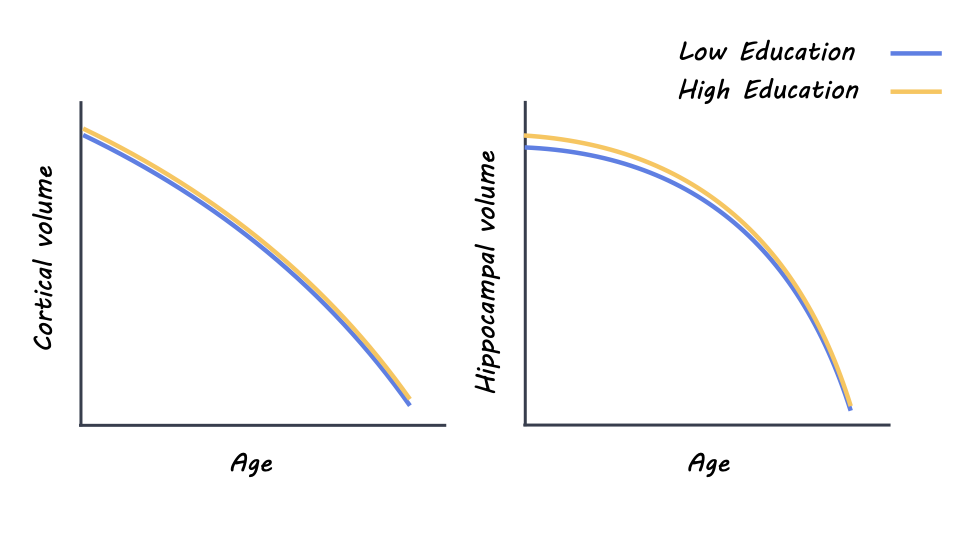
Higher education was associated with greater cortical volume around the left central sulcus in the cross-sectional analysis but was not associated with the rate of volume change over time. Longitudinal analyses revealed that in the LB sample, occipital and lateral temporal areas showed greater volume loss in older ages (LB). Similarly, increasing age in the UKB sample was associated with more volume loss in the medial parietal, lateral, and medial frontal and temporal areas. However, these volume changes over time were not associated with educational attainment. Moreover, though hippocampal volume also decreased in older age in both the LB and UKB samples, the rate of hippocampal volume loss was not related to education. Thus, education is related to brain volume at a given point in time, but it does not slow down the rate at which brain volume changes in older age.

What's the impact?

This study found that higher educational attainment does not serve as a protective factor against the rate of regional brain atrophy. These findings are interesting because while they show that more education is associated with larger brain region volume, they contradict the notion that it has a protective effect on brain aging.

Access the original scientific publication here.