The 2021 Nobel Prize in Physiology or Medicine

Post by Lani Cupo

The quest to understand heat, cold and mechanical force

You take a bite of your curry and at once the powerful spice overwhelms you in a tidal wave of heat. Your eyes water, your nose runs, your friends laugh as your face turns red—you swear you could breathe fire to rival any dragon. Desperately you reach for a piece of bread or glass of milk—anything to quench the flame that has engulfed your head. But why does spicy food feel like fire? And why does it burn when you touch your eyes—organs that you don’t need to taste? The answers to these questions represent careers worth of work for two scientists and have recently earned them the most prestigious prize a scientist can win. In 2021, Drs. David Julius and Ardem Patapoutian were awarded the Nobel Prize in Physiology or Medicine for their work ultimately discovering the receptors providing the basis for sensing heat, cold, and mechanical force. In the following overview, we will explore exactly what the researchers discovered and why it earned them a place in the scientific halls of fame.

The Nobel Prizes were established by a Swedish chemist, engineer, and inventor Alfred Nobel, and first awarded in 1901. The prize in Physiology or Medicine is chosen “for the discovery of major importance in life science or medicine”, and the discovery must be “of great benefit for humankind”. Nominations are invited with confidential letters, then the Nobel Committee is responsible for selecting the winners, consulting with experts in the appropriate field.

Explaining thermosensation

How is heat from our environment communicated through the nervous system to the brain? To convey this information, thermal signals must be converted to electrical signals that can travel up nerves to the brain. Different neurons that carry these electrical signals respond to different types of sensory information based on the molecular receptors and ion channels that the neurons express.

Born in New York and educated at Massachusetts Institute of Technology, the University of California, Berkeley, and Columbia University, Dr. Julius first became interested in these receptors through his curiosity about psilocybin research. In 1997, his group at the University of California, San Francisco published seminal work in Nature describing the discovery of an ion channel responsive to painful thermal stimuli. To discover the channel, the group investigated capsaicin, a naturally-occurring compound in capsicum peppers responsible for their spicy or “hot” flavor. Before Julius’s research, it was known that exposure to capsaicin excited certain neurons, leading to nociceptive experiences (experiences that often result in the perception of pain), however the underlying molecular mechanism was unknown. In order to identify the mechanism, the group cloned the genes encoding the receptor.

The researchers set out to express genes encoding receptors in cells that do not normally respond to capsaicin. They first created a library of complementary DNA (cDNA) from messenger RNA derived from dorsal root ganglion neurons. The clones of the DNA were then transfected into cells from the kidney. These kidney cells were examined for changes to intracellular calcium (indicative of cell activation) in response to capsaicin. By repeating the process for pools of cloned DNA the researchers eventually discovered a 3-kilobase clone of cDNA that made kidney cells sensitive to capsaicin. They named the receptor “transient receptor potential vanilloid type 1”, or TRPV1 because a main structural component of capsaicin is known as a vanilloid. TRPV1 responds not only to capsaicin but also noxious heat, which is why the sensation of eating spicy food feels like “burning”.

Explaining mechanosensation

In addition to probing temperature sensory signals, research teams worldwide were investigating how mechanical stimuli, such as pressure, could be converted to neuronal signals. A similar hunt for the receptor responsible for mechanical stimuli responses was underway.

Dr. Patapoutian was born and raised in Beirut, Lebanon. After moving to the United States, he completed degrees at the University of California, Los Angeles and California Institute of Technology, followed by a postdoctoral fellowship at the University of California, San Francisco. His research on nociception led to the investigation of the receptors responsible for sensitivity to mechanical stimuli that underlie processes like touch and pain sensation, hearing, and blood pressure regulation.

Researchers first established that a line of mouse neuroblastoma (Neuro2A [N2A] cancer cells) responded to physical pressure. Next, they generated a list of genes that encoded ion channels and were enriched in the N2A cells and systematically knocked-down (removed the function of) the candidate genes one by one. After each gene was knocked down, they tested the cells to see if they still responded to pressure. This process allowed them to identify a gene that controlled pressure sensitivity, which they named Piezo1 after the Greek word for pressure (pίesi). Piezo1 is present in many species, from slime mold to humans, but vertebrates also have a second member, Piezo2. Using similar methods to Dr. Julius, Dr. Patapoutian extended the work on thermosensation to mechanosensation. Independently of one another, both researchers also used menthol (the chemical responsible for the taste of mint) to identify a channel that responds to cold temperatures, TRPM8. 

What’s the impact?

The contributions of Drs. Julius and Patapoutian to neuroscience provide an important puzzle piece for neuroscientists to understand how the external world is translated into signals perceptible to individuals. These advances in such fundamental elements of our perception changed the scientific understanding of how our brains recognize and interpret the surrounding world. By understanding the mechanisms underlying such environmental experiences, future scientists may also be able to better conceptualize what is happening when perception differs from expected, in the case of chronic pain or the lack of sensation. 

There is still much unknown about the channels responsible for our perception of heat, cold, and pressure. Future studies may focus on interactions between the receptors and the surrounding cell environment, further explaining methods of activation responsible for our sensations.

References +

Bautista, D. M. et al. The menthol receptor TRPM8 is the principal detector of environmental cold. Nature 448, 204–208 (2007). Access the original scientific article here.

Coste, B. et al. Piezo1 and Piezo2 are essential components of distinct mechanically activated cation channels. Science 330, 55–60 (2010). Access the original scientific article here.

Ranade, S. S. et al. Piezo2 is the major transducer of mechanical forces for touch sensation in mice. Nature 516, 121–125 (2014). Access the original scientific article here.

Caterina, M. J. et al. The capsaicin receptor: a heat-activated ion channel in the pain pathway. Nature 389, 816–824 (1997). Access the original scientific article here.

Mueller, B., Santora, M. & Engelbrecht, C. Nobel Prize Awarded for Research About Temperature and Touch. The New York Times (2021). Access the original article here.

The Nobel Prize in Physiology or Medicine 2021. “Press release: The Nobel Prize in Physiology or Medicine 2021”. Access the original article here.

The Nobel Prize in Physiology or Medicine 2021. “Scientific background: Discoveries of receptors for temperature and touch”. Access the original article here.
Lapses in Attention and Mind-Wandering are Related but Distinct Constructs

Post by Shireen Parimoo

The takeaway

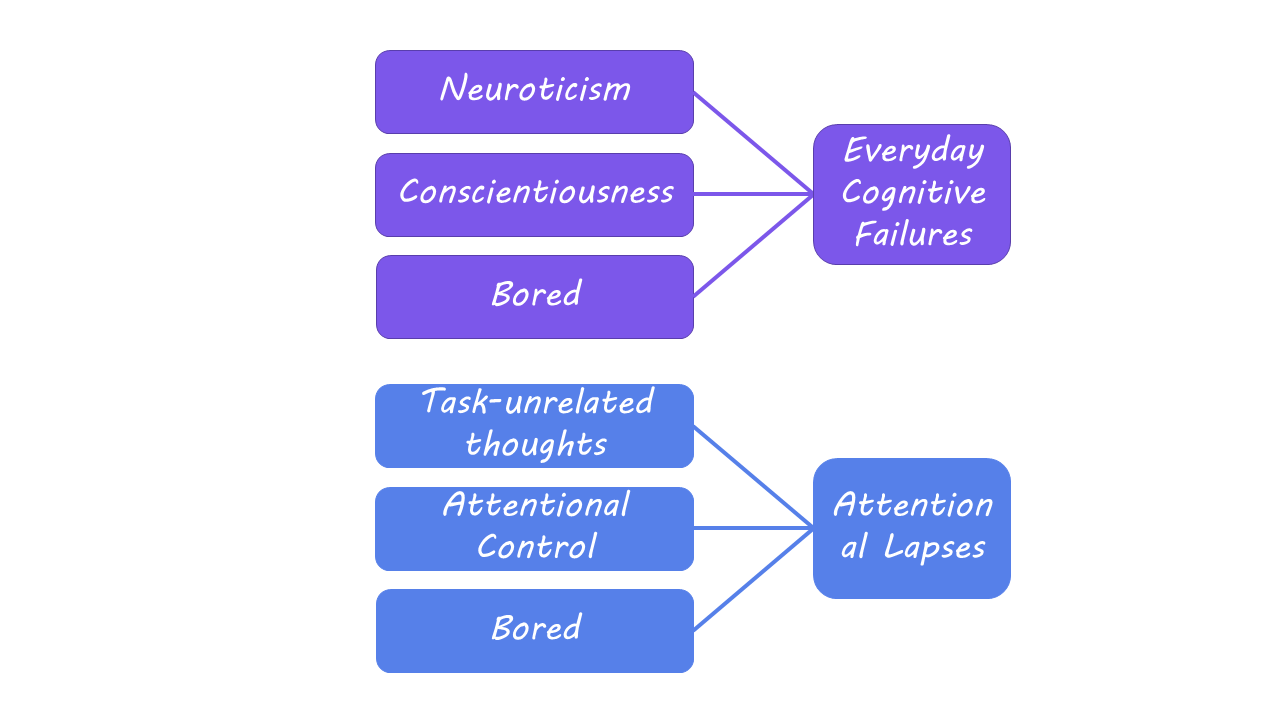
Lapses in attention are more common in people who are prone to boredom, have poor attentional control, and a tendency to let their mind wander. Mind-wandering, on the other hand, is more strongly related to low motivation and alertness, as well as personality traits like conscientiousness and neuroticism.

What's the science?

We have all experienced days at work where we find it challenging to stay focused on the simplest of tasks. Lapses of attention can occur when we are disengaged from a task or when we let our mind wander, often negatively impacting our performance. The degree to which different causes of attentional lapses are related to each other, as well as to other cognitive abilities and personality traits is unclear. This week in Journal of Experimental Psychology: General, Unsworth and colleagues used latent variable analysis techniques to investigate the underlying causes of lapses in attention and whether individual differences might make some people more prone to experiencing attentional lapses than others.

How did they do it?

Participants were 358 young adults who completed a battery of cognitive tasks that assessed their working memory capacity (e.g., reading span), attentional control abilities (e.g., anti-saccade task), and lapses in attention (e.g., sustained attention to response task – SART). Participants also rated the degree to which they experienced task-unrelated mind-wandering by responding to infrequently presented thought probes during some of the tasks, as well as their level of motivation and alertness. Lastly, they filled out a series of self-report questionnaires assessing aspects of their personality (Big Five Inventory), proneness to boredom, daily cognitive failures including lapses in attention and memory, and sleep habits.

The authors first performed confirmatory factor analyses in which all the measures from the lapses of attention tasks were hypothesized to load onto a single latent factor (i.e., the construct of lapses in attention). In subsequent analyses, they tested whether the lapses of attention measures loaded onto the same factor as mind-wandering thoughts and attentional control or whether those were separable constructs. They then tested how all the cognitive factors were related to each other and to the questionnaire measures. Finally, the authors used structural equation modeling to determine which of the self-reported measures and cognitive factors uniquely contributed to (i) in-lab lapses in attention, (ii) daily cognitive failures, and (ii) task-unrelated mind-wandering, after accounting for the shared contribution of the remaining variables.

What did they find?

Behavioral measures of in-lab attentional lapses loaded onto a single latent factor, which means that those measures do arise from lapses in attention. Importantly, the factor of lapses in attention was distinct from both mind-wandering and attentional control, despite being correlated with them. Reduced attentional control and greater mind-wandering contributed to increased lapses in attention. Moreover, those who were more prone to boredom and lapses in attention in their daily lives were also more likely to experience greater lapses in attention on the cognitive tasks in the lab. In contrast, none of the cognitive factors predicted daily cognitive failures, only boredom proneness, conscientiousness, and neuroticism. These findings demonstrate that although in-lab lapses in attention are associated with boredom proneness, cognitive abilities, and everyday cognitive failures, everyday cognitive failures are primarily driven by personality traits.

Mind-wandering was not only distinct from lapses in attention but also showed a different pattern of correlations with other variables. For example, mind-wandering was associated with greater neuroticism and lower conscientiousness, whereas these personality traits were not related to lapses in attention. Compared to lapses in attention, mind-wandering was weakly related to attentional control and working memory but more strongly correlated with motivation and alertness. Lastly, greater lapses in attention, greater attentional control, and low alertness predicted greater mind-wandering. Thus, cognitive variables and personality traits differentially contribute to every day and in-lab lapses in attention and mind-wandering.

What's the impact?

This study found that lapses in attention and mind-wandering are related but separate constructs that arise from a distinct combination of cognitive abilities and personality traits. These findings provide greater insight into the different reasons why people have difficulty focusing on tasks and pave the way for developing effective interventions for improving task focus and performance.

Access the original scientific publication here.

P.S. This post is a part of our new BrainPost Behavior series. For more posts like this check out BrainPost Behavior.

The Medial Entorhinal Cortex is Necessary for Perception of Time Intervals

Post by Leanna Kalinowski

The takeaway

Connections between two brain regions - the hippocampus and medial entorhinal cortex - are responsible for perceiving and memorizing intervals of time. Neurons in the medial entorhinal cortex play an important role in reproducing these memorized time intervals.

What's the science?

Perceiving and memorizing intervals of time is important for our ability to interact with the changing world. The hippocampus has long been considered important for regulating memory of elapsed time. It receives input from the medial entorhinal cortex (MEC), primarily through the firing of neurons at specific time intervals. The time intervals at which these neurons fire are associated with elapsed time as measured by a clock. However, the specific role of MEC in time perception is still largely unknown. This week in The Journal of Neuroscience, Dias and colleagues examined the role of the MEC in time perception by disrupting MEC activity during a goal-directed timing task.

How did they do it?

To measure rats’ ability to tell time, the authors developed a goal-directed timing task called the Waiting-for-Trajectory (WfT) task. This task took place on a 2.0 m linear testing track: at one end of the track was the rats’ starting area, and at the other end of the track was a delivery pump for a chocolate milk reward. To receive the reward, rats were trained to voluntarily stop and wait at the starting area of the track for 2.5 seconds. If the rats left the waiting area before the 2.5 seconds elapsed, they did not receive a reward.

Once rats were trained on the WfT task, the researchers used a technique called chemogenetics, which is commonly used in neuroscience to directly manipulate the activity of neurons. First, the rats received an injection of a viral vector directly into the MEC. This viral vector then caused the MEC to express DREADDs (“designer receptor exclusively activated by designer drugs”) that “turn off” the neurons when the animals are given a substance called clozapine N-oxide (CNO). This allowed for the researchers to selectively “turn off” cells in the MEC. Following this procedure, rats underwent the WfT task daily for 10 consecutive days. Prior to each testing session, rats received daily alternating injections of either CNO (to “turn off” the MEC) or saline (to keep the MEC “on”), for a total of 5 CNO and 5 saline sessions per rat. The researchers measured the time that rats spent in the waiting area and classified each trial as a “hit” (staying in the waiting area for the full 2.5 seconds) or “miss” (prematurely leaving the waiting area).

What did they find?

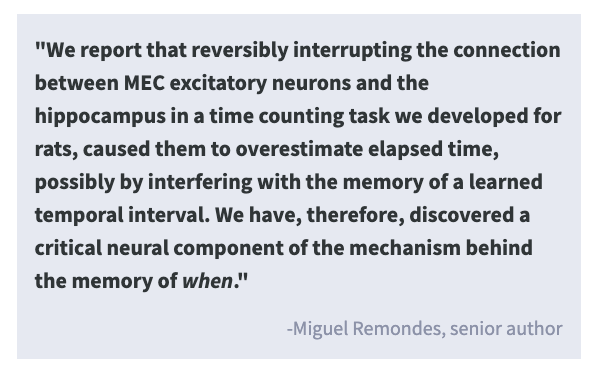
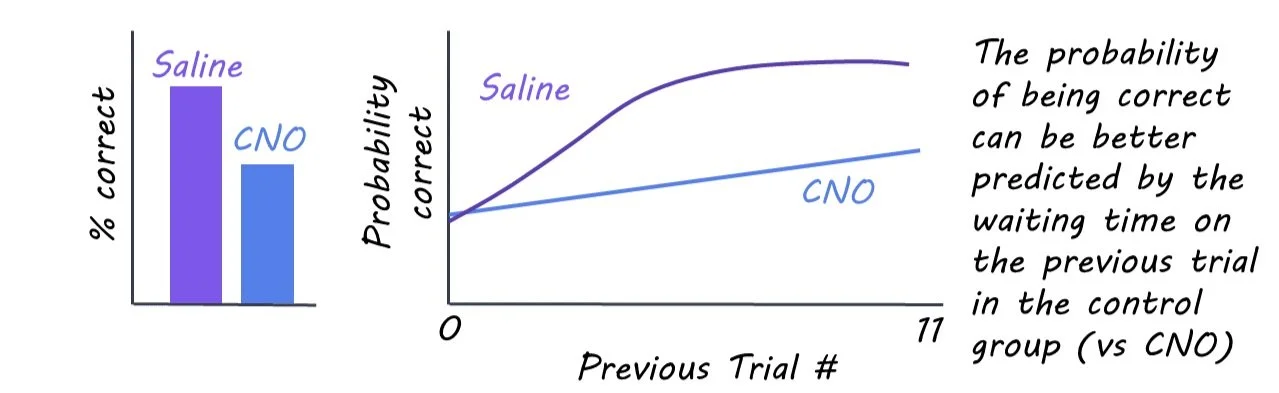
First, the researchers found that “turning off” the MEC impaired rats’ ability to successfully complete the WfT task. These rats overestimated the amount of time spent waiting in the designated area, ended their waiting periods prematurely, and did not receive a reward. This suggests that activity in the MEC is necessary for the brain to accurately measure time.

To determine whether the memory of the target waiting time was affected by silencing the MEC, the researchers then used the individual waiting times from each trial to determine whether they would influence performance in subsequent trials. They found that waiting times and performance of any given trial were influenced by up to three of the preceding trials. They also found that “turning off” the MEC increased the number of consecutive misses (trials where rats stopped waiting prematurely). This suggests that decreasing activity in the MEC might influence the effects of trial history on timing behavior.

What's the impact?

Findings from this study reveal an important role of MEC neurons in the accurate reproduction of a memorized time interval. Specifically, these neurons may be responsible for maintaining a reference memory of important time intervals across multiple trials of a goal-directed timing test. These results aid in our understanding of how the brain measures and perceives time.