
The Medial Entorhinal Cortex is Necessary for Perception of Time Intervals

Post by Leanna Kalinowski

The takeaway

Connections between two brain regions - the hippocampus and medial entorhinal cortex - are responsible for perceiving and memorizing intervals of time. Neurons in the medial entorhinal cortex play an important role in reproducing these memorized time intervals.

What's the science?

Perceiving and memorizing intervals of time is important for our ability to interact with the changing world. The hippocampus has long been considered important for regulating memory of elapsed time. It receives input from the medial entorhinal cortex (MEC), primarily through the firing of neurons at specific time intervals. The time intervals at which these neurons fire are associated with elapsed time as measured by a clock. However, the specific role of MEC in time perception is still largely unknown. This week in The Journal of Neuroscience, Dias and colleagues examined the role of the MEC in time perception by disrupting MEC activity during a goal-directed timing task.

How did they do it?

To measure rats’ ability to tell time, the authors developed a goal-directed timing task called the Waiting-for-Trajectory (WfT) task. This task took place on a 2.0 m linear testing track: at one end of the track was the rats’ starting area, and at the other end of the track was a delivery pump for a chocolate milk reward. To receive the reward, rats were trained to voluntarily stop and wait at the starting area of the track for 2.5 seconds. If the rats left the waiting area before the 2.5 seconds elapsed, they did not receive a reward.

Once rats were trained on the WfT task, the researchers used a technique called chemogenetics, which is commonly used in neuroscience to directly manipulate the activity of neurons. First, the rats received an injection of a viral vector directly into the MEC. This viral vector then caused the MEC to express DREADDs (“designer receptor exclusively activated by designer drugs”) that “turn off” the neurons when the animals are given a substance called clozapine N-oxide (CNO). This allowed for the researchers to selectively “turn off” cells in the MEC. Following this procedure, rats underwent the WfT task daily for 10 consecutive days. Prior to each testing session, rats received daily alternating injections of either CNO (to “turn off” the MEC) or saline (to keep the MEC “on”), for a total of 5 CNO and 5 saline sessions per rat. The researchers measured the time that rats spent in the waiting area and classified each trial as a “hit” (staying in the waiting area for the full 2.5 seconds) or “miss” (prematurely leaving the waiting area).

What did they find?

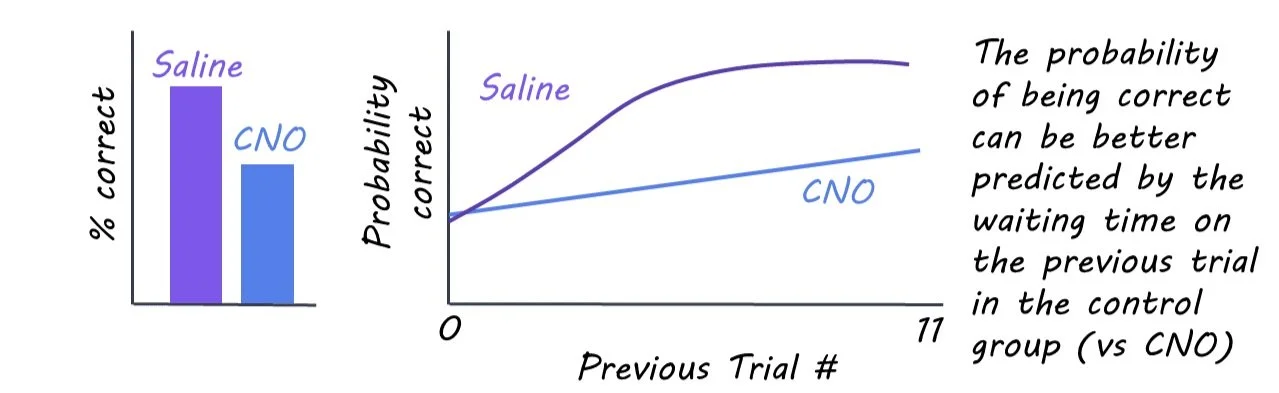
First, the researchers found that “turning off” the MEC impaired rats’ ability to successfully complete the WfT task. These rats overestimated the amount of time spent waiting in the designated area, ended their waiting periods prematurely, and did not receive a reward. This suggests that activity in the MEC is necessary for the brain to accurately measure time.

To determine whether the memory of the target waiting time was affected by silencing the MEC, the researchers then used the individual waiting times from each trial to determine whether they would influence performance in subsequent trials. They found that waiting times and performance of any given trial were influenced by up to three of the preceding trials. They also found that “turning off” the MEC increased the number of consecutive misses (trials where rats stopped waiting prematurely). This suggests that decreasing activity in the MEC might influence the effects of trial history on timing behavior.
What's the impact?

Findings from this study reveal an important role of MEC neurons in the accurate reproduction of a memorized time interval. Specifically, these neurons may be responsible for maintaining a reference memory of important time intervals across multiple trials of a goal-directed timing test. These results aid in our understanding of how the brain measures and perceives time.

Memory Reactivation Predicts the Consolidation of Long-Term Cognitive Maps

Post by Andrew Vo

The takeaway

Forming a mental map of our spatial environment involves both active (i.e., exploration) and passive (i.e., rest) processes in the brain. Reactivation of spatial memories occurs during rest and is related to how stable these memories are in the future.

What's the science?

Cognitive maps provide mental representations of our environments. They are encoded during ‘online’ exploratory periods and then consolidated through replay during ‘offline’ resting periods by place cells in the hippocampus. The neural mechanisms by which offline reactivation (i.e. reactivation of memory at rest) of spatial memories strengthen the long-term stability of such representations are still poorly understood. This week in Nature Neuroscience, Grosmark et al. track the activity of hippocampal place cells over 2 weeks to investigate the relationship between offline reactivation and the persistence of spatial memories.

How did they do it?

The authors performed calcium imaging and electrophysiological recordings to measure the activity of cells in the dorsal hippocampus of mice over 12 days. During periods of offline rest, hippocampal activity occurs in short sharp-wave/ripple (SWR) events corresponding to 125-225 Hz oscillations, and these events are thought to support offline reactivation and consolidation of memories. On each day, the mice performed three consecutive sessions, each lasting 15-20 minutes. Their heads were fixed in position to allow recording of hippocampal activity during the behavioral task. During pre- and post-run sessions, the mice would mostly rest on a cue-less treadmill belt. These two sessions were separated by a run session, during which they would run on one of two different 2-m long, cue-rich belts to obtain a spatially fixed reward.

What did they find?

During run sessions, mice spent more time near rewarded versus unrewarded locations on the belt. Recordings from hippocampal place cells revealed pronounced spatial coding and theta oscillations typically associated with online encoding. These spatial representations decayed across days, although those place cells with peak activity occurring closer to reward locations showed greater stability.

During pre- and post-run sessions, increased place cell activity and synchrony coincided with the occurrence of SWR events that are associated with offline reactivation. SWR events were more frequent and longer-lasting during post- than pre-run sessions. This increase in pre to post SWR events was greater for those place cells that coded locations farther away from reward during the run sessions, which the authors argue allows for consolidation of a more comprehensive spatial map of the underlying environment. Ensembles of place cells detected during run sessions were more strongly reactivated during post- than pre-run sessions and coincided with SWR events. Ensemble reactivation remained elevated compared to baseline for at least 24 hours following spatial exploration. Further, this cross-day ensemble reactivation was greater across pairs of days in which the animal ran on the same belt than when they ran on different belts. These findings illustrate the persistence and contextual specificity of offline reactivation across days.

Finally, the authors describe that pre to post-learning changes in SWR recruitment and memory-ensemble participation predicted place cells’ future cross-day spatial coding stability. Notably, the stability-predicting effect of SWRs was specific to the areas of the environment far from the reward. The authors suggest that this is a mechanism by which post-learning reactivation selectively stabilizes the low-salience, under-sampled areas of the cognitive map which are otherwise vulnerable to being forgotten.

What's the impact?

In summary, this study showed that hippocampal offline reactivation predicts the long-term stability of spatial representations and is most prominent for locations farthest from rewards. This process might help to stabilize representations of under-explored or less rewarding parts of the environment that are most vulnerable to memory decay, allowing for a more comprehensive cognitive map of our spatial environment. The findings here reveal a role of offline memory consolidation that is distinct from but complimentary to online learning.

Robust Circadian Rhythms Associated with Fewer Relapses in Bipolar Disorder

Post by Elisa Guma

The takeaway

Individuals with bipolar disorder often experience relapses (depressive or manic episodes) despite engaging in maintenance therapy. Robust circadian rhythm activity may be associated with fewer of these relapses, particularly for depressive episodes. 

What's the science?

Circadian rhythm disruption is often observed in individuals with bipolar disorder and may be linked to mood. These disruptions may be linked to depressive or manic episode relapses, which about 1/3 of patients experience within 1 year of initial onset, despite maintenance therapy. Objectively measured circadian rhythm activity has not been measured in individuals with bipolar disorder. This week in Translational Psychiatry, Esaki and colleagues prospectively studied the relationship between circadian rhythm activity and mood episodes in individuals with bipolar disorder.

How did they do it?

Outpatients with bipolar disorder (n=218; 19 excluded) underwent a baseline clinical and behavioural assessment in which depressive and manic behaviours were recorded. For the following 7 consecutive days participants wore an accelerometer on the wrist of their non-dominant hand for 24h/day (apart from bathing), which recorded their activity levels. Additionally, they were asked to record their bedtimes and rising times in a sleep diary. Following the baseline assessment, participants were followed up to 12 months for mood episode relapses.

To analyze the activity data acquired from the accelerometer, the authors identified the amplitude and onset of the least active continuous 5-hour period, as well as the amplitude and onset of the most active continuous 10-hour period. They then investigated differences in these measures between individuals who experienced mood episode relapses, either depressive or manic. 

What did they find?

Of the participants, 46% experienced mood episodes during the 12-month follow-up period, of which 39% were depressive episodes, and 19% were manic, hypomanic, or mixed. The authors observed a significant association between mood and circadian rhythm activity. More specifically, higher activity levels, particularly during the 10 most active hours, were associated with a decrease in mood episode relapse, particularly for depressive episodes. Thus, higher physical activity during waking hours may be associated with better outcomes for individuals with bipolar disorder. In contrast, if the onset of this 10-hour active period occurred later in the day, there was an increased likelihood of mood episodes, both for depressive and manic/hypomanic episodes. However, the association between late onset of the active period and manic episodes was not significant following covariation for several factors including age, gender, residual mood symptoms, mood episodes within the year prior to the baseline assessment, total sleep time, sleep efficiency, and daylight availability. This suggests that the increased likelihood of relapse may be associated with higher activity levels that are not aligned with normative sleep-wake cycles.

What's the impact?

This study found that robust circadian rhythm activity, characterized by higher physical activity during waking, may be associated with a decrease in mood relapses, particularly for depressive episodes, in individuals with bipolar disorder. Later timing of circadian activity rhythm was associated with an increase in relapse for depressive episodes. Further research is needed to understand the influence of medication on these associations, as well as the directionality of these relationships, i.e., do disruptions in circadian rhythm activity result in mood relapse, or can these changes be used as potential biomarkers to identify when a relapse may occur?

Esaki et al. Association between circadian activity rhythms and mood episode relapse in bipolar disorder: a 12-month prospective cohort study. Translational Psychiatry (2021). Access the original scientific publication here.