Brain Waves Travel in Both Directions in the Hippocampus

Post by D. Chloe Chung

What's the science?

The hippocampus, a brain region important for memory formation and processing, flexibly integrates various information from multiple interconnected brain systems. It can function in a substantially complex and flexible manner, processing emotional and visuospatial information at the same time. Previous studies have reported that brain waves in the hippocampus travel in one direction (specifically, from the back to the front of the hippocampus), but researchers question how the simple, unidirectional path of brain waves is sufficient to support the highly integrative function of the hippocampus. This week in Nature Communications, Kleen and colleagues utilized a novel two-dimensional array system and found that brain waves in the hippocampus can travel in both directions.

How did they do it?

The authors recruited six participants who required open brain surgery, which would expose the surface of the hippocampus. To detect and measure neural activity in the hippocampus, the authors used a novel, two-dimensional microgrid array system that contains 32 electrodes. This new device looks like a thin film and, when placed on the hippocampus surface, can conform to the contour of the hippocampus and uniformly record brain waves at a higher density. During the surgery, two participants stayed awake and were asked to verbally speak out the name of the objects that appeared on a screen. Their neural activity in the hippocampus was simultaneously recorded and time-locked with the verbal response detected by the microphone. This visual naming task was performed to test whether the direction and consistency of brain waves that travel through the hippocampus would change upon behaviors.

What did they find?

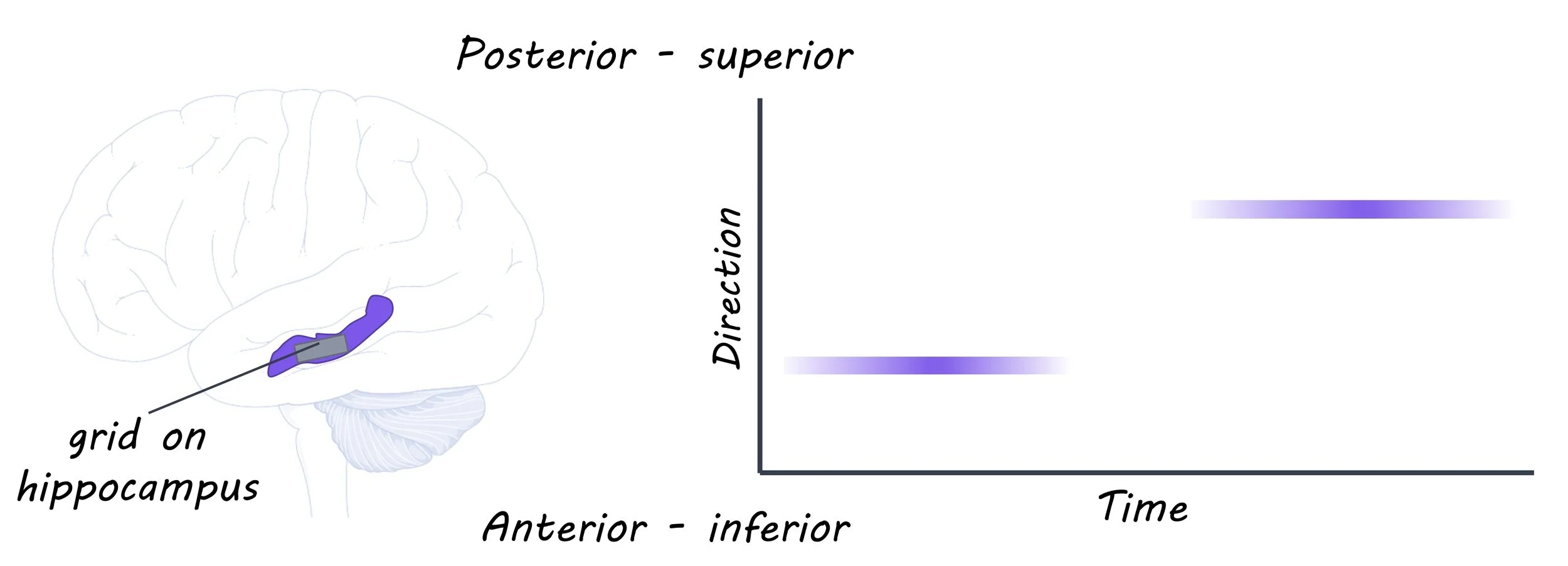
From the neural activity recording, the authors first found that hippocampal brain waves at different frequencies travel in both directions unlike popular belief: from the back of the hippocampus to the front, and also from the front of the hippocampus to the back. For instance, the authors observed that the brain waves that were first traveling from the back to the front would reverse their route and move in the opposite direction, potentially integrating information from different interconnected brain regions. This bi-directional traveling pattern of brain waves was maintained even when recording electrodes were re-adjusted on the hippocampus surface, which indicates that the observation occurs independently of the location of brain wave measurement. Interestingly, during the visual naming task, the authors observed that the low-frequency brain wave (1.9 Hz, meaning 1.9 cycles per second) travels from the back to the front when the participant was recalling the object name and reversed its direction when the participant was at rest. On the contrary, high-frequency brain waves (13.8 Hz, meaning 13.8 cycles per second) tend to travel from the back to the front when the participant was recalling the name of the object. These findings suggest that cognitive activity can modulate the traveling pattern of brain waves in the hippocampus in a frequency-dependent manner.
Chloe (4).png

What’s the impact?

This study is the first work to show that brain waves can travel back and forth in the hippocampus, expanding our understanding of how memory and cognition are processed in the hippocampus. This new piece of information may be valuable in evaluating how hippocampal function is affected in neurological diseases such as epilepsy. Also, this work highlighted the value of the new thin-film microgrid array system that can record real-time neural activity in a high-density manner, which can be similarly used in studying brain waves in other brain regions. As the authors suggested, it will be worthwhile for future studies to evaluate how hippocampal brain waves travel during more complex cognitive tasks.

Kleen et al. Bidirectional propagation of low frequency oscillations over the human hippocampal surface. Nature Communications (2021).Access the original scientific publication here.
The Role of Self-Talk in Sports

Post by Shireen Parimoo

What is self-talk?

Self-talk refers to our inner dialogue, consisting of statements we say to ourselves, either in our mind or out loud. Most of us use self-talk in our lives, like giving ourselves a pep talk before a job interview or a date. This practice helps us appraise and regulate our thoughts and emotions and can help reduce stress and anxiety in certain situations. Athletes also engage in self-talk during training and in competition, saying things like, “keep going” and “focus on form”, or repeating mantras like, “I’m feeling strong”. In sports, self-talk can serve two functions:

  1. Boosting an athlete’s motivation and encouraging them to put in more effort.

  2. Directing attention to the relevant actions that the athlete must execute (“pass the ball”, “go faster”) to improve the quality of their movement or performance. This is thought to be more beneficial for sports requiring fine motor control, such as basketball, rather than gross motor control, such as running. 

Types of self-talk

Self-talk varies along many dimensions. For example, self-talk can be positive (“I’m ready”, “I feel good”), negative (“I’m too tired to continue”), verbally articulated, internal, a statement (“I’m a winner”), or a question (“Who’s a winner?”), to name a few. 

There are three broad categories of self-talk:

  1. Self-expression: self-talk can often be a spontaneous expression of our thoughts and feelings in the moment (“this is so exciting!” or “it is so hot”). 

  2. Interpretive: we can use our inner voice to explicitly think through emotion or experience (“I’m so nervous, but I always feel this way before a game” or “I’m so nervous, maybe I shouldn’t have signed up for another race.”). This is important because negative thoughts can be evaluated differently by different people and therefore have a different impact on performance.

  3. Self-regulatory: this is often used intentionally to guide behavior (“check your form”) or self-motivate (“Keep going, don’t stop now”).

The type of self-talk that someone uses depends on traits like motivation, self-esteem, skill level, as well as on the context, like competition level (e.g., self-talk during practice vs during a game), the type of sport, and its culture (individual or team-based), prior experience (e.g., have they ever won a game vs have they consistently won in the past?), and the audience or where the sport is played (e.g., home vs away game). 

Dual process theory and self-talk

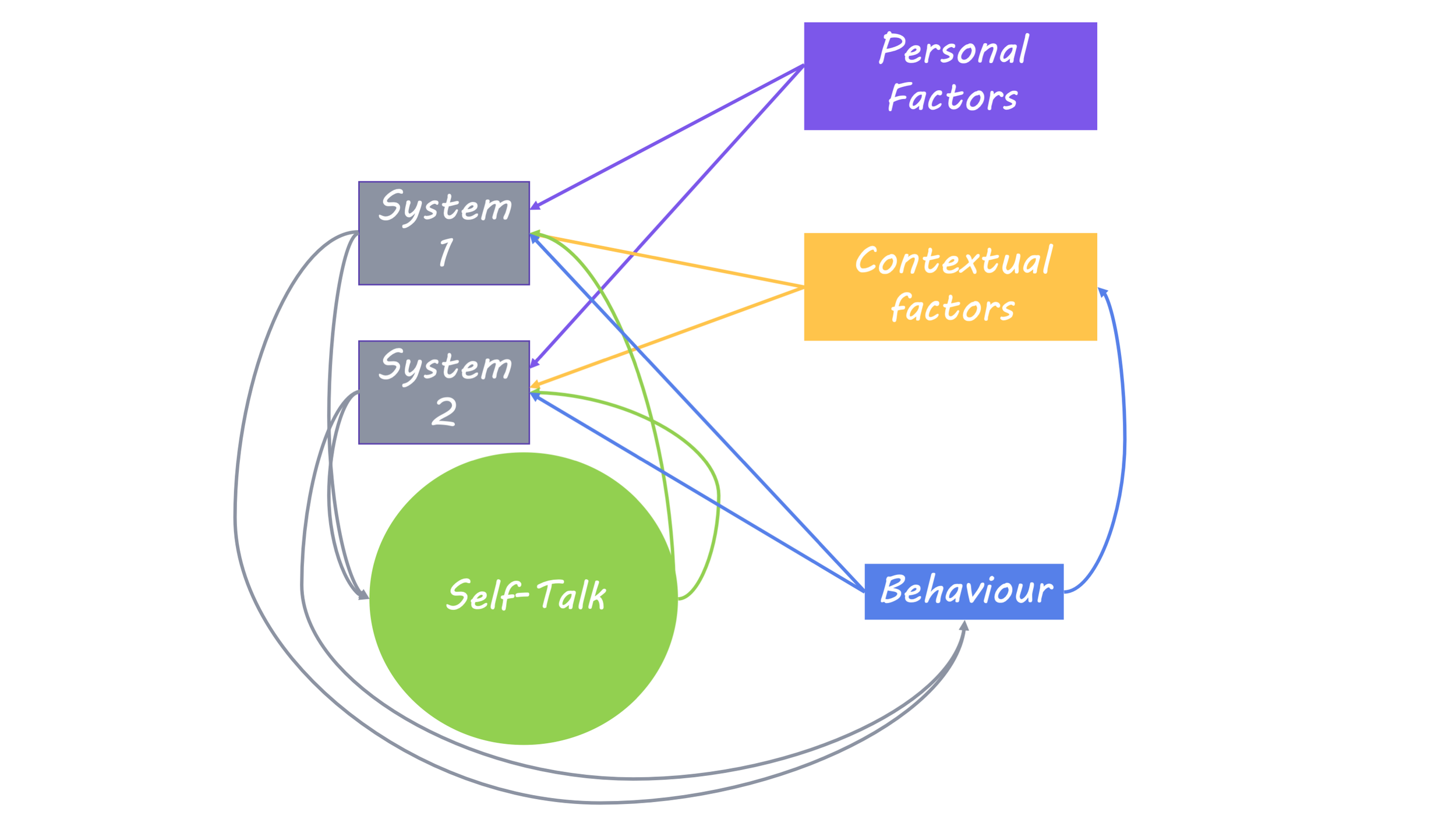
Dual process theory proposes that two systems – System 1 and System 2 – underlie many thoughts and behaviors. Where System 1 is engaged in a rapid, automatic, and effortless manner, System 2 is slower, more effortful, intentional, and conscious in nature

Under the dual process framework, System 1 might give rise to the spontaneous, self-expressive form of self-talk, making the athlete more aware of their feelings in the moment. System 2 might then be engaged to interpret the content of their self-talk based on any of the several factors identified above, such as their self-esteem and context. In addition, since self-talk arising from System 2 processing is more intentional, it can be used to regulate subsequent behavior. 

Self_talk_may18.png

Is self-talk effective?

A large body of research, as well as individual experiences of athletes and coaches, shows that self-talk is effective for improving athletic performance. The effectiveness of self-talk on performance depends on situational factors, the athlete, and the features of self-talk itself. For instance, some researchers suggest that instructional self-talk might be more beneficial during training because it helps the athlete finesse their skill, whereas motivational self-talk might boost performance in a competitive setting. Self-talk may primarily act by reducing performance-related anxiety among athletes, particularly when it is positive. Moreover, self-talk has been linked to greater enjoyment, self-confidence, and higher perceived self-competence. 

There is an active area of research geared toward identifying the most effective forms of self-talk. Though research shows that positive self-talk is most effective for performance, some individuals might improve more than others through negative self-talk due to individual differences in motivation and self-esteem. Additionally, in situations where the content of self-talk conflicts with the context or with an individual’s beliefs about themselves, the self-talk might have no effect or even negatively impact performance. For example, a runner might have a positive mantra that they repeat, like “I’ve got this”. However, if they are neck and neck with another runner, they might begin to doubt whether they trained adequately enough to outcompete them. If this doubt begins to conflict with their mantra, they might start to fall behind, and rather than boosting motivation to keep going, the mantra is rendered ineffective. An athlete who does not start doubting their training might instead use the same mantra to push themselves harder to win the race. 

Many self-talk intervention studies train athletes to use self-talk that engages System 2, the slower but more intentional type of self-talk. As described above, some forms of self-talk might rely more on System 2, but it may be difficult for someone to interpret or regulate their self-talk if this slower, more intentional system is maximally engaged by other thoughts. For example, a runner who is tired and doubting their training during a critical moment in a race might start to over-analyze their training and what they could have done better leading up to the race, leaving few cognitive resources to re-appraise the current situation. As a result, they might not be able to engage in motivational self-talk that would otherwise help push through the fatigue. Thus, a number of factors determine whether practicing self-talk has a beneficial effect on performance in any given situation. 

References

Hardy, J. (2006). Speaking clearly: A critical review of the self-talk literature. Psychology of Sport and Exercise, 7(1), 81-97. https://doi.org/10.1016/j.psychsport.2005.04.002

Hatzigeorgiadis, A., Zourbanos, N., Galanis, E., & Theodorakis, Y. (2011). Self-talk and sports performance: A meta-analysis. Perspectives on Psychological Science, 6(4), 348-356. https://doi.org/10.1177/1745691611413136

Hatzigeorgiadis, A., Zourbanos, N., Galanis, E., & Theodorakis, Y. (2014). Self-talk and competitive sport performance. Journal of Applied Sport Psychology, 26(1), 82-95. https://doi.org/10.1080/10413200.2013.790095

McCormick, A., Meijen, C., & Marcora, S. (2017). Effects of a motivational self-talk intervention for endurance athletes completing an ultramarathon. The Sport Psychologist, 32(1), 42-50. https://doi.org/10.1123/tsp.2017-0018

Park, S-H., Lim, B-S., & Lim, S-T. (2020). The effects of self-talk on shooting athletes’ motivation. Journal of Sports Science and Medicine, 19(3), 517-521. PMID: 32874104

Van Raalte, J. L. & Vincent, A. (2017, March 29). Self-Talk in Sport and Performance. Oxford Research Encyclopedia of Psychology. https://doi.org/10.1093/acrefore/9780190236557.013.157

Van Raalte, J. L., Vincent, A., & Brewer, B. W. (2016a). Self-talk interventions for athletes: A theoretically grounded approach. Journal of Sport Psychology in Action, 8(3), 141-151. https://doi.org/10.1080/21520704.2016.1233921

Van Raalte, J. L., Vincent, A., & Brewer, B. W. (2016b). Self-talk: Review and sport-specific model. Psychology of Sport and Exercise, 22, 139-148. https://doi.org/10.1016/j.psychsport.2015.08.004

Walter, N., Nikoleizig, L., & Alfermann, D. (2019). Effects of self-talk training on competitive anxiety, self-efficacy, volitional skills, and performance: An intervention study with junior sub-elite athletes. Sports, 7(6), 148. https://doi.org/10.3390/sports7060148

How Our Brains Perceive a Changing World

Post by Anastasia Sares

What's the science?

We gather evidence to make predictions about the world. Was that a bat flying in the darkness? Am I smelling a skunk, or someone smoking nearby? Is that person smiling or are they in pain? Classical models of evidence accumulation assume that the world stays the same as we gather information about it. According to this, we would accumulate evidence in a linear way: all information has the same value, and the longer we examine something the more certain we become. But the real world is constantly in motion, and our information can quickly become out of date. To better explain how brains accumulate evidence, we need a non-linear model that takes into account a changing world. This week in Nature Neuroscience, Murphy and colleagues showed how people update their predictions in this non-linear way.

How did they do it?

The authors created a simple task, in which they asked participants to look at small shapes appearing and disappearing on a screen. These shapes appeared in different positions, but with enough observation, it was evident that they were coming from a single source (like a spray of drops from a sprinkler). On each trial, participants were supposed to watch the shapes and indicate whether this source was on the right or left side of the screen at the end. However, there was a twist—the source would sometimes change positions partway through a trial. Participants’ neural activity was recorded with magnetoencephalography (MEG) while they performed the task, and the size of their pupils was monitored to track changes in mental arousal.

What did they find?

The authors compared the participants’ performance to different artificial models to see how well the models fit. There were two very good models, one which was more mathematical, and one that was based on a circuit of interconnected neurons.

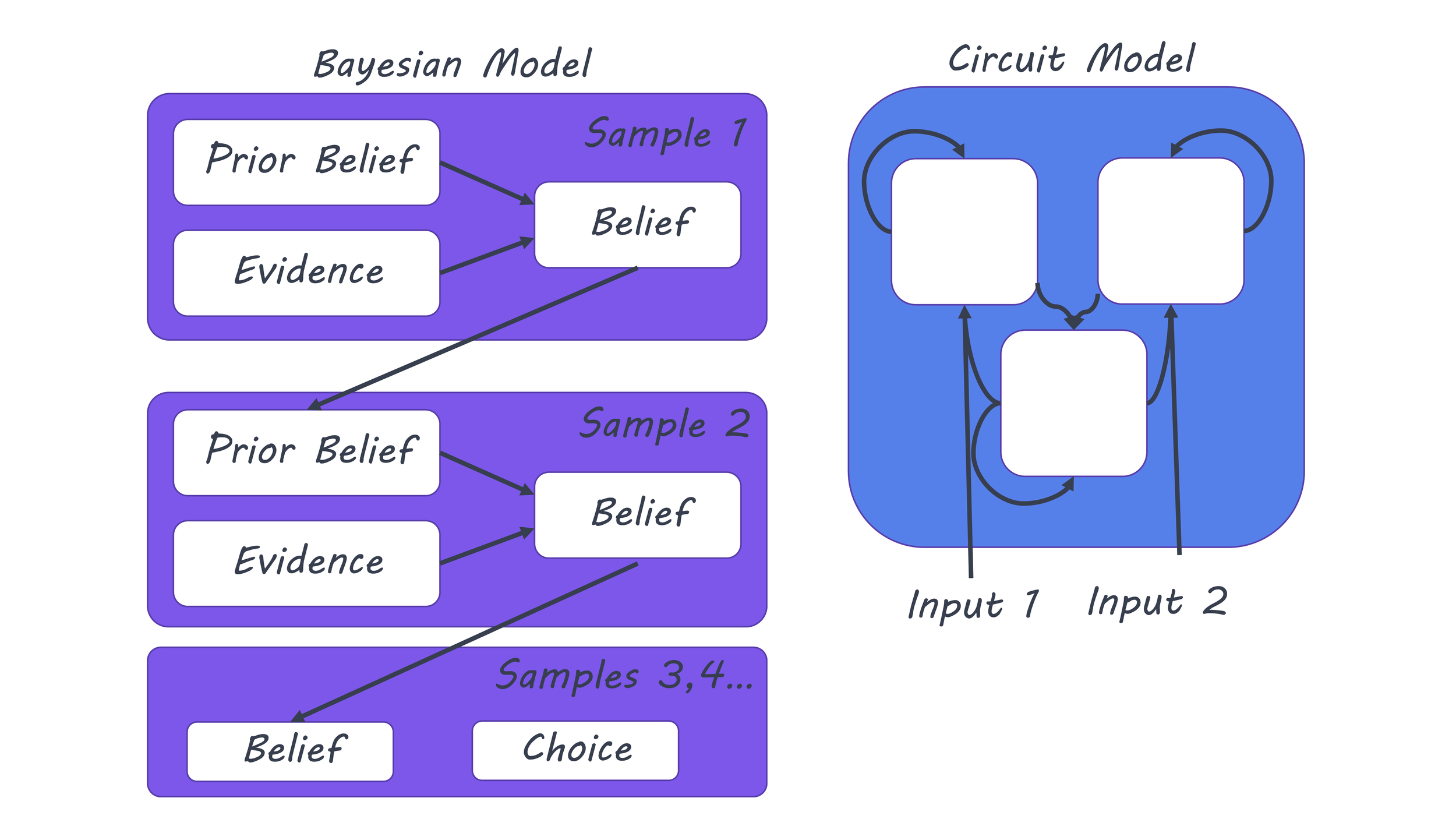
The mathematical model (a Bayesian ‘ideal observer’ model) updates its predictions after each piece of evidence based on what information was encountered recently, the current uncertainty, and also the expectation that the source would be changing. It performed much better than simpler mathematical models that gave equal weight to the evidence from all previous observations. The circuit-based model consisted of just three groups of neurons, which interact and compete with each other through excitatory and inhibitory connections. This circuit made very similar predictions to the mathematical (Bayesian) model, without being told how to do so. 

Over the course of a trial, participants showed widespread brain activity that closely tracked their accumulated evidence predicted by the models. This was seen in parts of the brain linked to action preparation, and also—surprisingly— in early sensory brain areas. This could indicate that the sensory areas were receiving feedback from areas responsible for decision-making and action preparation (this is known as a “top-down” influence). Participants’ pupils also dilated when there was a likely change in the source location, and this dilation predicted changes in brain activity. Altogether, the findings indicated that non-linear evidence accumulation is implemented in brain circuits that are distributed across the brain, and shaped by changes in physiological arousal state.

Anastasia (3).png

What's the impact?

This work demonstrates that we don’t treat all sensory information the same—our expectations and biases matter, and they affect how we interpret the world by exerting “top-down” influences. Being able to represent these factors in a mathematical or circuit-based way is difficult, but it is an important step forward. By showing that the mathematical (Bayesian) model and the circuit model both make similar predictions, and by identifying signatures of the underlying processes in human brain activity, the authors hope that their work can bridge the gap between researchers with different analytical approaches.

Murphy_quote_May11.png

Murphy et al. Adaptive circuit dynamics across human cortex during evidence accumulation in changing environments. Nature Neuroscience (2021). Access the original scientific publication here.