
How Our Brains Perceive a Changing World

Post by Anastasia Sares

What's the science?

We gather evidence to make predictions about the world. Was that a bat flying in the darkness? Am I smelling a skunk, or someone smoking nearby? Is that person smiling or are they in pain? Classical models of evidence accumulation assume that the world stays the same as we gather information about it. According to this, we would accumulate evidence in a linear way: all information has the same value, and the longer we examine something the more certain we become. But the real world is constantly in motion, and our information can quickly become out of date. To better explain how brains accumulate evidence, we need a non-linear model that takes into account a changing world. This week in Nature Neuroscience, Murphy and colleagues showed how people update their predictions in this non-linear way.

How did they do it?

The authors created a simple task, in which they asked participants to look at small shapes appearing and disappearing on a screen. These shapes appeared in different positions, but with enough observation, it was evident that they were coming from a single source (like a spray of drops from a sprinkler). On each trial, participants were supposed to watch the shapes and indicate whether this source was on the right or left side of the screen at the end. However, there was a twist—the source would sometimes change positions partway through a trial. Participants’ neural activity was recorded with magnetoencephalography (MEG) while they performed the task, and the size of their pupils was monitored to track changes in mental arousal.

What did they find?

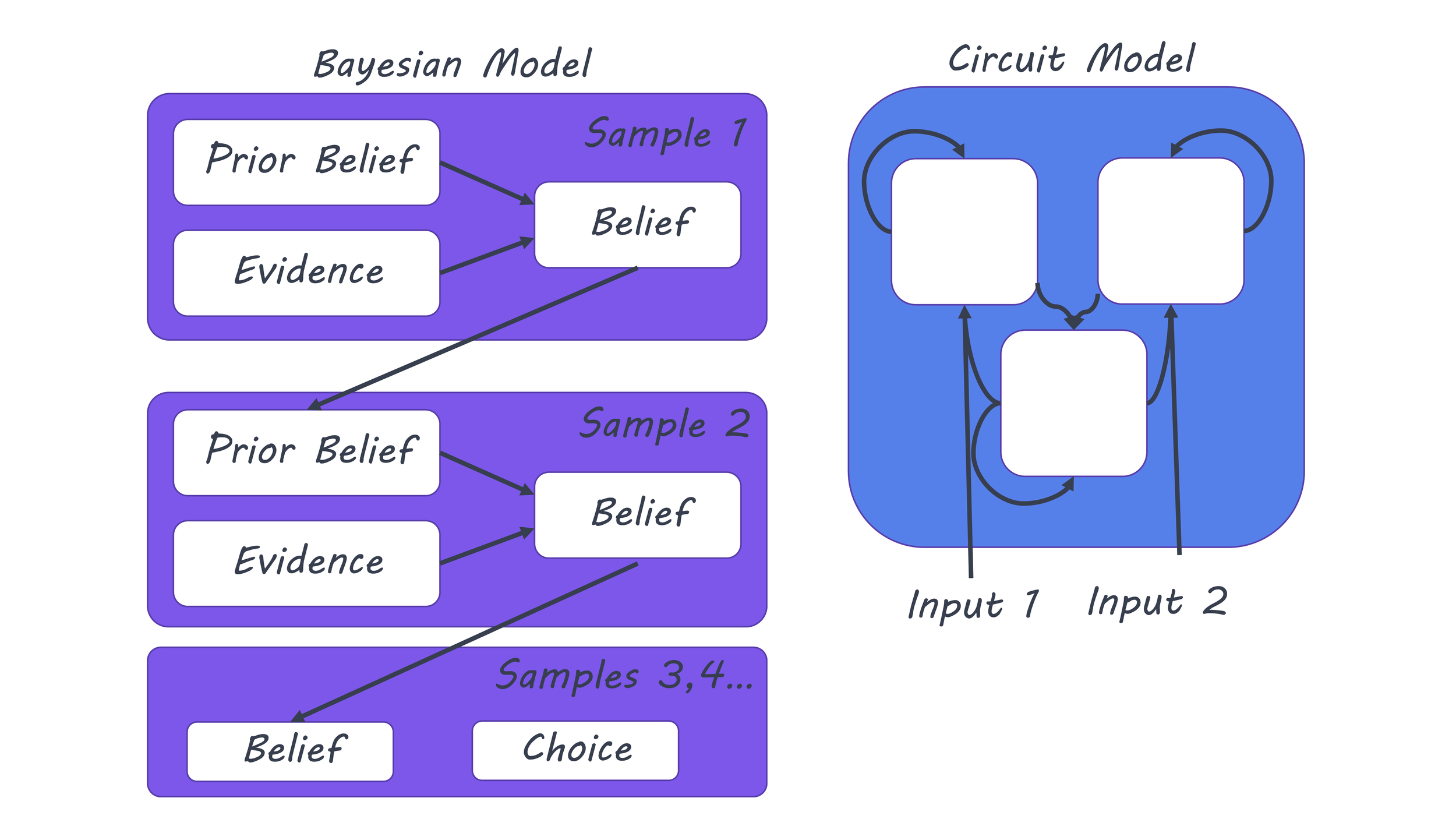
The authors compared the participants’ performance to different artificial models to see how well the models fit. There were two very good models, one which was more mathematical, and one that was based on a circuit of interconnected neurons.

The mathematical model (a Bayesian ‘ideal observer’ model) updates its predictions after each piece of evidence based on what information was encountered recently, the current uncertainty, and also the expectation that the source would be changing. It performed much better than simpler mathematical models that gave equal weight to the evidence from all previous observations. The circuit-based model consisted of just three groups of neurons, which interact and compete with each other through excitatory and inhibitory connections. This circuit made very similar predictions to the mathematical (Bayesian) model, without being told how to do so. 

Over the course of a trial, participants showed widespread brain activity that closely tracked their accumulated evidence predicted by the models. This was seen in parts of the brain linked to action preparation, and also—surprisingly— in early sensory brain areas. This could indicate that the sensory areas were receiving feedback from areas responsible for decision-making and action preparation (this is known as a “top-down” influence). Participants’ pupils also dilated when there was a likely change in the source location, and this dilation predicted changes in brain activity. Altogether, the findings indicated that non-linear evidence accumulation is implemented in brain circuits that are distributed across the brain, and shaped by changes in physiological arousal state.
Anastasia (3).png

What's the impact?

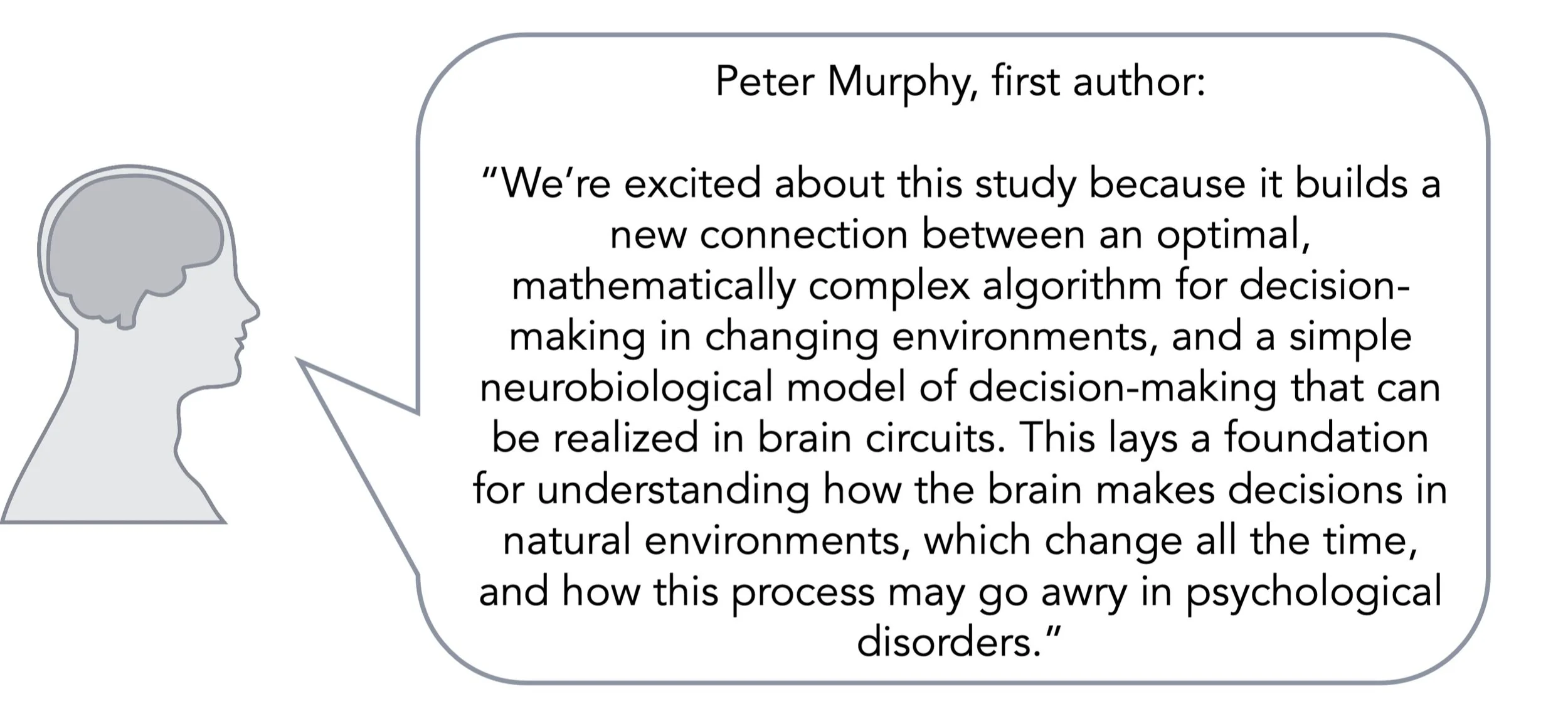
This work demonstrates that we don’t treat all sensory information the same—our expectations and biases matter, and they affect how we interpret the world by exerting “top-down” influences. Being able to represent these factors in a mathematical or circuit-based way is difficult, but it is an important step forward. By showing that the mathematical (Bayesian) model and the circuit model both make similar predictions, and by identifying signatures of the underlying processes in human brain activity, the authors hope that their work can bridge the gap between researchers with different analytical approaches.
Murphy_quote_May11.png

Murphy et al. Adaptive circuit dynamics across human cortex during evidence accumulation in changing environments. Nature Neuroscience (2021). Access the original scientific publication here.
Greater Education Does Not Reduce the Rate of Brain Aging

Post by Lincoln Tracy

What's the science?

Educational attainment has been linked with numerous advantages across an individual’s lifespan. One proposed advantage of education relates to brain aging, where education either acts as a protector, or contributes to our cognitive reserve (how resilient our brain is). However, cross-sectional studies investigating the association between education and brain aging (where participants are only examined at one point in time) are inconclusive. In addition, data from longitudinal studies (where participants are examined at multiple time points, often months or years apart) on this association are sparse. This week in PNAS, Nyberg and colleagues used two large-scale, longitudinal datasets to test the association between education and brain aging. Brain aging was defined as brain atrophy measured by structural magnetic resonance imaging [MRI]).

How did they do it?

The authors obtained MRI and educational data from two large-scale, longitudinal studies: the European Lifebrain project and the UK Biobank. Specifically, they obtained data for 1844 MRI scans from 735 participants (29-91 years old, 368 females) from the Lifebrain project and 2578 MRI scans from 1289 participants (47-82 years old, 660 females) from the UK Biobank. Education was measured as the number of years spent in formal schooling for the Lifebrain project and whether participants had obtained a college or university degree in the UK Biobank sample. MRI data were processed to determine hippocampal, intracranial, and cortical volume. Associations between education and cortical volume in both datasets were then tested in cross-sectional and longitudinal analyses.  

What did they find?

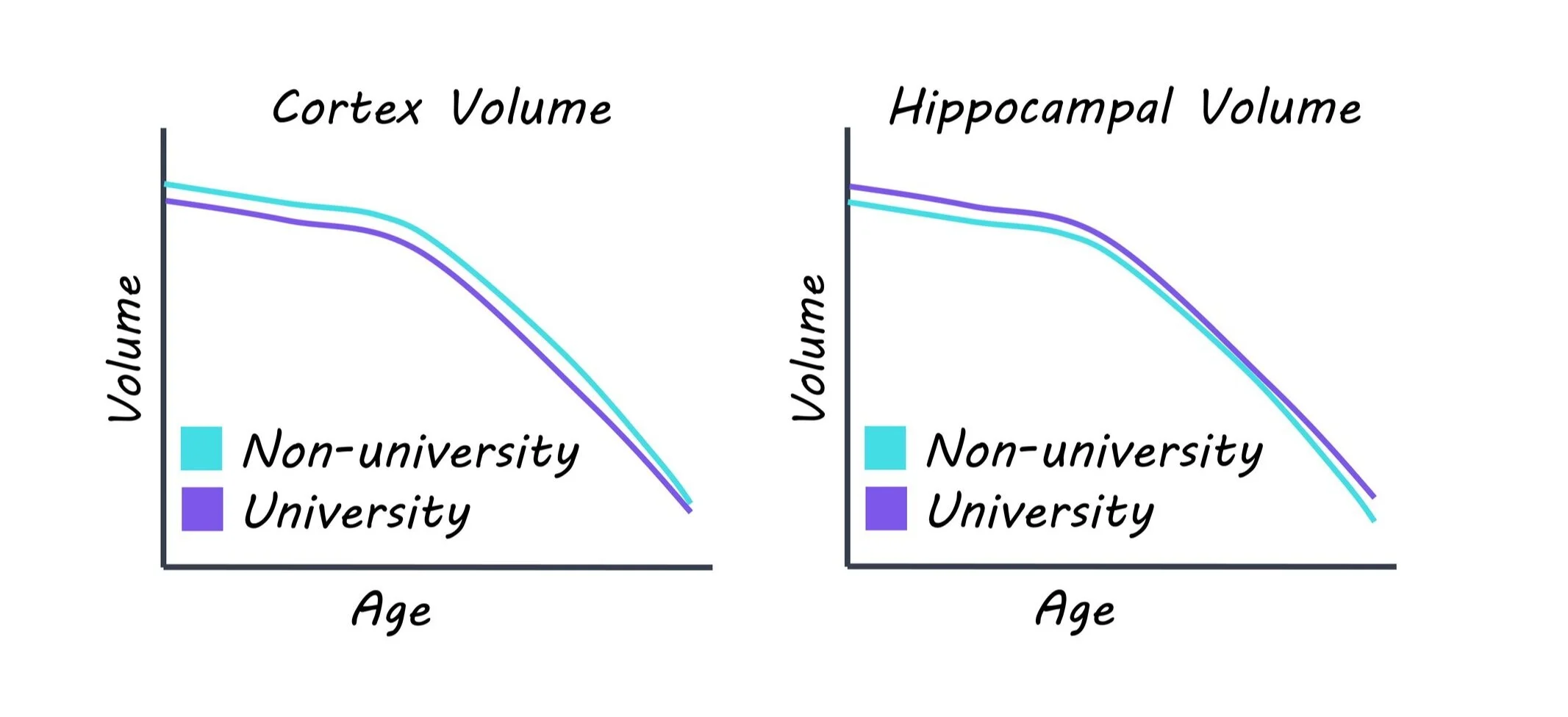
Both the Lifebrain project and the UK Biobank found age-related reductions in hippocampal volume over time. There was no association between education and cortical or hippocampal volume over time when the two datasets were analyzed separately. However, cross-sectional analysis revealed associations between education and regional cortical volume around the left central sulcus.  

lincoln (5).jpg

What's the impact?

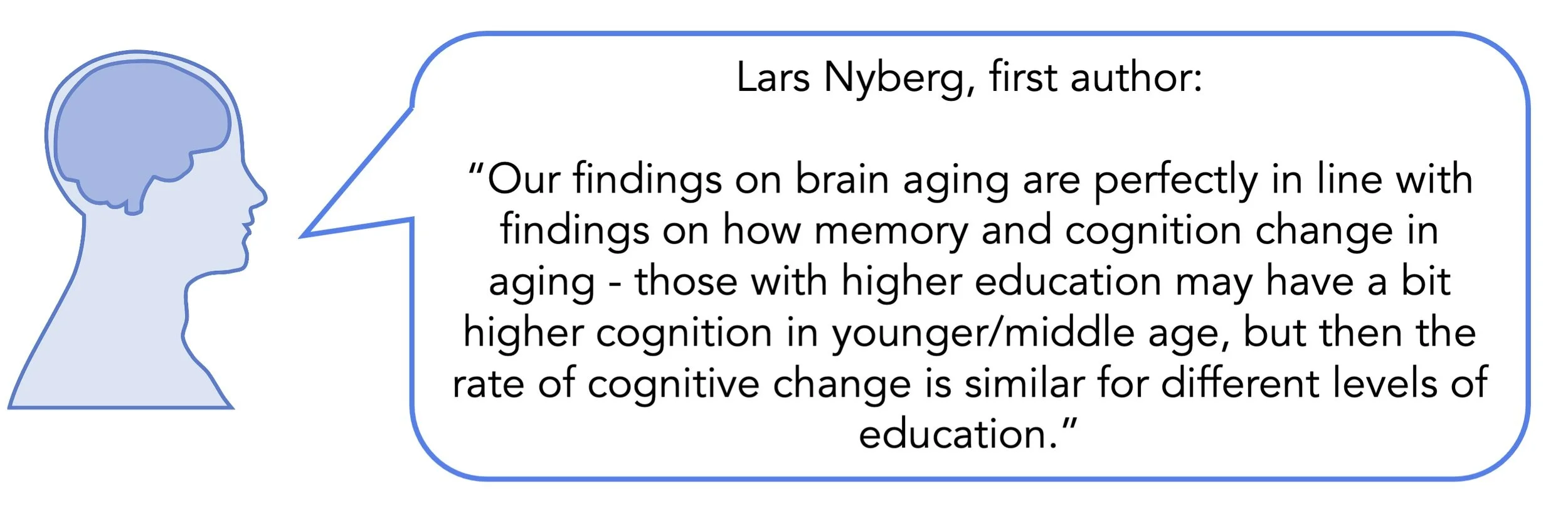
Despite examining almost 4500 MRI scans from over 2000 individuals, the authors found no evidence to support the theory that greater amounts of education lead to decreased rates of brain aging. These findings, together with the existing literature, suggest that individuals with higher education develop more of a “passive” cognitive reserve compared to individuals with lower education, which is eroded as they age. In other words, brain aging occurs at the same rate regardless of how much education an individual has, but a greater level of education provides a greater reserve of brain (or proportion of the brain) that is required to age before adverse outcomes such as dementia occur.  

Nyberg_quote_May11.png

Nyberg et al. Educational attainment does not influence brain aging. PNAS (2021). Access the original scientific publication here.

Autophagic Degradation of the Dopamine Transporter Regulates Behavioural Effects of Cocaine

Post by Amanda McFarlan

What's the science?

Cocaine blocks dopamine reuptake and causes prolonged dopamine signaling in the brain by directly binding to the dopamine transporter. Researchers, however, have speculated that this might not be cocaine’s only mechanism of action, since other drugs that block dopamine reuptake, such as sibutramine or bupropion, fail to induce the stimulant effects of cocaine. Recent findings have shown that cocaine may be associated with autophagy, a lysosomal process that involves the degradation and recycling of cellular components to maintain cellular homeostasis. This week in Molecular Psychiatry, Harraz and colleagues examine the role of autophagy in regulating the molecular and behavioural effects of cocaine.

How did they do it?

The authors explored whether cocaine administration in cortical and ventral midbrain neuronal cultures induced autophagy. They used confocal microscopy and transmission electron microscopy to quantify levels of LC3-II, a microtubule-associated protein that tags the autophagosomal membranes. Then, the authors investigated the role of autophagy in the behavioural stimulant effects associated with cocaine. To do this, they treated mice with either one of three autophagy inhibitors (HCQ, vacuolin-1, or SBI-0206965) or saline 45 minutes prior to being placed in an open field test. After measuring baseline locomotor activity, they delivered intraperitoneal injections of either cocaine or saline and placed the mice back in the open field test to monitor locomotor behaviour. Next, the authors performed synaptosome fractions (separation of molecules in the synapse based on size or density) to explore the role of cocaine-induced autophagy on the degradation of the dopamine transporter. Finally, to examine the effect of autophagy on the rewarding actions of cocaine, the authors treated mice with either HCQ (an autophagy inhibitor) or saline prior to administering cocaine in the conditioned place preference paradigm.

What did they find?

The authors determined that cocaine induces autophagy with high potency in neurons. They showed that cocaine-induced locomotor stimulation was greatly reduced in mice that were treated with an autophagy inhibitor compared to mice that were treated with saline. Next, synaptosomal fractions from the nucleus accumbens (an area of the brain associated with reward) revealed that the dopamine transporter was largely depleted in mice that had been treated with cocaine compared to mice treated with saline. The cocaine-induced depletion of the dopamine transporter could be rescued with the administration of an autophagy inhibitor 90 minutes prior to cocaine administration. Notably, cocaine’s effects were selective for the dopamine transporter since levels of the serotonin transporter or tyrosine hydroxylase (an enzyme involved in the synthesis of dopamine) were unchanged. Finally, the authors found that cocaine-induced conditioned place preference was impaired in mice treated with HCQ compared to saline, suggesting that autophagy is involved in regulating the rewarding effects of cocaine.

amanda.png

What’s the impact?

This study is the first to show that cocaine induces autophagic degradation of the dopamine transporter with high potency. The authors found that this cocaine-induced autophagy was important for regulating behavioural characteristics associated with cocaine, including locomotion and reward. These findings provide new insights into the mechanisms by which cocaine acts in the brain.


Harraz et al. Cocaine-induced locomotor stimulation involves autophagic degradation of the dopamine transporter. Molecular Psychiatry (2021). Access the original scientific publication here.