
Mapping Gene Transcription and Neurocognition Across Human Neocortex

Post by Andrew Vo

What's the science?

As neuroscientists, we study the brain at different levels: from genes and neurons at the microscale to cognition and behavior at the macroscale. We know intuitively that these two scales are linked, building from gene expression to protein interactions, to neuronal wiring and firing, to complex psychological processes. However, this link has yet to be demonstrated in a comprehensive, data-driven, and multivariate framework. This week in Nature Human Behaviour, Hansen and colleagues bridge these two scales by spatially mapping gene expression and functional activation patterns across the human cortex.

How did they do it?

The authors began by performing partial least-squares (PLS) analysis on two open source datasets: (1) the Allen Human Brain Atlas (AHBA) that maps the expression of different genes across the brain and (2) Neurosynth that meta-analytically assigns psychological terms to brain regions they are commonly associated with. The resulting latent variable represented a covarying pattern of gene expression and functional activation, which they referred to as a gene-cognition gradient. In other words, they generated a scale that captured how much gene expression was related to functional activation of different brain regions. Next, they determined which specific sets of genes and psychological processes were related to one another by computing their loadings (i.e., the strength of their contributions) on the gene-cognition gradient. They further examined the biological processes and specific cell types associated with the uncovered gene sets.

To test whether their gene-cognition gradient followed the brain’s structural organization—an intermediate step proposed to link gene expression to functional activation—they compared it to several other previously reported brain patterns. These patterns described microstructural, laminar (referring to the brain’s layers) and functional organizations of the brain. Finally, they tested whether the gene-cognition gradient evolves across neurodevelopment by examining this pattern in the BrainSpan dataset, which provides gene expression estimates across varying stages of human development.

What did they find?

Multivariate PLS analysis revealed a pattern of gene expression and functional activation that spatially covaried across the brain in a ventromedial-dorsolateral gradient. This pattern separated gene sets that were related to affective (emotion-related) processes, neurogenesis, and differentiation, and support cell (e.g., astrocytes, microglia) expression from those gene sets associated with perception and attention, synaptic signaling, and inhibitory/excitatory neurons. Taken together, these findings demonstrate a link between gene expression and functional brain processes.

andrew (1).jpg

The authors also found that the gene-cognition gradient reflected other previously described brain organizations, hierarchies based on microstructural, laminar, or functional attributes. This suggests that the link between gene expression and functional activation is likely mediated through brain structure. Examining changes in the gene-cognition gradient across different stages of neurodevelopment, they found that the pattern strengthened over time and was most pronounced in adolescence and adulthood.

What's the impact?

In summary, this study identified a gene-cognition gradient that directly couples genetic expression to functional activation across the human cortex. This gradient delineates sets of genes, biological processes, and specific cell types related to emotional versus perceptual processes. The organization of this gene-cognition coupling follows the brain’s structural and functional hierarchies and matures through neurodevelopment. The study builds on previous literature that focused on single genes, brain regions, or cognitive functions by analyzing high-dimensional genetic and psychological data in a multivariate framework to offer a broader, more comprehensive view of the link between genes and cognition. This framework opens doors to new hypotheses about the genes involved in specific psychological processes, and vice-versa. It may also allow thorough characterization of brain alterations related to different psychiatric disorders across multiple scales, from transcription to cognition.

Hansen et al. Mapping gene transcription and neurocognition across human neocortex. Nature Human Behaviour (2021). Access the original scientific publication here.
Adolescent Cannabis Use and Outcomes in Young-Adulthood

Post by Leigh Christopher

What's the science?

One common concern with cannabis legalization is the possibility that cannabis use negatively impacts brain development during youth. Many studies have shown links between cannabis use and negative outcomes like mental health problems, cognitive problems, and a reduced ability to obtain education and income later in life. Understanding whether cannabis use is actually the cause of negative outcomes in adolescents is challenging from an experimental perspective. Other genetic and environmental factors might contribute to vulnerability to negative outcomes in response to cannabis use, making it difficult to disentangle which factors are causal. Many studies to date have been limited as they have either 1) examined the impact of cannabis use at one point in time (not over time), or 2)  they have not accounted for genetic factors that could influence vulnerability to negative outcomes. This week in PNAS, Schaefer and colleagues used three longitudinal twin studies which fully account for shared genetic and environmental factors, to examine the effects of cannabis use on cognitive, psychiatric, and socioeconomic outcomes in young adults.

How did they do it?

The authors looked for associations between cannabis use in adolescents and negative outcomes in young adulthood using a large sample (3762 participants) that included data from 3 longitudinal twin studies. Analyses conducted in monozygotic (identical) twins account for shared genetic and environmental contributions to the outcome measure of interest since these twins have identical genes and come from the same families. Therefore, twin studies act as a much stronger indicator of causality - a finding that twins who use more cannabis and show more negative outcomes would indicate that the negative outcomes are not due to any confounding genetic or shared environmental vulnerability, but rather are due to the cannabis use itself. Having said that, there are always other potential twin-specific confounders that could differ between a set of twins such as exposure to other drugs. The authors created an adolescent cannabis use index to examine the participants' cannabis use prior to and during adolescence. They examined whether individuals who used more cannabis also experienced more negative cognitive, psychiatric, and socioeconomic outcomes in young adulthood.

What did they find?

Broadly speaking, cannabis use was associated with a number of psychiatric, cognitive, and socioeconomic outcomes such as anxiety, depression, and lower educational attainment. The authors then looked at whether this association still held true after accounting for shared genetic and environmental variability by examining monozygotic twin pairs who differed in terms of their cannabis use. When looking at these twins, the association between cannabis use and cognitive or psychiatric outcomes was no longer significant, suggesting that this association is due to genetic predisposition or other family background factors. The association between cannabis use and socioeconomic outcomes, however, remained significant, indicating that the link between cannabis use and worse socioeconomic outcomes (housing, income, education, occupational status) is not confounded by shared genetic or environmental vulnerability. Since twins may also differ in some environmental factors like exposure to substance abuse in adolescence, the authors performed a follow-up analysis to account for exposure to alcohol and tobacco. They found that the results did not differ when taking these factors into account. Lastly, the authors conducted a follow-up analysis to examine the pathways through which cannabis use might influence socioeconomic outcomes. They found that cannabis use was predictive of worse academic performance, motivation, and problems in school after accounting for shared genetic or environmental vulnerability. 

What's the impact?

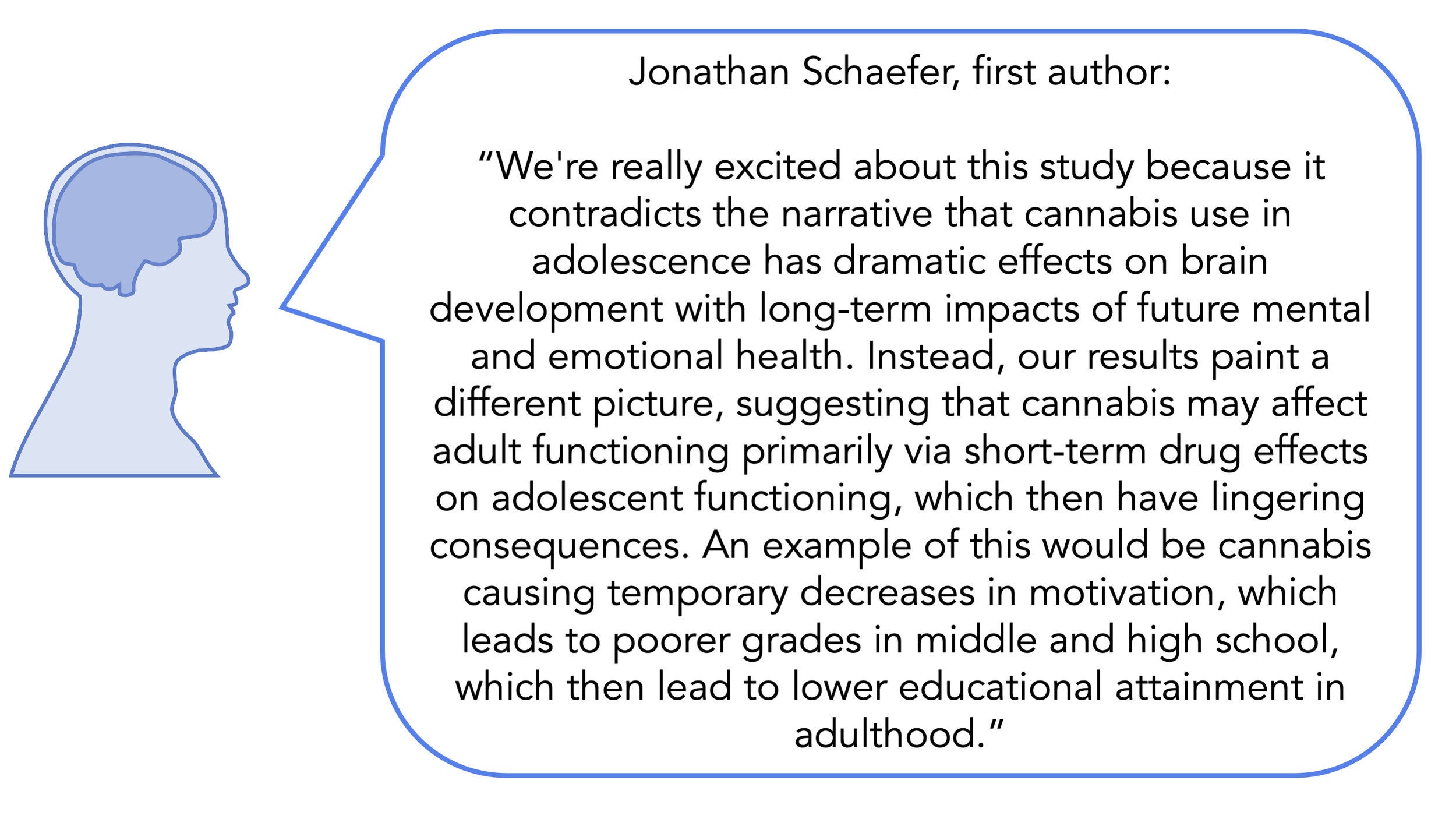
This study was the first to look at the impact of adolescent cannabis use on multiple adult outcomes using a large, longitudinal sample of twins with repeated assessments of cannabis use administered during the teenage years. These findings suggest that cannabis use does not cause negative cognitive or psychiatric outcomes in adolescents and that these outcomes are more likely driven by shared genetic or environmental vulnerability. However, this study did show that cannabis use is linked to worse socioeconomic outcomes after controlling for genetic factors and that cannabis use likely impacts academic performance leading to worse outcomes in young adulthood.

Schaefer_quote_april6.png

Schaefer et al. Associations between adolescent cannabis use and young-adult functioning in three longitudinal twin studies. PNAS (2021). Access the original scientific publication here.
Evolutionary Expansion of the Human Forebrain

Post by Amanda McFarlan

What's the science?

The human brain rapidly expanded in size following our divergence from other great apes. Relative to other mammals, the human brain is enlarged and has a higher number of neurons. However, the mechanisms underlying this human brain expansion relative to other mammals remain unclear. This week in Cell, Benito-Kwiecinski and colleagues used cerebral organoids (tissue grown in a lab that mimics brain cells) to investigate the early developmental processes prior to neurogenesis in human, gorilla, and chimpanzee brains. They primarily focused on studying the transitional period during which precursor cells, known as neuroepithelial cells, become radial glia cells, triggering the onset of neurogenesis (the formation of new neurons).

How did they do it?

Using human, gorilla, and chimpanzee cell lines, the authors generated cerebral organoids to study differences in brain development across these three species. They used several methods including reverse transcription PCR, immunofluorescent staining, and live imaging to examine neuroepithelial expansion, nuclear migration, and cell cycles in the cerebral organoids at several time points during development. Then, to identify the biological factors that might be involved in mediating the shift from neuroepithelial cell to radial glial during brain development, the authors used RNA-sequencing and time course sequencing to examine changes in gene expression in human and gorilla organoids at multiple time points between day 0 (pre-neurulation) and day 25 (neurogenesis). This revealed a difference in expression of the gene ZEB2 (a transcription factor), which the authors confirmed by western blot and imaging in both human and gorilla organoids. Finally, the authors developed ZEB2 mutant human embryonic stem cells that were heterozygous for the ZEB2 gene to investigate the role of ZEB2 in the transition from neuroepithelial cell to radial glia. Furthermore, they examined how altering the timing of ZEB2 expression during development affects this transition period in human and gorilla organoids.

What did they find?

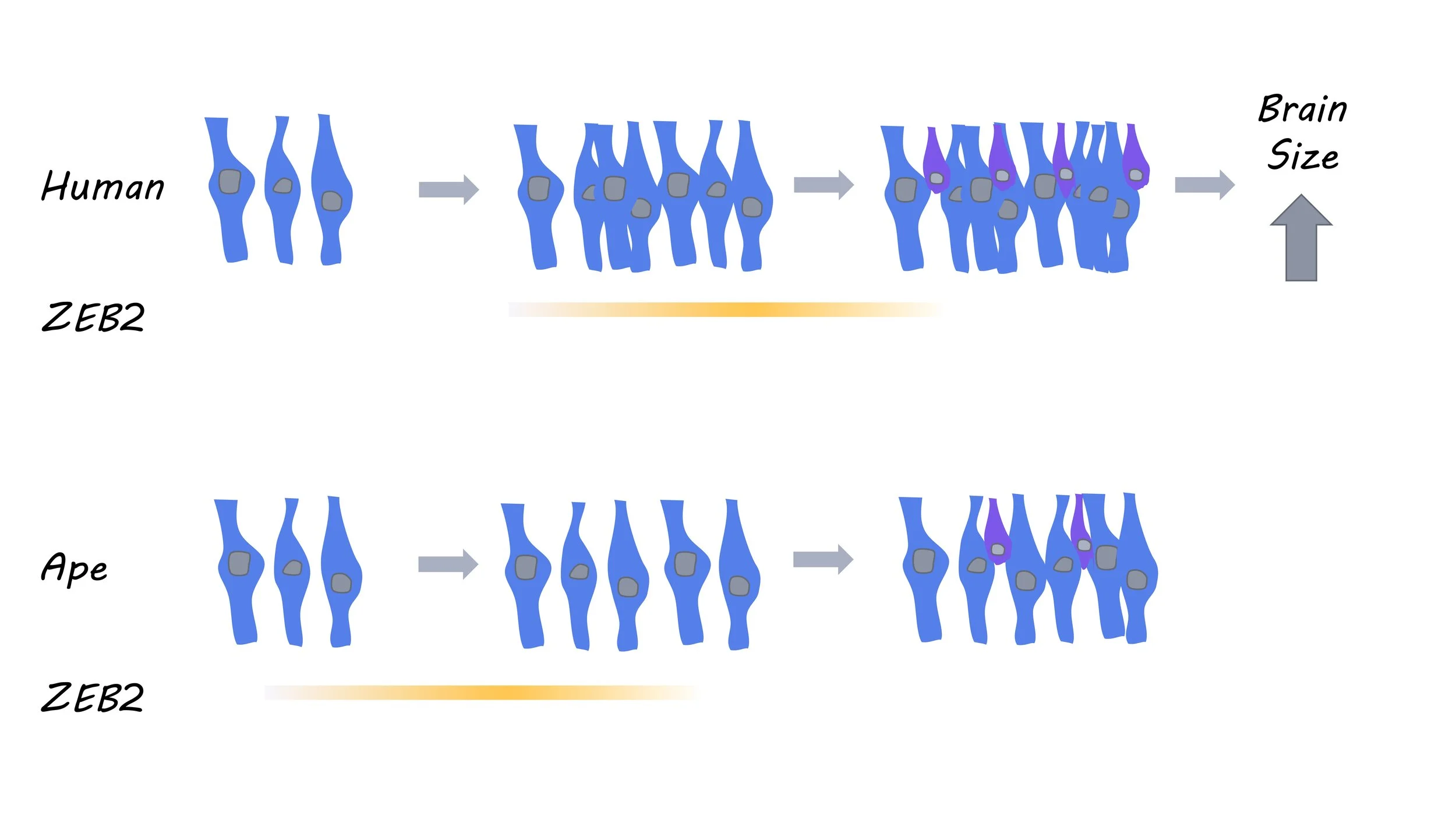
The authors found that human organoids showed greater neuroepithelial expansion prior to neurogenesis compared to gorilla and chimpanzee organoids. All organoids underwent a transition state prior to the change from neuroepithelial cell to radial glia, however, this transition state was shorter and delayed in the human organoids relative to the gorilla organoids. Then, the authors revealed that while genes associated with neurogenesis and RNA processing had identical clustering among the species, genes associated with cell morphogenesis and the epithelial-to-mesenchymal transition (a process by which cells gradually lose epithelial features and become neurons) clustered differently between species. They identified the transcription factor ZEB2 as a likely candidate for regulating the transitional period from epithelial cell to radial glia since ZEB2 is known to be involved in the epithelial-to-mesenchymal transition. The authors showed that ZEB2 expression increased in gorilla and human neuroepithelial cells that were transitioning into radial glia cells and that heterozygous expression of ZEB2 in human neuroepithelial cells disrupted this transition. They also found that earlier expression of ZEB2 in human organoids resulted in neuroepithelial cells that more closely resembled those observed in gorilla organoids. Similarly, delayed expression of ZEB2 in gorilla organoids resulted in neuroepithelial cells that more closely resembled those observed in human organoids.

amanda (2).jpg

What’s the impact?

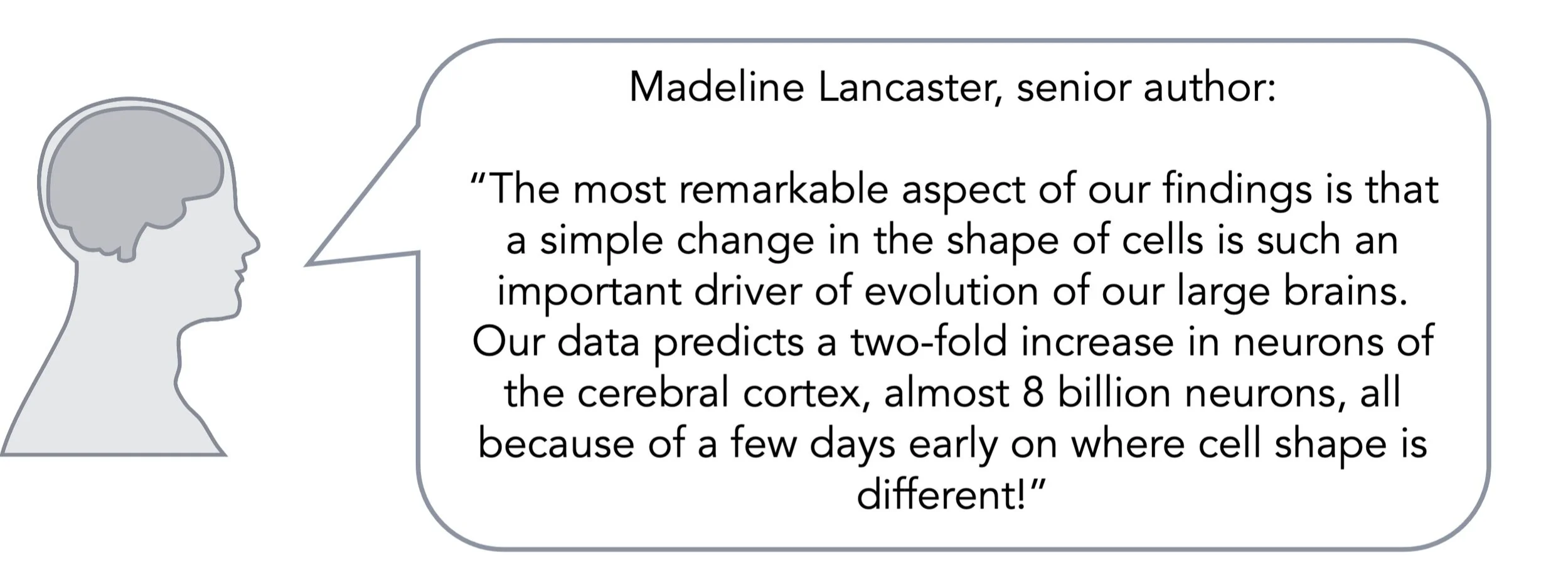
This study is the first to show evidence of differences between species in a transitional stage that occurs during the switch from neuroepithelial cell to radial glia. Using cerebral organoids, the authors demonstrated that this transitional stage is delayed in humans and mediated by the expression of ZEB2, resulting in more expanded brains in humans. Together, these findings highlight how differences in the timing of early developmental processes can have a major impact on overall brain evolution across mammalian species.

Lancaster_quote_april6.jpg

Benito-Kwiecinski et al. An early cell shape transition drives evolutionary expansion of the human forebrain. Cell (2021). Access the original scientific publication here.