
Integration of New Memories in the Hippocampal Network

Post by Anna Cranston

What's the science?

The incorporation of new memories without disrupting acquired ones is critical for adaptation and survival. Prior memories have been shown to influence and promote further learning as well as the ability to re-active memories held in the hippocampus network. However, the exact network-level operations underlying cross-memory interaction are not yet known. This week in Nature Neuroscience, Gava and colleagues investigate the organizational mechanisms that allow for the continuous integration and interaction of hippocampal memories.

How did they do it?

The authors took recordings from the dorsal CA1 region of the hippocampus in mice, using microdrives containing electrodes that were surgically implanted at the site of the CA1 hippocampal pyramidal layer. In these recordings, mice were exploring a familiar environment before and after associating a separate, novel environment with a reward (sucrose), using a behavioral test known as the conditioned place preference (CPP) task. They analyzed the compartment preference for the mice that were conditioned by sucrose solution in the CPP task, while simultaneously recording neuronal spiking in these mice. Next, using recordings of spike trains, which are representations of neuronal activity at defined time-points, the authors recorded the mice during active exploration to determine the firing pattern relationships between sets of co-active, or nearby neurons during each task. The authors also constructed mathematical graphs that represent the spike relationships among CA1 principal cells recorded in a given CPP task session. Finally, they analyzed spatial coherence and topology of neuronal cluster firing, to determine grouped firing patterns of neurons (how the neurons co-fire together) that depended on the location of the mice during the task.

What did they find?

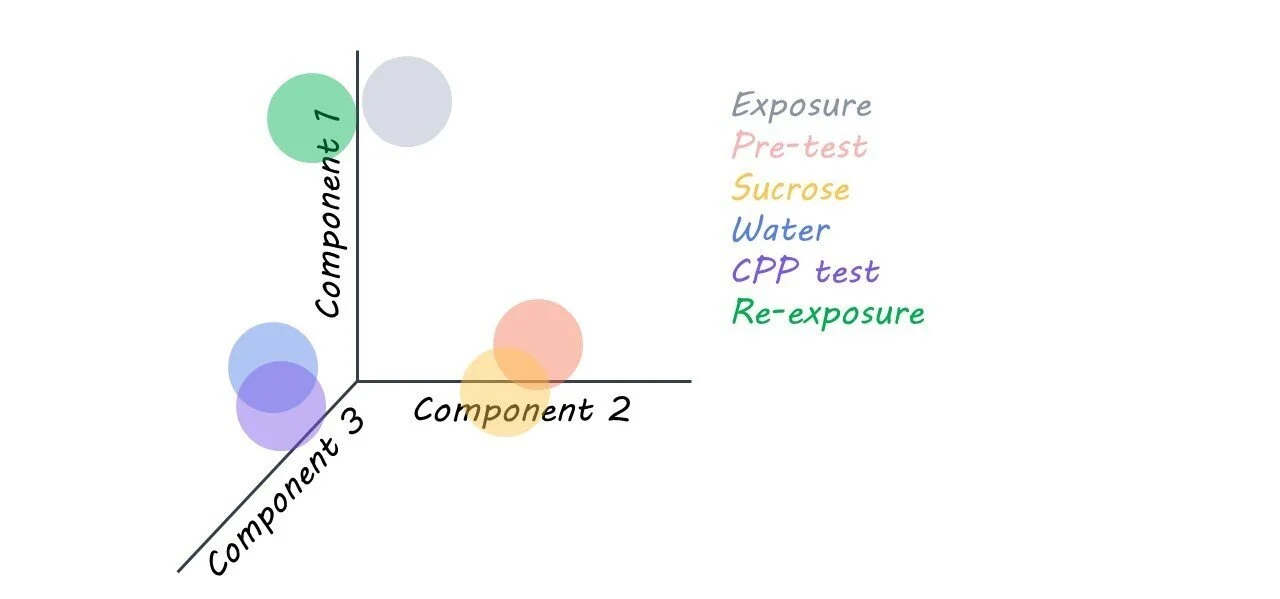
Through the spike train recordings obtained during the CPP performance task, the authors found that the new CPP memory reorganized pre-existing hippocampal firing topology. In addition, through a principal component analysis of co-firing maps generated from recordings throughout the CPP tasks, they found that the co-firing maps could be described by three principal components (in other words, the data varied primarily along three axes in three ways): 1) Similar co-firing patterns could be seen across different sessions in the same environment, indicating the location of the memory and considered to represent the core or main part of the memory, 2) Different co-firing patterns described different aspects of the behavioural task/CPP sessions, and 3) Different co-firing patterns differentiated between exposure and re-exposure to an environment. Overall, new memories obtained during the CPP task influenced existing firing patterns of hippocampal neurons representing prior memory. Finally, the authors found that high- and low-activity cells contribute differently to these hippocampal network co-firing axes, working together to segregate memories by space, novelty, and events.
anna.jpg

What's the impact?

This study investigated the topology of neuronal co-activity and found that memory information spans multiple functional axes of the neuronal network in the mouse hippocampus. Their findings reveal underlying principles of organization for how memories are integrated, and provide novel insights into the division of labor between distinct types of hippocampal neurons.  
Dupret_March2.jpg

Gava et al. Integration of New Memories in the Hippocampal Network. Nature Neuroscience (2021). Access the original scientific publication here.
Expectations of Reward and Efficacy Guide Cognitive Control Allocation

Post by Andrew Vo

What's the science?

Each day, we are faced with tasks and challenges for which we must decide whether the mental effort (in the form of cognitive control) to invest is worthwhile. The Expected Value of Control theory posits that people adjust the amount of mental effort they invest in a task by integrating information about the expected reward (the expected outcome) and the efficacy of task performance (the likelihood that investing effort will yield the desired outcome) to determine the expected value of control. The role of reward expectancy in shaping cognitive control is well-established, however, the effects and neural mechanisms of efficacy are far less studied. This week in Nature Communications, Frömer and colleagues investigated the contributions of reward, efficacy, and their interaction on behavioral and neural measures of control allocation.

How did they do it?

Across three studies, the authors tested their hypothesis that the allocation of cognitive control is based on the expected value of control. The worth of executing different types and amounts of control is determined by weighing its costs (i.e., mental effort) against its benefits. These benefits are shaped by a combination of the two incentive components: reward and efficacy.

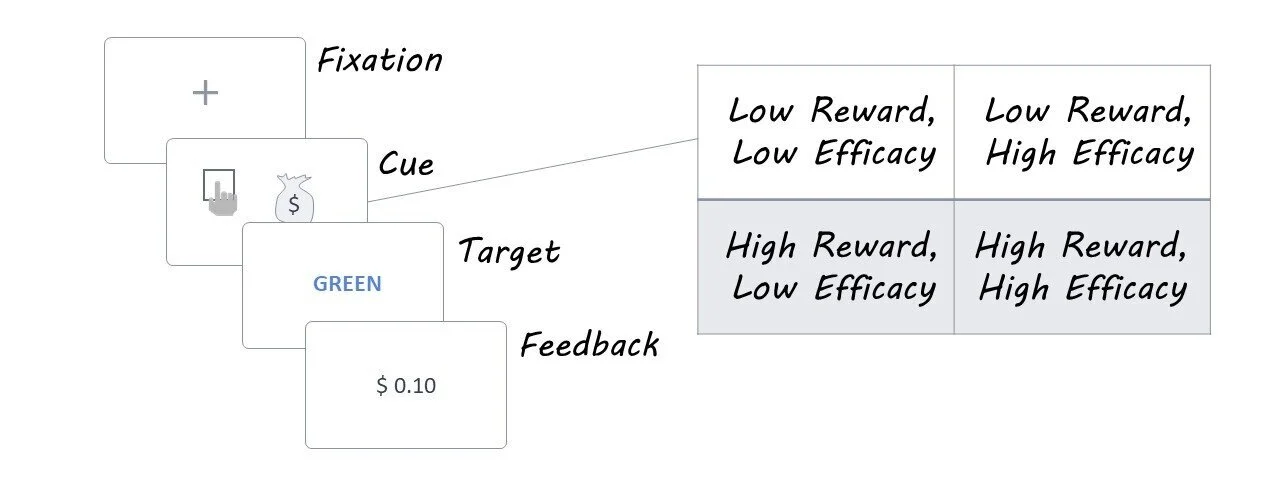
Participants completed a modified version of the color-word Stroop task that dissociated reward and efficacy effects on control allocation. On each trial, participants were initially presented with an incentive cue that disclosed whether they would receive a high or low monetary reward if successful ($0.10 vs. $1.00) and whether their efforts would be high or low in efficacy (success determined by their performance versus by the flip of a coin). They were then shown a Stroop stimulus — a color-word printed in either the same (congruent) or different (incongruent) color — to which they needed to respond with the color the word was written in rather than the word itself. Feedback was then given to indicate the value of the reward received. Correct reaction times (i.e., how fast the participant made a correct response) were used as a measure of task performance.

In Study 2, participants performed the task as their brain activity was recorded using EEG. The authors were interested in how reward and efficacy modulated the magnitude of two specific event-related potentials (ERP): the P3b (250-550 ms after cue onset that reflects incentive evaluation) and the CNV (500 ms before Stroop target onset that reflects control allocation).

What did they find?

The authors found that both reward and efficacy, as well as their interaction, modulated task performance. Participants were faster to make a correct response for higher levels of reward and efficacy. This pattern of findings was consistent whether each incentive component was varied in a binary manner (Study 1 and 2) or parametrically across four levels (Study 3). Control analyses ruled out that these effects were not simply due to speed-accuracy trade-offs, task difficulty, or practice effects.

EEG recordings (Study 2) revealed that reward and efficacy manipulations modulated the amplitude of both ERPs of interest. The P3b and CNV amplitudes were significantly larger in response to cues signaling larger rewards and efficacy. Notably, only the CNV was sensitive to the interaction of both incentive components. Examining trial-by-trial variability, the authors found that larger amplitudes in both ERPs were associated with an increased likelihood of correct responses and faster correct reaction times, with a more pronounced effect in CNV than P3b.

andrew.jpg

What's the impact?

This study provides behavioral and neural evidence supporting the critical roles of both reward expectancy and efficacy in determining the value of exerting cognitive control. The results are in line with predictions made by the EVC theory, which suggests that the integration of both incentive components (reward and efficacy) shapes how mental effort is allocated. As the authors succinctly state, “Cognitive control is critical but also costly”. This study illustrates how we may go about computing the worth of investing mental effort (in the form of cognitive control) towards achieving goals throughout our daily lives.

Hause_March2.jpg

Frömer et al. Expectations of reward and efficacy guide cognitive control allocation. Nature Communications (2021). Access the original scientific publication here.
Effects of Ketamine on Brain Function During Metacognition

Post by Lani Cupo

What's the science?

Metacognition, or thinking about the process of thought itself, is considered to be essential to the experience of consciousness.  While some studies have used neuroimaging techniques in an attempt to localize brain regions integral to metacognition, little is known about the role of specific neurotransmitter receptors underlying consciousness. Previous metacognition research has indicated the importance of the N-methyl-D-aspartate (NMDA) glutamate receptor, bound by antagonists—such as ketamine—which, at sub-anesthetic doses, can induce a psychotropic state accompanied by euphoria and out-of-body experiences. This week in Neuroscience of Consciousness, Lehmann and colleagues conducted a double-blind, placebo-controlled pharmacological functional magnetic resonance imaging (fMRI) study, in order to investigate the role of the glutamate system in metacognition and its underlying neural activity following exposure to ketamine.

How did they do it?

In the laboratory, metacognition can be measured by asking participants to reflect “trial-by-trial” on their performance on behavioral tasks, such as recall in a memory task. These tests allow researchers to assess, not only performance on the task (referred to as type 1 responses) but also participants’ insight into that performance (referred to as type 2 responses). Fifty-three adult participants (29 females) were included in the study, and 24 of them received sub-anesthetic doses (2 mg/ml) of ketamine (29 received saline) during a task-based fMRI scan. After being placed in the scanner and initiating infusion with ketamine or saline control, two phases of the study were completed. 

In phase 1, participants took part in a memory task, encoding 120 words, 60 of which they also rated on “pleasantness” leading to a deeper encoding. In the retrieval phase of the task, for type 1 responses, participants were presented with 180 words, 60 of which they had never seen before, and were asked to press a button when they recognized the word from before. For type 2 responses, they were asked to rate how confident they were in their type 1 response, either by reporting on a 6-point scale (report condition) or merely placing the cursor on a color-coded digit on the scale (follow condition). This distinction allowed the authors to study the difference between true metacognition and the “follow” control condition. 

In phase 2, participants saw 100 words, half of which they rated on pleasantness for deep encoding and half of which they merely reported the number of syllables. An hour after the scan and ketamine infusion were finished, participants performed the same retrieval task from phase 1, without the influence of current ketamine exposure. Finally, participants filled out a questionnaire designed to assess altered states of consciousness.

What did they find?

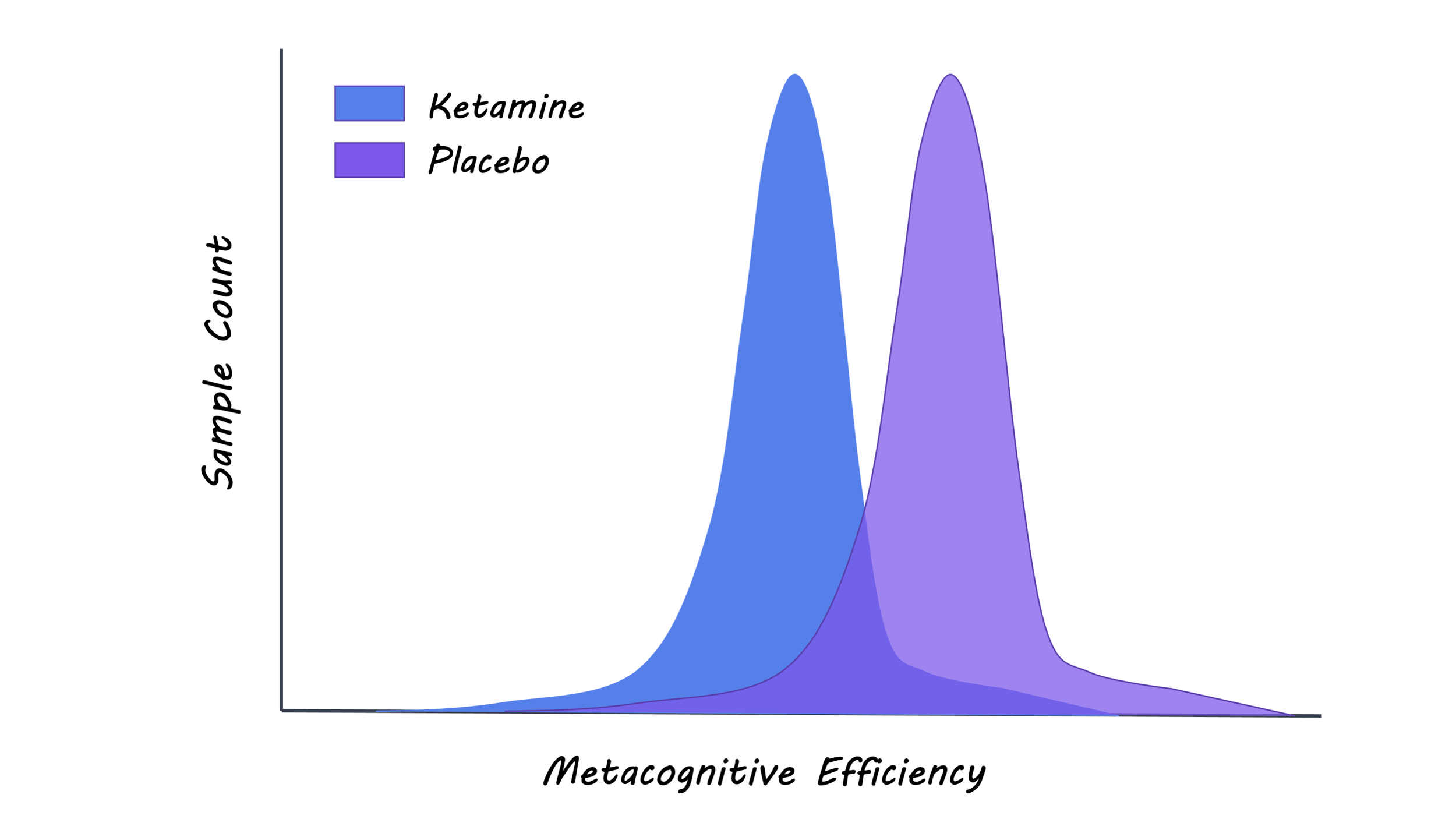
Results from the questionnaire suggested ketamine significantly altered participants’ states of consciousness, but, as expected, did not affect performance on the memory task. In phase 1, participants displayed more metacognitive sensitivity on deeply-encoded words, implying they were better at assessing their performance on the task for these words. However, ketamine reduced participants’ metacognitive sensitivity. This suggests that ketamine significantly alters metacognition, even though it did not impair memory encoding itself. When the authors analyzed the fMRI data, they found that ketamine infusion was associated with a higher blood-oxygen level dependent signal (an indirect measure of brain activity) in five clusters in the parietal and occipital lobes during type 2 ratings. The authors note that these changes were present regardless of how ratings were reported (with both the report and follow conditions) suggesting they are not specific to true metacognitive processes. Behavioral results from phase 2 memory trials were in accordance with phase 1, however, metacognitive sensitivity was not impacted by ketamine in this phase. This finding confirms that ketamine did not impair memory-encoding, and implies that an hour after termination of ketamine exposure, metacognitive self-assessment of performance on the task was no longer impaired.

Meta_March2.png

What's the impact?

This study is the first to investigate the effects of disrupting the glutamatergic system with ketamine on metacognition, showing that the pharmacological intervention may impair introspection. The authors acknowledge these results are too preliminary to attribute solely to the role of NMDA receptors, however, the evidence does suggest ketamine impacts metacognition. The present study provides a foundation for future investigations into the role of the glutamatergic system underlying metacognition and, ultimately, conscious experience.

Lehmann et al. Effects of ketamine on brain function during metacognition of episodic memory. Neuroscience of Consciousness (2021). Access the original scientific publication here.