Dopamine Rewards Information-Seeking

Post by Elisa Guma

What's the science?

Humans have a desire to gain knowledge from their environment, often exhibited via information-seeking behaviours. Despite this being a central human behaviour, little is known about the biological mechanisms that control it. Previous studies have shown that information-seeking activates many of the brain’s reward pathways and dopamine-rich areas. This week in eLife, Vellani and colleagues seek to investigate the impact of dopamine, a neurotransmitter central to motivation and reward, on information-seeking behaviours.

How did they do it?

The authors performed a double-blind pharmacological intervention on 248 participants, who were recruited to perform an information-seeking task; one half of the group received L-DOPA to boost their dopamine levels, and the other half received a placebo. L-DOPA (or levodopa) is a precursor of dopamine which is converted to dopamine in the brain. It is typically used as a treatment for Parkinson’s disease symptoms.

Forty minutes following administration, participants completed a behavioural task consisting of four blocks (50 trials each) in which they had to invest in two of five possible stocks in a simulated stock market. On each trial, participants observed changes in the stock market and were instructed to bid for a chance to either know or remain ignorant about the value of their portfolio. Additionally, they had to decide how much they were willing to pay to secure their choice. The authors performed statistical modeling (linear mixed models) to investigate the effects of L-DOPA administration on information seeking behaviours, and whether or not the valence of the expectation influenced the participants’ decision to seek or avoid information. 

What did they find?

The authors observed that L-DOPA administration did not affect general information-seeking as there were no differences between groups in the number of trials in which participants chose to pay for or avoid information, or not to pay at all. Despite there being no differences in general information seeking, the authors found that information-seeking behaviour was modulated by the expected market outcome: participants were more likely to pay for information when the market was going up, in the hopes of receiving positive information, and more likely to pay to avoid information when the market was going down, in order to avoid negative news.

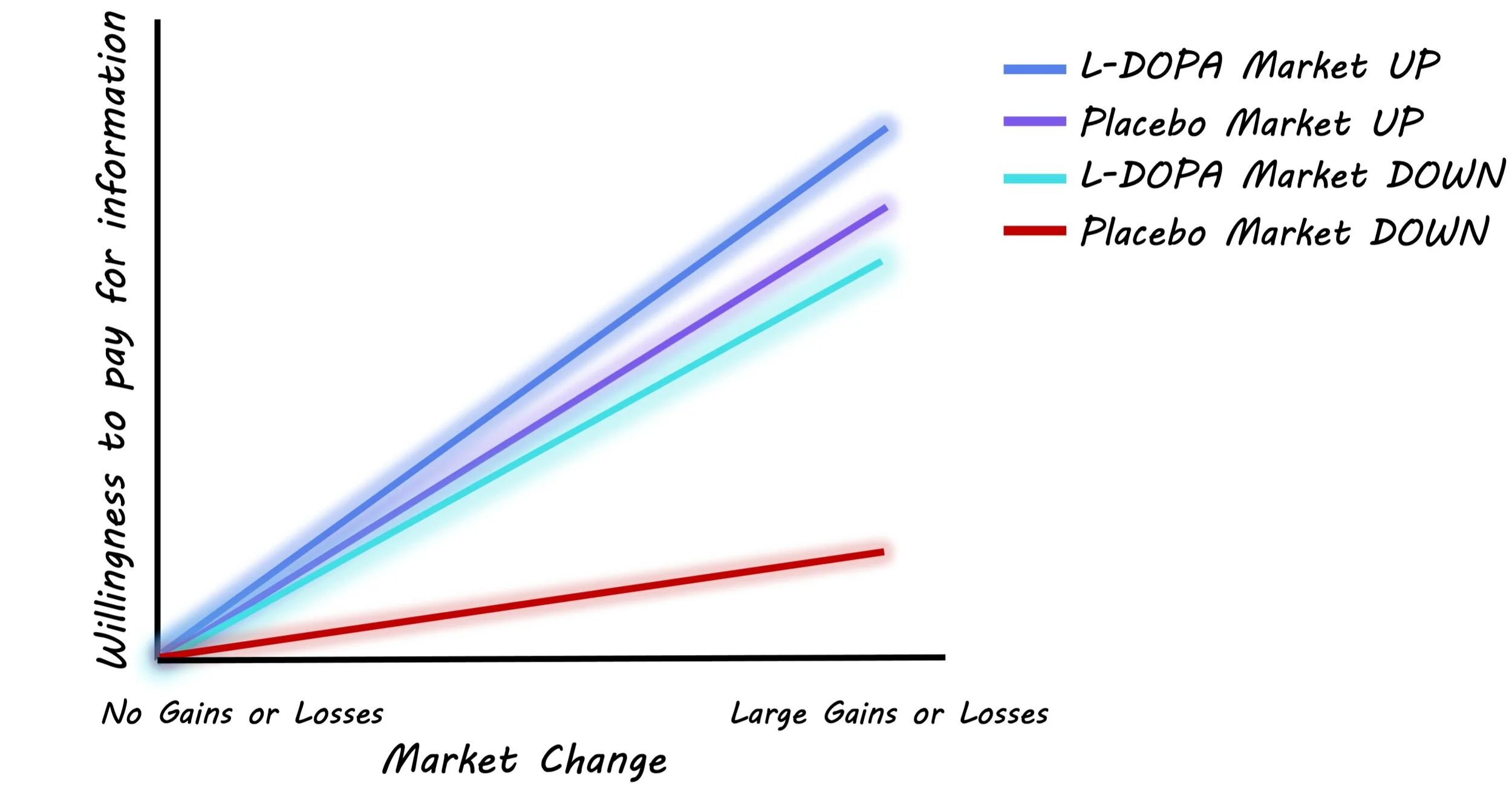
Interestingly, they found that the L-DOPA group was less affected by the expected valence of the information (whether it was a win or a loss). Specifically, participants in the placebo group desired to learn more information when the market was up vs. down, whereas the L-DOPA group’s desire to seek information was not affected by valence (i.e. they wanted to gain information regardless of whether it might be a win or a loss). Furthermore, when investigating the degree of market change, the L-DOPA group was willing to pay more for information the greater the gains or losses, whereas the placebo group was only willing to pay more for information the greater the gains, but not the losses. Finally, they found that the effects of valence observed in the L-DOPA group were not affected by the participant’s expectations about their outcomes (based on whether they believed their stocks to have increased or decreased).
LDOPA_dec15.jpg

What's the impact?

This study shows that dopamine plays a critical role in motivating information-seeking, even if it does not directly lead to a reward. By increasing dopamine levels via L-DOPA administration, participants sought out information both about potential wins and losses, contrary to the placebo group who was mostly interested in information about potential wins. Future studies may investigate whether patients with dopamine deficiencies exhibit abnormal patterns of information-seeking.

Sharot_quote_dec14.jpg

Vellani et al. A selective effect of dopamine on information-seeking. eLife (2020). Access to the original publication can be found here.

Changes in Personality Traits Predict Early Career Outcomes

Post by Shireen Parimoo

What's the science?

Are conscientious people more likely to be satisfied with their career? Several studies show that career outcomes are associated with personality traits. For example, traits like emotional stability and conscientiousness are related to higher income and occupational attainment. Although these traits are largely stable aspects of our personality, they also tend to vary across different life stages, suggesting that our personality undergoes changes over the course of our lifetime. It is particularly important to understand the nature of personality growth in early adulthood because it is a critical period in career development. This week in Psychological Science, Hoff and colleagues investigated how personality changes from late adolescence to early adulthood are related to various career outcomes.

How did they do it?

The authors followed two large, nationally representative samples of adolescents in Iceland (Sample 1 N = 485, Sample 2 N = 1290), beginning when participants were students (15-17 years old) to when they were young adults (27-29 years old). During this period, they measured participants’ personality traits at three (Sample 1) and five time points (Sample 2) using the NEO Five-Factor Inventory, a personality test that provides scores on the traits of openness, conscientiousness, extraversion, agreeableness, and emotional stability. They used linear growth-curve analysis to assess participants’ baseline scores in adolescence on each personality trait and the rate at which their scores changed over time.

After approximately 12 years, the authors recorded subjective career outcomes such as job and career satisfaction, as well as objective measures like monthly income, highest degree obtained, and occupational prestige. Occupational prestige was based on the most recent job held by the participants. To rate occupations on status and prestige, they used the online tool O*NET that classified jobs into different titles (e.g., surgeon) and assigned each title a rating on various work-value dimensions like Achievement and Recognition. To investigate the relationship between personality changes and career outcomes, the authors specified a separate path model (a statistical approach) for each outcome, including personality traits as predictors and controlling for the effect of gender.

What did they find?

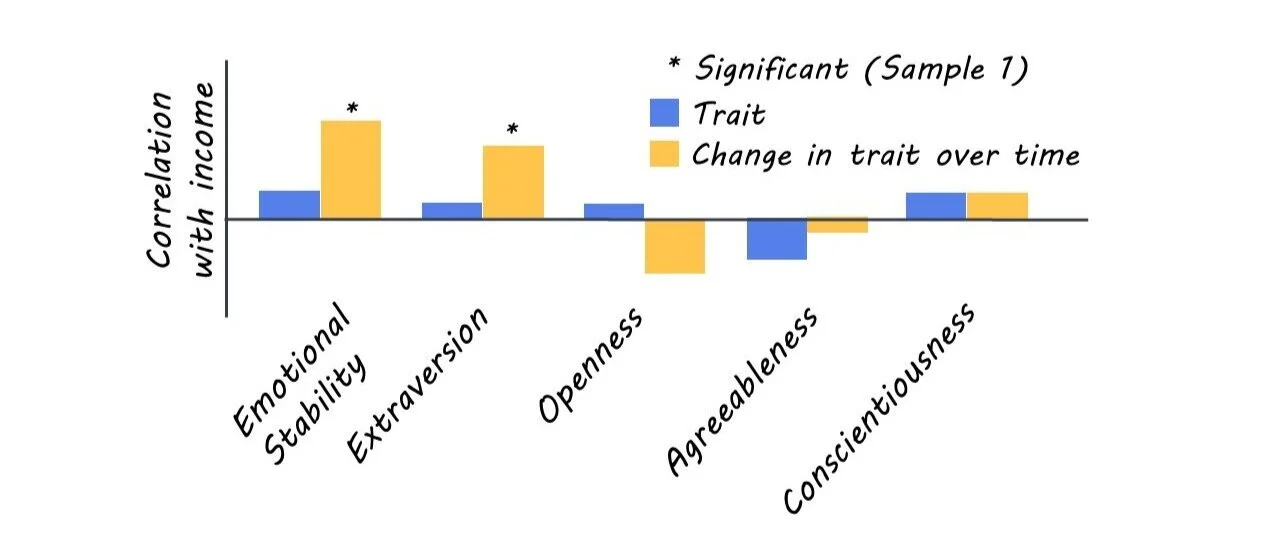
Agreeableness, conscientiousness, and openness increased with age, whereas emotional stability did not change, and extraversion scores decreased. Higher conscientiousness, emotional stability, and agreeableness in adolescence were associated with higher degree attainment in the future. Similarly, baseline levels of emotional stability and conscientiousness (Sample 1) as well as openness and extraversion (Sample 2) were related to greater future occupational prestige. In fact, emotional stability and conscientiousness in adolescence were positively related to nearly all career outcomes, highlighting their importance in future career development. Moreover, changes in personality traits were also predictive of career outcomes. For example, higher income and career satisfaction were associated with increases in emotional stability from adolescence to young adulthood. Similarly, although extraversion decreased in general, increases in extraversion were related to higher career and job satisfaction. Overall, these results show that personality traits in adolescence predict objective measures of career success whereas certain changes in personality traits over time are linked to subjective career outcomes.

shireen+%281%29.jpg

What's the impact?

These results are exciting because they highlight both enduring and mutable aspects of personality development in the transition from adolescence to adulthood. In addition, this is the first longitudinal study to demonstrate how personality traits in adolescence and young adulthood predict objective and subjective career outcomes, respectively. Future research can further examine the direction of the relationship between personality changes and career success.

Hoff_quote_dec14.jpg

Hoff et al. Personality Changes Predict Early Career Outcomes: Discovery and Replication in 12-Year Longitudinal Studies. Psychological Science (2020). Access the original scientific publication here.

GABAergic Interneuron-Astrocyte Interaction Facilitates Complex Behaviours

Post by D. Chloe Chung

What's the science?

Interneurons that release a type of inhibitory neurotransmitter called GABA regulate complex behaviours such as decision-making. Along with other neurotransmitters, GABA released at synapses can be detected by astrocytes that express receptors for GABA (GABABRs). Until now, it has not been well understood whether interaction between GABAergic interneurons and astrocytes can impact complex behaviours. This week in Nature Neuroscience, Mederos and colleagues found that GABAergic signaling to astrocytes plays an important role in modulating behavioural outcomes, by applying electrophysiology and optogenetics to a novel mouse model.

How did they do it?

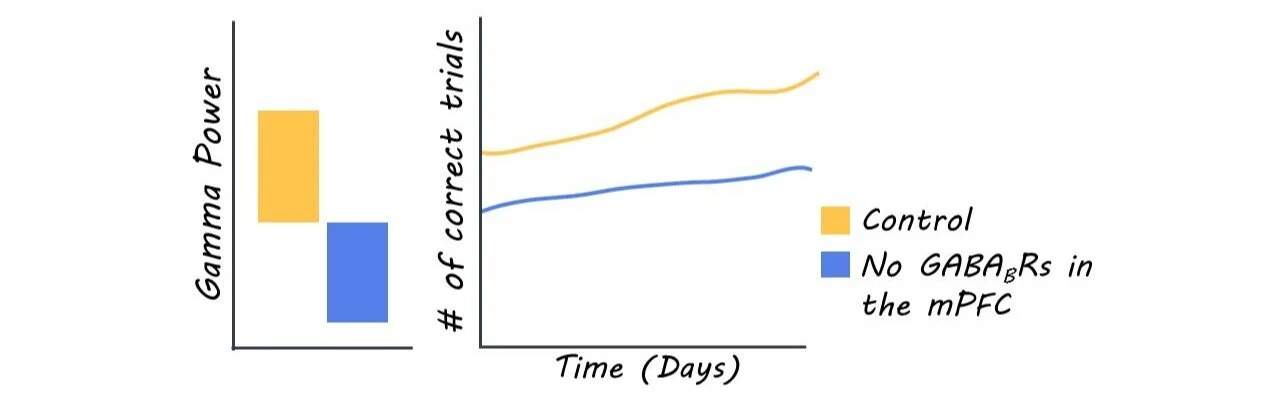
To test the functional role of astrocytes sensing GABA, the authors made a new mouse model that is designed to lack astrocytic GABABRs in the medial prefrontal cortex (mPFC), a brain area that controls decision-making. These mice, along with the control mice, underwent a behavioural test that measures working memory and decision-making. Specifically, mice were made to choose which arm of the simple maze (T-maze) to enter based on their spatial memory (i.e. which arm they previously took food from). During the behavioural test, the authors monitored dynamic changes in neural activity in the mouse brain using electrophysiological techniques. In parallel, the authors used a slice of mouse mPFC to perform ex vivo recordings of neuronal firing while mimicking interneuron-astrocyte signaling. To understand direct consequences of mPFC astrocyte activation on mouse behaviors, the authors injected virus into the brains of both control mice and genetically modified mice to specifically stimulate astrocytes using melanopsin, a light-sensitive G-protein.

What did they find?

The authors first observed that mice without GABABRs in the mPFC astrocytes had impaired working memory and decision-making compared to control mice, as shown by the T-maze test. From simultaneous electrophysiological recordings, the authors found that low gamma oscillations (30–60 Hz) in the brain were substantially reduced while mice were experiencing impaired decision-making. These findings collectively indicate that deficits in GABAergic astrocyte signaling disrupted brainwaves and neuronal firing properties that are critical for decision-making, subsequently impairing behavioural outcomes. Ex vivo mPFC recording further revealed that interaction between GABAergic interneurons and astrocytes through GABABRs importantly regulates the inhibitory neural circuitry. Interestingly, when the authors optogenetically activated mPFC astrocytes, control mice performed better at the decision-making test. The observed improvement in decision-making was accompanied by enhanced neuronal firing and gamma oscillations, suggesting that activation of astrocytes in the mPFC can markedly improve cognitive capacity. Based on this finding, the authors performed a similar optogenetics experiment with mice that lack GABABRs in mPFC astrocytes and found that optogenetic stimulation of mPFC astrocytes rescued behavioural deficits. In other words, mice that were once impaired in their decision-making due to the loss of GABAergic astrocyte signaling behaved similarly to naïve mice upon selective activation of astrocytes.

Chloe+%281%29.jpg

What’s the impact?

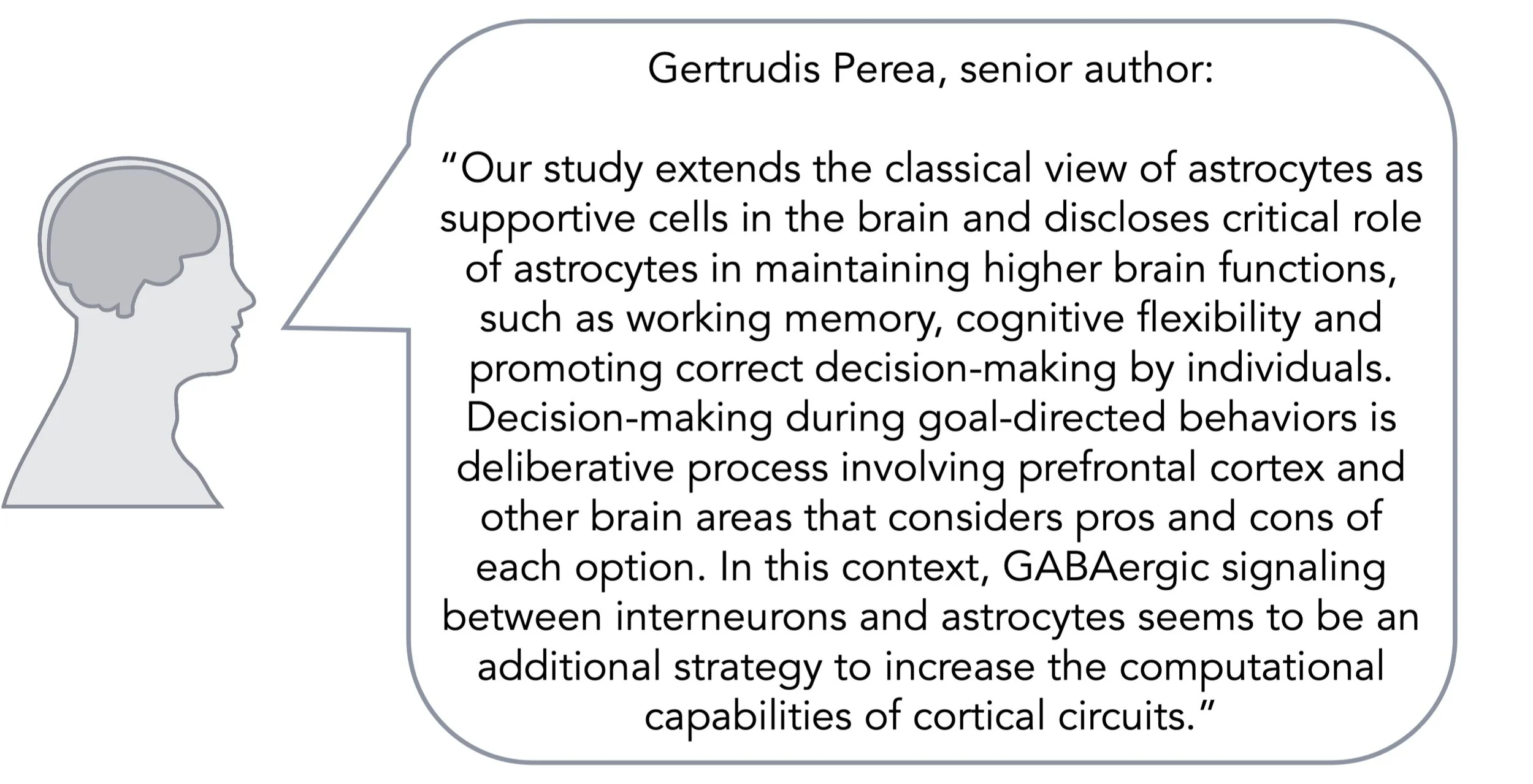
This study is the first to demonstrate that GABAergic signaling involving interneurons and astrocytes in the mPFC is critical in modulating decision-making. Past studies have reported that behaviour can be impacted by astrocytes in brain regions other than mPFC such as the hippocampus and amygdala. This work expands the functional role of astrocytes, presenting them as essential players in facilitating complex behaviour controlled by mPFC. As the authors suggested, given the variety of interneurons in the brain, it will be interesting to further investigate whether other types of interneurons can also interact with astrocytes in a similar manner.

Perea_quote_dec14.jpg

Mederos et al. GABAergic signaling to astrocytes in the prefrontal cortex sustains goal-directed behaviors. Nature Neuroscience (2020). Access the original scientific publication here.