Children Are Fundamentally Different in Visual Perceptual Learning

Post by D. Chloe Chung

What's the science?

Visual perceptual learning is the phenomenon in which our visual performance improves as we continue to practice perceptual tasks composed of visual cues. Visual perceptual learning can also be influenced by our age. It has been previously reported, for example, that older individuals perform drastically different in visual learning compared to younger adults. However, it has been unexplored whether visual perceptual learning also changes during development, such as from childhood to adulthood. This week in Current Biology, Frank and colleagues show that visual perceptual learning is different in children and young adults as they do not handle visual information in the same way.

How did they do it?

On the first day of the study, 20 healthy children (7-10 years old) and 20 healthy young adults (18-31 years old) fixated their gaze to the center of the screen and monitored 70 dots of which some of them were moving in the same direction. At the end of each of 300 trials, the participants were asked if they noticed the motion of dots to be coherent or random. Their “detection threshold” was determined based on the minimum percentage of dots moving in the same direction required for the participants to perceive the coherent motion. The next day, during the “pretest” session, the participants again monitored moving dots and determined the direction of the dots’ motion, similar to the first day of the study. On the third day of the study, participants had the first of several “exposure sessions” where they were exposed to moving dots either at threshold or at suprathreshold levels for coherent motion detection while completing a visual task at screen center. Specifically, on each trial, participants were presented with a stream of eight images, either “target” (two different animals) or “distractor” (six non-animal objects), surrounded by dots moving in a certain direction. At the end of each of 110 trials, participants were shown with four animal photos and asked to answer which two animals (targets) were presented in what order on this trial. A total of 12 exposure sessions was conducted on separate days. On the last day of the study, the participants underwent the “post-test” session where they repeated the same task from the “pre-test” session” to see if their visual performance for motion direction discrimination improved after the exposure sessions. Additionally, the participants took another test that measures their selective attention, in which they had to determine peripheral stimuli among distractors while focusing on the main target at the center of the visual field.

What did they find?

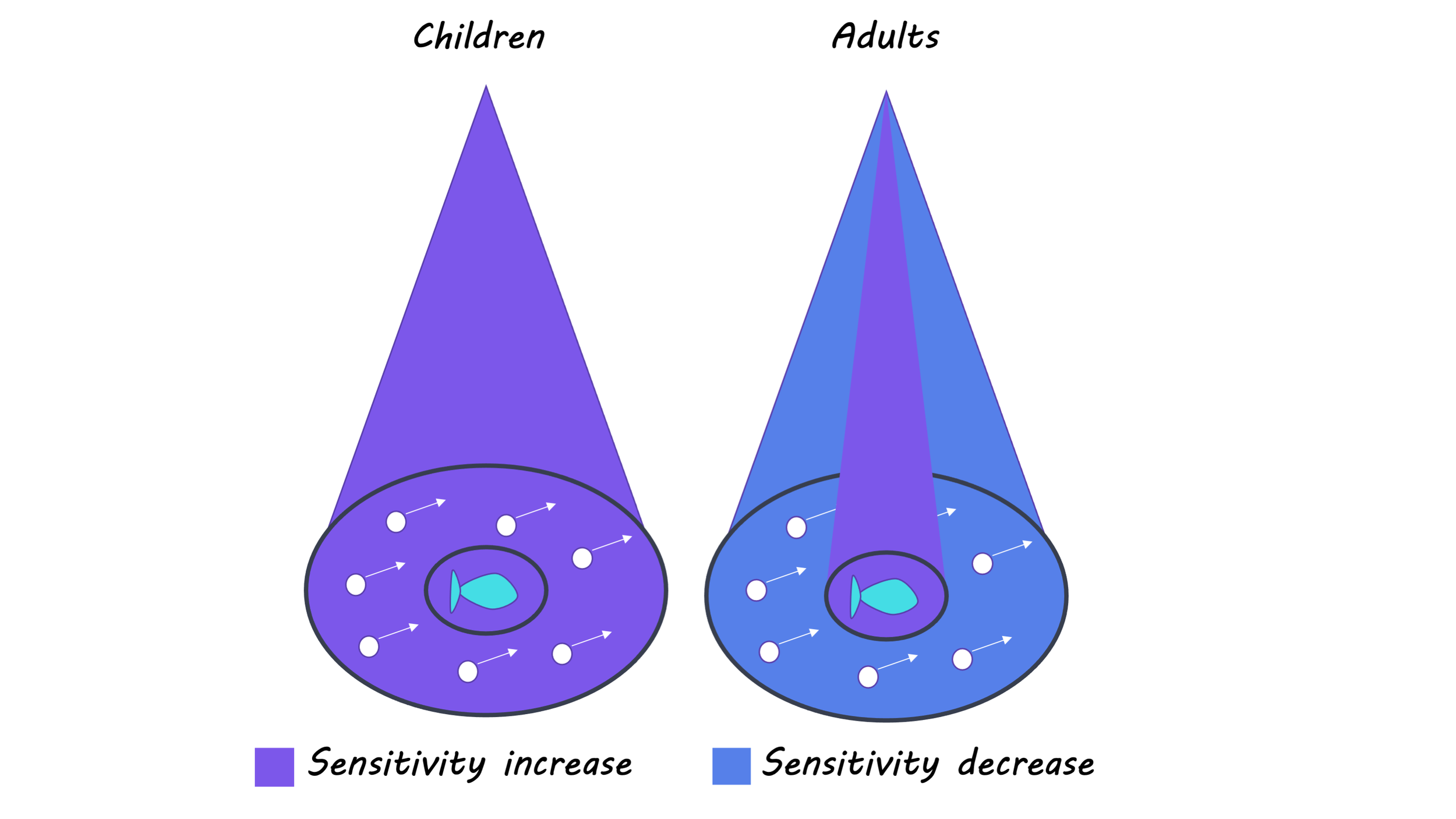
First, the authors found that children and young adults had a comparable detection threshold, meaning that the participants were similar in their baseline ability to detect the coherent motion of dots regardless of their age. Next, the authors evaluated whether the participants improved in distinguishing the motion of moving dots after being repeatedly exposed to moving dots while completing a central visual task. Between the pre-test and post-test, both children and young adults showed approximately 40% performance improvement in their performance when the moving dots were presented at the threshold level. Interestingly, when moving dots were presented at the suprathreshold level, children still showed improved visual performance while adults drastically decreased in their performance, indicating that visual perceptual learning substantially differs between two age groups. This noticeable change in performance only occurred for motions that were linked to targets that the participants had to focus on during the exposure session.
vision_img_nov24.png

To rule out the possibility that children’s improvement in visual performance was due to their inability to ignore visual features that were irrelevant to tasks during their visual exercise, the authors analyzed the correlation between selective attention ability and visual performance change for motion discrimination after suprathreshold exposure across participants. This analysis showed that children with greater selective attention ability also showed greater performance increases. Importantly, this correlation between selective attention ability and visual performance change was not found among young adults, emphasizing that mechanisms of visual perceptual learning are fundamentally different between children and young adults.

What’s the impact?

This study is the first one to report that visual perceptual learning remains dynamic as we advance from childhood to adulthood, due to differences in the way children handle visual cues compared to young adults. Findings from this study provide another important piece of evidence that similar to many of our other learning abilities, visual perceptual learning can dramatically change throughout our lifetime. For future studies, it will be interesting to investigate specific brain regions or neurotransmitters that are involved in the mechanistic differences between children and adults in their visual perceptual learning.

Frank_quote_Nov24.jpg

Frank et al. Fundamental Differences in Visual Perceptual Learning between Children and Adults. Current Biology (2020). Access the original scientific publication here.
Modulating Gamma Oscillations with Deep Brain Stimulation Improves Motor Symptoms in Parkinson’s Disease

Post by Amanda McFarlan

What's the science?

Deep brain stimulation is a commonly used treatment for improving motor symptoms in individuals with Parkinson’s disease. This treatment consists of stimulating the subthalamic nucleus (nucleus within the basal ganglia that contributes to the control of involuntary movement) via implanted electrodes to help regulate brain activity and improve motor function. It has been shown that deep brain stimulation leads to a reduction in pathologically enhanced beta oscillations in the brain. Additionally, recent findings have suggested that modulations in gamma oscillations may also play a role in the improvement of motor deficits following deep brain stimulation. This week in Brain, Muthuraman and colleagues investigated the effect of deep brain stimulation on resting state oscillatory activity in the brain in individuals with Parkinson’s disease.

How did they do it?

The authors recruited 31 participants who were diagnosed with Parkinson’s disease and had received chronic treatment with deep brain stimulation for 6-12 months prior to the study. For half of the participants, deep brain stimulation was optimal when it was delivered at 130 Hz, while the other half experienced optimal results when deep brain stimulation was delivered at 160 Hz. All participants received a preoperative MRI brain scan and a postoperative CT scan. The authors recorded 10-minute periods of resting state electroencephalography (EEG) activity in four conditions: (1) deep brain stimulation off, (2) deep brain stimulation at clinically effective frequency, (3) deep brain stimulation 20 Hz below the clinically effective frequency, and (4) deep brain stimulation 20 Hz above the clinically effective frequency. The authors performed post-hoc analyses examining beta and gamma frequency bands to determine the effect of deep brain stimulation on oscillatory activity during resting state.  

What did they find?

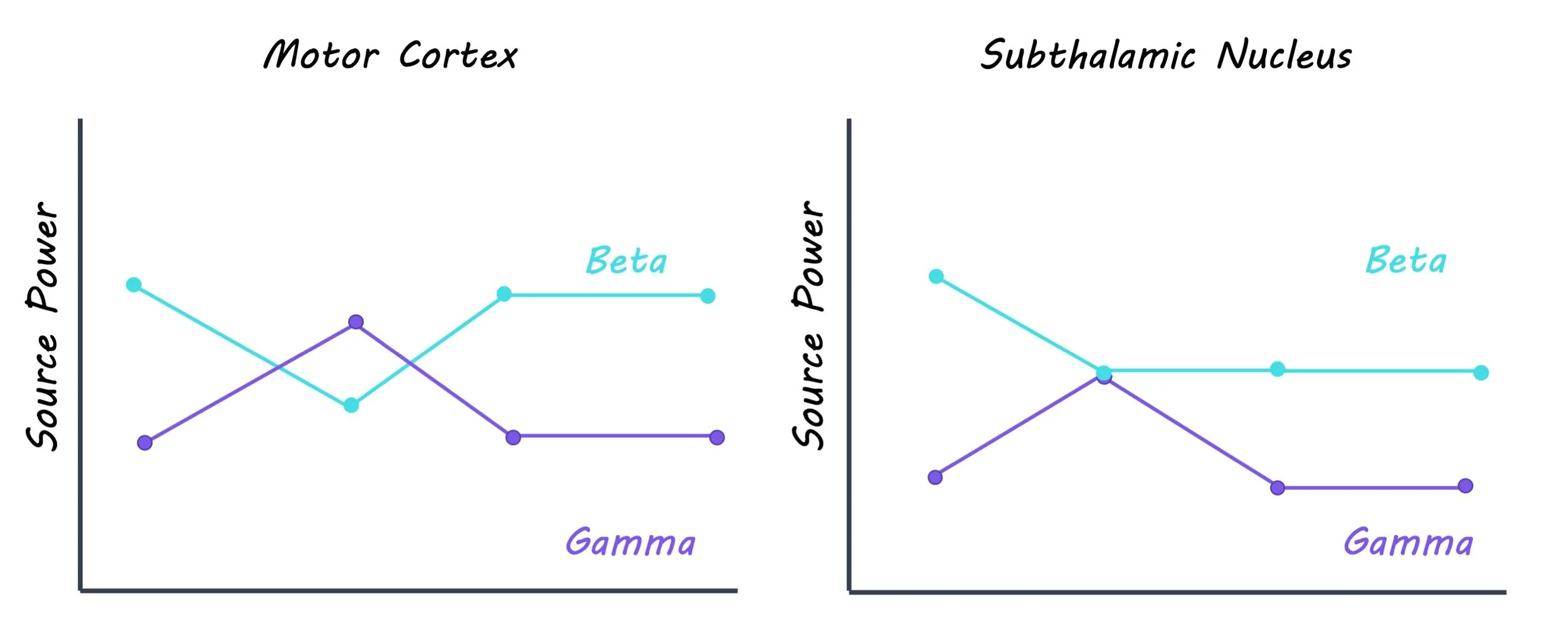
The authors determined that motor impairments were only significantly reduced following clinically effective deep brain stimulation. They found that clinically effective deep brain stimulation also significantly reduced beta power and increased gamma power in cortical regions of the brain that form connections to the basal ganglia. The beta and gamma power for these regions were negatively correlated with one another while the deep brain stimulation was on, but were not significantly correlated when the stimulation was off. Furthermore, the authors observed cross-frequency coupling of gamma oscillations during clinically effective deep brain stimulation in the cortico-basal ganglia brain network. The cross-frequency coupling of gamma oscillations was also shown to be negatively correlated with motor deficits

DBS_image.jpg

What’s the impact?

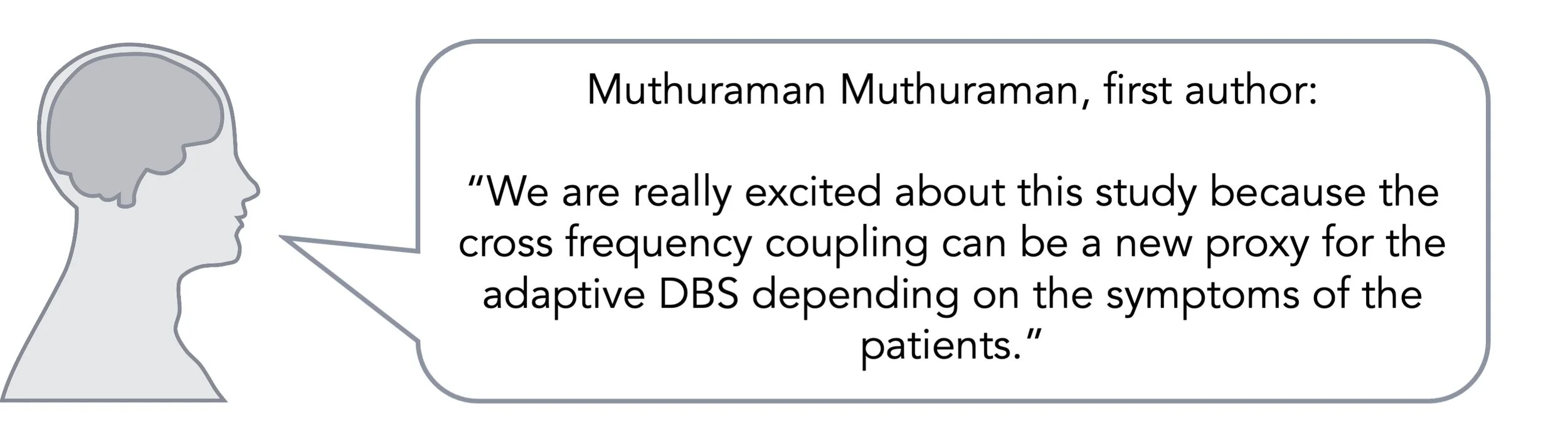
This study demonstrates that oscillatory activity within the cortico-basal ganglia network is altered following clinically effective deep brain stimulation. The authors showed that alterations in gamma oscillations may play an important role in improving the motor deficits associated with Parkinson’s disease. Together, these findings provide insight into the network-level effects of deep brain stimulation which may be useful in future studies for optimizing treatment for Parkinson’s disease using deep brain stimulation.  

DBS_quote_nov17.jpg

Muthuraman et al. Cross-frequency coupling between gamma oscillations and deep brain stimulation in Parkinson’s disease (2020). Access the original scientific publication here.
Belief Updating in Bipolar Disorder Predicts Relapse

Post by Flora Moujaes

What's the science?

Bipolar disorder affects around 3% of the population and is characterized by periods of mania and depression, interspersed with periods of wellbeing. A key question in bipolar disorder research is whether it is possible to predict when relapse will occur in order to treat patients earlier. One approach to addressing this question is to examine how bipolar disorder patients learn about self-relevant information. We know that healthy individuals update their beliefs more in response to new positive information than negative information. This pattern of learning is often distorted in individuals with mental health disorders. For example, individuals with depression update their beliefs more in response to negative information than positive information, leading to a more pessimistic outlook. This week in Elife, Ossola and colleagues investigate whether it is possible to predict when an individual with bipolar disorder will relapse by examining how they update their beliefs.

How did they do it?

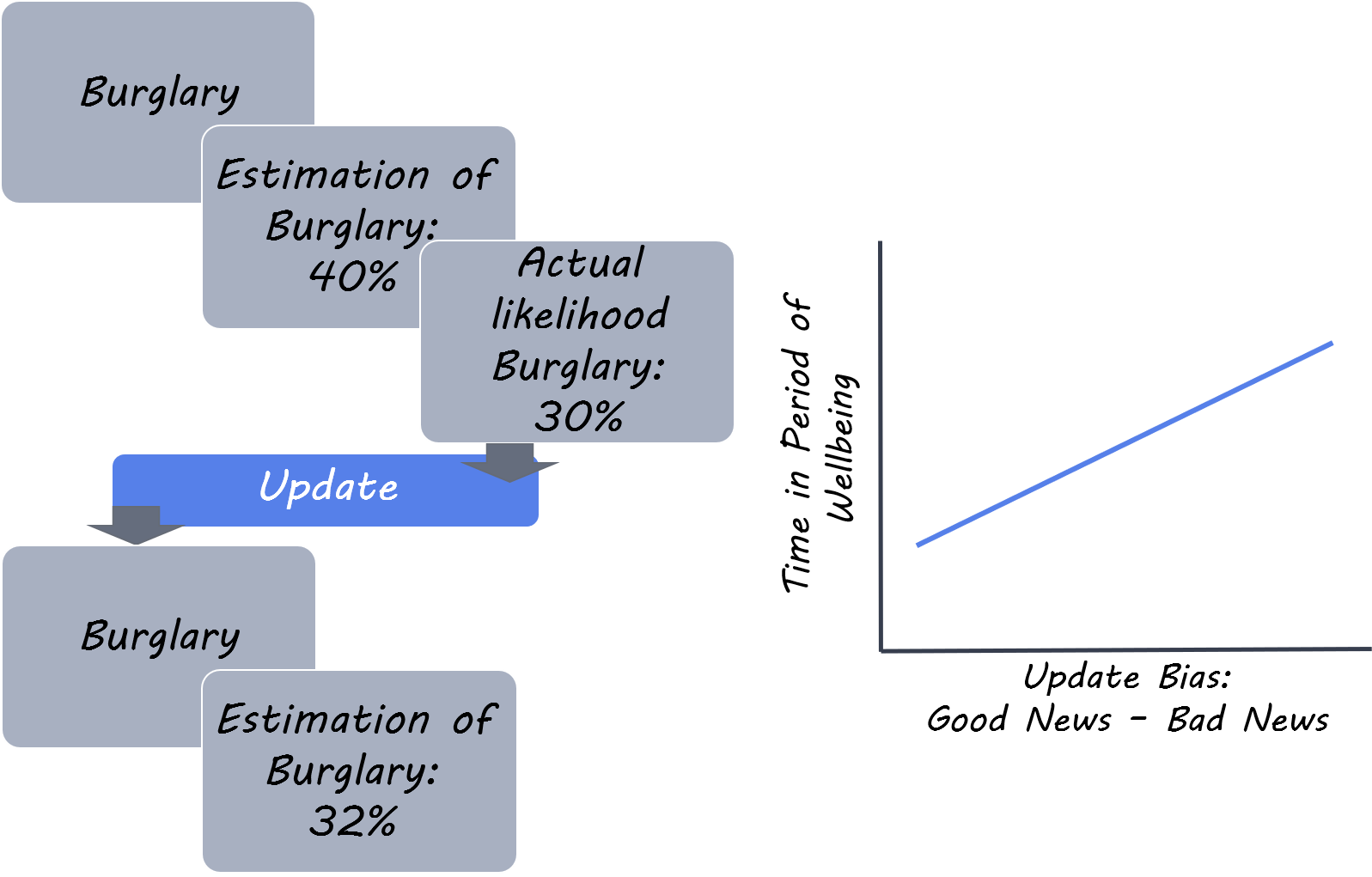
In order to explore whether changes in belief updating could predict relapse in bipolar disorder, 36 individuals diagnosed with bipolar disorder performed a belief-updating task during a period of wellbeing. They were then monitored for symptoms of bipolar disorder every 2 months for the next 5 years. In the task, participants were presented with 40 adverse life events, such as a robbery, and asked to estimate how likely it was to happen to them in the future (first estimate). They were then presented with information about how likely the event was to happen in a demographically similar population. The information provided was either positive (e.g. robberies occur less frequently than the participant estimated in the demographic similar to them) or negative (e.g. robberies occur more frequently than the participant estimated). In a second session, participants were then asked to provide an estimate of how likely the same event was to happen to them (second estimate). By measuring the difference between the first and second estimate, the task is able to capture how participants update their beliefs based on new information. The researchers also controlled for confounding factors such as participants' memory, and their familiarity with the adverse event.

What did they find?

The researchers found that there was an association between belief updating and time to relapse. Participants who were more likely to update their beliefs in response to good news relative to bad news took longer to relapse. Interestingly, the reduction of a positivity bias in belief updating was predictive of both depressive and manic episodes, which is consistent with the clinical observation that stressors are equally likely to trigger episodes of depression and mania. 

flora (1).png

The researchers also showed that change in belief updating was a better predictor of when participants would relapse than traditionally used clinical and demographic indicators such as age, education, gender, medication, duration of illness, and depression score. Finally, they used a machine learning method (leave-one-out validation) to show that including the update bias in their model was crucial in order for the model to predict the time to relapse.

What's the impact?

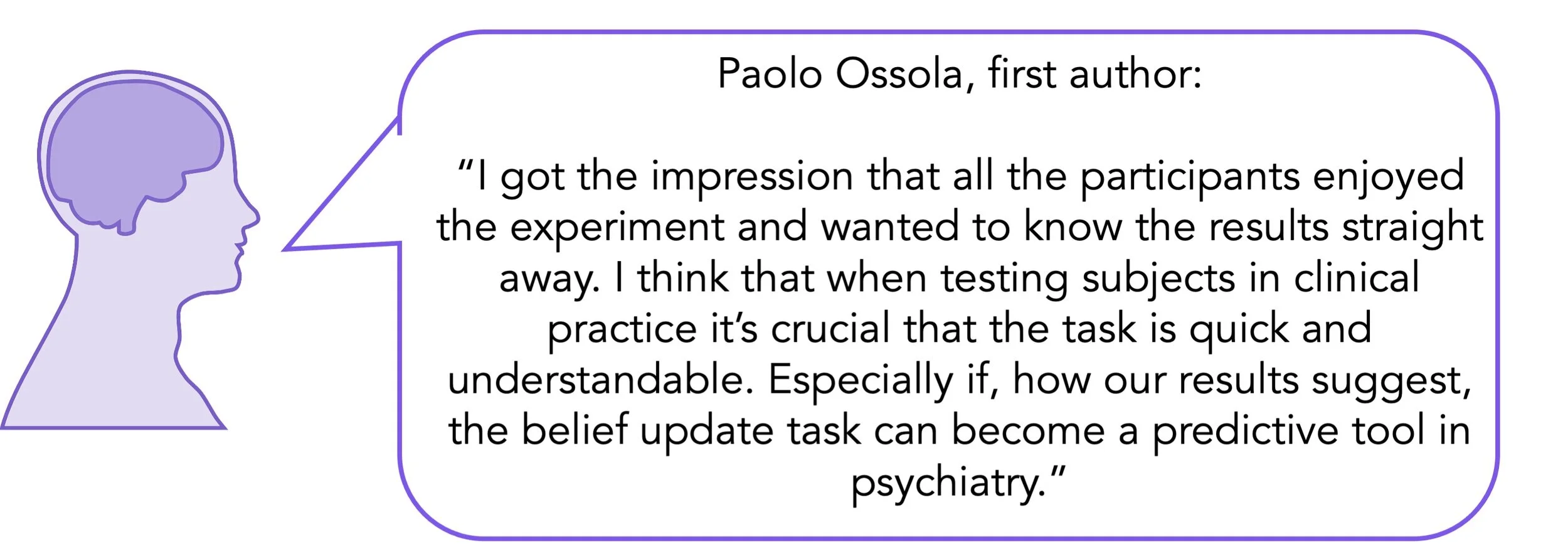
This is the first study to show that greater belief updating in response to positive information relative to negative information predicts a longer time to relapse in individuals with bipolar disorder. This indicates that biased processing of information in a manner that supports an optimistic outlook is linked to a more favorable course of bipolar disorder, while biased processing of information in a manner that supports a pessimistic outlook may provide a more fruitful environment for clinical symptoms to manifest. Not only is this finding important for understanding the relationship between valence-dependent learning and mood, but it may have wide-reaching clinical implications in terms of developing preventative treatments, the identification of high-risk patients, and developing tools for the early diagnosis of affective disorders.

Ossola_quote.jpg

Ossalo et al. Belief updating in bipolar disorder predicts time of recurrence. Elife (2020). Access the original scientific publication here.