
Why Do We Reward Giving, but Not Giving Effectively?

Post by Amanda McFarlan

What's the science?

The concept of donating is one with which we are all familiar, and yet, very few of us actually take the time to think about the effectiveness of our giving. One potential explanation for this is that giving evolved to be mainly driven by social rewards - rewarding behaviours that are easily defined and observed. Thus, the efficacy and impact of donating, which are not easily defined or observed, may not have evolved to be important factors to consider when deciding to donate. This week in Nature Human Behaviour, Burum and colleagues performed a total of five studies to demonstrate that the social rewards associated with giving are sufficient to encourage people to give, but not to give effectively.

How did they do it?

In the first study, participants were divided into two groups, and each given a 30-cent bonus. The first group of participants was given the option of donating all, some, or none of their bonus to a charity of their choosing, while the second group of participants was given the option of saving all, some, or none of their bonus to receive later. In both groups, the amount of money donated or saved would be matched by a factor of 1 to 10. 

In a second study, participants were asked what percentage of their income they would be willing to donate in order to prevent one stranger, five strangers, one family member, or five family members from starving for a year. Participants in the third, fourth and fifth studies were matched with a donor who had selected their favorite charity from a list and was given the choice to keep or donate all of a bonus to that charity, varying with each study. In the third study, the donor was given the choice to donate all or some of a bonus that would either be matched (1:1) or not. In the fourth study, the donor had the same choice to keep or donate all of a bonus, but this time the participants were told that the bonus was either 10 cents or 20 cents. In the fifth study, the donor received a bonus of either 75 cents or 90 cents and was given the choice to donate one of several amounts. Participants were always matched with a donor who donated 60 cents. After reading about the donor’s decision, participants were given a 30-cent bonus and were given the option to reward the donor with some or all of their bonuses. Participants were also asked to rate the donor on characteristics including how generous, giving, good a person, ethical, moral, and deserving of praise they were. 

What did they find?

In the first study, the authors found that participants responded to efficacy when saving, but not when donating to charity. Matching the donation by a factor of 1 to 10 did not have an effect on the amount the participants donated, but it did have a significant effect on the amount they saved. In the second study, the authors showed that participants donated effectively when helping their family members, but not when helping strangers. Participants were willing to donate substantially more when helping family members compared to strangers. They were also willing to donate more when five family members were in need compared to one family member, while the amount they were willing to donate to strangers was similar regardless of the number of people in need. 

Amanda (1).png

Next, the authors showed that in the third, fourth, and fifth studies, the donors who chose to donate were rewarded more by the participants than the donors who did not choose to donate. Notably, the authors found that the participants did not reward the donor more if their donation was larger, whether they donated a small or large bonus, or if the donor gave a larger portion of their total bonus. The participants’ character assessments of the donors mirrored these results such that donors that chose to give were seen as generous, but donors who gave more were not seen as more generous than donors who gave less.

What’s the impact?

This study demonstrates that people do not attend to efficacy when donating to charity but are capable of attending to efficacy in situations that are not dictated by social rewards, such as saving for the future and helping family members. Additionally, people are insensitive to the impact of giving. All together, these findings support the notion that donors evolved to be sensitive to clearly defined behaviors that bring social rewards.
Burum_Oct20.jpg

Burum et al. An Evolutionary Explanation for Ineffective Altruism. Nature Human Behaviour (2020). Access the original scientific publication here.
 

Smartphone Use in School and Academic Performance

Post by Shireen Parimoo

What's the science?

Ever since smartphones gained popularity and became a seemingly indispensable part of our lives, they have been linked to a number of negative outcomes including low grades, poor sleep, reduced social engagement, and even depression. How much of this is supported by research? Does smartphone use really have a negative impact on students’ grades? This week in Psychological Science, Bjerre-Nielsen and colleagues report results from a 2-year observational study that investigated the relationship between smartphone use among young adults and their academic performance.

How did they do it?

Participants were 470 students (19-29 years old) who were part of the Copenhagen Networks Study in Denmark. The students agreed to have their smartphone usage tracked over the course of two years, which included tracking their GPS location, social interactions, and the on/off status of the smartphone screen. The authors combined the frequency of smartphone use and class attendance to obtain measures of in-class and out-of-class smartphone usage. They also obtained student-specific characteristics such as the participants’ age, sex, personality traits (e.g., Big Five Inventory), and grade-point averages (GPA) for each course.

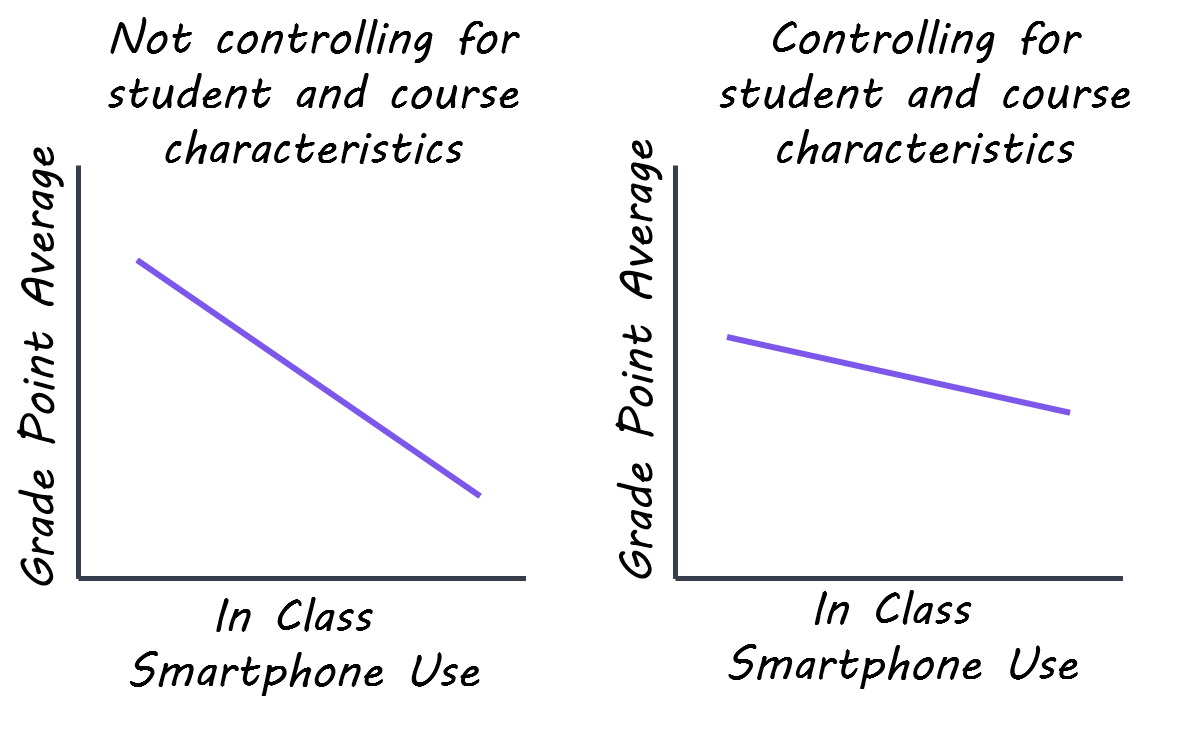
The authors first assessed the correlation between in-class and out-of-class smartphone use and GPA. They then specified two types of statistical models to assess the effect of smartphone use on academic performance, each of which had its own set of advantages. Panel models included data for every student’s grades and smartphone use in each of their courses, which allowed the authors to examine the effect of both student characteristics (e.g., age) and course characteristics (e.g., difficulty) on academic performance. Conversely, a cross-sectional model included data for each student’s overall grade and smartphone use and allowed them to compare their results to previously published research on the topic.

What did they find?

Greater smartphone use was related to poorer academic performance, and this relationship was stronger for in-class smartphone use. Smartphone use was also negatively correlated with students’ high-school GPA. Thus, students who used their smartphone more frequently in class had a lower GPA in both high school and university. The cross-sectional model largely replicated previous findings on this topic, namely, that greater smartphone use during class is associated with lower grades. However, results from the panel model indicate that the relationship between smartphone use and academic performance is not as strong as previously thought. Specifically, when student and course-specific characteristics like personality traits and class difficulty are accounted for in the model, the association between smartphone use and GPA is not reliable.

shireen.png

What's the impact?

Smartphone use may not have as detrimental an impact on students’ academic performance as previously thought. Moreover, the study highlights the importance of considering individual- and context-specific characteristics in performing this type of research, which can have an impact on the magnitude of the observed effects. Overall, these findings provide some reassurance as smartphones are becoming increasingly pervasive and students are exposed to them at younger ages than before.  

smartphone_quote_Oct12.jpg

Bjerre-Nielsen et al. The negative effect of smartphone use on academic performance may be overestimated: Evidence from a 2-year panel study. Psychological Science (2020). Access the original scientific publication here.
Blood-Brain Barrier Gene Expression and Function Changes with Neuronal Activity

Post by D. Chloe Chung

What's the science?

The blood-brain barrier (BBB) is a semi-permeable structure that tightly controls the movement of molecules between the brain and neighboring blood vessels. Several studies have described the dynamic communication between the brain vasculature and neuronal activity. For example, blood volume and flow increase following neuronal activity (likely for oxygen and nutrient provision). However, it is not yet well understood whether changes in neuronal activity can directly influence the properties of BBB. This week in Neuron, Pulido and colleagues report that neuronal activity in the mouse brain, either chemically or behaviorally stimulated, can regulate efflux via BBB transporters (i.e. for waste removal) by altering its gene expression profile.

How did they do it?

The authors used transgenic mouse models in which glutamatergic neurons can be either activated or silenced using specific drugs. Three hours after drug injection, the authors collected endothelial cells, which form blood vessel walls, from the mice and performed RNA sequencing to examine gene expression changes in the BBB. These mice were also injected with fluorescent-labeled substrates of one of the BBB transporters to test whether functional properties of BBB, such as molecule transport, changed with neuronal activity. As an additional approach to stimulate neuronal activity, the authors capitalized on the knowledge that whisker movement typically leads to neuronal firing in a specific brain area. They designated two groups: mice with intact whiskers were made to explore their cage with many things to interact with using their whiskers, while mice with their whiskers trimmed off were left in an empty cage. Similar to the transgenic mouse models, these mice were analyzed for the gene expression changes in their endothelial cells. To evaluate the relationship between BBB efflux and neuronal activity-regulated circadian rhythm, the authors made an additional mouse model in which circadian genes can be deleted specifically in endothelial cells.

What did they find?

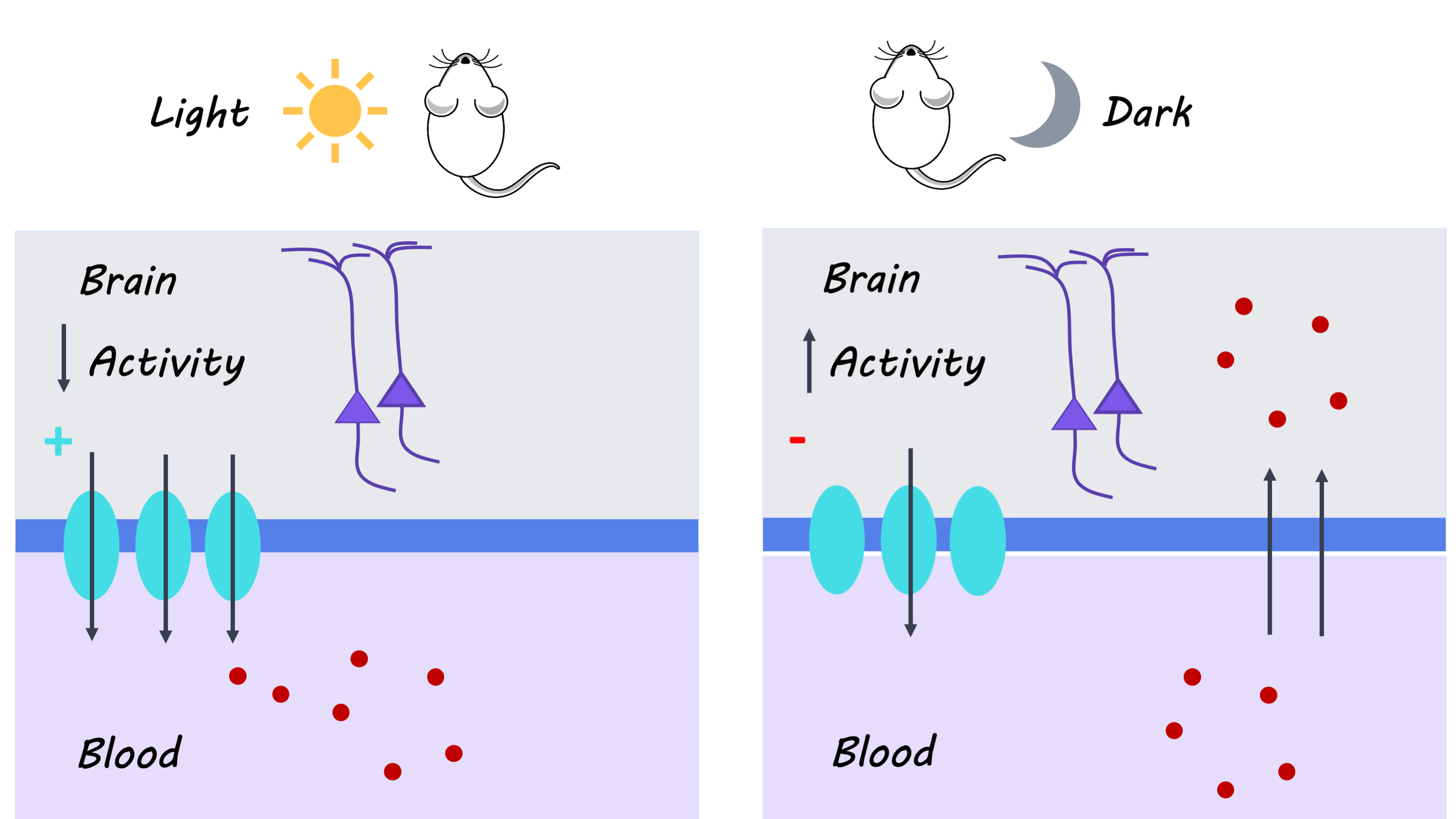
The authors found that changes in glutamatergic neuronal activity can dramatically regulate the expression level of hundreds of genes in endothelial cells, including multiple transporters and efflux pumps that can control the transfer of molecules across the BBB. In particular, several BBB efflux transporters were upregulated when neuronal activity was silenced, and downregulated when neuronal activity was higher. These gene expression changes led to transporter substrates (but not the non-substrates) entering the mouse brain more readily when neurons were activated. 

In addition to transporters, several genes involved in circadian rhythm were also differentially regulated upon neuronal activity. They showed a similar pattern to transporters: gene expression was upregulated with neuronal silencing and downregulated with neuronal activation. In the context of circadian rhythm, the authors observed that the gene expression level of a BBB efflux transporter and its permeability rhythmically fluctuated throughout the light-dark cycle and generally correlated with net neuronal activity throughout the day. Interestingly, this rhythmic fluctuation and acute neuronal regulation were completely abolished when one of the circadian genes was deleted in the endothelial cells, indicating that circadian genes, regulated by neuronal activity, can impact the expression and function of the BBB efflux transporter. Of note, the same transporters and circadian genes were also downregulated in mice in which neurons were activated via whisker stimulation, further demonstrating that neuronal activity can modulate these genes in the BBB.

BrainPost_images_Oct12.png

What’s the impact?

This work revealed that the gene expression profile and functional properties of the BBB can be regulated by neuronal activity, in contrast to the previous belief that the BBB remains largely static. As the authors suggest, future studies examining activity-dependent gene expression changes in the endothelial cells across different time points will expand our understanding of the dynamic nature of the BBB. From a clinical standpoint, this study can be useful in optimizing drugs to cross the BBB with higher efficiency, as these BBB efflux transporters pose a major obstacle for drug delivery into the brain. Finally, findings from this work may be applied to investigate the relationship between dysregulated BBB efflux and neurological disorders.

BBB_quote_oct12.jpg

Pulido et al. Neuronal Activity Regulates Blood-Brain Barrier Efflux Transport through Endothelial Circadian Genes. Neuron (2020). Access the original scientific publication here.