
Cortical-Like Dynamics Emerge as a Result of Sampling-Based Inference

Post by Cody Walters

What’s the science?

The brain’s cortical dynamics are characterized by a variety of motifs such as stimulus-dependent oscillations, transients, and changes in variability. The functional role of these phenomena are unclear, and to date there is no unifying framework to account for these distinct features of cortical activity. This week in Nature Neuroscience, Echeveste et al. provide evidence that these dynamics might emerge as a result of how the brain represents uncertainty.

How did they do it?

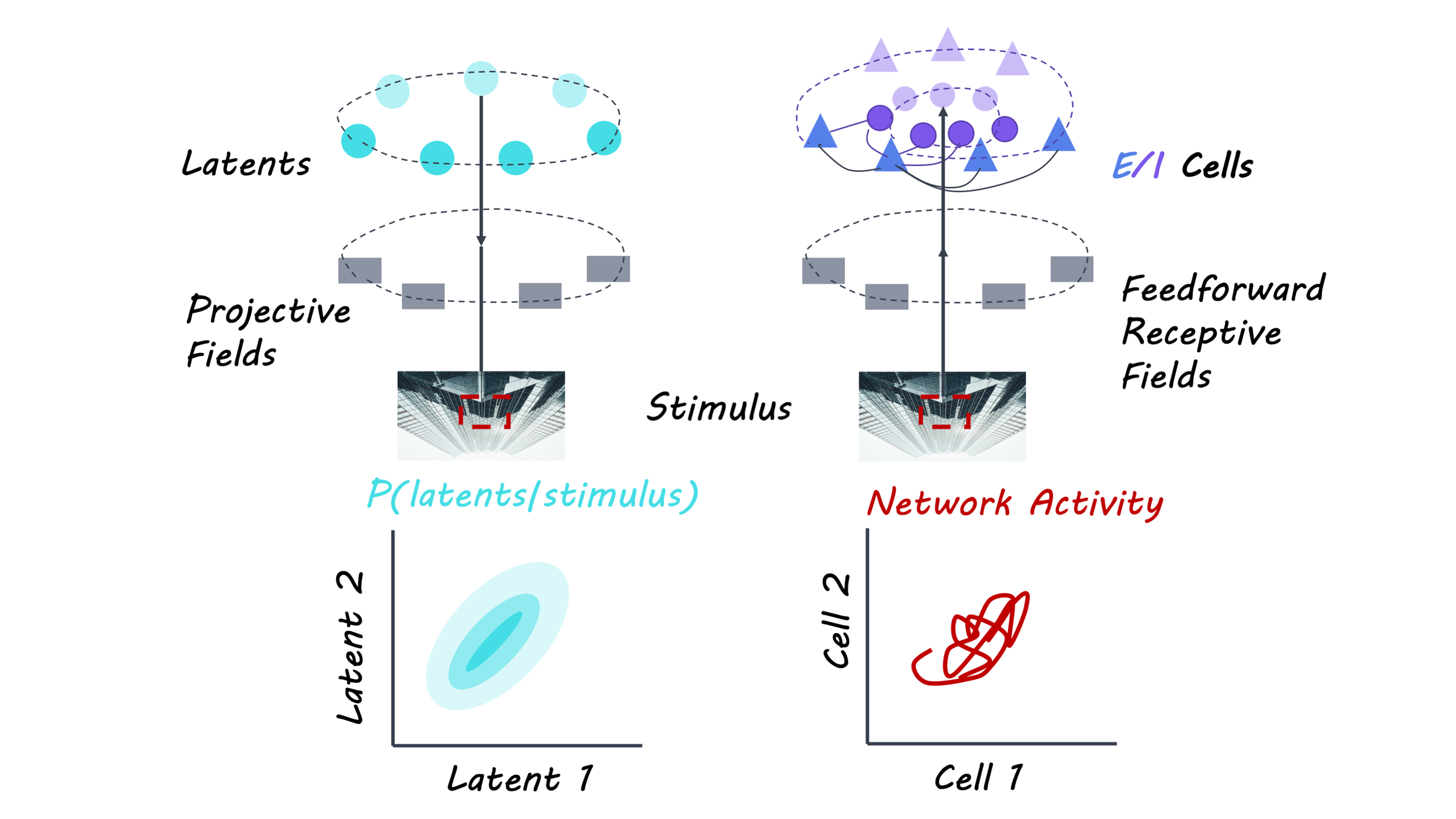
The authors optimized a recurrent neural network (a form of machine learning) with biological constraints to perform sampling-based probabilistic inference. In order to train the network, they employed a known generative model (a Gaussian scale mixture model) to capture the statistics of small segments of natural images. A generative model is a probabilistic model of the world that describes how sensory observations were likely generated. Specifically, a well-calibrated generative model allows you to infer the state of latent (i.e., unobserved) variables that most likely caused a given stimulus. The authors used a generative model that describes each image patch as a weighted sum of gabor filters (which are commonly used to approximate the receptive fields found in visual cortex) with varying orientations and intensities. Using Bayes rule, they ‘inverted’ their generative model in order to probabilistically infer the configuration of latent variables (in this case, the set of gabor filter intensities) that were the most likely cause of a given image patch. This method is referred to as the ‘ideal observer’ because it performs the task optimally (from a Bayesian perspective). The distribution of inferred latent variable values (i.e., gabor filter intensities) given a specific stimulus (i.e., image segment) are known as the posterior in Bayesian modeling, and the weights in the recurrent network were trained in order to mimic the posterior distributions produced by the generative model. 

The architecture of the recurrent network mirrored the structure of the generative model such that each excitatory neuron in the network corresponded to a specific latent variable (i.e., gabor filter intensity). Thus, as the firing rate patterns between neurons evolved over time, they traced out regions in membrane potential space that reflected a probability distribution (with each point in that region of neural activity representing a ‘sample’ from the posterior). Under this assumption, the mean of the neural activity is related to the estimated peak of the posterior (i.e., the most likely configuration of latent variables given an image segment), while variability in the neural activity is related to the uncertainty of that estimate (i.e., the width of the posterior). 

What did they find?

The authors first confirmed that the mean, variance, and covariance of the posterior distributions obtained by the ideal observer for five different stimulus (i.e., gabor filter) contrast levels of varying orientation were closely matched by the distribution of network activity profiles, thus demonstrating that the network had been successfully optimized to perform sampling-based inference. In order to determine whether their network could generalize to stimuli it hadn’t been trained on, the authors tested its performance on novel image patches. Once again, they found that the network activity profiles were able to closely match the ideal observer posterior distributions. 

The authors then examined how the neural responses in the optimized network compared to actual neural data obtained from macaques and mice on a similar visual task. Interestingly, they found that the network replicated four fundamental properties of cortical dynamics: (1) the tuning curves of individual neurons in the network closely matched experimental data, (2) network activity exhibited variability quenching (i.e., a reduction in firing rate variability at stimulus onset), (3) the network exhibited gamma oscillations, and the peak of those gamma oscillations shifted to higher frequencies as stimulus contrast levels increased, and (4) the network displayed stimulus-dependent inhibitory transients that scaled with stimulus contrast. Furthermore, they found that these cortical-like features of the network disappeared when it was only trained to match the mean (and not the variance and covariance) of the ideal observer posterior distributions. This suggests that the cortical-like dynamics they observed were not an inevitable consequence of the structure of the network, but rather that these dynamical features arose due to the network being optimized for a specific computational objective (i.e., to match the mean, variance, and covariance of the ideal observer posterior distributions). 
computational_img.png

Next, the authors examined the potential functional role of oscillations in the network, finding that gamma oscillations allowed the network to more rapidly converge with the target distribution that it was attempting to match through sampling. Indeed, gamma oscillations appeared to allow the network to more quickly traverse terrain in neural state space (and thus get a more accurate estimate of the target distribution) as evidenced by the fact that the first principle component of the neural activity contained much of the gamma power. This result suggests that the network uses gamma oscillations to speed-up neural state space sampling in the direction that captures most of the variance of the target distribution. 

Finally, the authors explored the potential functional role of transients. They found that overshoots seen at stimulus onset (when the network has to suddenly switch from representing one target mean to a different target mean) allowed neurons in the network to more accurately approximate the new target distribution (as compared to approaching the new target mean exponentially). The reason for this is that the transient overshoots seen during the first ~100 milliseconds after stimulus onset average out to match the target mean, thus conferring the ability to perform more rapid inference. This form of averaging-out made specific predictions about overshoots, namely (1) that they should scale with the magnitude of the difference between the pre-stimulus onset mean and the post-stimulus onset mean, and (2) that they should be orientation-tuned (i.e., larger for a given neuron’s preferred stimulus orientation). The authors then provided experimental confirmation for both of these predictions through a novel analysis of awake macaque data.

What’s the impact?

Echeveste et al. showed that a recurrent network with biological constraints exhibited various dynamical features commonly seen in cortical structures such as gamma oscillation peak-shifting, variability quenching, and transients. Importantly, none of these dynamics were directly encoded into the network; rather, they emerged indirectly as a consequence of the computational goal the network was optimized to perform: sampling-based inference. These results highlight sampling-based inference as a candidate unifying framework that parsimoniously explains a suite of dynamical features exhibited by sensory cortices. 

Cortical-like dynamics in recurrent circuits optimized for sampling-based probabilistic inference, (2020). Access the publication here.

New Experiences Help Strengthen Old Memories

Post by D. Chloe Chung

What's the science?

Long-term memories that are already stored in our brains can be retrieved and reactivated via memory reconsolidation, which is distinct from memory consolidation: encoding recent information into new memory. Several studies have suggested that memory of a weak experience can be strengthened by an associated experience that produces proteins related to plasticity (“behavioral tagging”). Indeed, new experience and information can be simultaneously acquired as pre-existing memories get reactivated, but how new experiences mediate memory reconsolidation is not fully understood. This week in Proceedings of the National Academy of Sciences, Orlandi and colleagues use rat models and multiple behavioral tests to show how memory reconsolidation can be mediated by an accompanying new experience.

How did they do it?

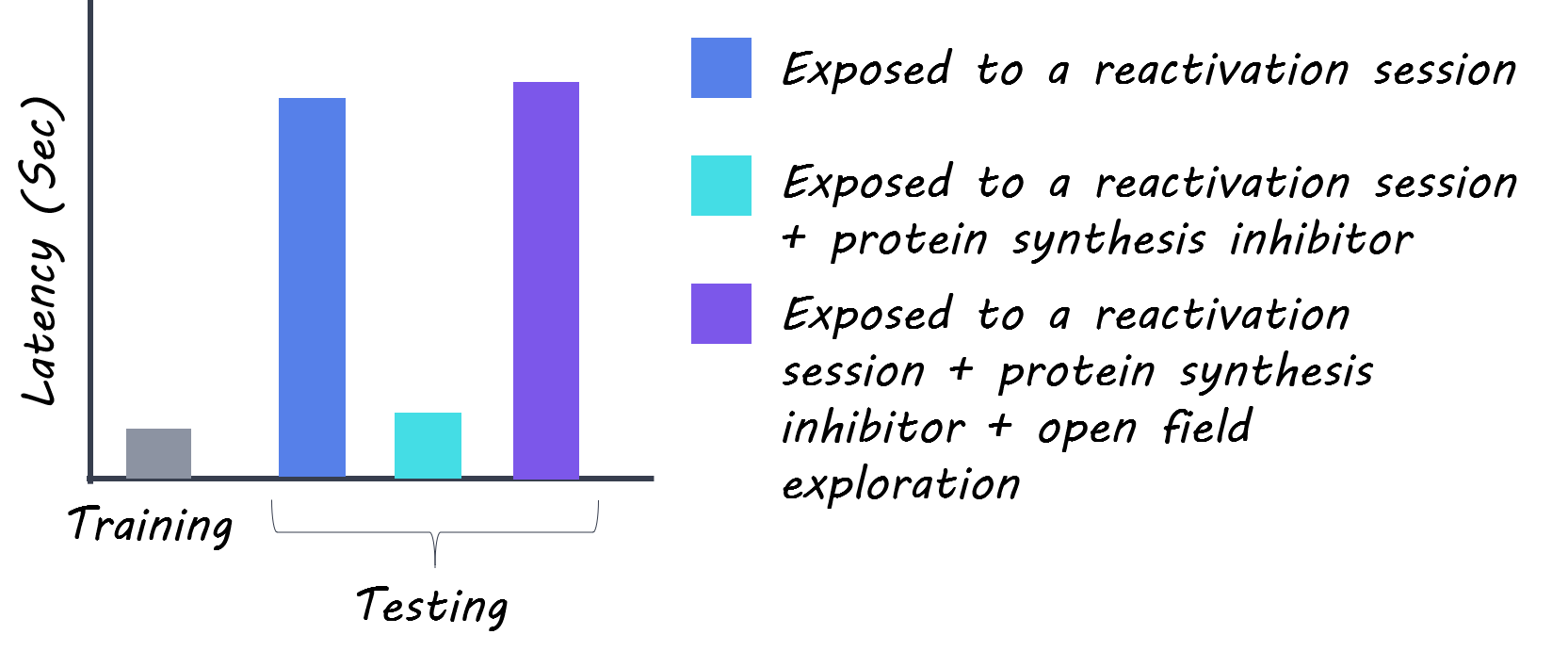
Rats were subject to the weak avoidance test in which they receive an electric foot shock when they step down on the lower platform during the training session. Twenty-four hours later, rats were returned to the test chamber without an electric foot shock as part of the “reactivation session” to retrieve their long-term memory from the earlier training session. The following day, rats were placed in the chamber again and the authors measured how long it took for rats to step down to the lower platform. If rats took a longer time to step down to the platform, they were thought to have a better memory of the foot shock. Different types of inhibitors were given to rats to explore the importance of new protein synthesis and second messenger pathways in memory reconsolidation and behavioral tagging. Also, to introduce a novel experience adjacent to this memory, rats were made to freely explore a new open field in addition to the weak avoidance test. The same experimental scheme was also applied to another assay called the object recognition task to expand understanding of how reconsolidation works for different types of memory. Here, two identical objects were placed in a chamber and one of the two was later moved to a different location. Rats were considered to remember the original locations of objects if they spent more time interacting with the object at a new location.

What did they find?

During the weak avoidance test, rats normally waited for about 2 minutes on average before descending to the lower platform, showing that they possess a long-term memory of the previous electric foot shock. However, rats failed to remember their earlier experience when the new protein synthesis was prevented right after the reactivation session, indicating that proteins related to plasticity are required for memory reconsolidation. Interestingly, forgetfulness was resolved when rats underwent the open field exploration close to the reactivation session (up to 60 minutes before or 30 minutes after the session). This effect disappeared when protein synthesis was inhibited right after the open field exploration, suggesting that a novel experience facilitates memory reconsolidation by providing proteins that could be used to re-solidify pre-existing memories. The authors also tested different protein quinase inhibitors and further dissected that different pathways are responsible for specific aspects of the behavioral tagging process during memory reconsolidation. For the second behavioral test of object recognition, rats showed similar results as they failed to remember the location of objects upon inhibition of protein synthesis, which was resolved by open field exploration (that provides plasticity proteins).

Chloe.png

What’s the impact?

This study presents evidence that behavioral tagging is critical in memory reconsolidation. Specifically, the authors showed that new experiences can contribute to updating old memories by providing newly synthesized proteins that can be used to mediate plasticity. These findings can be potentially useful in developing effective ways to alleviate traumatic memories in individuals who suffer from their negative effects. Conversely, these findings can also help us find ways to strengthen long-term memory for educational purposes.

Orlandi et al. Behavioral tagging underlies memory reconsolidation. PNAS (2020). Access the original scientific publication here.

Lipid Biomarkers of Psychosis in Clinically High-Risk Individuals

Post by Shireen Parimoo 

What's the science?

Psychotic disorders like schizophrenia can disrupt daily functioning and reduce quality of life, but early detection and intervention has the potential to mitigate some of these effects. Patients often experience rapid weight gain and develop insulin resistance due to changes in their metabolism, leading researchers to hypothesize that metabolic abnormalities might precede the development of psychosis. In particular, the concentration of lipids – a class of metabolites found in fats and oils – might be altered in individuals who are at risk of developing psychosis. This week in Biological Psychiatry, Dickens and colleagues performed lipidomic analysis and used machine learning to identify lipid biomarkers that predict clinical outcomes of psychosis in clinically high risk (CHR) individuals.

How did they do it?

The authors recruited 263 individuals identified as being at clinical high risk (CHR) for psychosis from a large-scale longitudinal study along with 51 healthy controls (HC). At the beginning of the study, they recorded clinical symptoms and obtained serum samples from both groups; they then followed up with the participants 1, 2, and up to 5 years later. At their follow-up clinical assessment, patients were categorized as (i) being in remission if their symptoms improved and they no longer met the diagnostic criteria for being at risk for psychosis (CHR-remission), (ii) having persistent symptoms, or (iii) having transitioned to psychosis.

The authors identified serum concentrations of lipids using a combination of liquid chromatography and mass spectrometry, which are techniques used in lipidomic analysis to separate and characterize different types of molecules based on their molecular properties. They performed a clustering analysis to identify different lipid clusters in each group and compared them between the groups at baseline. Lipids belonging to clusters that differed the most between the two groups were then used to predict clinical outcomes for HC and individuals in each CHR group. For a more fine-grained understanding of how lipid concentrations at baseline and demographic variables might be related to later outcomes, the authors used predictive logistic regression (a machine learning technique) to distinguish between the each CHR sub-group (e.g., CHR-remission vs. other CHR individuals) and between HC and all CHR individuals.

What did they find?

At baseline, CHR patients generally had higher serum lipid levels than HC. The authors identified 12 clusters of lipids differed between the HC and CHR individuals, which included triglycerols, ether phospholipids, and sphingomyelins, among others. Triglycerol levels most reliably distinguished between the two groups based on their structural properties: triglycerols with lower number of carbon atoms and fewer double bonds were higher in the CHR group, whereas HC had higher levels of triglycerols with longer, polyunsaturated fatty acid chains. Lipid profiles also differed between males and females. In both the HC and CHR groups, triglycerol levels were higher in males whereas sphingomyelin levels were higher in females. Serum lipid concentrations at baseline also predicted clinical outcomes at follow-up. Specifically, individuals who developed psychosis had lower ether phospholipids levels at baseline compared to other high-risk individuals. On the other hand, lipid profiles also differed between those who went into remission and those whose symptoms persisted. Importantly, there were no differences in the lipid profiles between HC and CHR-remission individuals. Overall, these results indicate that serum lipid levels in high-risk individuals are a sensitive marker of both the progression and regression of clinical symptoms of psychosis.

psychosis_img.png

What's the impact?

This study demonstrates that serum lipid levels can be used to predict clinical outcomes in individuals at high risk of developing psychosis. Although further work needs to be done to validate the predictive model, these findings have exciting implications for predicting the symptom trajectory of high-risk individuals and for providing early and personalized intervention to mitigate the progression of symptoms.

Dickens et al. Dysregulated lipid metabolism precedes onset of psychosis. Biological Psychiatry (2020). Access the original scientific publication here.