
A New Clinical Syndrome: Trigeminal Neuralgia Associated with a Brain Lesion

Post by Kasey Hemington

What's the science?

Trigeminal Neuralgia (TN) is an excruciatingly painful condition. Patients experience severe pain attacks in areas associated with the trigeminal nerve, which innervates the face. In some cases, TN is associated with demyelination (damage to myelin – a protective covering for the nerve) either due to compression of the trigeminal nerve itself or secondary to Multiple Sclerosis (MS-TN), which can cause demyelinating plaques in the brainstem. A few case studies have noted that some TN patients have lesions of the brainstem, but do not have Multiple Sclerosis. However, this unique patient sub-group has not been extensively studied. This week in PAIN, Tohyama and colleagues used magnetic resonance imaging (MRI) and clinical evidence to define a new syndrome: TN associated with solitary pontine lesion (SPL-TN; ‘pontine’ refers to the pons, a region of the brainstem)

How did they do it?

The authors examined clinical records and MRI brain scans for 481 TN patients who underwent neurosurgical TN treatment (commonly gamma knife surgery, a non-invasive type of surgery that uses beams of radiation). All patients underwent an anatomical MRI (T1-weighted), and a subset of patients also underwent a diffusion-weighted MRI. SPL-TN was defined based on an idiopathic TN diagnosis (e.g. TN not secondary to Multiple Sclerosis), a single lesion along the trigeminal nerve pathway, and no other brain lesions. To characterize the lesions, the authors used an anatomical MRI and mapped the lesion by hand in each patient before comparing lesion distribution and area across subjects. The authors hypothesized SPL-TN patients to be surgical treatment non-responders, and defined treatment non-response as having undergone three or more surgical procedures, or having undergone one surgical procedure without experiencing substantial pain relief. Lack of relief was defined as <75% pain reduction using an 11-point pain Numerical Rating Scale and a score of 4 or higher on the Barrow Neurological Institute Scale, which measures the frequency of medication use for pain control.

From diffusion-weighted MRI scans of the lesions, the authors calculated metrics including fractional anisotropy, mean diffusivity, axial diffusivity, and radial diffusivity, which reflect the brain’s white matter microstructure, neuroinflammation, myelination, and axonal integrity, respectively. To act as a healthy control group, the authors recruited healthy individuals, age- and sex-matched to SPL-TN patients for whom anatomical and diffusion-weighted MRI brain scans were available. The healthy control group underwent these same brain scans.

What did they find?

Upon reviewing the 481 TN patient records, the authors found 24 cases of SPL-TN. Eighteen of those patients had clinical follow-up information available post-surgery and it was determined that 17/18 of those patients did not respond to surgical treatment, suggesting non-response to surgical treatment is characteristic of SPL-TN. For these 17 patients (6 men, 11 women), lesions were mapped and found to be along the trigeminal pathway in the pons on the affected side of the brain in all cases. Overlap amongst patients was maximal in the trigeminal brainstem sensory nuclear complex. Diffusion-weighted MRI scans were available for 11 of the 17 patients, and were used to compare the lesions on the affected side of the brain in SPL-TN patients versus a) the same region on the non-affected side and b) the brains of 11 healthy controls. No differences in fractional anisotropy, mean diffusivity, axial diffusivity, or radial diffusivity were found between the non-affected side in patients and healthy controls, while lower fractional anisotropy and higher mean diffusivity and radial diffusivity were found on the affected side versus the non-affected sides and healthy controls. Additionally, axial diffusivity was higher on the affected side versus the non-affected side. These findings indicate abnormal white matter properties in SPL-TN lesions.
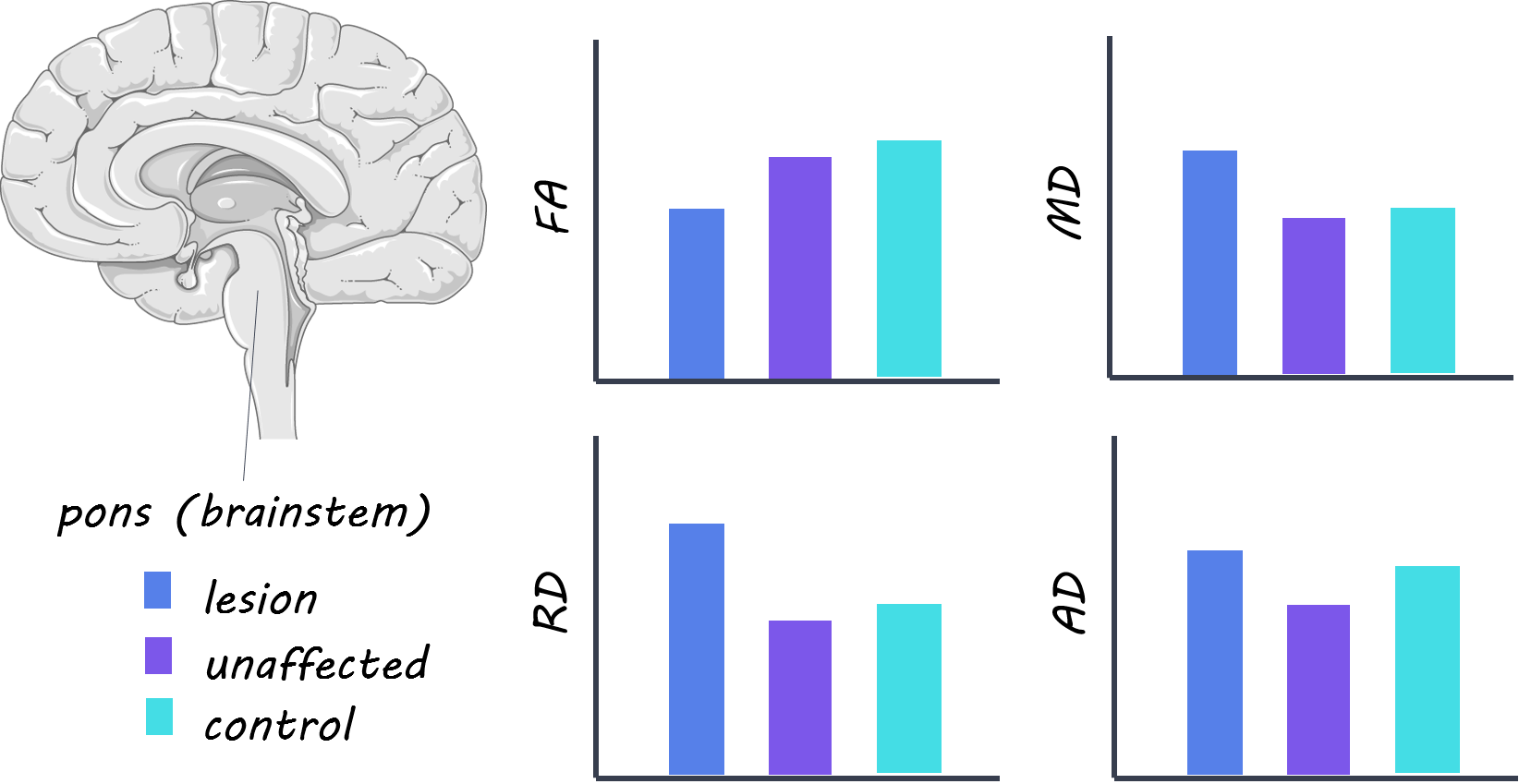
FA = Fractional Anisotropy, MD = Mean Diffusivity, RD = Radial Diffusivity, AD = Axial Diffusivity

FA = Fractional Anisotropy, MD = Mean Diffusivity, RD = Radial Diffusivity, AD = Axial Diffusivity

SPL-TN patient lesions were also compared to lesions in a group of 17 MS-TN patients, age-matched for the age of TN onset. In MS-TN patients, between 1-5 lesions could be found along the trigeminal nerve pathway. No differences between groups were found in diffusivity metrics when comparing whole lesions. However, when the analysis was restricted precisely to the trigeminal brainstem tract within a lesion, lower fractional anisotropy, and higher axial diffusivity, mean diffusivity, and radial diffusivity were found in SPL-TN lesions versus MS-TN lesions.

What's the impact?

This study is the first to define SPL-TN, a subtype of TN characterized by non-response to surgical treatment and a single brainstem lesion commonly in the trigeminal nucleus. These lesions have changes in diffusivity metrics that characterize abnormal white matter microstructure. The identification of SPL-TN will guide specialized treatment plans for these patients.

Tohyama et al. Trigeminal neuralgia associated with a solitary pontine lesion. PAIN (2020). Access the original scientific publication here.
Exploring the Long-Term Effects of Psychedelics on the Brain

Post by Flora Moujaes 

What's the science? 

Psilocybin, the psychoactive compound in magic mushrooms, has recently proven an effective treatment for depression, anxiety, tobacco addiction, and alcohol use disorder. Treatment with psilocybin can have long-lasting effects: 1-3 psilocybin sessions can lead to a reduction in clinical symptoms that lasts for up to one year. We still don’t fully understand the psychological and neural mechanisms that underlie psilocybin’s therapeutic effects. Molecular studies have shown that psilocybin is a serotonin 2A/5-HT2A partial agonist, while therapeutic studies have indicated that psilocybin exerts its clinical effects by reducing negative affect and increasing positive affect. The reduction in negative affect may be linked to the amygdala, the brain region responsible for tracking the salience of the stimuli in the environment. Functional magnetic resonance imaging (fMRI) studies have shown that psilocybin reduces amygdala activity when viewing negative stimuli. This week in Scientific Reports, Barrett et al. use fMRI to explore the long-term effects of psilocybin on emotional and brain plasticity in order to better leverage it as a clinical tool. 

How did they do it?

To explore the long-term effects of psilocybin, the researchers administered a single high dose of psilocybin (25mg/70kg) to twelve healthy volunteers in an open-label within-subjects pilot study. To investigate if psilocybin could lead to an enduring increase in positive affect and decrease in negative affect, a battery of self-report state and trait measures was completed one day before, one week after, and one month after psilocybin administration. Responses were then compared between time-points. At each time-point, in order to determine whether psilocybin could lead to an enduring change in neural response to emotional stimuli, participants also took part in an fMRI session in which they completed three emotion-processing tasks. fMRI analysis of the emotion-processing tasks focused on the amygdala as a key region of interest. Finally, to determine whether psilocybin could lead to an enduring change in brain plasticity, participants’ resting-state fMRI data were also collected at each time-point. Functional connectomes were then compared between timepoints.

What did they find?

Long-term behavioural effects of psilocybin on emotions: Behavioural measures indicated that one-week post-psilocybin there was a reduction in negative affect and an increase in positive affect. One month post-psilocybin, the reduction in negative affect returned to baseline levels, while positive affect remained elevated. Ratings of trait anxiety were also reduced one-month post-psilocybin, despite showing no significant reduction one-week post-psilocybin. 

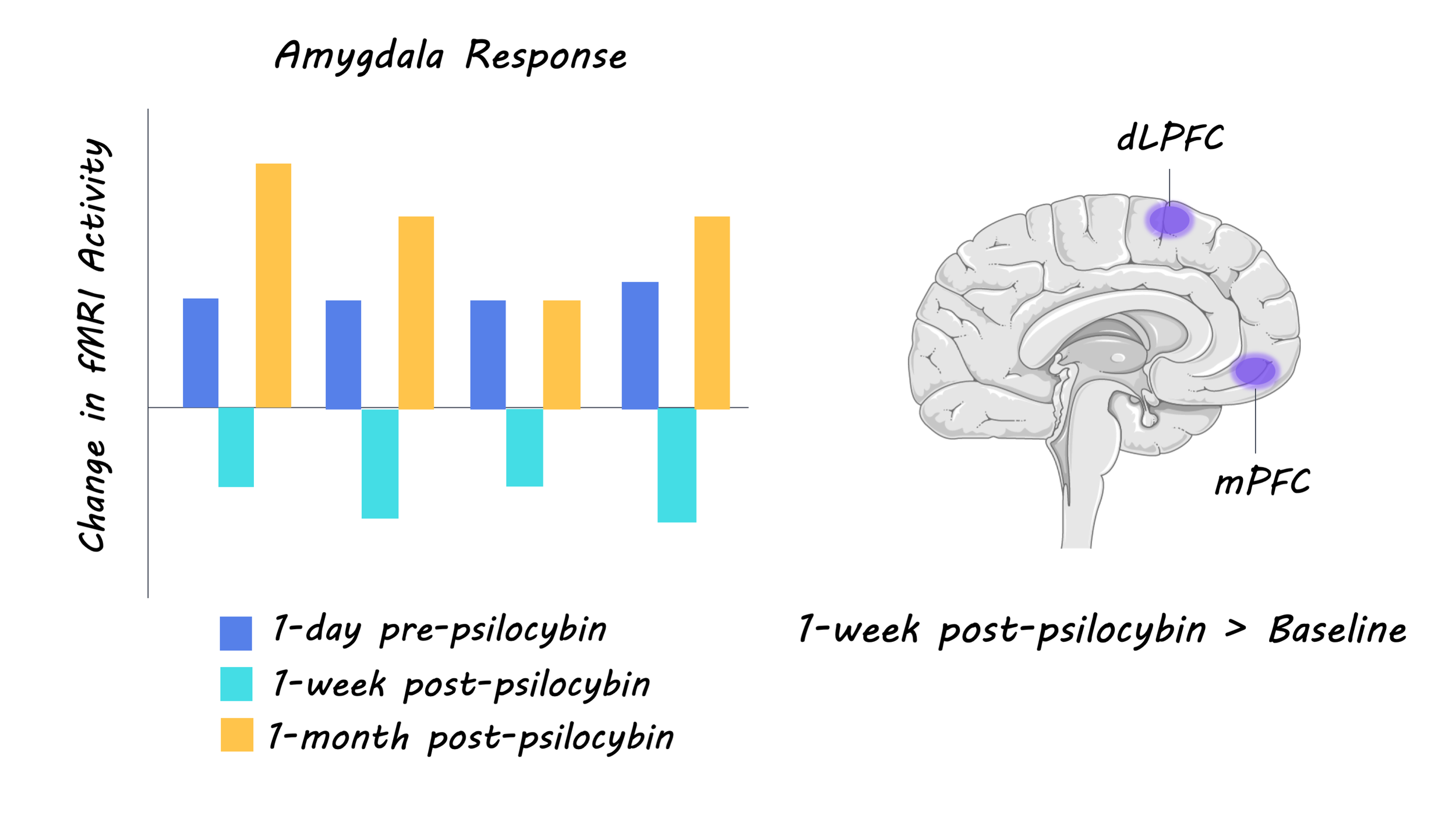
Long-term neural effects of psilocybin on emotions: Analyses of the fMRI data revealed that psilocybin led to reduced amygdala response to facial affect stimuli one-week post-psilocybin, however, this change was not sustained after one month. Overall, these results suggest that acute psilocybin administration leads to shifts in emotional affect, and the neural correlates of affective processing, which may endure one month later. fMRI data also showed that psilocybin resulted in increased dorsal lateral prefrontal and medial orbitofrontal cortex activity in response to emotionally conflicting stimuli after one week, and increased somatosensory cortex and fusiform gyrus activity in response to emotionally conflicting stimuli after one month. This indicates that psilocybin may also increase the top-down control of emotional processes, which may have a modulatory effect on the amygdala.

psilocybin_quote_Feb18.png

Long-term effects of psilocybin on brain plasticity: Global increases in functional connectivity were found both one week and one-month post-psilocybin. The increase in functional connectivity strength that was observed indiscriminately across multiple networks may reflect a domain-general cortical plasticity process that supports the observed changes in affective processing. 

What's the impact? 

Overall this study shows that despite the fact that the half-life of psilocybin is roughly 3 hours, psilocybin induced behavioural and neural changes were seen one-week and one-month post-psilocybin administration. This indicates that acute psilocybin may lead to a dynamic and neuroplastic period that lasts for a number of weeks, during which the neural processing of affective stimuli is altered. These findings also help explain psilocybin’s therapeutic effects: reduction of negative affect may undermine ruminative processes that contribute to depression and explain the antidepressant effects of psilocybin. Studies that utilize a larger sample size and placebo-controlled design are needed to explore this key neuroplastic period following acute psilocybin administration. 

Barrett et al. Emotions and brain function are altered up to one month after a single high dose of psilocybin. Scientific Reports (2020). Access the original scientific publication here.

Individual Variation in Amygdala Connectivity

Post by Deborah Joye

What's the science?

The amygdala is a part of the brain most known for its role in aggression and fear. Amygdala function is affected in many psychiatric illnesses including post-traumatic stress disorder, anxiety, depression, and phobias. Most in-depth studies of the amygdala in humans measure brain signals averaged across a group of individuals to determine the location and connections of the amygdala. While this approach has helped us to better understand the amygdala in general, it has limited our ability to tailor treatment of amygdala dysfunction to individual patients. This week in PNAS, Sylvester and colleagues use extensive functional magnetic resonance imaging (fMRI) of individuals to characterize three functional subdivisions of the amygdala and their specific patterns of connectivity with other networks in the brain.

How did they do it?

The authors analyzed over 5 hours of fMRI data per individual from 10 individuals to determine different amygdala subdivisions based on activity patterns within the amygdala and associated activity in other cortical regions. The authors then used both group-averaged and individualized data to demonstrate that group-averaged analyses can obscure the specific locations of amygdala regions and mask their functional patterns. The authors compared their amygdala subregions from the individualized dataset against a much larger independent dataset to understand whether amygdala subdivisions and their connectivity patterns were roughly consistent across people. Finally, the authors investigated possible differences in the timing of activity across the amygdala and other cortical networks to investigate whether individual differences exist in the timing of amygdala-cortex connectivity.

What did they find?

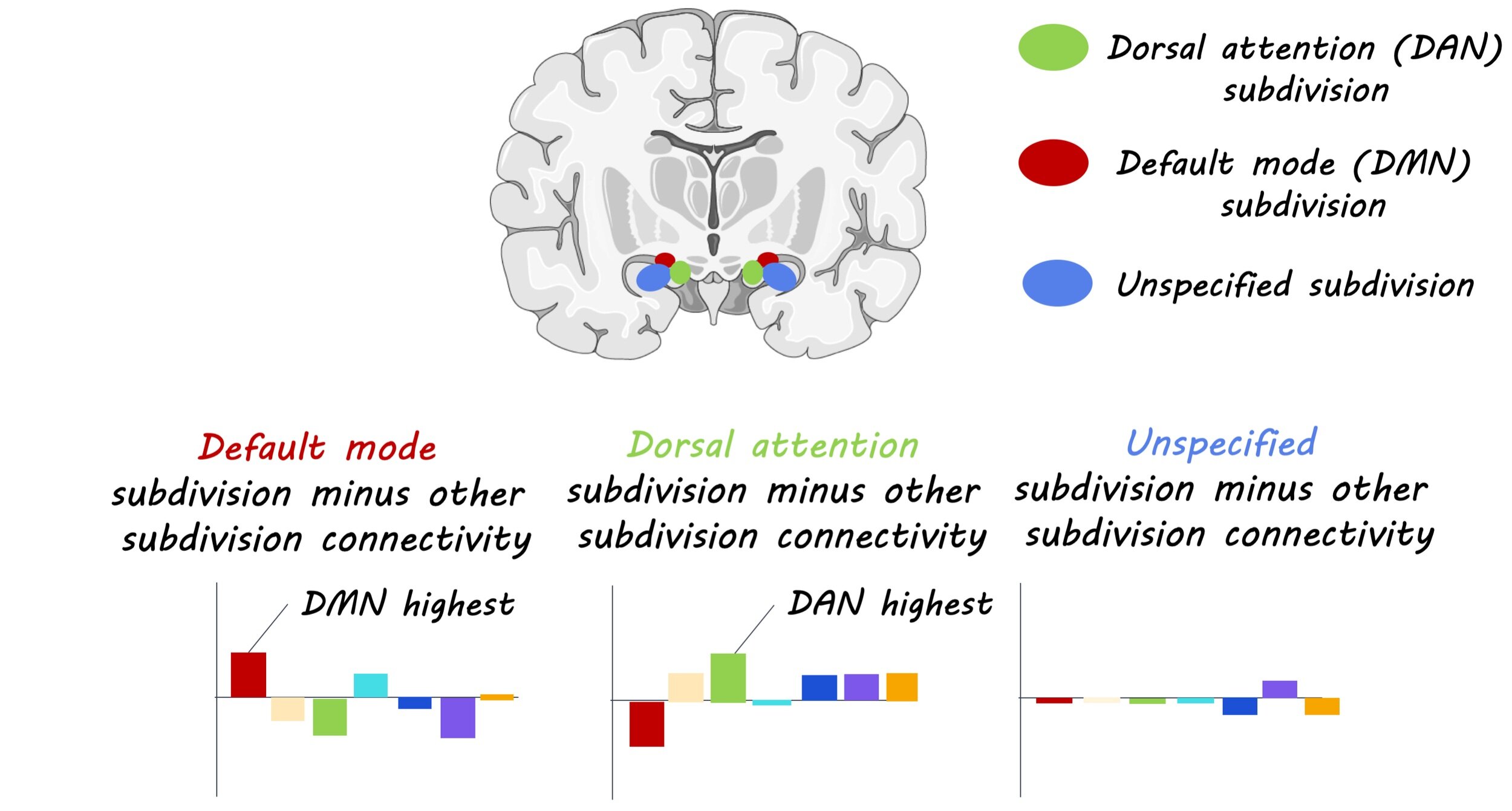
The authors characterized three subdivisions of the amygdala that are roughly consistent across individuals with some differences in spatial location. The authors also found that each subdivision of the amygdala had its own unique connections to other brain networks and that the magnitude of these connections varied from person to person. One subdivision was anatomically superior and preferentially connected to the default mode network, a widespread neural network important for reflecting on the self and others, as well as thinking of the past and future. This amygdala connection’s role could be to integrate important environmental information with an individual’s past history regarding the emotional significance of that stimuli. Another subdivision was anatomically medial in most people and preferentially connected to the dorsal attention network which is active during attention-demanding tasks. This amygdala connection’s role might be the top-down modulation of attention networks.

amygdala_connectivity_Feb11.jpg

The last subdivision was anatomically ventral and did not show a preferential connection to a specific neural network but had connectivity properties that were shared across the rest of the amygdala. When the authors compared these findings with a larger, publicly available dataset they found similar amygdala subdivisions, but the selectivity of each subdivision for particular neural networks was much weaker compared to individual analyses. Lastly, the authors found that the timing of activity between amygdala subdivisions and other neural networks was consistent across both datasets, suggesting that though location and magnitude of amygdala connections may vary from person to person, the networks themselves are consistent.

What's the impact?

This study is the first to use extensive fMRI from individuals to demonstrate that three distinct subdivisions of the amygdala are roughly consistent across people, but with important individual variation in location and magnitude of connectivity. The study also revealed that subdivisions of the amygdala can have preferential connectivity with specific neural networks, providing a framework for a more detailed understanding of how the amygdala interacts with other brain regions in individual patients. These findings could lead to improvements in personalized psychiatry and potential therapeutics for amygdala dysfunction.

amygdala_quote_Feb11.jpg

Sylvester et al., Individual-specific functional connectivity of the amygdala: A substrate for precision psychiatry, PNAS (2020). Access the original scientific publication here.