
Pain Prediction Can Bias Pain Sensation

Post by Elisa Guma 

What's the science?

Pain is necessary for survival, both for quickly responding to aversive stimuli and for predicting potential harm from objects or situations. It is generally known that the experience of pain is related to nociception: the activation of special nerve endings in the body by potentially harmful stimuli such as mechanical (e.g. a sharp nail) or thermal (e.g. high heat). However, our experience of pain often deviates from nociception. Previously, it was shown that pain is influenced by our predictions of how painful the stimulus will be by using simple-Pavlovian cues. This week in the Journal of Neuroscience, Lim and colleagues show that pain can be strongly influenced by predictions from a conceptual schema. 

How did they do it?

The authors recruited 42 healthy adults and administered a series of tests in order to investigate how pain ratings are affected by a mismatch in pain prediction (top-down cognition; from the brain) and sensation due to nociception (bottom-up; from the body/nerves). First, a baseline pain rating was recorded for two heat stimuli used as the pain stimuli: 45°C (low) or 47°C (high). Next, all participants underwent functional magnetic resonance imaging while the pain tests were administered. This allowed the authors to make associations between neural responses to a) pain prediction and b) prediction errors. In the matched condition, participants learned a schema: when the value shown in the visual cue increased the pain produced by the heat stimulus also increased. Thus, visual cues stated “The incoming heat stimulus is at x% intensity”. The x value was a number between 0-100, and was increased linearly, with a 10-point increase corresponding to a 0.4 degree increase in stimulus temperature. 

In a second task set (mismatch level 1), the authors gradually introduced prediction errors where initially the cues continued to vary between 1-100, but the heat was held at either 45 ° C for cue values  0-40 or at 47 ° C for cue values from 61-100. Subsequently, the mismatch level was increased over a third and fourth task set (mismatch level 2) where the cues kept changing between 1-100, but the stimulus was always at 47°C . Participants were not given information on the mismatch and made their own decision on how much pain they felt after experiencing each cue-heat stimulus pairing. Finally, to better understand the factors that might mediate perceptual biases, a pain catastrophizing scale was administered, as well as a mindfulness questionnaire.

What did they find?

First, the authors established that participants were able to successfully detect a linear pattern between pain (heat) stimuli and cued (visual) stimulus intensities. Interestingly, the authors observed a bias in pain perception driven by the cue, such that the cue value had a greater influence on pain perception than the sensory stimulus. For the majority (5/8) of mismatched conditions for mismatch level 2, and (to a lesser degree) for mismatch level 1, participants partially updated their pain ratings with the change in heat stimulus, but the predictions had a stronger influence on perception than the prediction errors from the heat stimulus. 
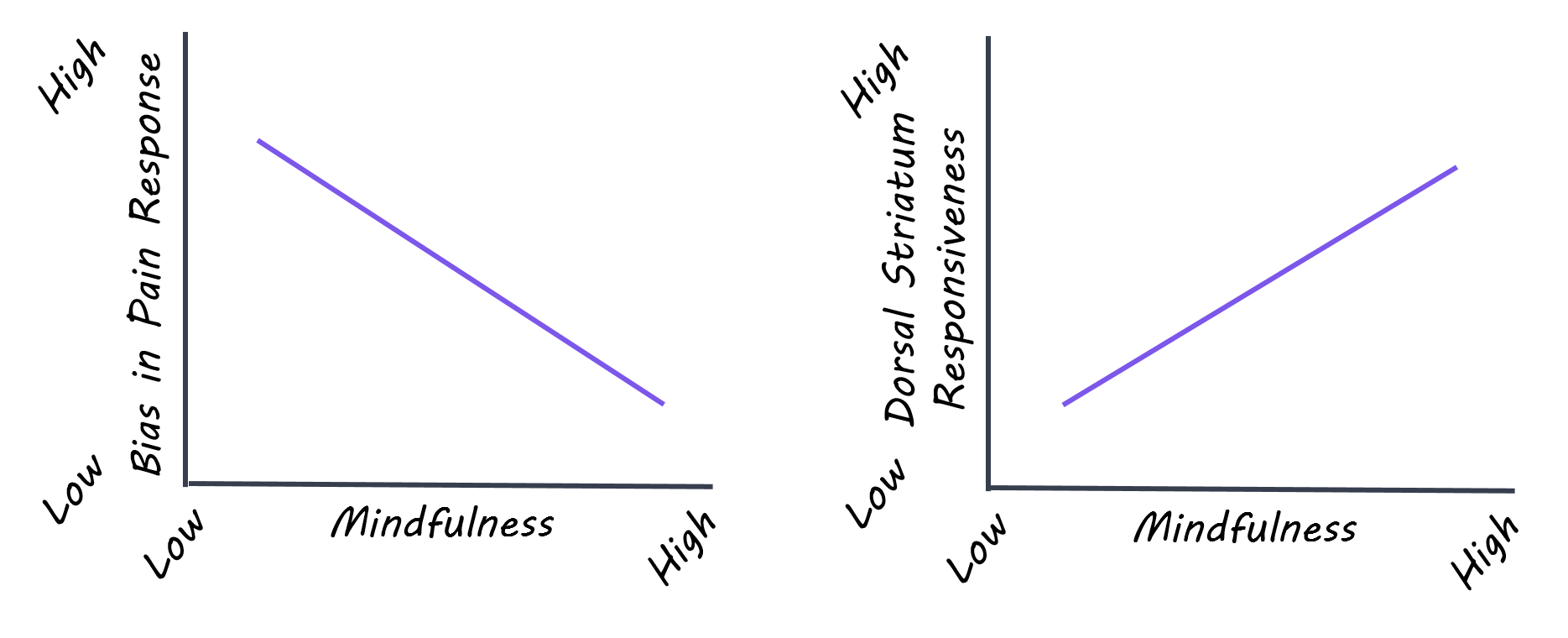
Hashmi_Pain.png

The authors observed that areas typically involved in pain perception were responsive to increases in cued threat (cue stimulus increases), such as somatosensory regions, posterior insula and periaqueductal gray area (corrected, FLAME1). When prediction errors were high, more cognitive cortical areas became active. Finally, the authors investigated individual differences in pain perception and found that people who had higher catastrophizing behaviours and lower mindfulness or sensory awareness (as measured by a self-report scale) tended to be more affected by the cues or threat predictions. These behaviors involved the ventral and dorsal striatal circuitry, which are implicated in value-based vs. model-free or habitual decisions respectively.   

What’s the impact?

This study demonstrates that predictions that arise from learning concepts have a strong impact on pain perception even if there are prediction errors arising from sensory inputs. In other words, our prediction of pain based on a reported upcoming stimulus intensity impacts our pain even if the level of stimulus intensity eventually administered is not the same as the reported intensity. Further, changes in the levels of cued-threats altered activity in cognitive and sensory networks in an opposite manner, which underscores the role of these top-down and bottom-up networks in biasing pain perception. Finally, the authors were able to attribute behavioural patterns with perception, showing that individuals with higher mindful awareness and less fear of pain are better able to update their pain perception.
pain_quote_Jan14.jpg

Lim et al. Threat prediction from schemas as a source of bias in pain perception. Journal of Neuroscience (2020). Access the original scientific publication here.

50 Years of Neuroscience: Progress and a Look Into the Future

Post by Stephanie Williams

What’s the science?

In honor of the 50th anniversary of the Society for Neuroscience, a group of scientists comment on the progress made in neuroscience over the previous 50 years. This week in The Journal of Neuroscience, Altimus, Marlin and colleagues review neuroscience research advancements and express a vision for the impact of future research.

What do we already know?

The authors review research in four major categories: 1) cellular and molecular neuroscience 2) developmental neuroscience 3) systems neuroscience and 4) disease. In the cellular section, the authors highlight technological innovation (patch-clamp electrophysiology, PCR, genomic sequencing), and progress made in the connectome project and in the creation of a cellular atlas of the mammalian brain. While acknowledging the reductive approach of some of these advancements, the authors argue that they will serve as a stepping stone to more detailed knowledge and will allow for novel cellular targeting strategies. In the development section, the authors highlight progress in understanding gene expression (i.e. the transcriptome) of neurons, whole-genome sequencing, the development of brain organoids and Brainbow, a fluorescent imaging approach in which individual neurons can be imaged using different colors. They review the debate over the existence of adult neurogenesis (production of new neurons) and cite recent evidence suggesting that adult hippocampal neurogenesis is indeed robust in healthy humans. In systems neuroscience, the authors focus on the potential of virally mediated gene-editing to study ensembles of neurons. They also point out the lack of precision in many behavioral measurements, which limits our ability to correlate behavior with neural activity. The authors list several brain-computer interface (BCI) advancements including BCI-mediated limb movement and visual imagery in the blind. In the disease section, the authors highlight the importance of collaborative research initiatives (eg. BRAIN, dementia research led by the United Kingdom), in accelerating research progress. They praise the progress made in psychiatric research, including the recent FDA approved treatments for major depressive disorder (esketamine), brexanolone (postpartum depression), siponimod (multiple sclerosis).

What’s next?

In cellular and molecular neuroscience, the authors predict that advancements in microscopy will allow us to visualize subcellular machinery at an unprecedented resolution. They predict that new tools will allow us to measure and manipulate epigenetic endpoints to better understand how the genome, transcriptome, and proteome relate to behavior. In the developmental neuroscience section, the authors call for the development of new technologies that can label neurons in vivo and be imaged non invasively, as well as tools that may be able to control neurogenesis across the lifespan. The authors predict that characterizing the transcriptome of neurons will lead to a new understanding of cell types. They also speculate that technological advances will resolve the difficulties that currently limit the establishment of brain organoids; brain organoids could one day act as a tool for screening potential therapies or replacing damaged brain tissue. In the systems neuroscience section, the authors predict that more precise behavioral measurements will allow for a better understanding of the corresponding neural activity. They suggest implementing new methods, such as computer vision, to automate and improve behavioral measurement and analysis. The authors predict that new imaging methods will be developed, such as cellular-resolution functional neuroimaging in humans, and hope that the imaging methods will be used to record from and interact with neural circuits in real-time. In the disease section, the authors predict we will enter an age of neurotherapeutics, characterized by an increase in the number of specific therapies for nervous system disorders. They foresee the use of technology—activity trackers and automated analysis tools—to improve diagnostics. They hope to see a shift towards preventative measures.

As a community, the authors call for scientists to prioritize addressing the lack of diversity in neuroscience, both in how research is conducted and the topics of research themselves. The authors criticize previous research for asymmetrically focusing on right-handed males, and previous clinical trials and genetic studies for asymmetrically focusing individuals of European descent. The authors also highlight the impact of neuroscience on education and recommend using neurodevelopmental and cognitive neuroscience to implement widespread changes in educational curricula so that students with disorders such as dyslexia or attention deficit hyperactivity disorder, can learn more effectively.  

Finally, the authors make several predictions about areas that will become more prominent in the next fifty years. They predict the rapid expansion of using neuroscience to explain criminal behavior, inform business practices, and advance wearable neurotechnology to customize marketing strategies.

What's the bottom line? 

Neuroscience has come a long way in the past 50 years, and it’s an exciting time to pursue promising new avenues for research. In all pursuits, the authors call for caution and strict adherence to ethical principles as the field continues to accelerate, and emphasize the importance of international collaboration and the coordination of research internationally and across disciplines.

50_yrs_quote_Jan7.jpg

Altimus et al. The Next 50 Years of Neuroscience. The Journal of Neuroscience. (2019). Access the original scientific publication here.
Enjoying Sad Music: What’s Going On In the Brain?

Post by Anastasia Sares

What's the science?

There are many components to an emotional response, such as whether it is pleasant or unpleasant, the intensity of an emotion, and our aesthetic enjoyment of the experience. This can lead to situations where we experience a “negative” emotion (like in response to a sad piece of music) but enjoy it at the same time. In addition, emotions are dynamic, but many carefully controlled studies focus on short stimuli and static responses. This week in NeuroImage, Sachs and colleagues dynamically tracked the neural responses of people listening to a sad (but enjoyable) piece of music in order to separate out different aspects of emotional cognition.

How did they do it?

Thirty-six participants first listened to three musical pieces passively in an MRI scanner. The pieces were unfamiliar, wordless, and validated for emotional content by prior testing. After the MRI, they were asked to complete a rating task, using a sliding scale to continuously track their emotional states while listening to the same pieces again. They listened to each song twice, separately evaluating their enjoyment of the song and its emotional quality/intensity (how happy/sad it was). Participants also completed questionnaires about musicality, empathy, anxiety, and depression.

One sad piece, in particular, was chosen for the fMRI analysis: Discovery of the Camp by Michael Kamen. It clocks in at 11 minutes, which gave ample opportunity to examine emotions unfolding over time. The idea of the analysis was to find parts of the brain that acted in synchrony across individuals—meaning that they were probably responding to some aspect of the stimulus. The authors did this by recording the brain activity at many points in the brain (voxels) and calculating the correlation of the signals between participants at each voxel using a process called inter-subject correlation. They also looked for brain regions where inter-subject correlations were predicted by changes in the emotion and enjoyment ratings.

What did they find?

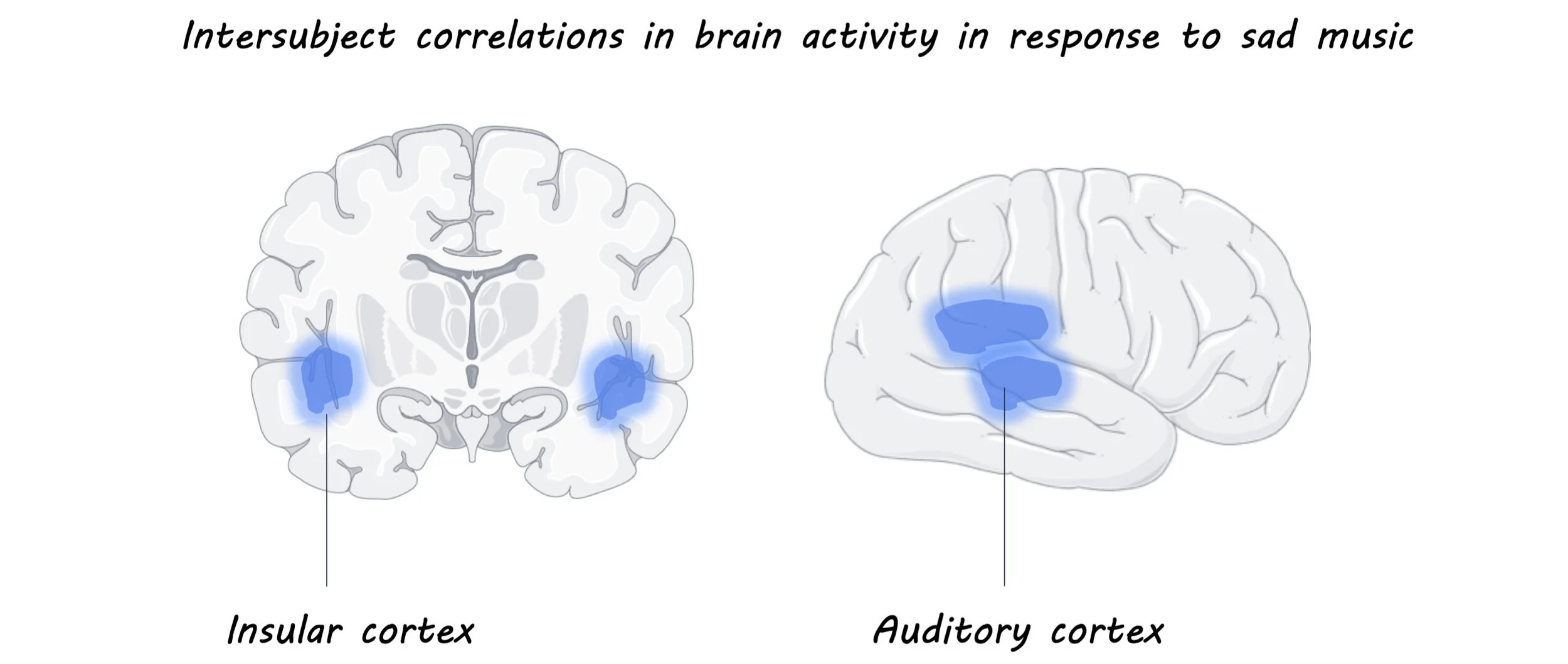
Signals from auditory brain regions and some motor brain regions were correlated across participants while listening to the music. Most of these were likely driven by the auditory signal itself. However, signals were also correlated in the insula, which is involved in processing the body’s own internal changes and the emotional states of other people. Both sadness and enjoyment involved synchronization in striatal regions. The intensity of sadness ratings was additionally related to dynamic synchronization in the limbic network, while enjoyment ratings were related to auditory, orbitofrontal, and default mode networks. This shows the separation between the emotion communicated by the piece (processed in the limbic system) and the participant’s enjoyment (aesthetic evaluation and reward, processed in other regions).

music_img_Jan7.jpg

One subcategory of the empathy questionnaire, fantasy, measures how transported a person is by a story or narrative and has previously been associated with the enjoyment of sad music. The authors, therefore, divided the participants into a high-fantasy and low-fantasy group to see whether their brain synchronization differed as a function of empathy. The high-fantasy group demonstrated more correlated activity in the left auditory cortex, extending to the middle temporal gyrus, frontal areas, and some visual areas. The low-fantasy group had more correlated activity in posterior auditory and parietal areas as well as the insula and caudate. The authors interpret the group differences in the following manner: high-fantasy participants may focus on reflecting, understanding, and visualizing emotions during music listening, and thus may enjoy sad music, while low-fantasy participants may have a more intense emotional response.

What's the impact?

This study separates the emotions communicated by a piece of music from the enjoyment of that music, showing that different brain networks are involved in processing various aspects of our emotional experience. Individual differences in empathy also play a role in our reaction to emotional stimuli. This is a step forward, but we are still only scratching the surface of the rich and complex nature of human emotion.

music_quote_Jan7.jpg

Sachs et al. Dynamic intersubject neural synchronization reflects affective responses to sad music. NeuroImage (2019). Access the original scientific publication here.