
Pairing Vagus Nerve and Tactile Stimulation Improves Somatosensory Function Following Nerve Injury

Post by Elisa Guma

What's the science?

Sensory dysfunction is a common consequence of injury to the nervous system due to nerve damage or stroke. Sensory training using tactile stimulation in affected areas is the most common form of rehabilitation for these patients, but most are left with sensory loss. Promising clinical data has identified a potential novel therapy involving pairing stimulation of the vagus nerve with tactile rehabilitation; this is thought to enhance synaptic plasticity and facilitate recovery of sensory function. This week in Annals of Neurology, Darrow and colleagues rigorously test this hypothesis in a rodent model of nerve damage.

How did they do it?

To create a model of chronic sensory loss in rodents, rats underwent transection followed by repair of the median and ulnar nerves in the forelimb, which produces lasting deficits in somatosensation in spite of reinnervation. This injury results in a denervation of mechanoreceptors on the ventral (but not dorsal) surface of the forepaw. Typically, reinnervation does occur over time, however animals still experience long lasting impairments in somatosensation and have disruptions in nerve morphology. The rats were also implanted with stimulating cuff electrode on the left cervical vagus nerve.

Sixteen weeks after the injury, animals were randomized to receive either 1) a tactile rehabilitation paradigm consisting of the presentation of various mechanical stimuli to the surface of the paw, or 2) a tactile rehabilitation paradigm with 0.5 s bursts of vagus nerve stimulation paired with the presentation of each tactile stimulus, daily for 6 weeks. The tactile stimuli included a paintbrush, a 10g filament, a copper rod, and a puff of air to the affected ventral forepaw. Mechanosensory thresholds were measured at baseline, weekly throughout the therapy, and every two weeks for 8 weeks after the cessation of therapy to see if benefits were long-lasting. Given that sensory and motor function are highly related, additional measures of forelimb sensorimotor function were recorded including the spontaneous use of the injured forelimb during exploration, grip strength, placement of the forelimb in a horizontal ladder rung task, and toe spread analysis.

What did they find?

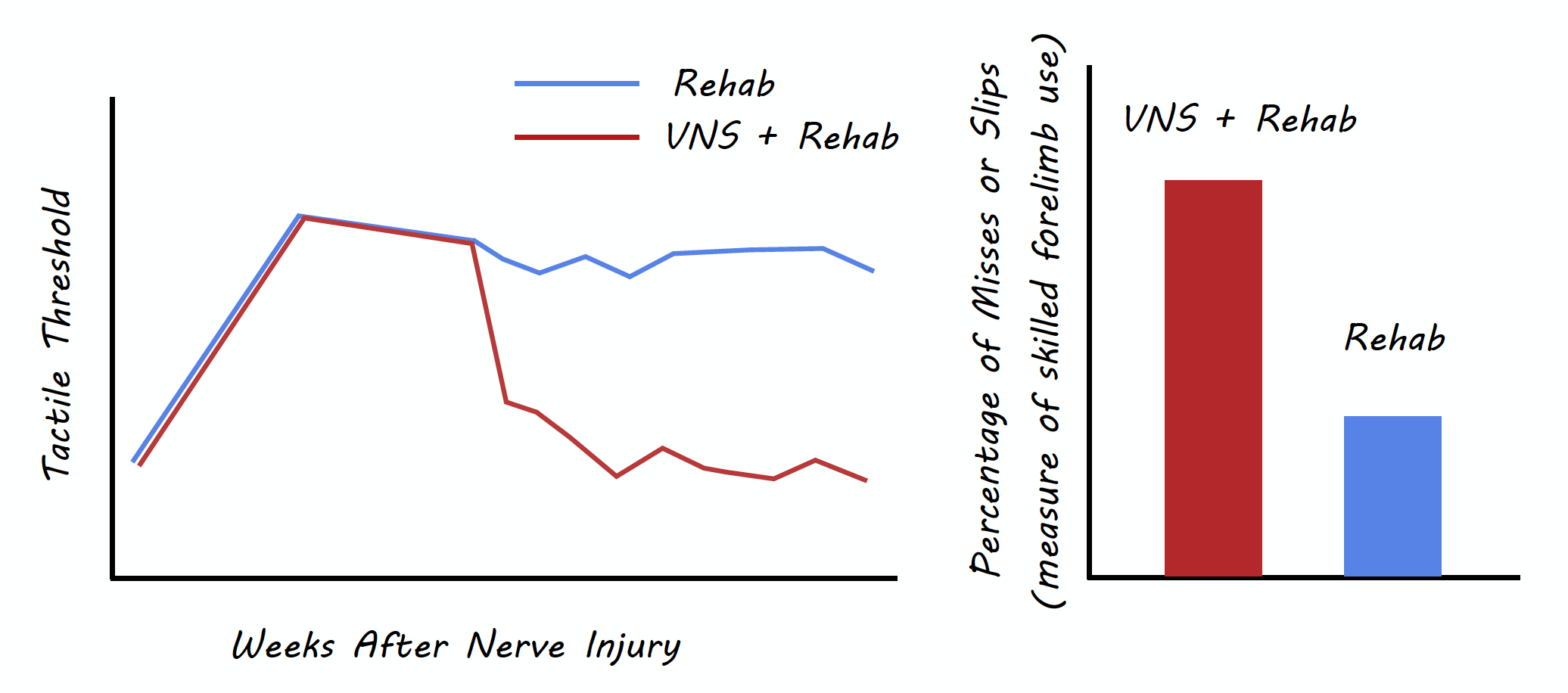
The authors found that pairing tactile rehabilitation with vagus nerve stimulation improved recovery of somatosensation in the forelimbs of animals with chronic sensory deficits compared to tactile rehabilitation alone. Improvements were already detectable in the first week of therapy and were maintained up to 2 months after the cessation of therapy. Furthermore, the animals that received paired vagus nerve and tactile stimulation therapy also had improved motor function in the injured forelimb, observable in exploratory behaviour, as well as reducing the length of toe spread during normal walking, and decreased missed placements and slips in the horizontal ladder task. The only motor behaviour that the paired therapy did not improve was for grip strength, where no difference between treatment groups were observed. 
Elisa_Dec31.png

What's the impact?

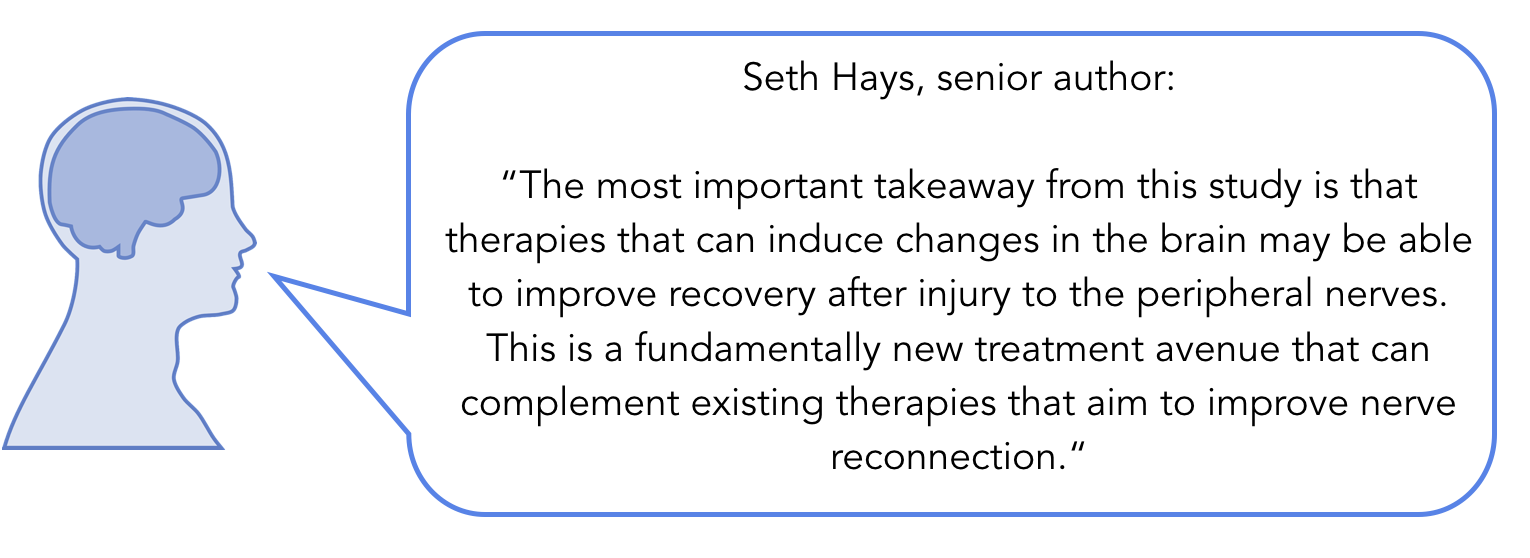
This study, motivated by recent clinical findings, provides compelling evidence for the efficacy of pairing tactile stimulation with vagus nerve stimulation for restoring somatosensation and motor function in a rodent model of sensory loss. This paired therapy could be a promising new approach for recovery from neurological injury. Future studies are needed to validate this strategy in other clinical populations, as well as to uncover the precise mechanisms supporting recovery.
Hays_Quote.png

Michael J Darrow et al. Restoration of somatosensory function by pairing nerve stimulation with tactile rehabilitation. Annals of Neurology (2019). Access the original scientific publication here.
Dopamine Projection Neurons in the VTA Have Distinct Roles in Reward Association and Motivation

Post by Amanda McFarlan 

What's the science?

The ventral tegmental area (VTA) is a midbrain structure with a large population of dopaminergic neurons that innervate the two major regions of the nucleus accumbens (NAc): the core and the shell. It is well known that dopamine projection neurons from the VTA to the NAc facilitate reward association and motivation. However, how dopamine release in the two regions of the NAc acts to facilitate these distinct functions remains unclear. This week in Neuron, Heymann and colleagues investigated the role of dopamine release in the NAc core versus the NAc shell in reward association and motivation.

How did they do it?

The authors used patterns of expression of different neuropeptide-associated genes in the VTA to identify distinct populations of dopamine neurons in the VTA that project to either the core or the shell of the NAc. Then, to understand the importance of these VTA to NAc connections during reward learning, they optogenetically inhibited projection neurons from the VTA to either the NAc shell or core in mice that were being trained in a Pavlovian conditioning paradigm. In this paradigm, mice were conditioned to expect a reward following the presentation of a lever, and had to press the lever and enter their head into an area with food to receive a reward. Next, the authors determined whether optogenetic activation of dopamine projection neurons from the VTA to the NAc would be sufficient to promote intracranial optical self-stimulation (i.e. a rewarding stimulation) in mice. To do this, they targeted the expression of Channelrhodopsin-2 (an excitatory light-gated ion channel) to VTA neurons that project to either the NAc shell or core and allowed mice to lever press for optical stimulation of these neurons. Additionally, the authors investigated the role of VTA projection neurons in reward-seeking behaviour: they trained calorie-restricted mice on a fixed-ratio schedule of food reinforcement (where food is delivered after a set number of responses) for 5 days and then switched the mice to 5 days of intracranial optical self-stimulation. Finally, the authors assessed the effect of simultaneous activation of VTA projection neurons to the NAc core and shell on reward seeking behaviours. 

What did they find?

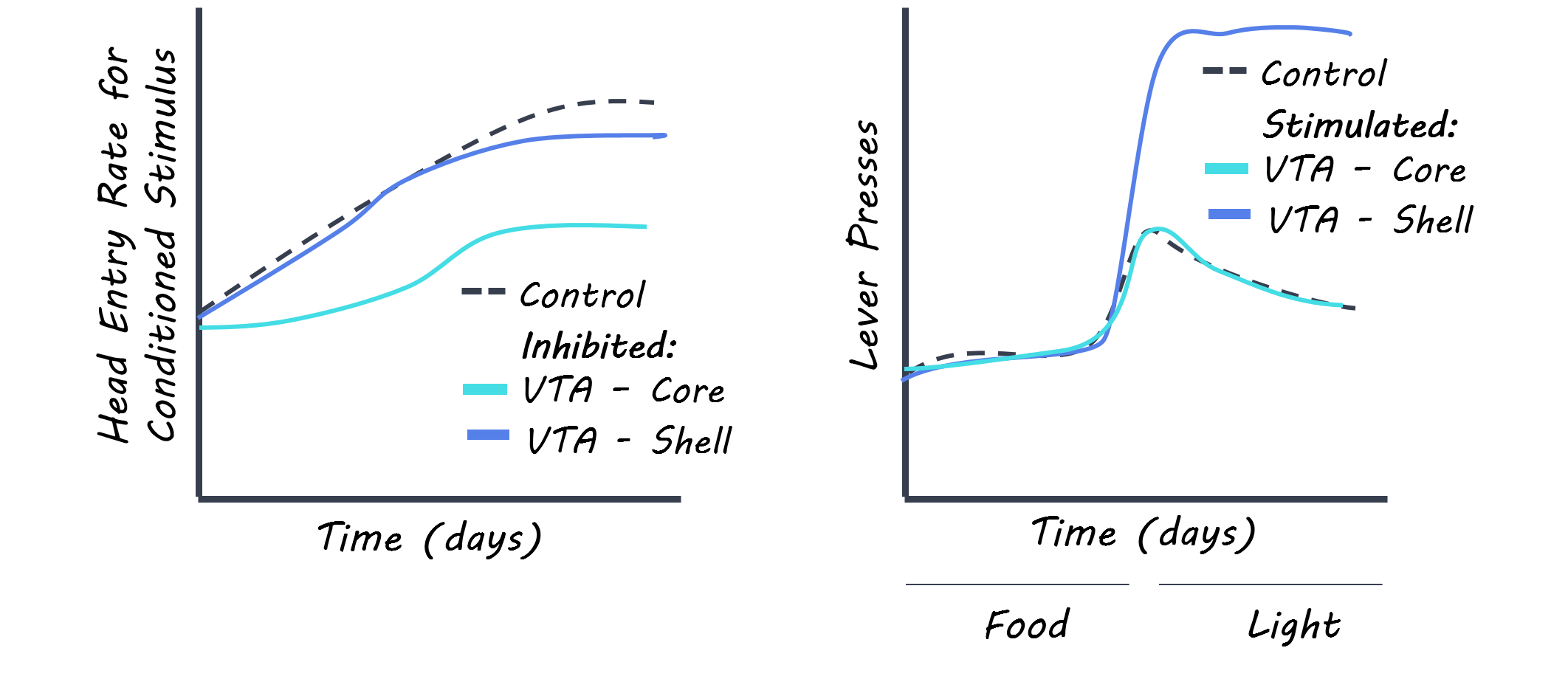
The authors found that the dopamine neurons in the VTA expressing corticotropin-releasing hormone receptor 1, preferentially innervated neurons in the NAc core, while dopamine neurons in the VTA expressing cholecystokinin, preferentially innervated neurons in the NAc shell. Then, they revealed that inhibiting VTA projection neurons that target the NAc core, but not the shell, during the Pavlovian conditioning paradigm significantly reduced the number of head entries in response to the conditioned stimulus. Similarly, they determined that optogenetic activation of VTA neurons innervating the NAc core, but not the shell, was sufficient to promote intracranial optical self-stimulation in mice, suggesting that VTA to NAc core connections are important for reward association. 

Next, the authors showed that the switch from food reinforcement to intracranial optical self-stimulation in calorie-restricted mice resulted in an acute increase in lever pressing for optogenetic activation of VTA neurons innervating the NAc core on day 1 that decreased over time. However, there was an increase in lever pressing for optogenetic activation of VTA neurons innervating the NAc shell that persisted all 5 days, suggesting that the VTA to NAc shell connections may be important for the motivation involved in maintaining reward-seeking behavior. Finally, the authors revealed that simultaneous activation of the VTA neurons that innervate the NAc core and shell resulted in robust self-stimulation in mice, suggesting that robust behavioural responses emerge from coincident activation of pathways involved in reward association and motivation.

amanda.png

What’s the impact?

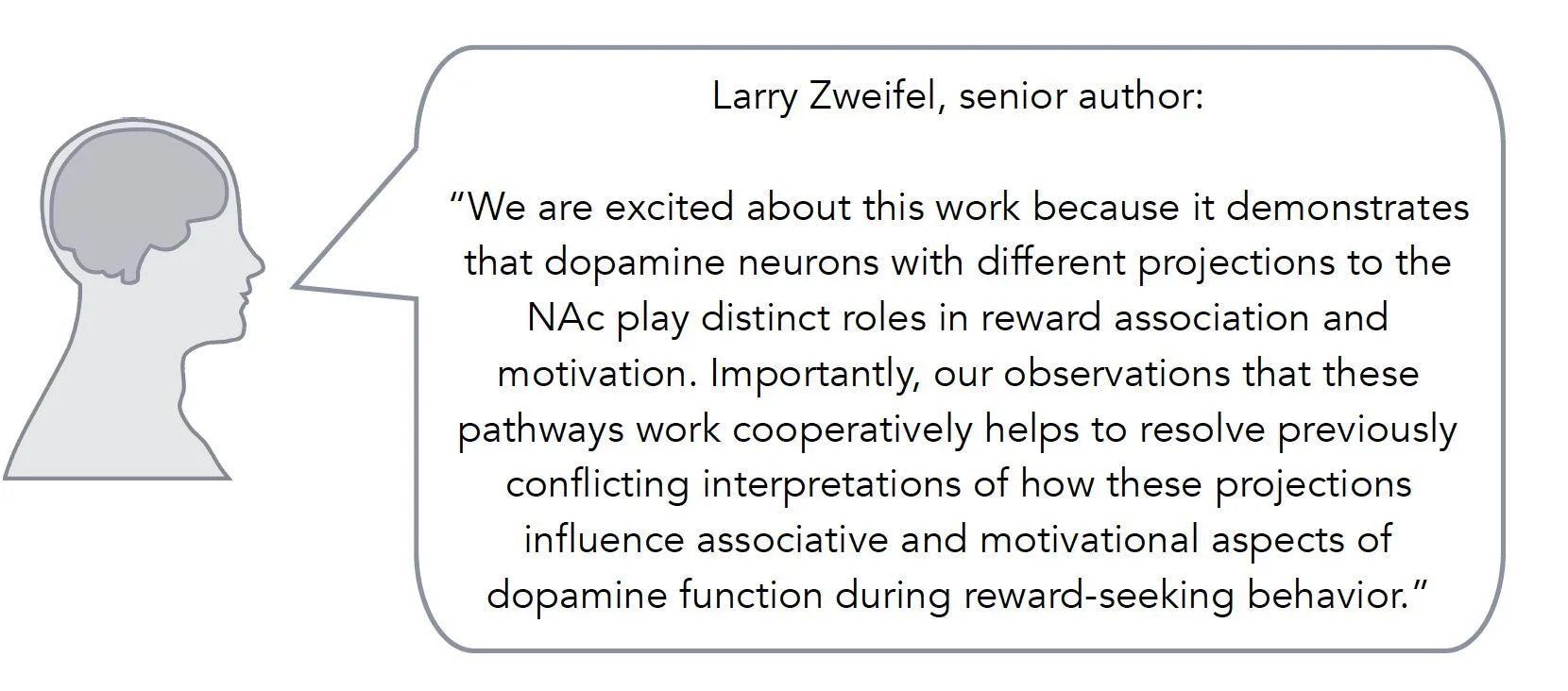
This is the first study to show that dopamine neurons in the VTA that preferentially innervate either the NAc core or shell can be isolated using neuropeptide-associated genes. The authors revealed that dopamine neurons in the VTA that project to the NAc core are important for reward association, while dopamine neurons in the VTA that project to the NAc shell are involved in motivation. Altogether, these findings highlight how the coincident activation of both VTA to NAc pathways leads to robust behavioural changes in response to a reward. 

leigh_zweifel.jpg

Heymann et al. Synergy of Distinct Dopamine Projection Populations in Behavioral Reinforcement. Neuron (2019). Access the original scientific publication here. 

The Role of the Posterior Medial Prefrontal Cortex in Confirmation Bias

Post by Shireen Parimoo 

What's the science?

Our beliefs can be influenced in many ways. For example, people often exhibit confirmation bias, which is the tendency to ignore information that is inconsistent with their existing beliefs while giving greater weight to information that confirms their beliefs. Similarly, people are more likely to be influenced by strongly expressed views than by weakly expressed views. It is important to understand how new information that could affect our decisions is processed. Activity in the posterior medial prefrontal cortex (pmPFC) has been implicated in monitoring and evaluating decisions, such as changing behavior after making a mistake. However, it is not known whether representations of beliefs in the pmPFC are sensitive to the strength (strong or weak) or type (consistent or inconsistent) of new evidence. This week in Nature Neuroscience, Kappes and colleagues used functional magnetic resonance imaging (fMRI) to investigate people’s sensitivity to the strength of new evidence and how this influences their judgments when the evidence confirms or contradicts existing beliefs.

How did they do it?

Participants completed the study in pairs across two testing sessions. In the first session, two participants individually played a real estate investment game, in which they were shown a property with a price and asked to (i) make a judgment about whether the true price was higher or lower than the price that was shown, and (ii) place a wager on their judgment (between 1 and 60 cents). They were informed that if they were correct, they would receive the amount of money that they wagered and if they were wrong, they would lose that amount. In the second session, the pairs of participants underwent fMRI scanning in adjacent rooms. They were shown the same properties as before along with their judgments and wagers. Importantly, they were also shown what were ostensibly their partner’s evaluations, which could be consistent or inconsistent with their own judgments, as well as the amount of money that their partner seemingly wagered on their judgment, which could be high (strong evidence) or low (weak evidence). Participants then had to decide whether they would change the amount of money that they wagered (but not the judgment itself) based on their partner’s evaluations. Thus, the partner’s judgment indicated whether participants saw confirmatory or contradictory evidence, and the partner’s wager amount indicated the strength of the evidence.

Shireen_Dec31.001.png

The authors first assessed whether participants showed confirmation bias. That is, were participants more likely to change their final wager when presented with consistent compared to contradictory evidence? Then, they determined whether participants were influenced by the strength of new evidence when it was consistent or inconsistent with their judgments. Finally, they performed a moderated mediation analysis to examine the sensitivity of the pmPFC to the type and strength of evidence. This allowed them to determine whether pmPFC activity mediated the effect of strong and weak evidence on participants’ final wagers, and if this varied based on whether the evidence was consistent or inconsistent with their own judgments.

What did they find?

Participants exhibited a confirmation bias, as they were more likely to increase their wager when their partner agreed with them. The strength of new evidence only affected behavior when the evidence was consistent with their existing beliefs. That is, participants were more likely to increase their wager when the evidence was strong (their partner made a large wager as well) than when the evidence was weak (their partner made a small wager). However, when their partner’s judgment did not align with their own judgments, the strength of the new evidence had no effect on their final wager.

The strength of new evidence was negatively correlated with pmPFC activity, but only for confirmatory evidence. Specifically, activity in the pmPFC was lower when the participant’s partner placed a higher wager on the same judgment, but pmPFC activation was not related to the partner’s wager when their judgment was inconsistent with the participants’ own judgments. Similarly, activity in the pmPFC mediated the effect of the strength of the new evidence and the participants’ final wager, but only when their partner’s judgments were consistent with their own. In other words, there was a reduction in pmPFC activity when participants were presented with strong confirmatory evidence, which was related to an increase in their final wager. Thus, the strength of new evidence only affects behavioral and neural responses when the evidence confirms existing beliefs.

What's the impact?

This study is the first to show that the pmPFC only tracks the strength of new evidence when it is consistent with prior beliefs, and that regardless of how strong the new evidence is, it does not influence behavior when it contradicts prior beliefs. These findings have important implications in numerous contexts, ranging from personal lifestyle to advocacy and policy making.

Kappes et al. Confirmation bias in the utilization of others’ opinion strength. Nature Neuroscience (2019). Access the original scientific publication here.