Stress-Induced Endocannabinoid Signalling Affects Amygdala Synaptic Connectivity

Post by Flora Moujaes

What's the science? 

Post-Traumatic Stress Disorder (PTSD) is a debilitating condition usually triggered by a traumatic event, that typically consists of (1) re-experiencing the traumatic event though intrusive memories and flashbacks, and (2) a state of constant vigilance or hyperactivity. We know that PTSD has a delayed onset, and that its often accompanied by hyperactivity in the amygdala - a brain region that plays a key role in the processing of emotions. Research has shown that a brief exposure to severe stress strengthens synaptic connectivity 10 days later in the amygdala, but we still don’t know what signalling mechanism is responsible for the delayed changes. Recently, there has been a huge surge in the number of patients with PTSD self-medicating using cannabis. This has led to the hypothesis that abnormal endocannabinoid signalling may be involved in the amygdala dysfunction seen in PTSD. This week in PNAS, Yasmin and colleagues investigate for the first time whether administering a pharmacological substance that modulates endocannabinoid signalling can prevent the impact of acute stress on the amygdala of rats.  

How did they do it?

To explore the mechanisms by which stress results in synaptic changes in the amygdala, researchers subjected rats to 2 hours of stress plastic immobilization bags, which contained a slit to allow animals to breathe, but no food or water. Amygdala slices were obtained 15 mins after the end of the stress exposure. They used whole-cell recordings in amygdala slices to first determine the effect of stress on the amygdala. Then, to investigate the involvement of the endocannabinoid signalling system they examined the effect of stress on the amygdala after inhibiting cannabinoid receptors. Next, they investigated the endocannabinoid signalling system more closely, focusing on how stress affects it’s two ligands (a neurochemical substance that binds to receptors): 1) N-arachidonylethanolamine (AEA) and 2) 2-arachidonoylglycerol (2-AG). In particular, they investigated how stress reduces AEA. Finally, they examined the effect of orally administering a substance that indirectly halts the reduction of AEA during stress exposure. 

What did they find?

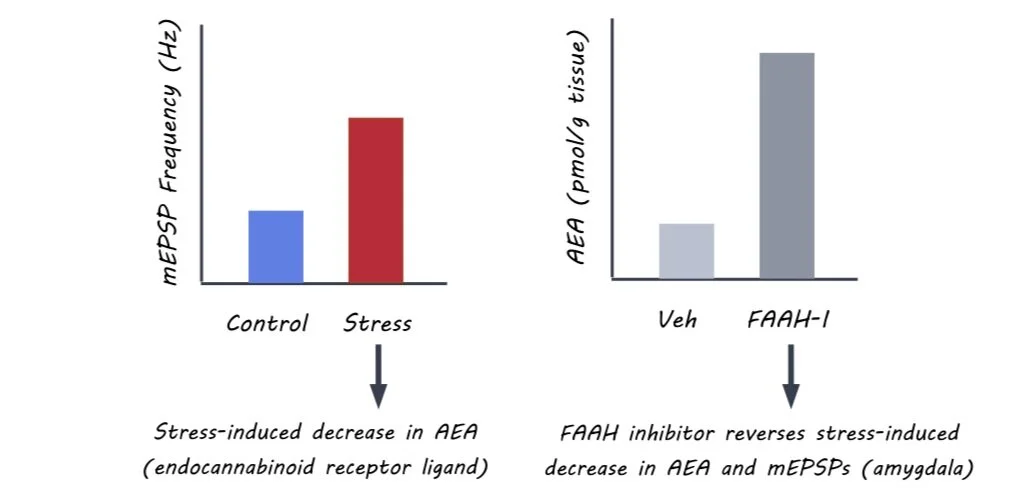
The researchers showed that stress caused immediate synaptic changes in the amygdala, as evidenced by a higher frequency of miniature excitatory postsynaptic currents (mEPSC). They also found that pharmacologically inhibiting cannabinoid receptors resulted in similar synaptic changes in the amygdala, which indicates that the endocannabinoid signalling system is crucial to the amygdala dysfunction seen following stress. When the researchers then investigated how the specific ligands involved in the endocannabinoid signalling system were affected by stress, they found that stress resulted in reduced AEA. Finally, they showed that orally administering a substance (a fatty acid amide hydrolase (FAAH) inhibitor) that indirectly halts the reduction of AEA during the stress exposure, prevented the synaptic excitability in the amygdala of rats. Most strikingly, FAAH inhibition during the stress exposure was also effective 10 days later, preventing both the enhanced mEPSC frequency and the increased dendritic spine-density usually seen following stress.
stress_dec24.001.jpg

What's the impact? 

The oral administration of a pharmacological compound that elevates the levels of an endogenous cannabinoid receptor ligand during stress, can prevent the early synaptic changes that eventually lead up to hyper-excitability in the amygdala. This finding has direct clinical relevance, as hyperactivity of the amygdala is a hallmark finding in PTSD. It suggests that the inhibition of FAAH could act as a novel treatment approach for PTSD, as FAAH inhibition could be used to target the endocannabinoid signalling system to prevent the gradual development of amygdala dysfunction triggered by traumatic stress.

Yasmin et al. Stress-induced modulation of endocannabinoid signaling leads to delayed strengthening of synaptic connectivity in the amygdala. PNAS (2019). Access the original scientific publication here.

Ongoing Antidepressant Medication Treatment Prevents Recurrence of Major Depression

Post by Lincoln Tracy

What's the science?

Evidence suggests that antidepressant medications and cognitive behavioral therapy (CBT) are equally effective in the acute treatment of major depressive disorder (MDD). Furthermore, the combination of these two treatment approaches has been proven to be more effective than either treatment alone in the short term. The ongoing use of antidepressant medication has also been proven to be effective in preventing future depressive episodes. However, it is not known whether CBT has the same long-term preventative effects. This week in JAMA Psychiatry, DeRubeis and colleagues investigated the effects of combining CBT and antidepressant medications when they were continued or withdrawn on preventing recurrent episodes of depression in patients with MDD. 

How did they do it?

In phase one of the study, the authors recruited 452 patients (266 women, mean age of 43.2 years) with MDD from three outpatient clinics across the United States. The patients were randomly allocated to one of two treatment groups: antidepressant medication monotherapy or a combination therapy of antidepressant medication and CBT. Patients received treatment for up to three and a half years until recovery from MDD was achieved. The patients who achieved recovery in phase one continued into phase two of the study. In phase two, the authors randomly allocated the 292 patients who recovered from MDD (171 women, mean age of 45.1 years) into one of two groups: one group continued to take antidepressant medication while the second group stopped taking antidepressant medication. Patients who received combination therapy were discontinued from CBT for phase two. This allowed the authors to look at four different groups of patients across the two study phases: (1) patients who received only medication in both phase one and two, (2) patients who received only medication in phase one and received no treatment in phase two, (3) patients who received combination therapy in phase one and medication only in phase two, and (4) patients who received combination therapy in phase one and were discontinued from both treatments for phase two. Patients underwent regular assessments for three years, or until a recurrence of depression occurred.

What did they find?

In phase one, the combined treatment of antidepressant medication and CBT was associated with higher rates of recovery from MDD compared to the medication alone. In phase two, the authors first found that ongoing antidepressant medication therapy was associated with a decreased risk of recurrent depression. A greater proportion of patients who stopped taking antidepressant medication in phase two experienced a recurrent episode of depression regardless of whether they received monotherapy or combination therapy in phase one. That is, the proportion of patients who experienced a recurrent episode of depression was similar for both phase one treatment groups. Second, they found that the likelihood of sustained recovery (i.e. achieving recovery in phase one and then not having a recurrent episode in phase two) was higher for those who remained on medications in phase two, but was not affected by one treatment condition. In other words, receiving CBT in phase one did not appear to affect the odds of sustained recovery.

lincoln (4).png

What's the impact?

The findings of this study show that continued antidepressant treatment in patients with MDD is associated with lower rates of recurrent depression and increased odds of a sustained recovery. These findings highlight the benefits of ongoing antidepressant treatment in this population. Further research is required to determine whether CBT has a similar protective effect, or whether combining antidepressant therapy with CBT interferes with any potential benefits.

DeRubeis_Dec24.001.jpg

DeRubeis et al. Prevention of Recurrence After Recovery From a Major Depressive Episode With Antidepressant Medication Alone or in Combination With Cognitive Behavioral Therapy: A Phase 2 Randomized Clinical Trial. JAMA Psychiatry (2019). Access the original scientific publication here.

Sleep Disturbance and Migraine Onset

Post by Sarah Hill 

What's the science?

Getting a good night's sleep goes a long way towards helping a person stay healthy, and for those that suffer from migraine, maybe even more so. According to previous research, the same neurotransmitter system responsible for mediating sleep and wake states may also initiate the onset of a migraine, characterized by severe headache with adverse sensory, autonomic, and cognitive effects. Thus, sleep disturbance may directly trigger migraine in some patients. Despite this mechanistic evidence, the link between sleep disturbance and migraine has been poorly investigated in a real-world setting. This week in Neurology, Bertisch and colleagues show that disturbances in sleep efficiency and fragmentation, but not duration or quality, temporally precede a migraine.   

How did they do it?

The authors conducted a prospective cohort study to test the hypothesis that sleep disturbance is temporally associated with migraine onset. For this study, they recruited 98 adult participants with episodic migraine. Participants were asked to wear wrist actigraphs continuously for 6 weeks to monitor sleep activity, as well as record sleep measures each morning in a sleep diary. Subjects also reported the presence of migraine each morning and evening, including the time of onset, duration, symptom intensity, and medications used, as well as other factors, such as daily caffeine and alcohol use and stress levels. In addition to sleep duration, the following sleep parameters were assessed: 1) WASO - minutes awake after sleep onset 2) sleep efficiency - the proportion of total sleep duration/duration of rest period 3) sleep quality (self-reported rating). After the 6-week study period, the relationship between sleep disturbance and migraine onset was examined throughout the day immediately following each sleep period (day 0) and the subsequent day (day 1).      

What did they find?

Unexpectedly, the authors found no association between sleep duration or quality and migraine occurrence on either day. Instead, diary-assessed low sleep efficiency (defined as ≤90%) was associated with a 39% increase in the odds of migraine occurrence on day 1. Paradoxically, high sleep fragmentation (defined as actigraphy-based WASO ≥53 minutes and efficiency ≤88%) was associated with a 36% reduction in the odds of headache during the day immediately following the sleep period (day 0). Taken together, these results suggest that low sleep fragmentation precedes migraine on day 0, while low sleep efficiency precedes migraine on day 1.   

sarah (3).png

What's the impact?

The findings presented here indicate that changes in sleep efficiency and fragmentation, but not duration or quality, precede migraine onset. This is one of the few studies to investigate a link between sleep quality and migraine using a prospective cohort study design, and the largest to collect objective sleep data in adults with episodic migraine.

Bertisch_dec24.001.jpg

Bertisch et al. Nightly sleep duration, fragmentation, and quality and daily risk of migraine. Neurology (2019). Access the original scientific publication here.