Successful Treatment of Post-Traumatic Stress Disorder Reverses DNA Methylation

Post by Stephanie Williams

What's the science?

Some individuals with post-traumatic stress disorder (PTSD) experience an extinction of their symptoms either spontaneously or following psychotherapy treatment. Many individuals, however, continue to experience symptoms even after treatment, demonstrating that treatment response varies among individuals with PTSD. We know that the development of PTSD is associated with changes in the regulation of gene expression, also known as epigenetic changes, such as the addition of a methyl group to DNA (i.e. methylation), which can change the expression of some genes. Less is known about the epigenetic changes that follow the successful treatment of PTSD. Identifying specific molecular changes associated with successful treatment of symptoms could advance our understanding of the biological process underlying recovery, and explain why some individuals do not respond to treatment. This week in Molecular Psychiatry, Vinkers and colleagues used data collected from trauma-exposed soldiers to identify specific changes in DNA methylation linked to recovery from PTSD symptoms following treatment.

How did they do it?                             

First, the authors confirmed that the PTSD psychotherapy treatment could effectively reduce PTSD symptoms for some individuals, as indexed by decreases in scores on a standard psychological interview, called CAPS. The authors then performed longitudinal genome-wide DNA methylation analyses in two separate cohorts to address questions about epigenetic-related treatment changes. To investigate recovery-related epigenetic changes, the authors analyzed DNA extracted from the blood of 44 male war veteran patients with PTSD and 23 trauma-exposed male war veterans without PTSD (controls). The data were collected from the 2010-2013 longitudinal study BETTER and included blood samples taken before and after the individuals were treated for PTSD. The authors analyzed the methylation profile of both samples for patients who did (N=21) and did not (N=23) respond to treatment. The severity and diagnosis of PTSD were established via an oral interview that was administered by a clinician or researcher. The authors looked for DNA regions that were differentially methylated following symptom reduction in response to the successful treatment of PTSD. Treatment administered to patients was either both (1) eye movement desensitization and reprocessing and trauma-focused cognitive behavioral therapy, or (2) trauma-focused cognitive behavioral therapy alone. To understand whether the different treatment arms induced different molecular changes, the authors compared methylation changes induced by the two treatment types. After identifying several DNA-methylation changes in specific regions in the recovery cohort, the authors analyzed the same regions in a separate PRISMO military cohort, which included blood samples before deployment, and 1 and 5 months post-deployment to Afghanistan. Using the two cohorts, the authors looked for regions that showed opposite patterns of methylation during symptom development and remission.

What did they find?

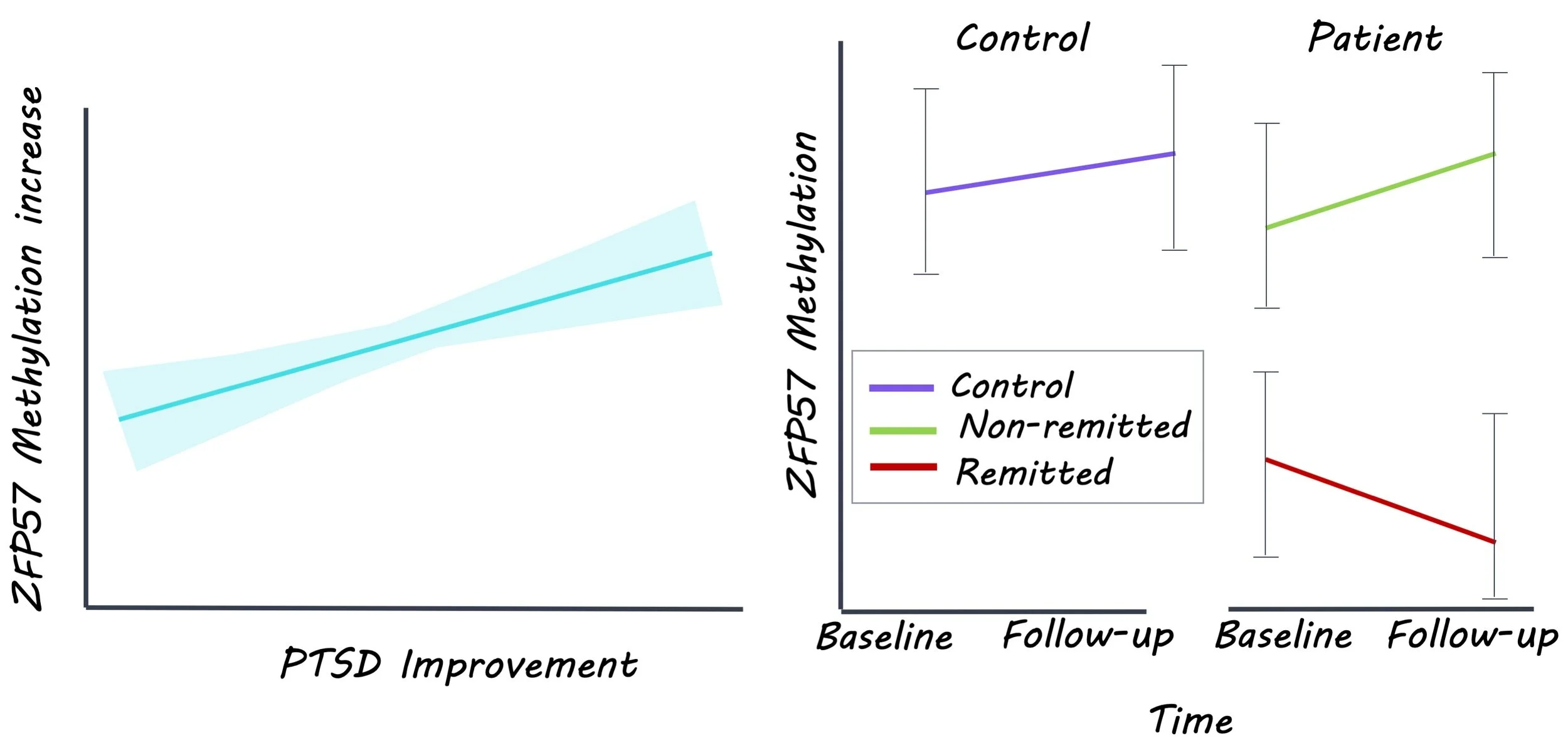
The authors identified twelve differentially methylated regions that were significantly associated with a reduction in PTSD symptoms after treatment in the BETTER cohort. When the authors analyzed the methylation status of the same regions in the PRISMO cohort, they found that only one of the twelve identified regions was significantly decreased in proportion to increased PTSD symptoms during the development of the disorder. The region, called ZFP57, showed an increase in methylation following symptom extinction and a reduction in methylation following the development of PTSD symptoms. The authors interpret this evidence as suggesting that ZFP57 methylation is involved in deployment-related PTSD. Next, that authors compared the two different treatments on methylation of ZFP57 and found that the eye movement desensitization treatment, induced slightly greater methylation than trauma-focused cognitive behavioral therapy. Both of the methylation changes induced by the treatments were disproportionately larger (greater methylation than would have been expected for the reduction in symptom scores) than expected, given the corresponding reduction in PTSD symptoms. The authors interpreted this finding as indicating that the treatment-induced methylation changes were directly influenced by the treatment and not due to symptom remission alone. 
PTSD_img_Oct29.jpg

What's the impact?

The authors have identified specific methylation changes that associate with symptom development and remission. They show that treatments such as cognitive-behavioral therapy and eye movement desensitization can directly affect the biology of patients on a molecular level. Their identification of a specific genomic region, ZFP57, associated with successful treatment of PTSD symptoms will allow future research to parse apart how treatments can exert successful molecular changes to improve future treatment outcomes.

Boks_quote_Oct29.jpg

Vinkers et al. Successful treatment of post-traumatic stress disorder reverses DNA methylation marks. Nature Molecular Psychiatry (2019). Access the original scientific publication here.

Partially Overlapping Representations of Speech and Sign Language in the Brain

Post by Anastasia Sares

What's the science?

Communication between humans involves a fascinating process of transformation in the brain. We begin with external signals: spoken words, written symbols, street signs, emojis, braille, or sign language. These signals enter the brain through different senses, but eventually, they become a concept, something that transcends the medium used to communicate them. What are some of the neural processes underlying the formation of concepts? This week in Current Biology, Evans and colleagues used advanced MRI techniques to find out how concepts live in the brain, independent of the signals that created them.

How did they do it?

The authors tested individuals who were bilingual in spoken British English and British Sign Language. This kind of bilingualism is interesting because it is also bimodal in terms of the senses used: spoken language uses auditory information while sign language uses visual information. The participants underwent an MRI scan while being presented with a number of words in both of their languages, with audio-only for speech and visual-only for sign language. The words could be grouped into conceptual categories (fruit, animals, and transport), and the conceptual relationships between each item had been modeled in a previous experiment. For example, an orange and a banana would have a high similarity rating whereas, an orange and a truck would have low similarity. The analysis focused on patterns of brain activity for each object. The authors applied their conceptual relationship model to the brain, looking for areas where conceptually similar words had similar patterns of brain activity, while conceptually distant words had differing patterns of brain activity (using multivariate pattern analysis, or MVPA). They first did this within modalities (within speech and within signs). They found clusters of the brain that fit their criteria. Then, they further tested each cluster, looking for the ones that could distinguish concepts across modalities, having similar patterns of activity for both speech and sign language. The only cluster that met all of their criteria was located in the left posterior middle/inferior temporal gyrus.

What did they find?

The patterns of brain activity in the left posterior middle/inferior temporal gyrus were related to the category of the word (e.g., fruit vs animal), regardless of whether it was spoken or signed. Interestingly, however, this area was not very good at representing individual items (e.g. banana vs orange) cross-modally. There were other regions that did have patterns distinguishing individual items, but these were located in areas specific to either speech or sign language. The authors interpreted this to mean that higher-level concepts were modality-independent, but individual objects had modality-specific representations in the brain.

anastasia (5).png

What's the impact?

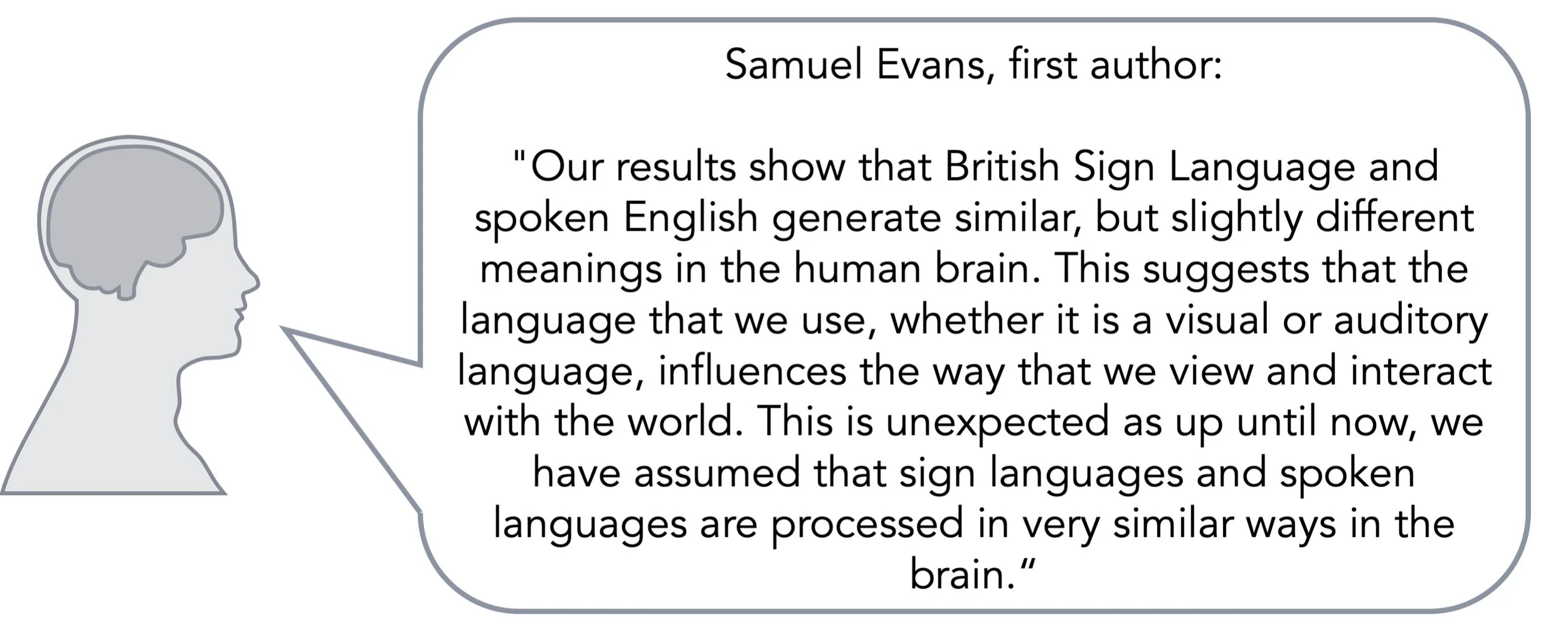
This study demonstrates that there is at least one brain area that responds to concepts, independent of the language used (even if one is a spoken language and the other is a sign language). Some recent media trends (like the movie Arrival) advocate for linguistic relativity: the idea that the language we speak determines the way we think. However, Evans and colleagues see language more like a ‘subtle filter’ that ‘influences, rather than determines, perception and thought.’

Evans_quote_Oct29.jpg

Evans et al. Sign and Speech Share Partially Overlapping Conceptual Representations. Current Biology (2019). Access the original scientific publication here.

Neuroprotective Effects of Sphingosine Kinase 2 in Mouse Models of Alzheimer’s Disease

Post by Shireen Parimoo

What's the science?

Alzheimer’s disease (AD) is a neurodegenerative disease most commonly characterized by memory deficits and the accumulation of amyloid-beta (Aβ) plaques in the brain. The hippocampus, which is important for memory and spatial navigation, is one of the brain regions that is severely affected by Aβ pathology in AD. Studies have linked AD to lower concentrations of hippocampal sphingosine-1-phosphate (S1P), a signaling lipid that is important for glial cell survival, and sphingosine kinase 2 (SK2), an enzyme responsible for producing S1P. Although this suggests that SK2 and S1P may be important for normal brain functioning, SK2 has also been shown to facilitate the formation of Aβ plaques. This week in The Journal of Neuroscience, Lei and colleagues investigated the effects of SK2 deletion on the structural and functional characteristics of hippocampal neurons in mouse models of AD.

How did they do it?

Transgenic mice with SK2 deletion (SK2D) or without SK2 deletion (SK2+/+) were cross-bred with AD mice (J20) to produce four different lines of transgenic mice: (i) SK2+/+ mice, (ii) SK2D mice, (iii) J20-SK2+/+ or J20 mice, and (iv) J20-SK2D mice. The J20 mice over-express the human amyloid precursor protein transgene, resulting in high concentrations of Aβ proteins and memory deficits, like in AD. The authors used immunohistochemistry and enzyme-linked immunoassays to examine Aβ pathology, including plaque number, burden, and Ab concentration in the hippocampal tissue of 8- and 13-month-old mice. To determine the effects of Aβ pathology and SK2 loss on behavior, 7- and 12-month-old mice completed several cognitive tests, including the Y-maze (spatial memory), the social preference test (social exploration), the social novelty test (social recognition memory for novel vs familiar mice), and the novel object recognition test (object recognition memory for novel vs familiar objects).

The authors then examined the hippocampal volume and neuronal density in 7- and 12-month-old mice. They further identified potential causes of volume and density changes using immunofluorescence microscopy and Western blotting to characterize de-myelination, axonal degeneration, and oligodendrocyte (glial cells produce myelin) density in the hippocampus. Finally, electroencephalography was used to determine the effect of SK2 deletion on functional hippocampal activity in 13-month-old mice. This included measures of epileptiform activity (transient, high-frequency activity), oscillatory power modulation in the theta (4-12 Hz) and gamma (25-100 Hz) frequency bands, and theta-gamma phase-amplitude coupling.

What did they find?

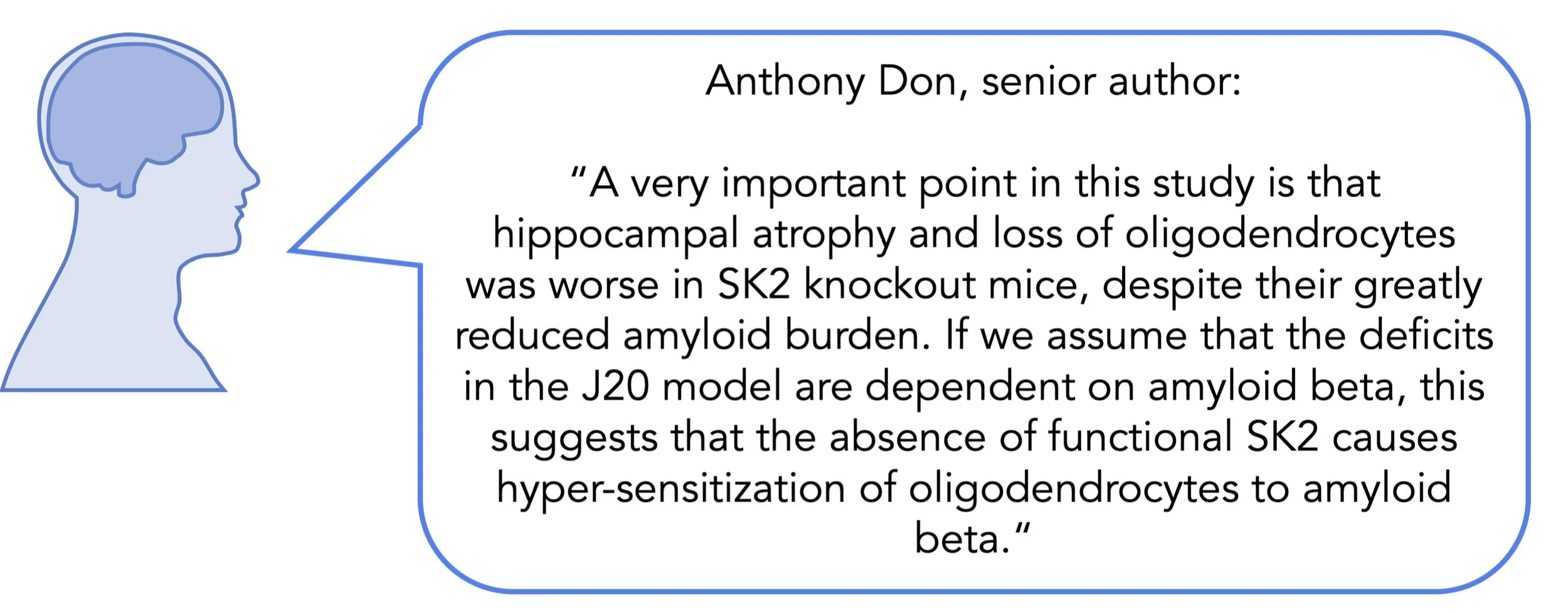
Plaque pathology was not observed in the wild-type (WT) or SK2+/+ mice. However, there was greater plaque pathology in J20 mice at 13 months old than at 8 months old. Moreover, J20 mice had greater plaque pathology and Aβ concentration than J20-SK2D mice. Consistent with this, hippocampal epileptiform activity was higher in the J20 mice compared to the J20-SK2D mice, but absent in the WT and SK2D mice. Oscillatory power was also lower in J20-SK2D mice compared to the other mouse lines. Thus, the absence of SK2 reduces plaque burden, hippocampal oscillatory power, and epileptiform activity in AD mice. In contrast, hippocampal volume was lower in the J20-SK2D mice compared to the WT mice at 13 months old. Furthermore, hippocampal neurons in the 13-month-old J20-SK2D mice were less myelinated and had fewer oligodendrocytes compared to the WT mice. This means that the accumulation of Aβ plaques in the absence of SK2 likely resulted in fewer oligodendrocytes, leading to demyelination and smaller hippocampi in the AD-like mice.

shireen (3).png

Cognitive performance was also affected by SK2 deletion, as the J20-SK2D mice performed at chance levels on the Y-maze test whereas the WT, SK2D, and J20 mice performed above chance. Similarly, the J20-SK2D mice had lower performance on the social novelty test. However, they did not differ from other mice on the social preference test, suggesting that their deficit is specific to memory rather than social exploration. Thus, spatial memory and social recognition memory are particularly impaired in mice with both Aβ burden and SK2 deletion.

What's the impact?

This study is the first to demonstrate the role of SK2 in Aβ formation in vivo and the resulting abnormal activity in the hippocampus. At the same time, however, the study establishes the adverse effects of SK2 deficiency on hippocampal structure, myelination, and cognitive performance. These findings also provide further insight into the importance of oligodendrocytes in maintaining normal hippocampal function and pave the way for future research to investigate how the loss of glial cell function contributes to pathology in neurodegenerative diseases.

Don_quote_Oct29.jpg

Lei et al. Sphingosine kinase 2 potentiates amyloid deposition but protects against hippocampal volume loss and demyelination in a mouse model of Alzheimer’s disease. The Journal of Neuroscience (2019). Access the original scientific publication here.