Partially Overlapping Representations of Speech and Sign Language in the Brain

Post by Anastasia Sares

What's the science?

Communication between humans involves a fascinating process of transformation in the brain. We begin with external signals: spoken words, written symbols, street signs, emojis, braille, or sign language. These signals enter the brain through different senses, but eventually, they become a concept, something that transcends the medium used to communicate them. What are some of the neural processes underlying the formation of concepts? This week in Current Biology, Evans and colleagues used advanced MRI techniques to find out how concepts live in the brain, independent of the signals that created them.

How did they do it?

The authors tested individuals who were bilingual in spoken British English and British Sign Language. This kind of bilingualism is interesting because it is also bimodal in terms of the senses used: spoken language uses auditory information while sign language uses visual information. The participants underwent an MRI scan while being presented with a number of words in both of their languages, with audio-only for speech and visual-only for sign language. The words could be grouped into conceptual categories (fruit, animals, and transport), and the conceptual relationships between each item had been modeled in a previous experiment. For example, an orange and a banana would have a high similarity rating whereas, an orange and a truck would have low similarity. The analysis focused on patterns of brain activity for each object. The authors applied their conceptual relationship model to the brain, looking for areas where conceptually similar words had similar patterns of brain activity, while conceptually distant words had differing patterns of brain activity (using multivariate pattern analysis, or MVPA). They first did this within modalities (within speech and within signs). They found clusters of the brain that fit their criteria. Then, they further tested each cluster, looking for the ones that could distinguish concepts across modalities, having similar patterns of activity for both speech and sign language. The only cluster that met all of their criteria was located in the left posterior middle/inferior temporal gyrus.

What did they find?

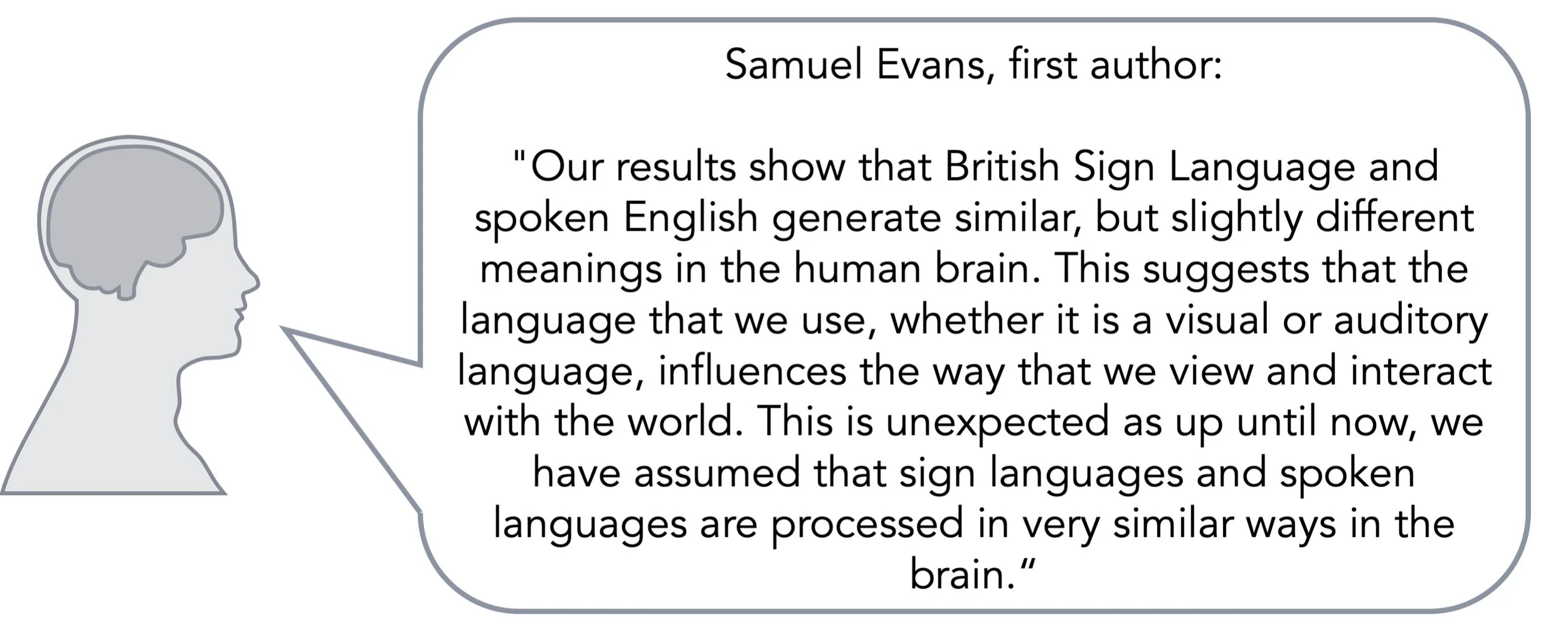
The patterns of brain activity in the left posterior middle/inferior temporal gyrus were related to the category of the word (e.g., fruit vs animal), regardless of whether it was spoken or signed. Interestingly, however, this area was not very good at representing individual items (e.g. banana vs orange) cross-modally. There were other regions that did have patterns distinguishing individual items, but these were located in areas specific to either speech or sign language. The authors interpreted this to mean that higher-level concepts were modality-independent, but individual objects had modality-specific representations in the brain.

anastasia (5).png

What's the impact?

This study demonstrates that there is at least one brain area that responds to concepts, independent of the language used (even if one is a spoken language and the other is a sign language). Some recent media trends (like the movie Arrival) advocate for linguistic relativity: the idea that the language we speak determines the way we think. However, Evans and colleagues see language more like a ‘subtle filter’ that ‘influences, rather than determines, perception and thought.’
Evans_quote_Oct29.jpg

Evans et al. Sign and Speech Share Partially Overlapping Conceptual Representations. Current Biology (2019). Access the original scientific publication here.

Neuroprotective Effects of Sphingosine Kinase 2 in Mouse Models of Alzheimer’s Disease

Post by Shireen Parimoo

What's the science?

Alzheimer’s disease (AD) is a neurodegenerative disease most commonly characterized by memory deficits and the accumulation of amyloid-beta (Aβ) plaques in the brain. The hippocampus, which is important for memory and spatial navigation, is one of the brain regions that is severely affected by Aβ pathology in AD. Studies have linked AD to lower concentrations of hippocampal sphingosine-1-phosphate (S1P), a signaling lipid that is important for glial cell survival, and sphingosine kinase 2 (SK2), an enzyme responsible for producing S1P. Although this suggests that SK2 and S1P may be important for normal brain functioning, SK2 has also been shown to facilitate the formation of Aβ plaques. This week in The Journal of Neuroscience, Lei and colleagues investigated the effects of SK2 deletion on the structural and functional characteristics of hippocampal neurons in mouse models of AD.

How did they do it?

Transgenic mice with SK2 deletion (SK2D) or without SK2 deletion (SK2+/+) were cross-bred with AD mice (J20) to produce four different lines of transgenic mice: (i) SK2+/+ mice, (ii) SK2D mice, (iii) J20-SK2+/+ or J20 mice, and (iv) J20-SK2D mice. The J20 mice over-express the human amyloid precursor protein transgene, resulting in high concentrations of Aβ proteins and memory deficits, like in AD. The authors used immunohistochemistry and enzyme-linked immunoassays to examine Aβ pathology, including plaque number, burden, and Ab concentration in the hippocampal tissue of 8- and 13-month-old mice. To determine the effects of Aβ pathology and SK2 loss on behavior, 7- and 12-month-old mice completed several cognitive tests, including the Y-maze (spatial memory), the social preference test (social exploration), the social novelty test (social recognition memory for novel vs familiar mice), and the novel object recognition test (object recognition memory for novel vs familiar objects).

The authors then examined the hippocampal volume and neuronal density in 7- and 12-month-old mice. They further identified potential causes of volume and density changes using immunofluorescence microscopy and Western blotting to characterize de-myelination, axonal degeneration, and oligodendrocyte (glial cells produce myelin) density in the hippocampus. Finally, electroencephalography was used to determine the effect of SK2 deletion on functional hippocampal activity in 13-month-old mice. This included measures of epileptiform activity (transient, high-frequency activity), oscillatory power modulation in the theta (4-12 Hz) and gamma (25-100 Hz) frequency bands, and theta-gamma phase-amplitude coupling.

What did they find?

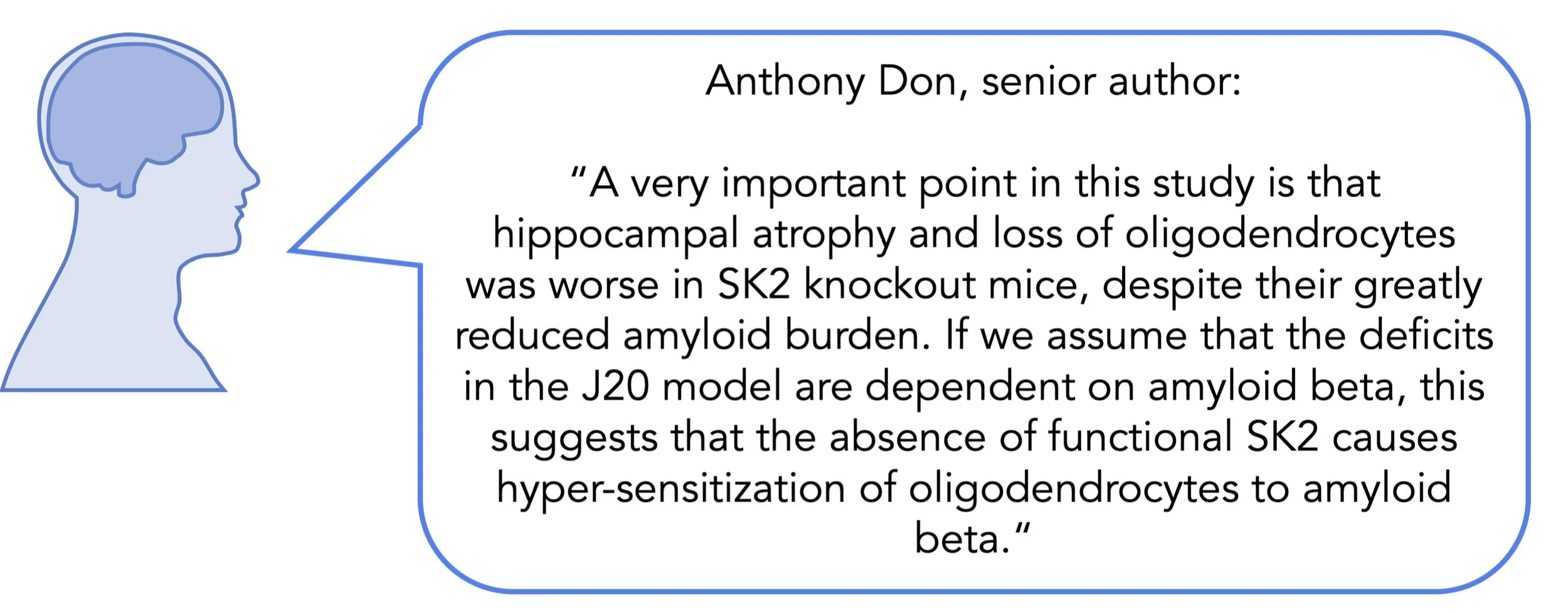
Plaque pathology was not observed in the wild-type (WT) or SK2+/+ mice. However, there was greater plaque pathology in J20 mice at 13 months old than at 8 months old. Moreover, J20 mice had greater plaque pathology and Aβ concentration than J20-SK2D mice. Consistent with this, hippocampal epileptiform activity was higher in the J20 mice compared to the J20-SK2D mice, but absent in the WT and SK2D mice. Oscillatory power was also lower in J20-SK2D mice compared to the other mouse lines. Thus, the absence of SK2 reduces plaque burden, hippocampal oscillatory power, and epileptiform activity in AD mice. In contrast, hippocampal volume was lower in the J20-SK2D mice compared to the WT mice at 13 months old. Furthermore, hippocampal neurons in the 13-month-old J20-SK2D mice were less myelinated and had fewer oligodendrocytes compared to the WT mice. This means that the accumulation of Aβ plaques in the absence of SK2 likely resulted in fewer oligodendrocytes, leading to demyelination and smaller hippocampi in the AD-like mice.

shireen (3).png

Cognitive performance was also affected by SK2 deletion, as the J20-SK2D mice performed at chance levels on the Y-maze test whereas the WT, SK2D, and J20 mice performed above chance. Similarly, the J20-SK2D mice had lower performance on the social novelty test. However, they did not differ from other mice on the social preference test, suggesting that their deficit is specific to memory rather than social exploration. Thus, spatial memory and social recognition memory are particularly impaired in mice with both Aβ burden and SK2 deletion.

What's the impact?

This study is the first to demonstrate the role of SK2 in Aβ formation in vivo and the resulting abnormal activity in the hippocampus. At the same time, however, the study establishes the adverse effects of SK2 deficiency on hippocampal structure, myelination, and cognitive performance. These findings also provide further insight into the importance of oligodendrocytes in maintaining normal hippocampal function and pave the way for future research to investigate how the loss of glial cell function contributes to pathology in neurodegenerative diseases.

Don_quote_Oct29.jpg

Lei et al. Sphingosine kinase 2 potentiates amyloid deposition but protects against hippocampal volume loss and demyelination in a mouse model of Alzheimer’s disease. The Journal of Neuroscience (2019). Access the original scientific publication here.

Neural Activity Levels and REST Regulate Longevity

Post by Sarah Hill

What's the science?

The global population is aging, with the number of adults over 80 years of age expected to triple by 2050. Consequently, the prevalence of aging-related neurological diseases such as dementia is predicted to increase in years to come. To this end, determining the biological mechanisms that mediate healthy aging is a key objective for many researchers. Past research has shown clear gene expression differences in the brains of aged individuals compared to those that are younger. However, whether activity levels in the brain affect the aging process is unknown. This week in Nature, Zullo and colleagues identify key neurobiological processes that regulate aging and longevity, demonstrating for the first time that neural activity levels influence lifespan.

How did they do it?

The authors carried out three major investigations to identify the neurobiological processes that govern longevity. In the first investigation, they analyzed gene expression datasets from three different human sample cohorts to characterize gene expression differences in the brains of aged individuals compared to younger adults. Finding that many of the differentially expressed genes associated with longevity (defined as >85 years of age) were related to neural excitation, they subsequently tested how neural activity levels affect aging using the worm Caenorhabditis elegans (C. elegans) as a model organism. In this investigation, they either boosted or suppressed neuronal activity through chemical and genetic manipulation and recorded resultant neural excitation levels through calcium imaging, allowing them to identify the specific populations of neurons responsible for longevity. In a third investigation, they shifted focus to the processes regulating differential gene expression in advanced age. Having previously found that REST, an inhibitor of gene expression in mammals, is upregulated in the aged brain, they investigated whether this regulatory transcription factor directs neural activity levels. First, they looked at whether REST was associated with any of the differentially expressed genes in the human sample cohorts. They then examined whether the C. elegans REST orthologs SPR-3 and SPR-4 regulate longevity and neural activity levels by comparing lifespans and evaluating gene expression in normal worms versus those lacking either or both of the SPR-3 and SPR-4 genes. Finally, they carried out calcium imaging of SPR-3/-4 mutant worms to confirm whether SPR-3 and SPR-4 regulate neural excitation.        

What did they find?

Analysis of the human gene expression datasets revealed an association between longevity and reduced expression of genes related to neural excitation and synaptic function, suggesting diminished excitatory neurotransmission is a feature of longevity. Indeed, manipulation and calcium imaging of neural activity levels in C. elegans confirmed that suppression of neural excitation lengthens lifespan, while neural overexcitation shortens lifespan. Specifically, inhibition of glutamatergic and cholinergic neurons, both of which are excitatory neuronal cell types, led to extended lifespan in the worms. When looking at whether REST is involved in dampening neural excitation and regulating longevity, the authors found negative associations between the gene expression repressor and many of the differentially expressed genes in the aged human subjects, suggesting that as REST is upregulated in the brain during aging, and genes related to neural excitation are selectively downregulated. This was validated in the worm model, in which the REST orthologs SPR-3 and SPR-4 were found to specifically downregulate the expression of neuronal genes associated with neural excitation and synaptic function. Interestingly, genetic manipulation of SPR-3 and SPR-4 expression in neurons was associated with dramatic differences in worm lifespans, with SPR-3/-4 affecting the insulin/IGF signaling pathway and activating an additional regulator of gene expression, DAF-16, to extend longevity. Finally, calcium imaging of SPR-3/-4 mutants demonstrated that both the C. elegans REST orthologs contribute to inhibition of neural excitation, a key feature of extended longevity.                

REST_image.png

What's the impact?

This is the first study to show that brain activity levels influence aging and lifespan in worms. Given the expected increase in population aging, identification of the neurobiological processes governing longevity is critical for developing interventions to promote healthy aging and extend lifespan. Findings from this study may thus be an important step in this effort.       

Yanker_quote_Oct22.jpg

Zullo et al. Regulation of lifespan by neural excitation and REST. Nature (2019). Access the original scientific publication here.