
Tracking Neurons During Development to Understand How Neural Circuits Form

Post by Sarah Hill

What's the science?

Neurons never act alone, but instead, organize into coordinated cellular ensembles or 'circuits' to direct behaviors. Linking how newborn neurons are arranged into coordinated networks during development has previously been limited by available technologies, leaving an incomplete picture of how neural circuits are formed. However, recent advances in imaging and computational methods have offered insight into this process. This week in Cell, Wan and colleagues present a new imaging framework for tracking neurons from cell birth to emergence of synchronized global activity, shedding new light on how neural circuits assemble during development.                

How did they do it?

The authors developed an imaging method based on light-sheet fluorescence microscopy to simultaneously track the identities, lineages, migration, and activation of newborn neurons, and demonstrated the approach in the zebrafish spinal cord. First, they imaged a whole zebrafish embryo using cell-type-specific markers to identify neuron types, trace cell lineages, and monitor neuronal movements. They then performed functional imaging of the embryos to record neuronal activation during circuit formation. Additional experiments were carried out to establish how ensembles of neurons become coordinated in their activation along with multiple segments of the spinal cord, as well as how synchronized activity on the left and right sides of the spinal cord is established. Using the imaging data, they pieced together how early spinal cord neurons assemble into a fully functional circuit.        

What did they find?

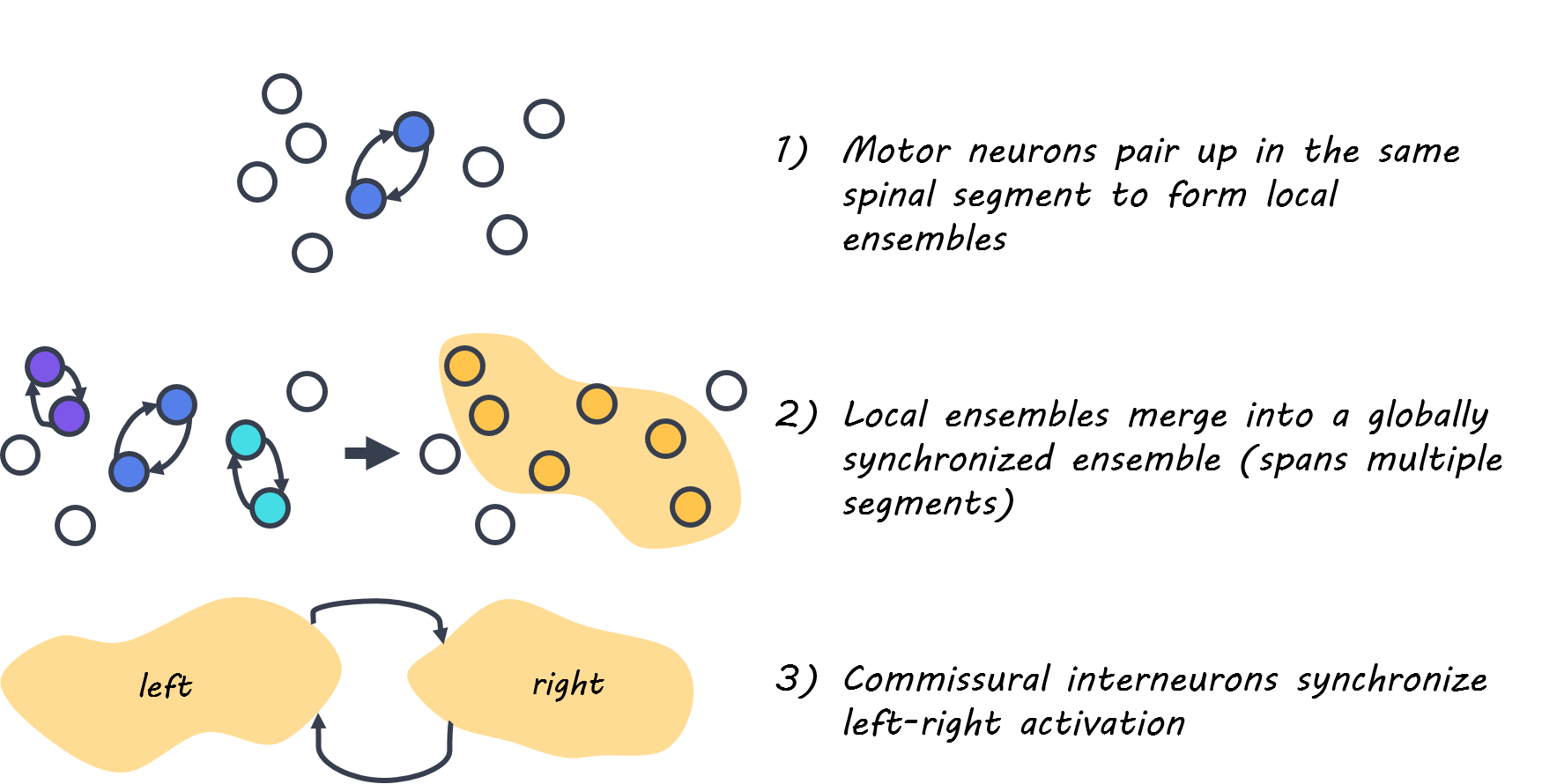
Through this new imaging method, the authors successfully reconstructed an assembly of the spinal cord circuit at the single-cell level. Using the zebrafish as a model, they identified three key stages in spinal cord circuit development. First, nascent motor neurons (cells that execute motor movements) pair up with other neurons in the same spinal segment to form local ensembles of synchronized activity. In stage II, the local ensembles merge based on size into a globally synchronized ensemble that spans multiple segments. Local spinal microcircuits continue to merge until only two neural ensembles remain, on the left and right sides of the spinal cord. In stage III, alternating left-right activation is synchronized by commissural interneurons (cells that project to the opposite side of the spinal cord) recruited into the global ensembles relatively late in the process.   
sarah.png

What's the impact?

This is the first study to trace the development of a neural circuit at the single-cell level, from neuronal birth to emergence of a functional circuit. Importantly, the imaging framework proposed in this study can be readily translated to neural circuits beyond the spinal cord and all computational methods are open-source. 

Keller_quote.jpg

Wan et al. Single-Cell Reconstruction of Emerging Population Activity in an Entire Developing Circuit. Cell (2019). Access the original scientific publication here.
Dopamine Stimulation Modulates the Balance Between Ignoring and Updating Information

Post by Flora Moujaes

What's the science?

Deficits in working memory are a common feature of numerous psychiatric disorders, however, are not effectively treated by available therapies. Working memory deficits have often been attributed to altered dopaminergic signalling, but dopamine’s specific role has not been clearly defined. For example, dopamine has been shown to be integral to the ability to ignore distracting stimuli, but less research has been done on how this may relate to flexibility and the ability to update working memory representations. Furthermore, how individual differences affect dopamine’s modulation of working memory is unclear. Research has indicated that the ability to gate the contents of working memory is linked to both the balance between D1 and D2 dopamine receptors and tonic dopamine levels (i.e. the ‘sustained’ background dopamine release). Although it is difficult to measure tonic dopamine levels in the human brain, it may be possible to use baseline working memory performance as a proxy. This week in Journal of Psychopharmacology, Fallon and colleagues from Masud Husain’s lab at the University of Oxford explore how dopamine D2 receptor stimulation modulates both working memory and cognitive control, and how this relates to individual differences in baseline working memory performance.

How did they do it?

Researchers manipulated dopamine in 26 healthy older adults. Older adults were chosen as, like Parkinson’s patients, they show a depletion of dopaminergic functioning. However, without the progressive neuronal pathology seen in Parkinson’s they provide a clearer window into the effect dopamine has on cognitive functioning. Participants completed two sessions following either the administration of a single dose of cabergoline (1 mg), a relatively selective D2 dopamine agonist, or placebo. The order in which they received the dopamine agonist or placebo was counterbalanced to avoid order effects. Each session consisted of three tasks. The first was the Ignore/Update working memory Task, designed to assess the ability to ignore or update information in working memory. In this task, participants were shown two differently coloured arrows and required to encode their orientations. They then saw a second pair of arrows that they either had to disregard in the ignore condition, or use to replace the previous orientation information held in working memory in the update condition. The second task was the Baseline working memory Task, which provided a baseline measure of working memory ability as participants merely had to remember the orientation of an arrow after a delay. The third task was the Response Conflict (Simon) Task, which was used to obtain a relatively working memory-free measure of cognitive control. In this task, participants had to indicate which way an arrow was pointing, and the arrow’s location on the screen was either congruent or incongruent to its direction.

What did they find?

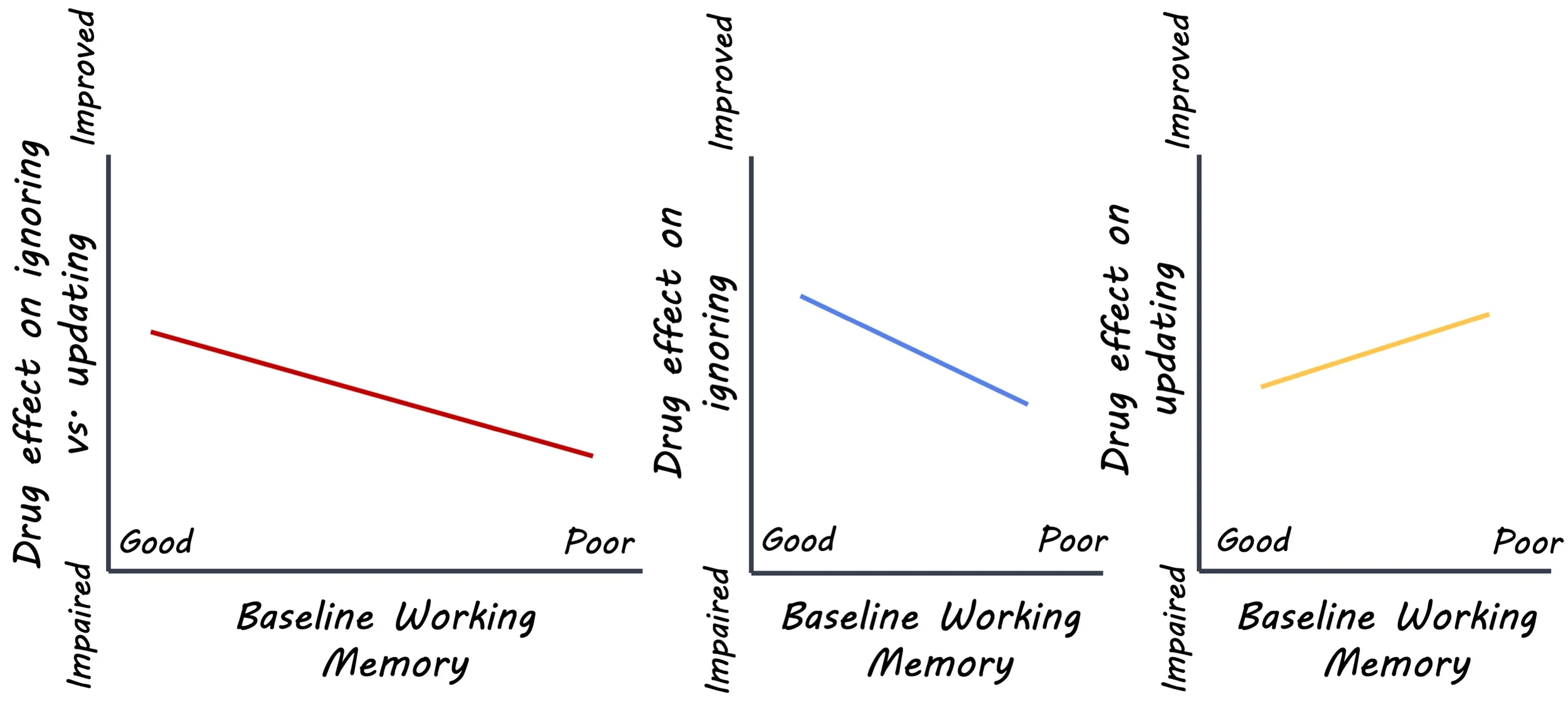
Baseline working memory ability modulates the direction of dopamine’s effect on ignoring vs. updating: Researchers found that dopamine D2 receptor stimulation did not influence overall working memory recall, but did modulate the balance between ignoring and updating in divergent ways according to baseline working memory performance. High-working memory individuals were relatively better at ignoring compared to updating after drug administration, whereas the opposite occurred in low-working memory individuals. This indicates that increased dopamine can enhance the robustness of mental representations in high-working memory individuals, but makes representations less stable and flexible in low-working memory individuals. Dopamine has common, but antagonistic, effects on ignoring and overcoming response conflict: The ability to overcome response conflict was not affected by drug administration, but the researchers did find a negative relationship between the effect the drug had on response conflict performance and ignoring. This indicates that both response conflict, a working memory free measure of cognitive control, and ignoring, a sub-process of working memory, are coupled to dopaminergic stimulation levels.
What's the impact?

WM_image.jpg

What’s the impact?

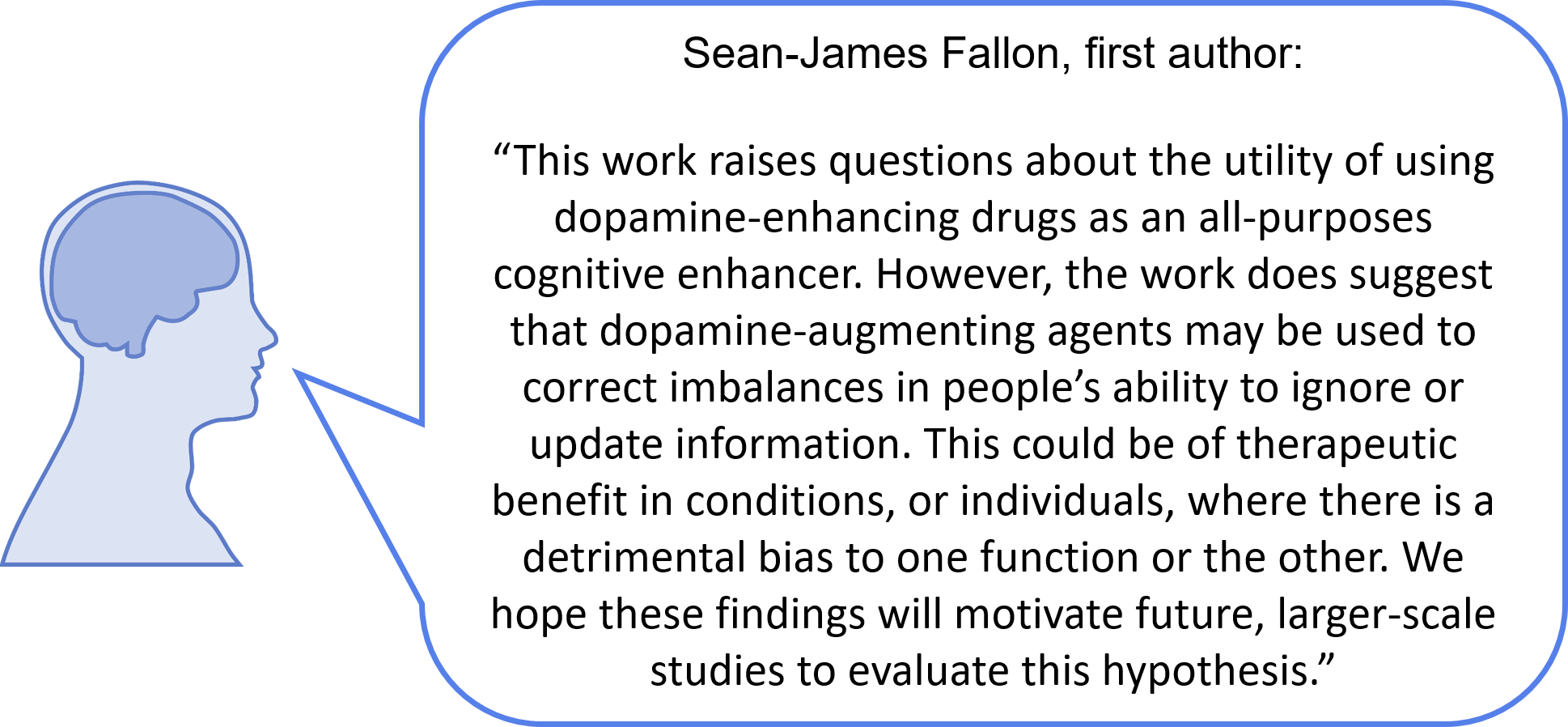
Overall, this study provides a clearer window into the effect dopamine has on cognitive functioning, which may have wider implications for disorders such as Parkinson’s. Furthermore, these findings highlight the importance both of accounting for individual differences and decomposing working memory into its subcomponents when assessing the effects of dopaminergic drugs. This study also suggests that dopamine-altering cognitive enhancers may be of minimal benefit, as augmenting D2 stimulation acts as a double-edged sword: improving one cognitive function at the expense of another. Future studies would benefit by examining the effects of both dopamine agonists and antagonists in the same sample, in order to more closely examine how the balance between D1 and D2 dopamine receptors relates to working memory.

seanjames.png

Fallon et al. Dopamine D2 receptor stimulation modulates the balance between ignoring and updating according to baseline working memory ability. Journal of Psychopharmacology (2019). Access the original scientific publication here.
Aerobic Exercise Mitigates the Severity of Motor Symptoms in Parkinson’s Disease

Post by Shireen Parimoo

What's the science?

Parkinson’s disease (PD) is a progressive neurodegenerative disorder that arises from the loss of dopamine neurons in the substantia nigra, resulting in motor symptoms like bradykinesia (slow movement), impaired posture, and resting tremors. Patients are typically treated with medications that increase dopamine levels in the brain or mimic the effects of dopamine, such as Levodopa or dopamine agonists, respectively. Although these medications help to reduce motor symptoms, they are often not as effective in the long-term. Previous studies linked exercise to an improvement in motor symptoms among PD patients; for example, a recent treadmill study showed attenuation of motor symptoms after aerobic exercise in unmedicated PD patients. However, few studies have investigated the long-term effects of aerobic exercise in PD patients, particularly in those who regularly take medication to treat symptoms. This week in The Lancet Neurology, van der Kolk and colleagues examined the impact of aerobic exercise on the severity of motor symptoms over a six-month period in patients with Parkinson’s disease.

How did they do it?

One hundred and thirty patients with mild PD participated in a double-blind, randomized controlled trial. Patients were randomly assigned to an aerobic exercise treatment group or an active control stretching group for six months. In the treatment group, participants exercised on a stationary cycle for 30-45 minutes at least three times a week, whereas the control group performed stretching and flexibility exercises for 30 minutes three days a week. Participants completed these exercises at home using a tablet-based application, and the stationary cycle included virtual reality software with videos to make the exercises more engaging. The groups were randomized based on sex and medication status, and the trial was double-blind. The authors assessed the following measures at the beginning of the study (baseline) and after six months: (i) severity of motor symptoms using the motor section of the Movement Disorders Society – Unified Parkinson’s Disease Rating Scale (MDS-UPDRS), (ii) other motor symptoms such as frequency of falls and finger-tapping performance, (iii) non-motor symptoms like sleep and depression, and (iv) cardiovascular fitness. Importantly, to rule out acute effects of medication on these outcomes, these symptoms were assessed during the off-state when at least 12 hours had passed since patients had taken their medication. On the MDS-UPDRS, a higher score is associated with more severe symptoms, thus, a bigger difference in scores after treatment suggests a worsening of symptoms. To determine if aerobic exercise improved the severity of motor symptoms, the authors compared the change in MDS-UPDRS scores after six months between the two groups.

What did they find?

There were no differences in baseline measures across the treatment and control groups. After six months, the score for motor symptoms on the MDS-UPDRS increased by 1.3 points in the treatment group but by 5.6 points in the control group. In other words, the motor symptoms became more severe in the control group after six months than in the treatment group. This difference of 4.2 points between the two groups is clinically relevant (>3.5 points), and provides support for the effectiveness of aerobic exercise in mitigating motor symptoms in PD. Cardiovascular fitness also increased in the treatment group but decreased in the control group. Interestingly, the severity of motor symptoms evaluated during the on-state (within 12 hours of taking medication) as well as other motor symptoms like the frequency of falls and finger-tapping performance did not differ across the two groups after the trial. Moreover, patients who exercised did not differ from those in the control group in non-motor symptoms. Thus, the specific effect of exercise during patients’ off-state indicates it can be a promising complementary treatment approach to medication in alleviating the severity of motor symptoms in PD.

What's the impact?

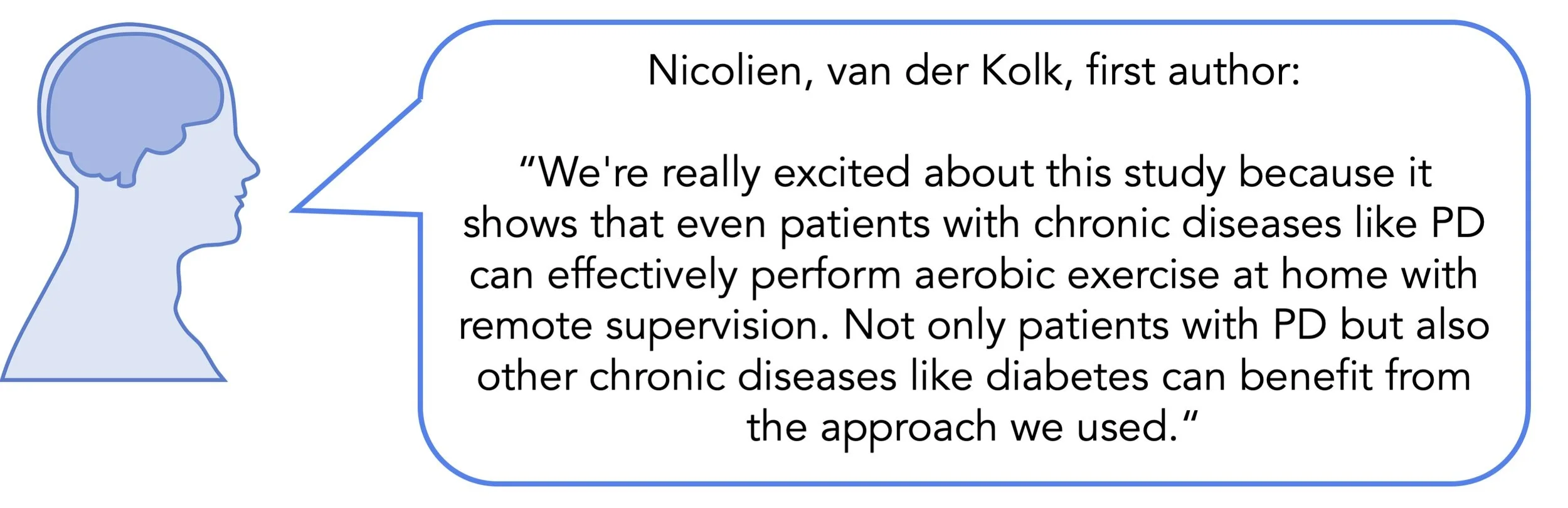
This study is the first to demonstrate that consistent aerobic exercise can attenuate the progression of motor symptoms in patients with PD. These findings have important implications for the treatment approaches available to PD patients and open the door for future research to investigate the longer-term impact of exercise on both motor and non-motor symptoms.

PD_quote.jpg

Van der Kolk et al. Effectiveness of home-based and remotely supervised aerobic exercise in Parkinson’s disease: a double-bind randomised controlled trial. The Lancet Neurology (2019). Access the original scientific publication here.