Thalamic Activity During Embryonic Development Helps Guide the Formation of Somatotopic Maps

Post by Shireen Parimoo

What's the science?

In sensory regions of the brain, like the primary somatosensory cortex (S1), sensory inputs from adjacent regions on the body are represented in adjacent populations of neurons (barrels). In mice, for example, whiskers are somatotopically represented in the cortex in barrels, which means that stimulating neighboring whiskers activates neighboring barrels in the mouse S1. Sensory input from the body travels through the thalamus (part of the forebrain) before reaching the cortex, and these connections are formed early in development. Interestingly, there is evidence of co-occurring spontaneous activity in the thalamus and S1 before the cortical barrels have fully developed. It is currently unclear whether this spontaneous co-activation of the thalamus and S1 facilitates the development of somatotopically organized cortical barrels or whether cortical barrel organization is dependent on external sensory input after birth. This week in Science, Antón-Bolaños and colleagues investigated the functional characteristics of thalamocortical connections in developing and newborn mice.

How did they do it?

First, the authors electrically stimulated the ventral posteromedial nucleus (VPM) of the thalamus in mouse embryos and used calcium imaging to measure the change in the response of S1 neurons. To determine how specific the projections were from the thalamus to S1, they also stimulated three other regions adjacent to the VPM and measured the cortical response. They then used a transgenic mouse line “Kir” to examine the effect of altered spontaneous thalamic activity on barrel development. Control mice have high-amplitude and synchronized neural activity in the VPM, whereas Kir mice have asynchronous and low-amplitude activity in 10-day old embryos (E10). They stimulated the VPM and adjacent thalamic regions and compared the cortical response in the Kir and control mice at 17.5 and 18.5 days.

To determine the longer term effect of altered thalamic activity on barrel development, the authors stimulated the VPM in Kir and control mice four days after birth (P4) and recorded cortical activity. They also stimulated the whiskers to determine if providing external sensory input could facilitate the development of cortical barrels. They used multichannel electrodes to measure extracellular activity in S1 of Kir and control mice at postnatal days 2 amd 3. To further examine the mechanism underlying cortical activity in Kir mice, a glutamate receptor antagonist was applied to S1 and change in cortical response was measured. Finally, axon tracing and immunostaining were used to detect cortical barrels and axons projecting between the thalamus and S1.

What did they find?

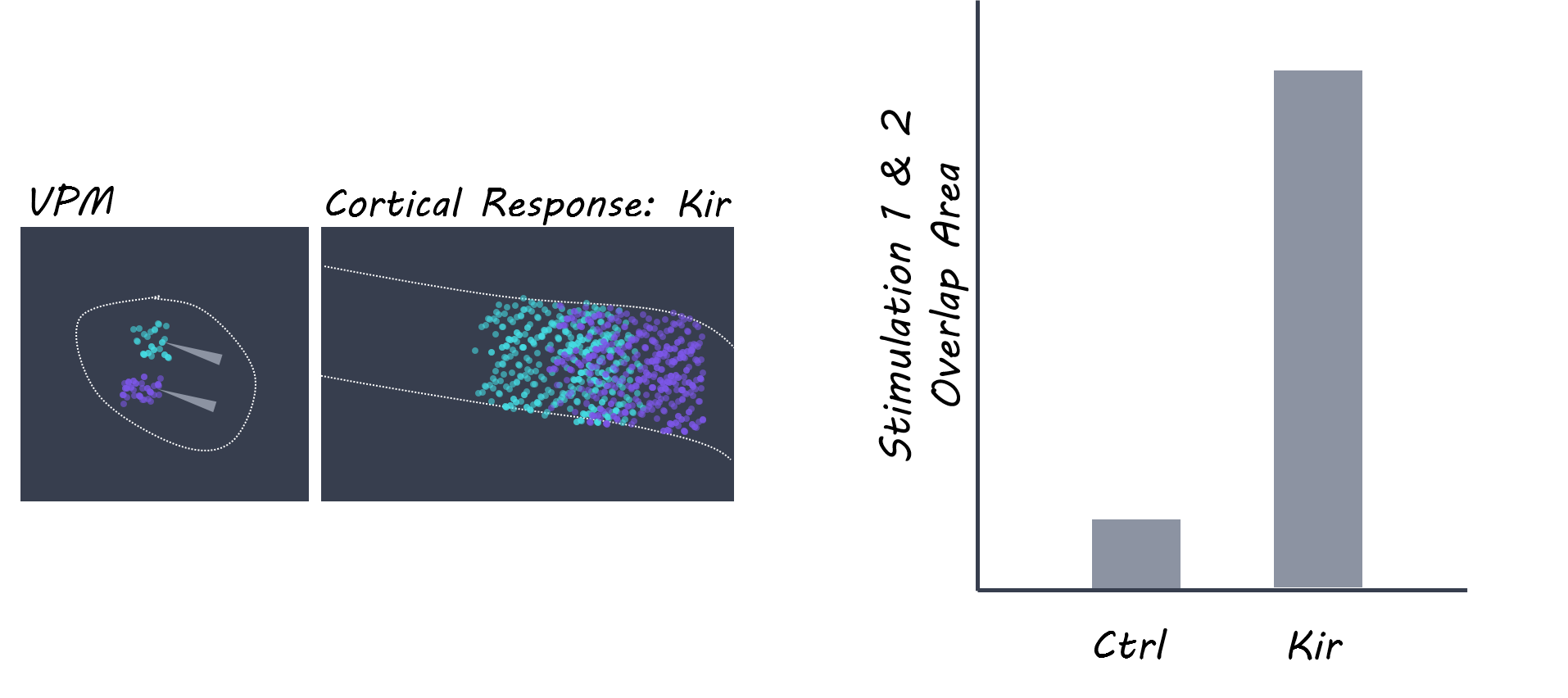
Stimulating the VPM resulted in a large cortical calcium response at day 17.5, but a smaller and more localized response at 18.5 days. Stimulation of VPM-adjacent regions at 18.5 days activated a population of neurons altogether. In transgenic Kir mice, on the other hand, VPM stimulation resulted in widespread cortical activation, and stimulating VPM-adjacent neurons activated overlapping neuronal populations in S1. In newborn control mice, VPM stimulation led to an even more localized cortical response, but this localization did not occur to the same extent in the Kir mice. This means that specific and functionally organized thalamocortical projections developed in 18.5-day old embryos, but altering thalamic activity disrupted the formation of cortical somatotopic maps. These effects persisted even after birth; control mice but not the Kir mice showed evidence of cortical barrels at postnatal day 4. Similarly, although stimulating the whiskers activated different S1 barrels in control mice, cortical activity was less distinct in the transgenic Kir mice and could not be rescued by sensory input after birth.
Kir.png

Axon tracing and staining revealed that in control mice, thalamic neurons projected to the corresponding cortical neurons in a barrel, but these axonal projections were less spatially specific in Kir mice. This means that neurons originating from a larger region of the thalamic VPM project to the S1 in Kir mice compared to the control mice. Finally, the transgenic mice had more glutamate receptors than control mice. Blocking glutamate receptors with an antagonist reduced the spatial extent of cortical activity in Kir mice, making it more similar to that of control mice. These results suggest that glutamate receptors underlie the widespread cortical response to thalamic activation in Kir mice, which subsequently affects the development of somatotopic maps in S1.

What's the impact?

This study is the first to demonstrate that spontaneous activity in the thalamus during embryonic development is critical for the formation of somatotopic maps in the mouse primary sensory cortex. Moreover, the finding that the concentration of glutamate receptors might underlie this relationship has important implications for understanding the role of genetic factors in cortical development. Overall, this study provides further insight into the importance of prenatal factors in the development of functionally organized cortical maps.

Antón-Bolaños et al. Prenatal activity from thalamic neurons governs the emergence of functional cortical maps in mice. Science (2019). Access the original scientific publication here.
Stress-Induced Memory Impairment is Mediated by Hippocampal Opioid Receptors

Post by Deborah Joye

What's the science?

Stress can impair your ability to retrieve memories. Perhaps you can recall a time that you sat down to take a big exam or started an important presentation only to have your mind go suddenly, frighteningly blank. We know that glucocorticoids (hormones activated by stress) can change excitatory synapses in the hippocampus and lead to impaired memory. But the effects of stress on memory go well beyond what can be explained just by the effects of glucocorticoids, suggesting that there may be other signals involved. In addition to glucocorticoids, stress also mobilizes endogenous opioids (i.e., made by your body) that can lead to cognitive, emotional, and physical effects that can help us adapt to stress. Opioids are often associated with pain relief, but how might they affect learning and memory in response to stress? This week in Molecular Psychiatry, Shi and colleagues use an impressive array of behavioral and cellular techniques to demonstrate that endogenous opioids produce stress-induced memory impairment by suppressing activity of GABAergic interneurons in the hippocampus.

How did they do it?

To produce stress, the authors placed mice on an elevated clear platform in a brightly lit room for close to an hour. Unstressed mice were in the same room but remained in their home cages. Throughout their experiments, the authors used the Morris Water Maze to test memory retrieval. In this task, mice are trained to swim in a circular pool and find a hidden platform which is consistently placed in the same region of the pool.

First, to determine if opioid receptors are involved with stress-induced memory impairment, the authors used naloxone, which strongly inhibits opioid receptors. Since there are three major opioid receptors in the hippocampus (µ, pronounced “mew”; δ, or delta; and κ, or kappa opioid receptors), the authors selectively activated or blocked specific opioid receptors to test which ones underlie stress-induced memory impairment. Next, the authors tested which endogenous opioid is involved by using antiserum to block the effects of opioids highly expressed in the hippocampus, β-endorphin and enkephalin, followed by memory retrieval testing. After testing which receptors and opioids are involved, the authors assessed which type of cells opioids might be acting on in stress-induced memory impairment. To do this, they used Cre-Lox recombination to delete the µ-opioid receptor gene in certain cell populations: GABAergic inhibitory interneurons, glutamatergic excitatory neurons, or astrocytes. Mice in the different µ-opioid receptor knockout conditions were then subjected to stress and the Morris water maze to test for memory impairment. To investigate possible changes in synaptic transmission, the authors recorded the electrophysiological activity of cells in the hippocampus immediately after stress. They also recorded electrophysiological changes in response to opioid receptor activation or inhibition. Finally, to test whether stress-induced memory impairments are due to inhibition of GABAergic interneurons, the authors activated or blocked GABA transmission in the hippocampus, then tested memory retrieval with the Morris water maze.

What did they find?

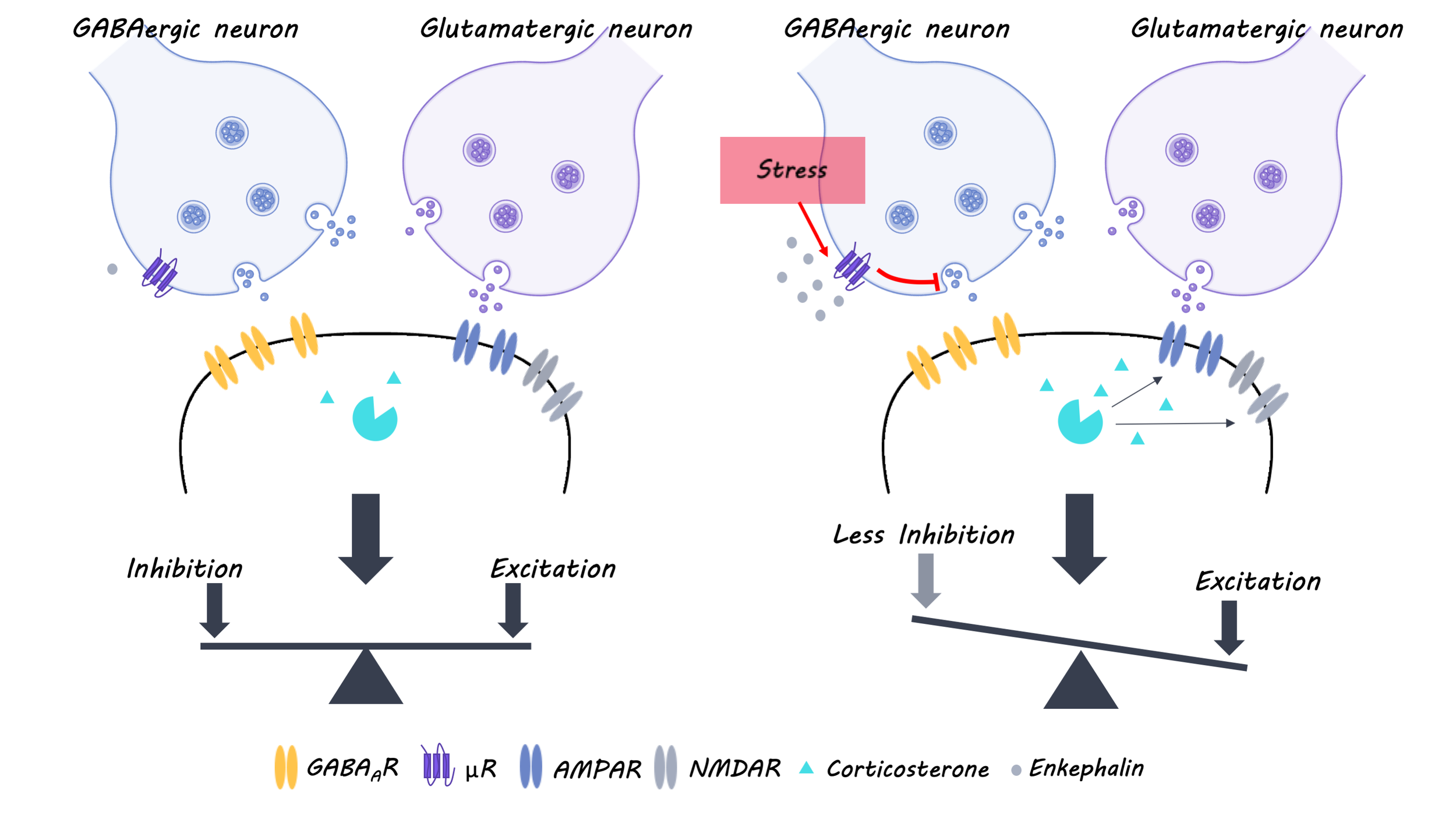
The authors found that µ-opioid receptor signaling is required for stress-induced impairment of memory retrieval. When µ-opioid receptor signaling is blocked, stressed mice do not exhibit memory impairments and activation of µ-opioid receptors in the hippocampus in unstressed mice reproduces memory impairment as if mice had been stressed. The authors also found that stress-induced memory impairment specifically depends on activation of µ-opioid receptors on GABAergic neurons, since stressed mice without µ-opioid receptors on GABAergic cells do not exhibit stress-induced memory impairments. Mice lacking µ-opioid receptors on glutamatergic cells or astrocytes still display stress-induced memory impairment. Using electrophysiology, the authors found that stress-induced activation of µ-opioid receptors on GABAergic interneurons decreases inhibitory synaptic transmission onto hippocampal CA1 neurons, resulting in memory impairment. Overall, the authors identified a new pathway in which acute stress mobilizes endogenous opioids to activate µ-opioid receptors on inhibitory GABA neurons in the hippocampus. This pathway reduces the release of GABA, increasing excitability of hippocampal cells and leading to impairments in memory retrieval.

Liu_image.png

What's the impact?

This study is the first to demonstrate that endogenous opioids play a role in stress-induced memory impairment. Specifically, this study examines and identifies the mechanism by which µ-opioid receptor activation on GABAergic cells within the hippocampus suppresses inhibition of hippocampal cells and results in memory retrieval impairments. These findings add an important new element to our understanding of how stress affects memory, and opens new avenues for research into the impacts of opioids in the hippocampus.

Liu_quote_June4.jpg

Shi et al., Hippocampal µ-opioid receptors on GABAergic neurons mediate stress-induced impairment of memory retrieval, Molecular Psychiatry (2019).Access the original scientific publication here.
Trait Anxiety Affects Our Cognitive Appraisal of Fear

Post by Elisa Guma

What's the science?

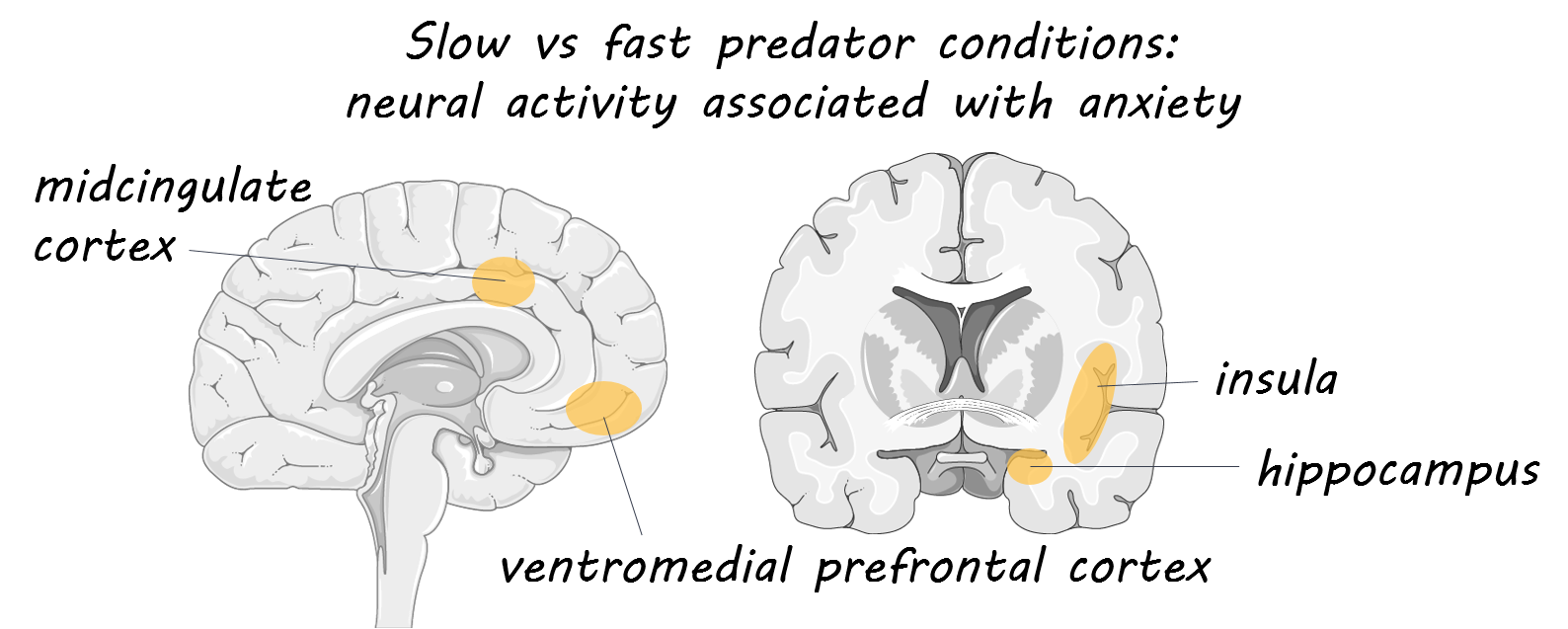
Anxiety, often described as an enduring state of apprehension, is thought to be an emotional state independent of fear that influences our behaviour in response to threat. It is thought that the neural response to less imminent or ‘cognitive’ threats involves the ventral hippocampus and the ventromedial prefrontal cortex, whereas the response to more immediate or ‘reactive’ threats involves mid-brain regions such as the periaqueductal gray. This week in Nature, Fung and colleagues set out to investigate whether trait anxiety selectively affects cognitive and reactive fear circuits in response to a threatening stimulus.

How did they do it?

To investigate this question, healthy adults for whom trait anxiety was measured, were tested on a behavioural task in which the goal was to successfully escape different predators, while maximizing money earned by fleeing as late as possible from an attack. In each trial, participants passively earned money while they encountered virtual predators of three colours, representing different attack distances: fast, medium, or slow. Fast attack predators quickly switched from a slow approach to a fast attack, requiring subjects to make quick escape decisions. Slow attack predators slowly approached for longer time periods, allowing participants more time to contemplate an escape. Subjects were given electrical stimulation when they were caught by the virtual predators. In order to measure contributions of the ‘reactive fear’ and cognitive fear’ networks to escape decisions, subjects performed this task while undergoing functional magnetic resonance imaging (fMRI), which measures blood oxygen level dependent (BOLD) changes (or changes in blood flow) throughout the brain, as a reflection of underlying neural activity.

With these data, the authors investigated how trait anxiety affected escape decisions based on predator attack speed. Next, they investigated the effects of trait anxiety on escape success as well as total earnings for the different predator types. For the fMRI data, they investigated the 2 seconds before the escape to examine neural circuitry involved in the anticipation of an escape response. Finally, they also investigated the interaction between brain regions involved in escape decisions by performing a seed-based connectivity analysis. This measures the correlation between patterns of activity in a ‘seed’ region (or region of interest), with activity in the rest of the brain. They chose the ventral hippocampus as a seed region given its critical role in cognitive fear and anxiety.

What did they find?

First, the authors found a significant interaction between the slow predator type and trait anxiety score, suggesting that trait anxiety affected the escape time only for slow predators, potentially via the ‘cognitive’ fear circuitry. More specifically, with every unit of increase in state anxiety there was a 5% increase in the chance of fleeing from a slow predator. Therefore, higher trait anxiety was associated with a greater likelihood of the participant escaping earlier when given enough time to prepare an escape.

elisa.png

Participants with higher trait anxiety were more likely to successfully escape in the slow predator conditions, but not in the medium or fast. However, this negatively impacted how much money they earned in the task because they were more likely to escape before individuals with lower trait anxiety. The authors found a significant BOLD response in regions often associated with fear and anxiety including the amygdala, hippocampus, ventromedial prefrontal cortex, and midcingulate cortex for higher trait anxiety and slow predators. Their seed-based analysis revealed that trait anxiety significantly influenced the coupling between the ventral hippocampus seed, and the bilateral medial prefrontal cortex, right inferior frontal gyrus, and left insula suggesting that anxiety affects these circuits during escape decisions involving slow predators. These areas have previously been shown to be involved in behavioural flexibility and information processing in fear response, so their role in cognitive fear appraisal is fitting. In addition, research from both human and non-human animal work has shown that activity of the ventral hippocampus and medial prefrontal cortex becomes more synchronous in environments that increase anxiety.

What's the impact?

The authors provide compelling evidence in support of the idea that trait anxiety affects behaviour only when there is sufficient time to perceive and recognize a threat, but not when threats require an immediate reactive response. It is possible that the influence of trait anxiety on escape decisions could influence survival outcomes such that individuals with higher trait anxiety escape predators earlier. Future work may apply this task to individuals with anxiety disorders, such as post-traumatic stress disorder, to try to understand in what ways their cognitive and reactive fear responses are affected, which may in turn allow for tailored treatments and interventions.

Fung_quote_June4.jpg

Fung et al. Slow escape decisions are swayed by trait anxiety. Nature (2019). Access the original scientific publication here.