Type I Interferon Protects Neurons from Infectious Prions

Post by Elisa Guma

What's the science?

Prion diseases are progressive neurodegenerative diseases for which no effective treatment is available. They are associated with a buildup of misfolded forms of naturally occurring proteins in the brain, known as prion proteins. Once formed, prion proteins can convert other normal proteins into an abnormal form, causing a chain reaction, leading to accumulation of prions, neuronal death, and progressive cognitive decline. Neuroinflammation is known to be associated with prion diseases, however, the interaction between the immune system and prion accumulation in prion diseases remains unclear. This week in Brain, Ishibashi and colleagues used in vivo and ex vivo prion disease models to understand the protective role of type I interferon (I-IFN), part of the body’s innate immune response, against prion disease.  

How did they do it?

The authors first investigated expression of various inflammatory signaling genes in a prion-infected cell culture (ex vivo model). Next, the authors investigated the potential anti-prion effect of I-IFNs (alpha and beta interferons) in the cell culture model, first by administering the I-IFNs, and then by administering Poly I:C (which activates the innate immune system via I-IFN induction) to see if this could rescue the prion infection. They then investigated the potential protective property of IFN in mice that were prion infected by selectively expressing the IFN-beta gene in the brains of these mice and then measuring the prion proteins expressed in their brains. The authors wanted to confirm that prion suppression was due specifically to IFN signaling, therefore they generated a cell line that did not express IFN receptors and examined prion expression. They also infected normal (wild-type) mice, and mice lacking IFN receptors, and monitored prion protein expression and gliosis in the brain.

The authors also investigated the effects of RO8191, a compound known to bind to the I-IFN receptor, and increase IFN related gene expression and signaling. They first administered RO8191 to cells, and measured prion protein levels. They then tested the efficacy of R08191 treatment in mice, administering treatment from the time of prion infection until death (3x/week). Lastly, the authors tested the blood-brain-barrier (a protective layer between brain tissue and blood vessels connected to the rest of the body) permeability of RO8191 by measuring RO8191 concentration in the brain and spleens of the treated mice.

What did they find?

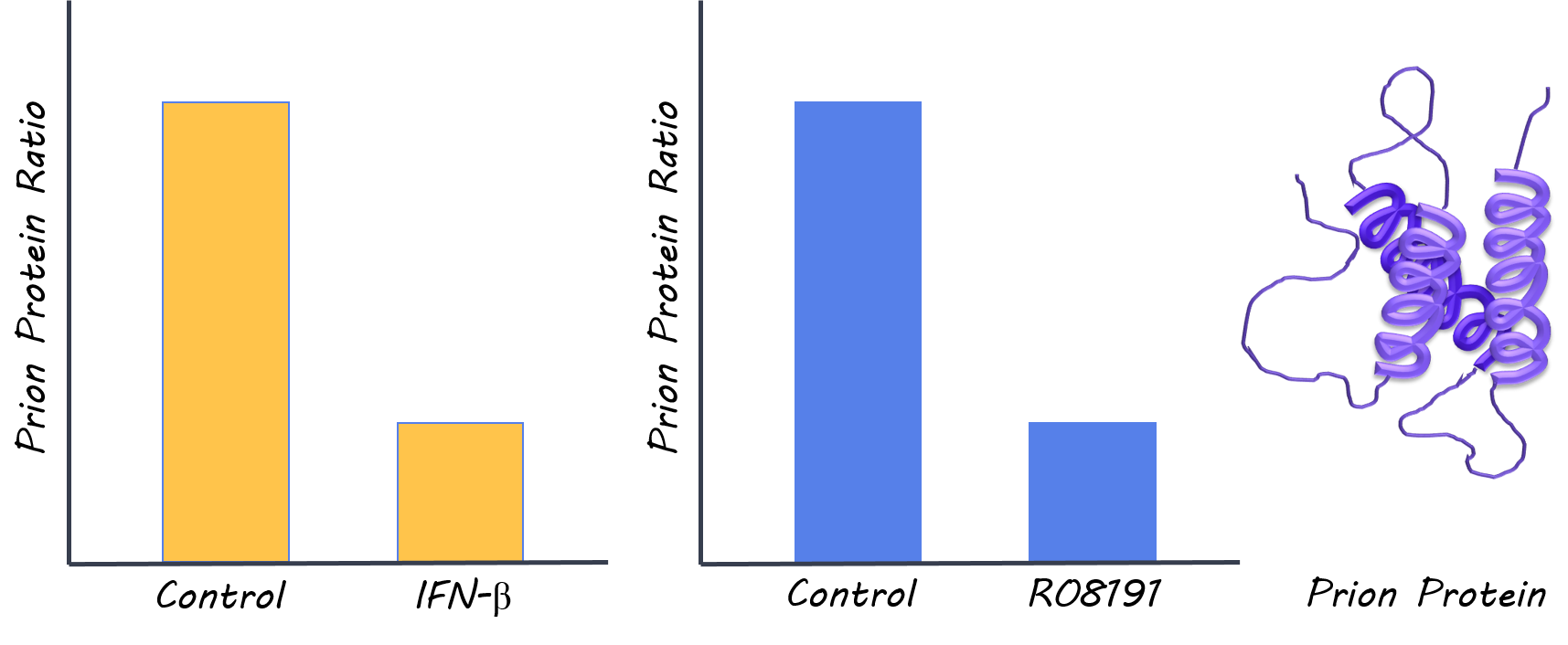
The authors found that prion infection decreased gene expression related to inflammatory signaling, including the I-IFN related gene. Next, they found that treating the prion infected cell line with IFN-beta (and alpha to a lesser extent), or Poly I:C (to stimulate IFN production) significantly reduced the number of prion proteins in the cell line. Introducing the IFN-beta into the brain of prion infected mice was also successful at reducing prion protein expression. The authors also observed that removal of IFN receptor genes significantly increased prion protein levels in cell lines, whereas and reintroduction of the IFN gene to these cells made them less susceptible to prion infection. Similarly, mice whose IFN genes had been knocked out were more susceptible to the prion infection - their lifespan was shortened, they had higher levels of prions in their brain and spleen and higher levels of gliosis (microglia and astrocytes) in their brain.
elisa_feb19.png

Next, the authors found that pre-treating prion infected cells and mice with R08191 decreased prion protein levels in the cells and in the brain and spleens of mice by at least 50%. Gliosis was also reduced in many brain regions including the cortex, thalamus and pons. Finally, the authors found that RO8191 had high blood-brain-barrier permeability, suggesting that it may reach and act on the brain, in addition to peripheral tissues.

What's the impact?

This study provides evidence that interferons may play a protective role against prion proteins in both cell lines and mice. Additionally, treatment with the novel small molecule RO8191, known to bind to the I-IFN receptor, was successful at reducing prion protein expression, making it a candidate for treatment. A better understanding of the role of the innate immune system in prion disease may provide ideas for novel therapeutic agents.

Ishibashi et al. Type I interferon protects neurons from prions in in vivo models. Brain (2019). Access the original scientific publication here.
Neuronal Maturation in the Developing Human Brain

Post by Shireen Parimoo

What's the science?

Ribonucleic acid (RNA) sequencing is a technique that is often used to create a genetic profile of cells in the brain. When applied at the level of single cells, RNA sequencing can be used to discern their identity. Studies using RNA sequencing have recently shown that many different types of neurons in the developing human brain arise from radial glia and other progenitor cells (cells that can differentiate into other cells). Although genetic profiles are useful for identifying cell types, other factors like cell physiology and morphology can also provide insight into cell identity. Currently, the physiological properties of various cells in the developing human brain – like how they respond to neurotransmitters – are not known. This week in Neuron, Mayer and colleagues developed a novel technique to combine RNA sequencing with cell imaging measures to identify the genetic and physiological profiles of developing human neocortical cells.

How did they do it?

The authors identified different cell types in tissue samples from the first and second trimester of the developing human neocortex including ventricular radial glia, outer radial glia, intermediate progenitor cells, and newborn neurons. They analyzed an RNA sequencing dataset to identify the gene expression levels of various neurotransmitter receptors and receptor subunits. They used single-molecule fluorescent in-situ hybridization and immunohistochemistry to examine the expression of a serotonergic receptor (HTR2A) and a purinergic receptor (P2RY1) in the radial glia specifically. To investigate the electrophysiological properties of these cells, they applied receptor agonists (molecules that bind to and activate receptors) to tissue slices and measured the change in the resulting electrical currents. Using calcium imaging as a measure of activity, they examined the effect of agonists on single cells from various regions of the neocortical tissue. To map the genetic profiles of neocortical cells with their physiological response profiles, the authors dissociated cells and dosed them with various receptor agonists to record their response, followed by RNA sequencing. They then investigated whether the maturational stage of newborn neurons affects their physiological responses. Finally, they trained two types of machine learning models (a supervised Bayes classifier and an unsupervised classifier) to predict cell identity from their genetic and physiological response profiles.

What did they find?

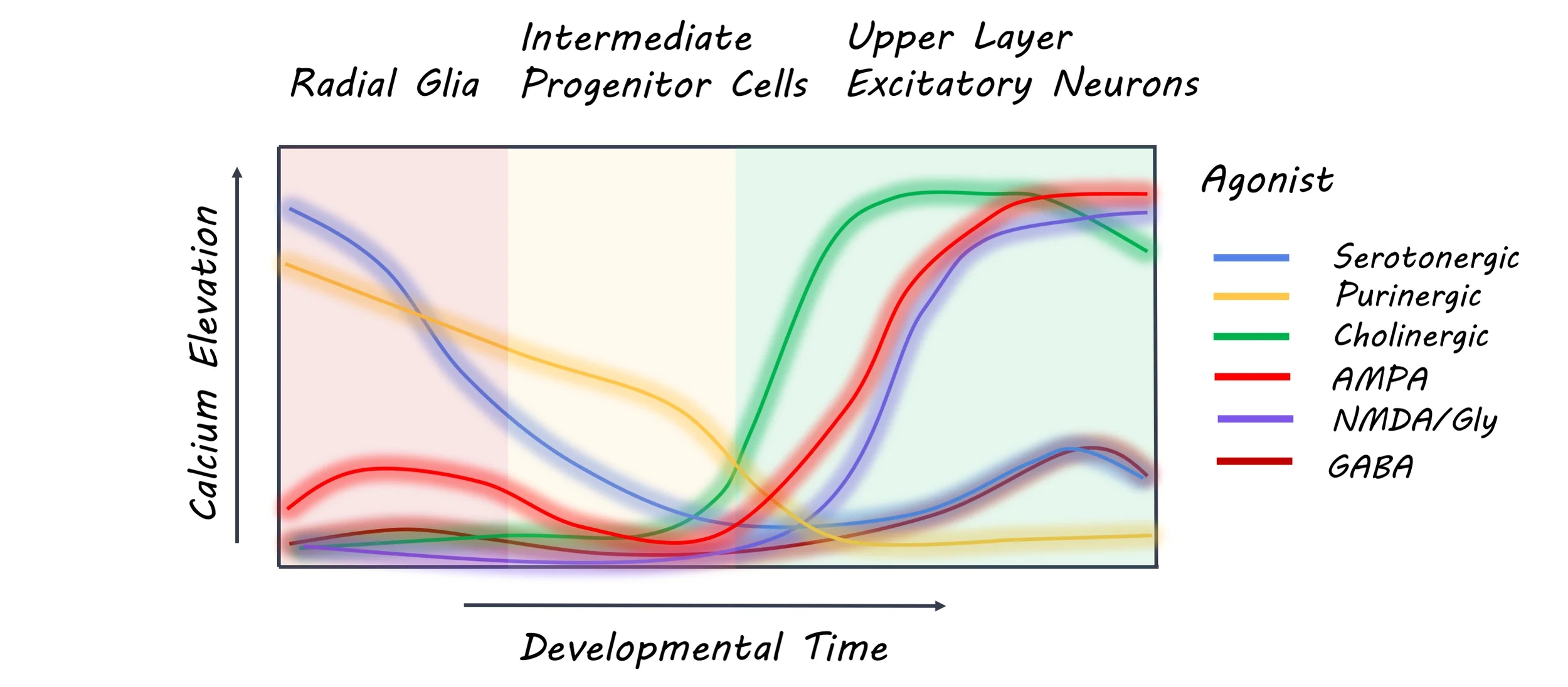
Cells in the developing brain differentially expressed genes for neurotransmitter receptors and their subunits. For example, the GRIN2A subunit of the NMDA receptor was highly expressed in progenitor cells, whereas the GRIN2B subunit was only expressed in neurons. Similarly, there was a high expression of the HTR2A receptor in radial glial cells. Application of receptor agonists also revealed a distinct response profile for each cell type. Specifically, NMDA receptors induced currents with different properties in neurons and radial glia. As the HTR2A receptor expression was only observed in the radial glial cells, applying agonists only induced currents in the ventricular and outer radial glia. In fact, applying an HTR2A antagonist (inhibitor) disrupted the morphology of the outer radial glia after 72 hours. This means that the various cells in the developing brain not only have distinct genetic and physiological response profiles, but these properties may also affect their morphology.

neuron_image_feb19.jpg

Neurons had more heterogeneous response profiles than progenitor cells, and this varied by their stage of maturation. The Bayes classifier was able to predict cell identities (in terms of physiological properties)  based on genetic data. However, it identified some cells as immature neurons, even though their physiological responses were more similar to mature neurons. Therefore, different readouts may help to better define neuronal maturation. On the other hand, the unsupervised classifier clustered cell types based on their physiological response profiles. Although genetic and physiological identification generally matched, some genetically identified cell types had several possible physiological responses, which was related to their maturational stage, for instance. This means that the same neuron can respond differentially to neurotransmitter signaling depending on its stage of maturation.

What's the impact?

This is the first study to use multimodal analyses to map the genetic profiles of developing human neocortical cells to their physiological profiles. In particular, the finding of distinct physiological response profiles across cell types is important because it highlights how the function of various cells and neurons in the brain can change as they mature. This has important implications for understanding the functional role of various cells and neurons in the brain.

neuron_quote_feb19.jpg

Mayer et al. Multimodal single-cell analysis reveals physiological maturation in the developing human neocortex. Neuron. (2019). Access the original scientific publication here.

Neurons from SSRI-Resistant Patients Exhibit Hyperactivity in Response to Serotonin

Post by Deborah Joye

What's the science?

Selective serotonin reuptake inhibitors (SSRIs) are the most common medication prescribed for Major Depressive Disorder (MDD). However, 30% of MDD patients do not improve with this type of medication and the reason why is unclear. One powerful technique to study this problem in patient populations is induced pluripotent stem cell (iPSC) technology (see BrainPost’s explanation of iPSC). iPSC technology has been instrumental for disorders such as schizophrenia and bipolar disorder, but has not yet been used to study MDD or treatment-resistant depression. This week in Molecular Psychiatry, Vadodaria and colleagues use iPSC technology to study serotonergic neurotransmission in neurons from patients who respond to SSRI treatment and those who do not, to demonstrate that SSRI neurons from non-responders become hyperactive in response to serotonin, which may play a role in SSRI resistance.

How did they do it?

The authors selected extreme cases of SSRI responders and non-responders from a large group of 803 MDD patients involved in an 8-week Pharmacogenomic Research Network Antidepressant Medication Pharmacogenomic Study. Depressive symptoms were quantified using the quick inventory of depressive symptomatology (QIDS) and Hamilton depression (HAMD) rating scales before beginning the 8-week study. Patients who exhibited remission from depressive symptoms after 8 weeks of SSRI treatment were considered responders; patients who did not exhibit changes in QIDS and HAMD scores were considered non-responders. The authors collected skin biopsies from 3 responsive, 3 non-responsive, and 3 healthy control subjects and used iPSC technology to reprogram skin cells into neurons. They then reprogrammed patient-derived iPSCs to become neurons from the forebrain, a region known to respond to serotonin signals.

To investigate activity levels of patient-derived neurons, the authors used a calcium-responsive dye to image calcium inside the cells. Electrical activation of neurons typically results in increases in intracellular calcium, allowing the authors to observe and measure calcium dynamics at baseline, and subsequently after treatment with serotonin (mimicking the actions of SSRI treatment). Since serotonin mediates its effects via seven known families of receptors, the authors then used receptor antagonists (to block specific receptors) and western blot (detects proteins present in tissue) to determine which receptors were responsible for mediating the effects of serotonin in SSRI responder, non-responder, and healthy neurons. Finally, the authors used RNA sequencing to analyze differences in protein expression between responder, non-responder, and healthy neurons.

What did they find?

First, the authors visualized calcium dynamics and found no differences between groups at baseline; however, after exposure to serotonin, non-responder neurons exhibited significantly higher activity compared to responder and healthy control neurons. This suggests that serotonin-induced hyperactivity may play a role in SSRI treatment resistance. Using RNA sequencing, the authors found that transcripts for two serotonin receptors – 5-HT2A and 5-HT7 – were differentially expressed between responder and non-responder groups. To confirm this, the authors analyzed proteins in patient-derived neurons using western blot and found significantly higher levels of 5-HT2A and 5-HT7 receptors in non-responder neurons compared to both healthy and responder neurons. This suggests that some receptors may be upregulated in non-responders. Since both receptors result in excitatory actions on neurons, the authors used specific antagonists to block signaling at 5-HT2A and 5-HT7 receptors and found that this reduced the hyperactive response to serotonin.

deb_feb12.png

What's the impact?

This study is the first to utilize iPSC technology to study patient-derived neurons from individuals with MDD. The findings of this study suggest that forebrain neurons from SSRI-treatment-resistant patients become hyperactive in response to serotonin – an effect that is mediated by upregulation of two specific serotonin receptors, 5-HT2A and 5-HT7. This study decisively moves MDD neuroscience research forward by utilizing cutting-edge iPSC technology to investigate patient-derived neuronal response to therapeutics already on the market.

A word of caution: It should be noted that the sample in this study is comprised entirely of females and examining sex differences in SSRI treatment response as well as general MDD neural circuits presents exciting avenues for future research.

SSRI_quote_feb12.jpg

Vadodaria et al., Serotonin-induced hyperactivity in SSRI-resistant major depressive disorder patient-derived neurons, Molecular Psychiatry (2019), Access the original scientific publication here.