Caudate Nucleus Stimulation Induces Negative Repetitive Decision-Making

What's the science?

Some mood disorders are characterized by irrational, pessimistic, persistent thoughts. These thoughts are related to more cautious/pessimistic and inflexible decision making or evaluation. We don’t know the neural mechanisms involved in these pessimistic evaluations. However, the caudate nucleus is known to be involved in mood disorders, and is known to be involved in behavioral flexibility. This week in Neuron, Amemori and colleagues stimulated the caudate nucleus in primates to understand the role of the nucleus in persistent negative states and value evaluation.

How did they do it?

Two monkeys performed a behavioral task while one of 15-18 electrodes distributed throughout the caudate nucleus was stimulated using a microstimulation technique. Local field potentials were recorded from the other electrodes simultaneously. In the behavioral task, the monkey was shown a red bar, with the size of the bar indicating the amount of food the monkey was about to receive, and a yellow bar indicating the size of an air puff to the face (which it disliked) the monkey was about to receive. It used a joystick to indicate one of two choices: it either chose to a) accept the airpuff and food (taking into account the size of each) (‘approach’ choice) or b) to avoid the airpuff and receive a very small amount of food (‘avoidant’ choice). Decision and reaction time was recorded. 112 stimulation experiments (across both monkeys) and 74 recording-only experiments (across both monkeys) were performed (each experiment consisted of 150-250 trials). In the stimulation experiment, a threshold of 5% was set indicating a change in decision frequency in stimulation-on versus stimulation off-blocks. If the threshold was passed during stimulation (decisions tended to be either more ‘approach’ or more ‘avoidant’) the stimulation was considered effective. The effect of microstimulation on decision behavior during the task was analyzed.

What did they find?

Microstimulation at most sites did not change decision behavior. However, stimulation at about a quarter of the sites increased avoidant choices, and stimulation at a few sites increased approach choices. These effective sites were distributed throughout the caudate nucleus. Sites where stimulation invoked avoidant decisions were considered to be part of a ‘generative circuit’. Neuronal spiking activity was more likely to encode avoidant decisions near these negative effective sites. To see whether stimulation had persistent effects, the authors assessed follow-up blocks without stimulation after stimulation blocks, and found that increased avoidant decisions persisted 78% of the time after effective stimulation at negative sites, while positive effect were maintained only 10% of the time following stimulation at positive sites. This suggests that stimulation at negative sites could induce persistent negative mood. A tendency for stimulation at negative effective sites to induce a repetitive pattern of avoidant decision was also found, suggesting negative stimulation resulted in repetitive avoidant behavior. Oscillatory brain activity in the beta frequency band is known to be associated with maintenance of cognitive states. Therefore, the authors tested whether changes in beta band oscillations were related to decision making. They identified electrodes where task-related beta band activity could be observed, and found that there was greater beta band power prior to avoidant decisions when stimulation was off. During follow-up following stimulation, beta band power tracked choices even more closely, suggesting stimulation enhanced this relationship.

kasey1800.png

What's the impact?

This study suggests that the caudate nucleus can influence negative or pessimistic decision making or valuation via potential generative circuits that can lead to a persistent negative state. These findings have implications for mood disorders in which persistent, inflexible, negative thinking is a common observation.

kaseyquote1800.png

Amemori et al., Striatal Microstimulation Induces Persistent and Repetitive Negative Decision-Making Predicted by Striatal Beta-Band Oscillation. Neuron (2018). Access the original scientific publication here.
 

Sleep Deprivation is Related to Loneliness and Changes in Brain Network Activity

What’s the science?

Humans are social animals, and social belonging is related to positive outcomes like well-being, while social isolation is associated with negative outcomes like depression and a higher risk for cardiovascular disease. Recent studies have linked loneliness to poor quality of sleep, as people who are socially isolated don’t get enough sleep or good quality sleep. However, it is unclear whether the reverse is also true: Can poor sleep quality lead to greater social isolation by making people less willing to interact with others? This week in Nature Communications, Simon and Walker set out to determine if sleep deprivation results in greater social withdrawal and if so, whether this social withdrawal behavior is related to changes in brain network activation.

How did they do it?

Two studies were conducted – one was online and the other took place both online and in-person. The online study took place on the Amazon Mechanical Turk (MTurk; a website on which people can perform tasks), in which 138 participants kept a log of their sleeping patterns for two nights and completed a questionnaire about social behavior and loneliness. In the second study, eighteen participants completed two versions of a social distance task, in which the experimenter and participant take turns walking toward each other. In both cases, participants indicate when the experimenter is uncomfortably close to them. Thus, this task provides a measure of an individual’s willingness to approach someone, and their receptiveness to being approached. Participants completed this task in-person with different experimenters, as well as a computerized version of this task while undergoing a functional magnetic resonance imaging (fMRI) scan. The fMRI scan allowed the authors to observe differences in activity in two brain networks; one associated with prosocial behaviors (‘Theory of Mind network’; ToM) and the other associated with personal space with respect to other people (‘Near Space network’). These participants were also filmed while answering questions about various topics. Video clips of these participants’ answers were then shown to over a thousand online raters on MTurk, who judged the participants in the videos on how lonely they seemed, whether they would interact and collaborate with those participants, and how lonely the participants made the raters feel.

What did they find?

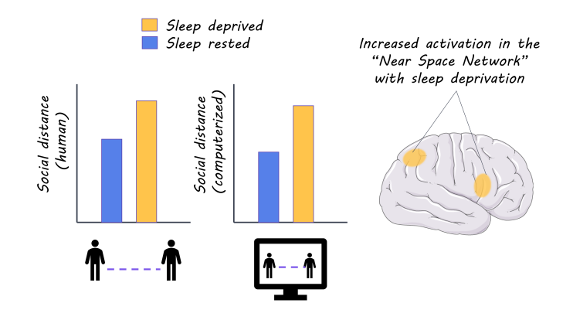
Sleep-deprived participants exhibited greater social distancing behavior compared to when they were well-rested. This trend was further corroborated with findings from the online MTurk study, wherein poorer quality of sleep was associated with increased self-reports of loneliness and social isolation the following day. Sleep-deprived participants also showed greater activation in the Near Space network and decreased activity in the prosocial Theory of Mind network when they were sleep deprived than when they were well-rested. Interestingly, these changes in brain activity were related to their performance on the social distance task, as the increase in social distancing behavior following sleep deprivation was positively correlated with the increased activation of the Near Space network. Thus, when participants were sleep deprived, they showed a reduction in their willingness to approach others and be approached, which was related to activity in the Near Space network, associated with personal space. Sleep deprivation also influenced others’ perception of the participants, as online raters were more likely to judge sleep-deprived participants as being lonely and were less willing to interact with them. In fact, the raters reported feeling more lonely themselves after watching videos of sleep-deprived people.

                                      Brain, Servier Medical Art, image by BrainPost, CC BY-SA 3.0

                                      Brain, Servier Medical Art, image by BrainPost, CC BY-SA 3.0

What’s the impact?

This study highlighted the complex relationship between poor quality of sleep and changes in both social outcomes and brain activity. Specifically, the authors showed that sleep deprivation is related to an increase in social withdrawal tendencies, and that this behavioral change is further correlated with changes in brain activity. They also showed that others perceive sleep-deprived people more negatively than well-rested people, which further exacerbates the social isolation following poor sleep.

shireenquote1800.png

Simon & Walker. Sleep loss causes social withdrawal and loneliness. Nature Communications (2018). Access the original scientific publication here.
Low Frequency Cortical Activity and Neuromodulation in Stroke

What’s the science?

Stroke that affects the brain’s motor cortex can cause motor impairment and disability. Low frequency oscillatory activity (LFO; rhythmic electrical activity in the brain) in the motor cortex is known to be involved in motor movements such as reaching. In particular, LFO is related to movement timing, and may be responsible for fast, accurate movements. The role of LFO in recovery from strokes that affect motor function is not known. This week in Nature Medicine, Ramanathan and colleagues studied LFO in rats and humans to understand their potential role in stroke.

How did they do it?

Four rats were trained to perform a skilled reaching task and then had microwire arrays (arrays of electrodes measuring electrical signal) implanted in their primary motor cortices. Signals were recorded from the electrodes while they performed the reaching task. The authors then performed a distal middle cerebral artery occlusion as a model of stroke (this model results in damage to sensorimotor cortex) and recorded brain activity and reaching behaviour 5 days post-stroke. However, the middle cerebral artery occlusion model of stroke results in widely variable damage to the motor cortex. Therefore, the authors next used a different stroke model (focal photothrombotic stroke) to study damage in a specific area of the motor cortex and how recovery of brain tissue at the edge of a stroke-related lesion (perilesional cortex) might be related to LFO. They did this by using a microwire array placed just anterior to the site of injury. The authors also assessed electrocorticography data in humans (when electrodes are placed on the brain’s surface to record activity – in this case in patients with epilepsy undergoing monitoring) and had them perform a reaching task. Two of the patients were otherwise healthy (‘non-stroke subjects’), while one patient had had a stroke in sensorimotor cortex four years prior (‘stroke subject’). Finally, the authors applied direct current stimulation to the sensorimotor cortex in rats to assess whether this stimulation would change LFO or could improve reaching behaviour.

What did they find?

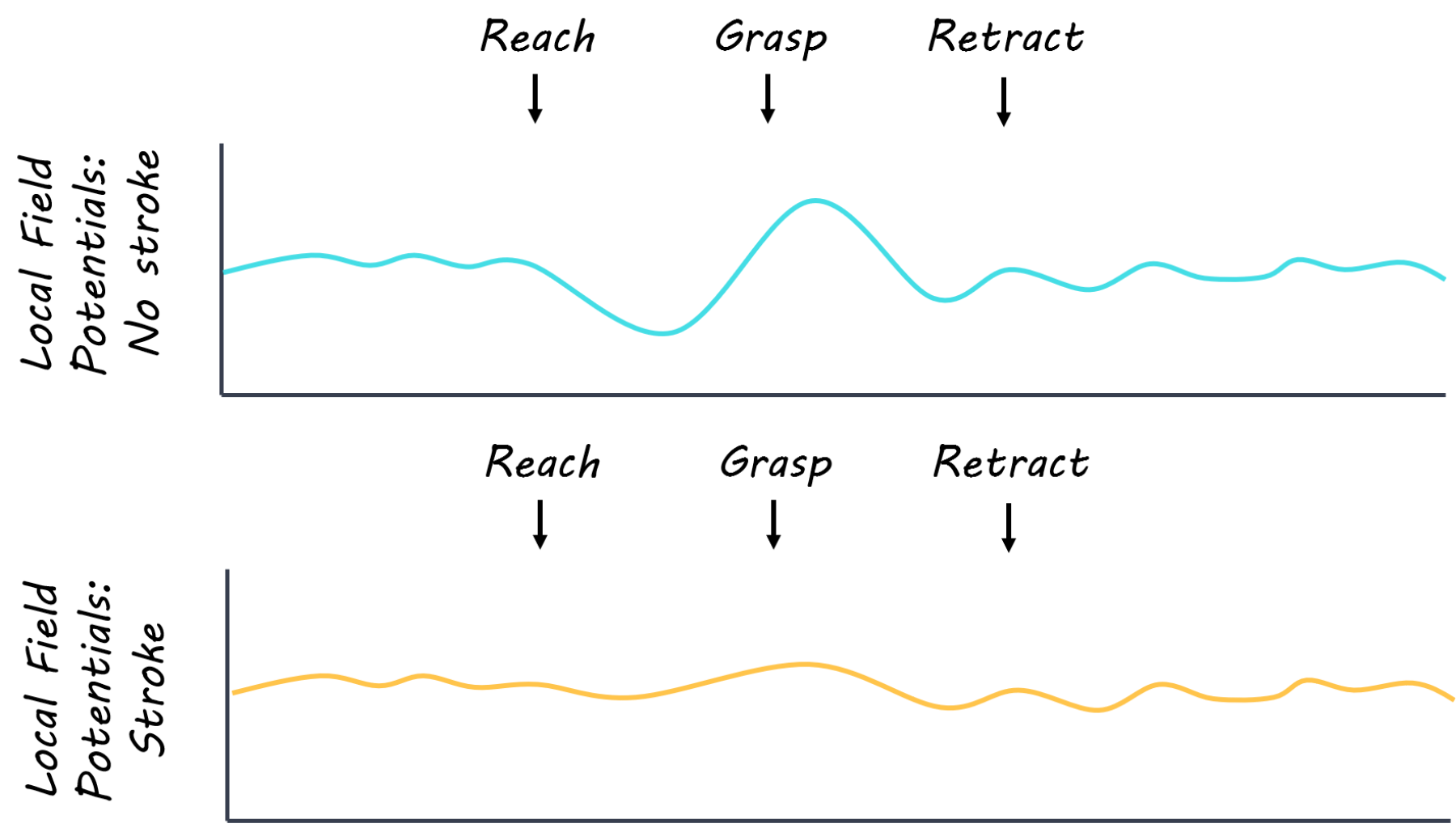
As expected, LFO was found in rats during the reaching task, both in terms of spiking (action potentials from neurons in the brain), and local field potentials (the summation of local electrical currents around neurons), especially at lower frequencies (~<4Hz). For example, neurons showed coherent spiking at low frequencies prior to the onset of reaching during the task. Five days following the middle cerebral artery occlusion stroke, the animals had impaired motor skills. However, at least some electrodes in the microwire array were in undamaged or viable tissue that was still able to demonstrate reach-related increases in activity similar to pre-stroke activity. Prior to stroke, the strength of local field potentials tracked the phase (phase locking, ie. synchrony of firing) of neuron spiking. However, after stroke, local field potential modulation was reduced and was no longer related to neuron spiking.

This reduction was not related to changes in the speed of reaching movements post-stroke. The results remained unchanged when the event-related potential (changes in local field potentials time locked to the stimulus) were subtracted. These results suggest that LFO was altered after stroke independent of other changes post-stroke. When the authors used the focal photothrombotic stroke model, they found that motor skills were impaired after the injury but improved over time with training. With this recovery, spiking activity and local field potentials returned in perilesional cortex (i.e. cortex near the stroke), and these changes were related to improvement in reaching accuracy. When they examined human electrocorticography data, task-related low frequency activity was found to be increased in the non-stroke subjects during the reaching task, but not in the stroke subject. Low frequency activity in the stroke subject was lower than that in the non-stroke subjects. The results suggest that LFO indicates healthy motor system function in rats and humans. When direct current stimulation was applied at varied times during the reaching task to post-stroke rats (with 1 second pulses), the authors found that reach accuracy was improved when stimulation was applied 500-400 ms prior to the reach. This time period overlaps with the expected LFO, suggesting that direct current stimulation could boost LFO.

What’s the impact?

This is the first study to assess cortical dynamics during stroke recovery and neuromodulation via direct current stimulation. LFO (spiking activity, local field potentials) is reduced following stroke and is related to improved accuracy during recovery. Cortical stimulation improved stroke recovery in rats, suggesting that neuromodulation may be an important clinical target for stroke patients.

Ramanathan et al., Low-frequency cortical activity is a neuromodulatory target that tracks recovery after stroke. Nature Medicine (2018). Access the original scientific publication here.