
Low Frequency Cortical Activity and Neuromodulation in Stroke

What’s the science?

Stroke that affects the brain’s motor cortex can cause motor impairment and disability. Low frequency oscillatory activity (LFO; rhythmic electrical activity in the brain) in the motor cortex is known to be involved in motor movements such as reaching. In particular, LFO is related to movement timing, and may be responsible for fast, accurate movements. The role of LFO in recovery from strokes that affect motor function is not known. This week in Nature Medicine, Ramanathan and colleagues studied LFO in rats and humans to understand their potential role in stroke.

How did they do it?

Four rats were trained to perform a skilled reaching task and then had microwire arrays (arrays of electrodes measuring electrical signal) implanted in their primary motor cortices. Signals were recorded from the electrodes while they performed the reaching task. The authors then performed a distal middle cerebral artery occlusion as a model of stroke (this model results in damage to sensorimotor cortex) and recorded brain activity and reaching behaviour 5 days post-stroke. However, the middle cerebral artery occlusion model of stroke results in widely variable damage to the motor cortex. Therefore, the authors next used a different stroke model (focal photothrombotic stroke) to study damage in a specific area of the motor cortex and how recovery of brain tissue at the edge of a stroke-related lesion (perilesional cortex) might be related to LFO. They did this by using a microwire array placed just anterior to the site of injury. The authors also assessed electrocorticography data in humans (when electrodes are placed on the brain’s surface to record activity – in this case in patients with epilepsy undergoing monitoring) and had them perform a reaching task. Two of the patients were otherwise healthy (‘non-stroke subjects’), while one patient had had a stroke in sensorimotor cortex four years prior (‘stroke subject’). Finally, the authors applied direct current stimulation to the sensorimotor cortex in rats to assess whether this stimulation would change LFO or could improve reaching behaviour.

What did they find?

As expected, LFO was found in rats during the reaching task, both in terms of spiking (action potentials from neurons in the brain), and local field potentials (the summation of local electrical currents around neurons), especially at lower frequencies (~<4Hz). For example, neurons showed coherent spiking at low frequencies prior to the onset of reaching during the task. Five days following the middle cerebral artery occlusion stroke, the animals had impaired motor skills. However, at least some electrodes in the microwire array were in undamaged or viable tissue that was still able to demonstrate reach-related increases in activity similar to pre-stroke activity. Prior to stroke, the strength of local field potentials tracked the phase (phase locking, ie. synchrony of firing) of neuron spiking. However, after stroke, local field potential modulation was reduced and was no longer related to neuron spiking.

This reduction was not related to changes in the speed of reaching movements post-stroke. The results remained unchanged when the event-related potential (changes in local field potentials time locked to the stimulus) were subtracted. These results suggest that LFO was altered after stroke independent of other changes post-stroke. When the authors used the focal photothrombotic stroke model, they found that motor skills were impaired after the injury but improved over time with training. With this recovery, spiking activity and local field potentials returned in perilesional cortex (i.e. cortex near the stroke), and these changes were related to improvement in reaching accuracy. When they examined human electrocorticography data, task-related low frequency activity was found to be increased in the non-stroke subjects during the reaching task, but not in the stroke subject. Low frequency activity in the stroke subject was lower than that in the non-stroke subjects. The results suggest that LFO indicates healthy motor system function in rats and humans. When direct current stimulation was applied at varied times during the reaching task to post-stroke rats (with 1 second pulses), the authors found that reach accuracy was improved when stimulation was applied 500-400 ms prior to the reach. This time period overlaps with the expected LFO, suggesting that direct current stimulation could boost LFO.

What’s the impact?

This is the first study to assess cortical dynamics during stroke recovery and neuromodulation via direct current stimulation. LFO (spiking activity, local field potentials) is reduced following stroke and is related to improved accuracy during recovery. Cortical stimulation improved stroke recovery in rats, suggesting that neuromodulation may be an important clinical target for stroke patients.

Ramanathan et al., Low-frequency cortical activity is a neuromodulatory target that tracks recovery after stroke. Nature Medicine (2018). Access the original scientific publication here.


The Brain’s Functional Connectivity Profile in Bipolar Disorder

What’s the science?

Differences in the brain’s connectivity or wiring are thought to underlie different psychiatric disorders. One functionally connected network in the brain is the reward network, which includes the nucleus accumbens. One role of this network is to seek out stimuli that are positive or pleasurable. In individuals with bipolar disorder, a connection between the nucleus accumbens and the ventromedial prefrontal cortex has been found to be abnormal during anticipation of reward. However, whether this altered connectivity is present in individuals with bipolar disorder while they are not experiencing symptoms is not known. This week in Biological Psychiatry, Whittaker and colleagues used functional magnetic resonance imaging (fMRI) to understand how connectivity of the brain’s reward network is altered in bipolar disorder.

How did they do it?

88 participants (35 with bipolar disorder, 30 unaffected siblings of those with bipolar disorder, and 23 healthy controls) aged 35-60 were included in the final analyses for the study. Individuals with bipolar disorder participated when they were in a euthymic state (a calm, normal mood) and had had no major mood or psychotic episodes for a month before scanning. IQ was measured in all participants using the National Adult Reading Test. fMRI data were collected while the participants were at rest (‘resting state’; not performing any task). The blood oxygen dependent level (BOLD) signal was recorded, which is a measure of fluctuations in the blood oxygen levels in the brain, (an indirect measure of brain activity). In each participant, the nucleus accumbens was identified, and the correlation between the activity of the nucleus accumbens and all other brain regions was measured (this correlation of activity between two brain regions is referred to as ‘functional connectivity’). The group of individuals with bipolar disorder was compared with the group of unaffected siblings as well as healthy controls, and the unaffected siblings were also compared with the healthy control group.

What did they find?

Across all participants, activity at rest in the nucleus accumbens was strongly positively correlated with activity in subcortical structures of the brain such as the hippocampus and amygdala, and cortical regions such as the ventromedial prefrontal cortex, anterior cingulate, and postcentral gyrus. There was a stronger functional connection between the nucleus accumbens and the ventromedial prefrontal cortex in the bipolar disorder group versus in healthy controls. The strength of this connection in the bipolar disorder group was not predicted by use of mood stabilizers (e.g. lithium). When the ventromedial prefrontal cortex was selected as a region of interest and group comparisons were performed, siblings exhibited connectivity midway between connectivity levels of the bipolar group (stronger connectivity) and the healthy control group (weaker connectivity). When depression and mania scores were included as covariates in the group comparison analyses, group differences remained. Depression and mania scores were not related to individual differences in functional connectivity amongst individuals with bipolar disorder.

&nbsp; &nbsp; &nbsp; &nbsp; &nbsp; &nbsp; &nbsp; &nbsp; &nbsp; &nbsp; &nbsp; &nbsp; &nbsp; &nbsp; &nbsp; &nbsp; &nbsp; &nbsp; &nbsp; &nbsp;Brain,&nbsp;Servier Medical Art,&nbsp;image by BrainPost,&nbsp;CC BY-SA 3.0

                                       Brain, Servier Medical Art, image by BrainPost, CC BY-SA 3.0

What’s the impact?

This study is the first to examine functional connectivity of a key region of the reward network (the nucleus accumbens) in individuals with bipolar disorder and unaffected siblings. Strong functional connectivity (i.e. correlated brain activity) between the nucleus accumbens and ventromedial prefrontal cortex may be a biomarker for bipolar disorder. The study has important implications for understanding the role of the reward network in bipolar disorder.

bipolarquote1800.png

Whittaker et al., The functional connectivity between nucleus accumbens and the ventromedial prefrontal cortex as an endophenotype for bipolar disorder. Biological Psychiatry (2018). Access the original scientific publication here.
The Association Between Blood Pressure, Brain Infarcts and Alzheimer’s Disease

What's the science?

Hypertension is known to be associated with stroke, however, it’s still unclear how blood pressure is related to stroke and brain infarcts (tissue injury occurring as a result of stroke). Brain infarcts are common in aging and often go undetected. Evidence for the association between blood pressure and infarcts is mixed, and further, no one has investigated whether blood pressure in late life is associated with neurodegenerative diseases like Alzheimer’s disease. Recently in Neurology, Arvanitakis and colleagues test whether blood pressure in late life is associated with brain infarcts and Alzheimer’s disease.

How did they do it?

1288 elderly adults completed a longitudinal study of aging (8-year follow-up). Systolic and diastolic blood pressure were recorded at baseline and annually throughout the study. The authors measured the mean blood pressure as well as the rate of change in blood pressure over time. History of medications and diseases were collected. Brains were assessed for neuropathology post-mortem (after autopsy). This assessment identified cerebrovascular disease (infarcts) using gross examination, microinfarcts with staining, atherosclerosis with vessel examination and arteriosclerosis with tissue staining. They also examined neurodegenerative pathology, including amyloid-beta plaques and neurofibrillary tangles.

What did they find?

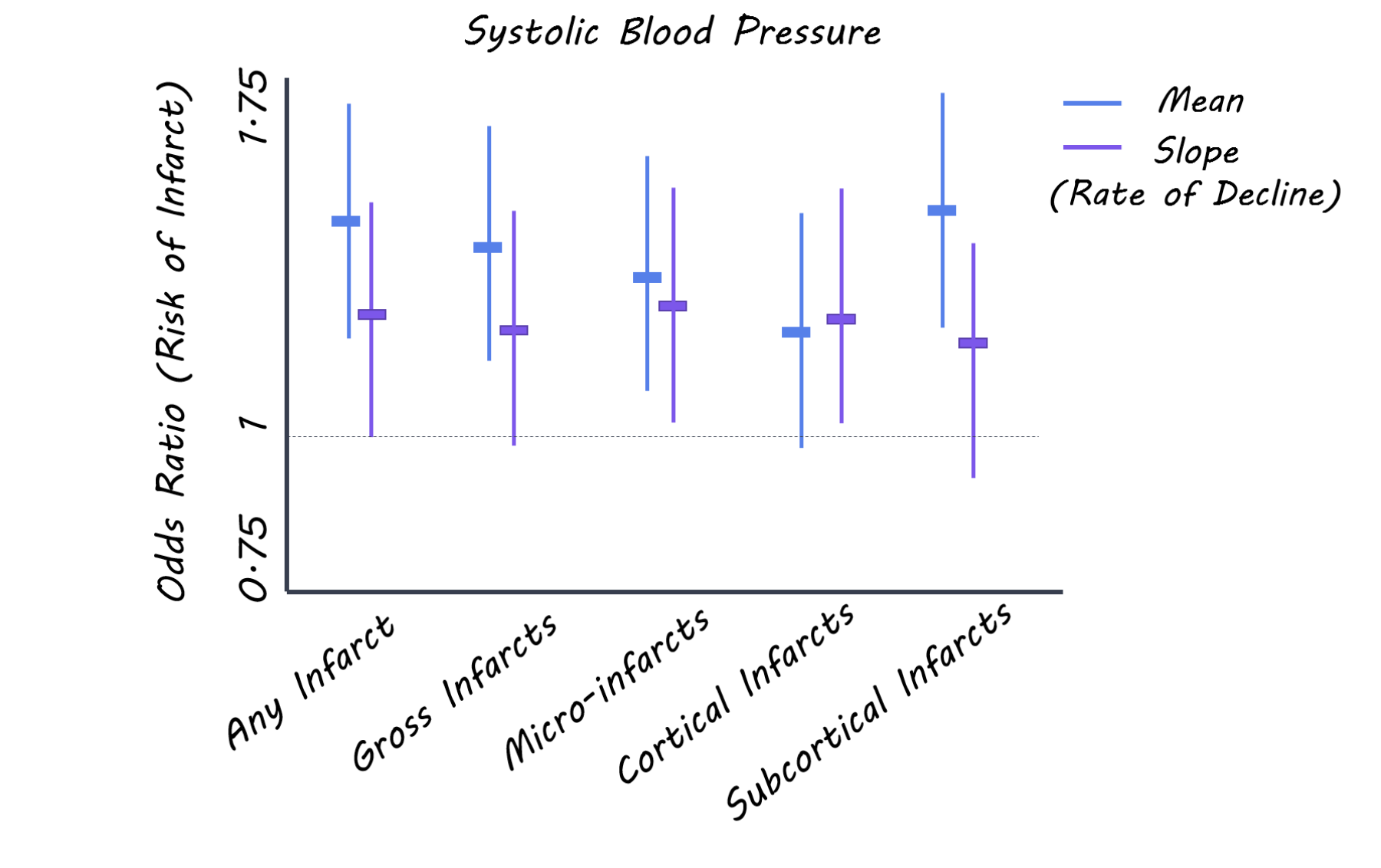
Risk of having one or more brain infarcts was higher in individuals with a higher systolic blood pressure (46% increased risk of one or more infarcts on average for an individual who was 1 standard deviation above the mean systolic blood pressure). Higher mean systolic blood pressure was associated with a greater risk of gross infarcts and micro-infarcts. The more rapid the decline in blood pressure over time, the greater the risk of developing one or more infarcts was. Individuals with a higher mean systolic blood pressure also had higher degrees severity of atherosclerosis and arteriosclerosis. Mean diastolic blood pressure was associated with brain infarcts, however the rate of decline was not. Using a linear regression model, they found that higher systolic blood pressure was associated with a higher number of neurofibrillary tangles (Alzheimer’s disease pathology), but was not associated with changes in amyloid plaque pathology. There was no relationship between rate on decline in systolic blood pressure and Alzheimer’s disease pathology. 

bloodpressure1800.png

What's the impact?

Higher systolic blood pressure in late life is associated with a greater number of brain infarcts. Higher blood pressure in late life may be associated with Alzheimer’s disease pathology (neurofibrillary tangles). Very little research exists on the link between blood pressure and Alzheimer’s disease pathology. We now know that blood pressure in late life is associated with brain infarcts and potentially the development of Alzheimer’s disease pathology.

Arvanitakis et al., Late-life blood pressure association with cerebrovascular and Alzheimer’s disease pathology. Neurology (2018). Access the original scientific publication here.