
The Association Between Blood Pressure, Brain Infarcts and Alzheimer’s Disease

What's the science?

Hypertension is known to be associated with stroke, however, it’s still unclear how blood pressure is related to stroke and brain infarcts (tissue injury occurring as a result of stroke). Brain infarcts are common in aging and often go undetected. Evidence for the association between blood pressure and infarcts is mixed, and further, no one has investigated whether blood pressure in late life is associated with neurodegenerative diseases like Alzheimer’s disease. Recently in Neurology, Arvanitakis and colleagues test whether blood pressure in late life is associated with brain infarcts and Alzheimer’s disease.

How did they do it?

1288 elderly adults completed a longitudinal study of aging (8-year follow-up). Systolic and diastolic blood pressure were recorded at baseline and annually throughout the study. The authors measured the mean blood pressure as well as the rate of change in blood pressure over time. History of medications and diseases were collected. Brains were assessed for neuropathology post-mortem (after autopsy). This assessment identified cerebrovascular disease (infarcts) using gross examination, microinfarcts with staining, atherosclerosis with vessel examination and arteriosclerosis with tissue staining. They also examined neurodegenerative pathology, including amyloid-beta plaques and neurofibrillary tangles.

What did they find?

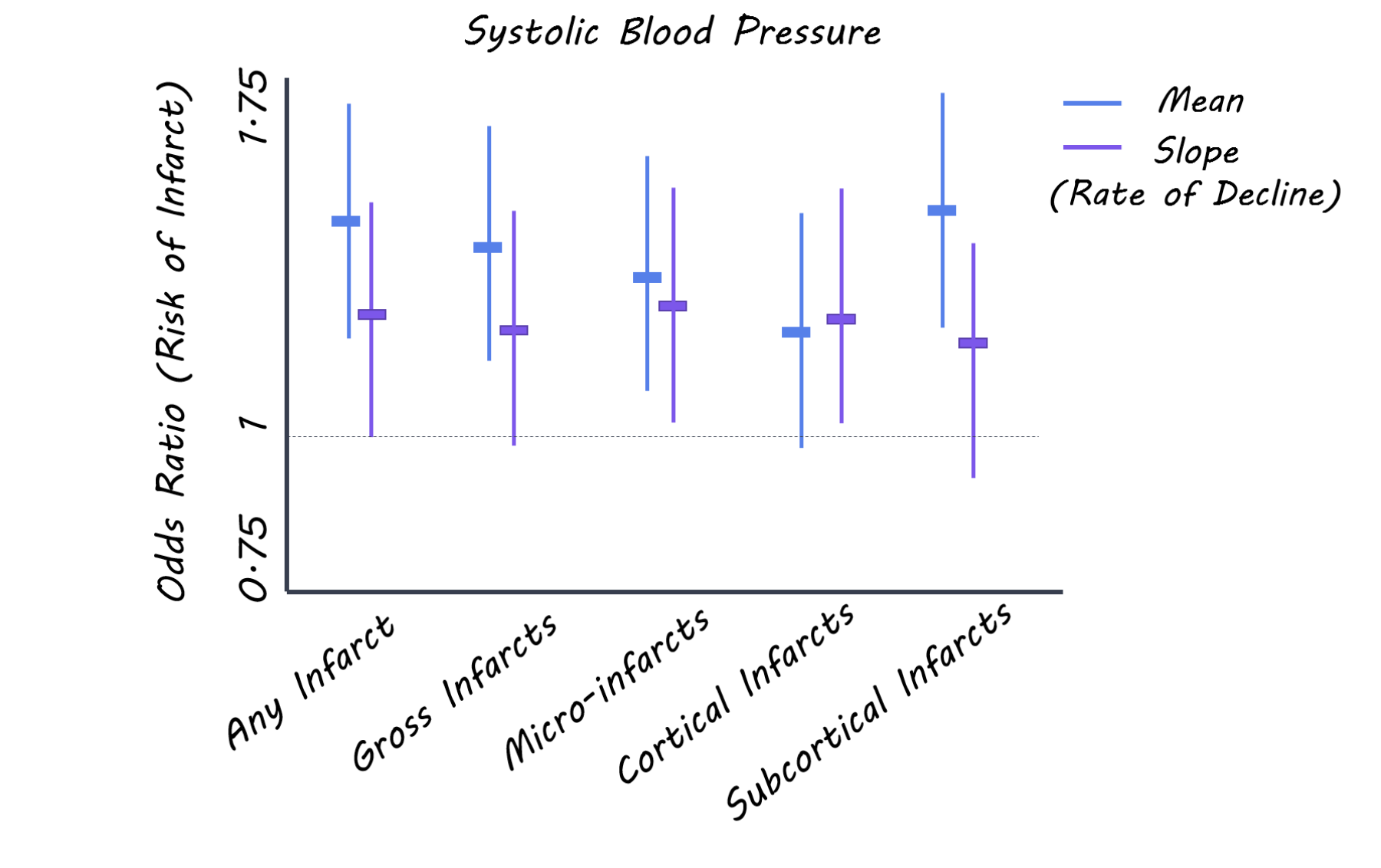
Risk of having one or more brain infarcts was higher in individuals with a higher systolic blood pressure (46% increased risk of one or more infarcts on average for an individual who was 1 standard deviation above the mean systolic blood pressure). Higher mean systolic blood pressure was associated with a greater risk of gross infarcts and micro-infarcts. The more rapid the decline in blood pressure over time, the greater the risk of developing one or more infarcts was. Individuals with a higher mean systolic blood pressure also had higher degrees severity of atherosclerosis and arteriosclerosis. Mean diastolic blood pressure was associated with brain infarcts, however the rate of decline was not. Using a linear regression model, they found that higher systolic blood pressure was associated with a higher number of neurofibrillary tangles (Alzheimer’s disease pathology), but was not associated with changes in amyloid plaque pathology. There was no relationship between rate on decline in systolic blood pressure and Alzheimer’s disease pathology. 
bloodpressure1800.png

What's the impact?

Higher systolic blood pressure in late life is associated with a greater number of brain infarcts. Higher blood pressure in late life may be associated with Alzheimer’s disease pathology (neurofibrillary tangles). Very little research exists on the link between blood pressure and Alzheimer’s disease pathology. We now know that blood pressure in late life is associated with brain infarcts and potentially the development of Alzheimer’s disease pathology.

Arvanitakis et al., Late-life blood pressure association with cerebrovascular and Alzheimer’s disease pathology. Neurology (2018). Access the original scientific publication here.

 

Smoking Tobacco is Associated with Reduced CB1R Density in the Brain

Post by Shireen Parimoo

What’s the science?

The cannabinoid type 1 receptor (CB1R) is a presynaptic receptor that’s present throughout the brain. It’s highly concentrated in areas involved in reward and addiction, like the basal ganglia, and it modulates GABA and glutamate (neurotransmitter) release in response to substances such as cannabinoids, alcohol, and nicotine. CB1R density is reduced in the brains of people with alcohol dependence and in chronic cannabis users. As CB1Rs are activated by nicotine, would CB1R density also be lower in smokers? In previous studies, participants who smoked tobacco also had alcohol and cannabis use disorder, making it difficult to find a direct link between nicotine use and CB1R density. This week in Biological Psychiatry, Hirvonen and colleagues systematically examined CB1R density in the brains of participants with nicotine dependence (and no other substance use disorder).

How did they do it?

Forty-six healthy men participated in the study; 18 had mild-to-moderate tobacco use disorder (smokers) and 28 were non-smokers (healthy controls). None of the participants had alcohol or cannabis use disorder. All participants underwent a two hour positron emission tomography (PET) scan, before which they were injected with [18F]FMPEP-d2, a radioligand that binds to CB1 receptors in the brain. This technique allows us to infer the density of CB1Rs by estimating the ratio of the concentration of ligand in the brain to plasma (VT). The authors also obtained genotype data from 43 participants, as carriers of the C allele of a single nucleotide polymorphism (SNP), rs2023239, in the gene CNR1 (encoding the CB1R receptor) tend to have higher levels of [18F]FMPEP-d2 binding. Participants’ smoking habits, like the age at which they started smoking and their frequency of smoking, were collected. Finally, the authors combined data from previous studies that used PET imaging in participants with alcohol and cannabis use disorder in order to examine the effect of smoking, substance use disorder, genotype, and body-mass index (BMI) on CB1R density in the brain.

What did they find?

Smokers had reduced CB1R density across several brain regions versus non-smokers. CB1R density was not reduced uniformly across the brain; it ranged from a 17% decrease in the prefrontal cortex to a 28% decrease in the midbrain. Even after ruling out the effect of BMI and genotype, the difference in CB1R density in the brains of smokers and non-smokers remained significant. Interestingly, CB1R density was not related to the age at which participants started smoking, how often they smoked, or to their level of nicotine dependence. After combining data across multiple studies, the authors also found an effect of smoking, other substance use disorders, and BMI on CB1R density. However, these effects diminished when the authors accounted for the effect of genotype. Finally, participants with a substance use disorder who also smoked did not exhibit additional CB1R down-regulation compared to those who only smoked (although CB1R density in both groups was still lower than in healthy controls).

shireenpic1800 (1).png

What’s the impact?

This is the first study to report reduced CB1R density across various brain regions of male smokers compared to healthy controls, without the confounding effect of other substance use disorders. Importantly, the authors also demonstrated that consumption of multiple substances – such as alcohol and tobacco – does not have an additive effect on CB1R density above and beyond dependence on one substance. These results provide further insight into the effects of nicotine dependence, though more research is needed to determine whether these findings will generalize to females and to other substance use disorders.


Hirvonen et al., Decreased Cannabinoid CB1 Receptors in Male Tobacco Smokers Examined with Positron Emission Tomography. Biological Psychiatry (2018). Access the original scientific publication here.

Learning That Is Spaced out over Time Engages the Brain Differently

What’s the science?

We use feedback from rewards every day to learn new things. For example, if we are offered a mango and we have enjoyed several mangos previously, over time we might learn to favor mangos. Research on the neural underpinnings of this form of reward-based learning typically focuses on short-term learning (across several minutes). However, we don’t know what happens when learning occurs over several weeks time, as it might in many everyday situations. Gradual learning from reward feedback relies on a dopaminergic system in the brain, but short-term learning paradigms in typical experiments may also rely on short-term (‘working’) memory systems. This week in the Journal of Neuroscience, Wimmer and colleagues used behaviour and functional magnetic resonance imaging (fMRI) to understand the mechanisms underlying reward learning over a period of several weeks versus within a single session in humans.

How did they do it?

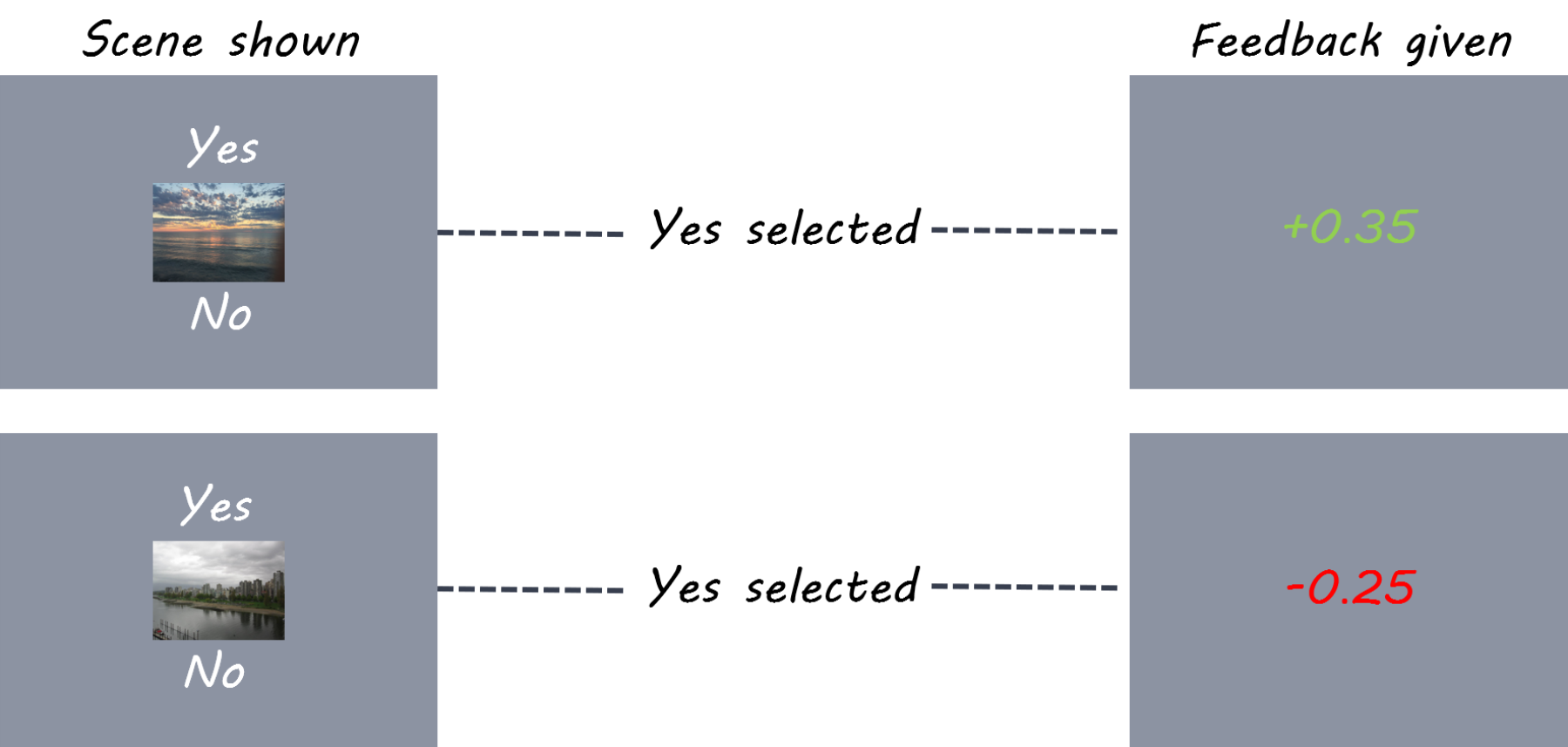
The authors completed two similar studies for replication purposes. In the first study, 33 participants completed a behavioural and fMRI experiment, while in the second study, 31 participants completed a behaviour-only experiment. In both studies, the participants' task was to learn whether the best response to a stimulus (scenes presented on a screen) was either ‘Yes’ or ‘No’ (the wording was arbitrary). The stimuli had been randomly assigned by the experimenter as either reward-associated or loss-associated. Reward-associated stimuli resulted in the participant winning $0.35 for ‘Yes’ (on average) and losing $0.05 for ‘No’. Loss-associated stimuli resulted in the participant losing $0.25 when ‘Yes’ was selected and gaining $0.0 when ‘No’ was selected. Feedback was given after each trial, and feedback was probabilistic, meaning there was an 80% chance that the best response would result in the best outcome/payment. In an initial learning session in the lab, participants learned about 8 'spaced' stimuli. Next, three learning sessions for the ‘spaced’ stimuli were done online (over ~ two weeks). In a lab session about two weeks later, participants learned about 8 new 'massed' stimuli for the same number of times as the previously seen 'spaced' stimuli.

wimmerpic1800.png

After learning, participants also rated whether they thought the stimuli were reward-associated or loss-associated. In the first study, fMRI data were also collected after learning was completed. Finally, three weeks later, participants tried to remember and rate whether each stimulus was reward-associated or loss-associated. This was completed online in the first study and in the lab in the second study.

What did they find?

In both the ‘spaced’ and ‘massed’ conditions, participants learned the best 'Yes' or 'No' response quickly, and performance was equivalent at the end of learning for both the ‘massed’ and ‘spaced’ training sessions. However, three weeks after learning, participants remembered the value of the ‘spaced’ stimuli much better. Additionally, during learning, working memory capacity was associated with learning after participants got used to the task (in the ‘massed’ session). These results indicate that the spacing out of learning sessions results in better long-term memory for whether stimuli are reward-associated or loss-associated, and that working memory is used during shorter learning paradigms (the ‘massed’ paradigm). During fMRI, using a searchlight (multivariate pattern analysis) approach, the authors discovered that there were very different patterns of activity for reward-associated versus loss-associated stimuli for ‘spaced’ stimuli but not ‘massed’ stimuli within the medial temporal cortex and prefrontal cortex. Patterns of brain activity were also different between the ‘spaced’ and ‘massed’ conditions in the striatum, a region of the brain known to be involved in reward learning. These results suggest that the neural mechanisms underlying ‘spaced’ and ‘massed’ learning may be partially different.

What’s the impact?

This study is the first to clearly demonstrate the effect of learning over a period of several weeks versus minutes on the maintenance of learning and the neural underpinnings of learning. The results have implications for studies of disorders that may involve changes in reward learning, such as addiction and mood disorders.

wimmerquote1800.png

Wimmer et al., Reward learning over weeks versus minutes increases the neural representation of value in the human brain. Journal of Neuroscience (2018). Access the original scientific publication here.