
Structure and Function of Presynaptic Inputs varies by Distance from the Postsynaptic Neuron Cell Body

What’s the science?

Neurons communicate by receiving signals from the terminals (boutons) of other neurons via their dendritic arbour (many branch-like processes/dendrites). Each connection between a bouton and a dendrite is a ‘synapse’. How do postsynaptic neurons differentiate between input from different presynaptic neurons? Most research on this topic has focused on postsynaptic neurons; it has been found that the size and strength of postsynaptic dendrites depend on the distance away from the soma or cell body of the neuron. Presynaptic inputs could also differ by location along the dendritic arbour. This week in Neuron, Grillo and colleagues explored whether the structure and function of presynaptic inputs to dendrites of CA1 pyramidal neurons of the hippocampus varied with distance from the soma of the postsynaptic neuron.

How did they do it?

The authors performed electron microscopy on the hippocampus of an adolescent mouse brain (postnatal day 22) at three locations (proximal – close to pyramidal cell layer with cell bodies, middle, and distal) to assess the structure of neuron bouton/terminal (presynaptic) and dendrite (postsynaptic) structure. They then used a patch-clamping technique to visualize CA1 pyramidal cells with fluorescent dye in order to understand which inputs to the neurons resulted in short term facilitation: Stimulating pipettes were placed in proximal and distal regions outside of the pyramidal cells to stimulate boutons on presynaptic neurons in those regions, and resulting AMPA currents (i.e. important for synaptic plasticity) were measured. The authors also administered paired electrical pulses to assess response of the postsynaptic neurons to multiple inputs. They then blocked NMDA receptor (neurotransmitter receptor) release (using a blocker; MK-801) to observe changes in neurotransmitter release (indicating neurotransmitter release potential). Finally, the authors created a computational model that mimicked the short-term potentiation/facilitation gradient they found between proximal and distal synapses.

What did they find?

They found that in proximal layers (closer to the soma), dendrite spines were larger. This is expected because dendrite size usually varies by distance from the soma. Critically, size of dendrite spine was related to the size of bouton active zones. Active zones themselves were also larger in proximal layers. These findings suggest that the structure of presynaptic neuron terminals (boutons) varied by distance from the pyramidal cell layer (somas of hippocampal neurons). When the authors used a fluorescent dye to assess AMPA (neurotransmitter) currents after stimulation, they found that excitation was greater for distal inputs (there were larger larger excitatory postsynaptic potentials). When paired pulses were administered at distal locations (versus proximal), neurons were more likely to exhibit larger responses to the second pulse in a supra-linear manner. However, when an NMDA receptor blocker was applied, decay in current was faster at proximal synapses, indicating more neurotransmitter release initially. Therefore, the results suggest that short-term potentiation was greater at distal synapses, but release probability was greater at proximal synapses. In a computational model, when distal synapses with greater short-term potentiation were stimulated, a larger response was generated. The authors suggest that greater short-term potentiation distally may counteract passive decay of a signal along a dendrite.

dendrite1800.png

What’s the impact?

This study is the first to show that structure and function of presynaptic boutons varies along a gradient in a distance-dependent manner; at more distal synapses, dendritic spines are smaller and have a lower release probability, but short-term excitation is greater, possibly as compensation for signal attenuation. This work has important implications for understanding how neurons integrate information from different locations.

Grillo et al., A Distance-Dependent Distribution of Presynaptic Boutons Tunes Frequency-Dependent Dendritic Integration. Neuron (2018). Access the original scientific publication here.
The Association between Performance Monitoring, Anterior Cingulate Volume and Obsessive-Compulsive Disorder in Early Development

What's the science?

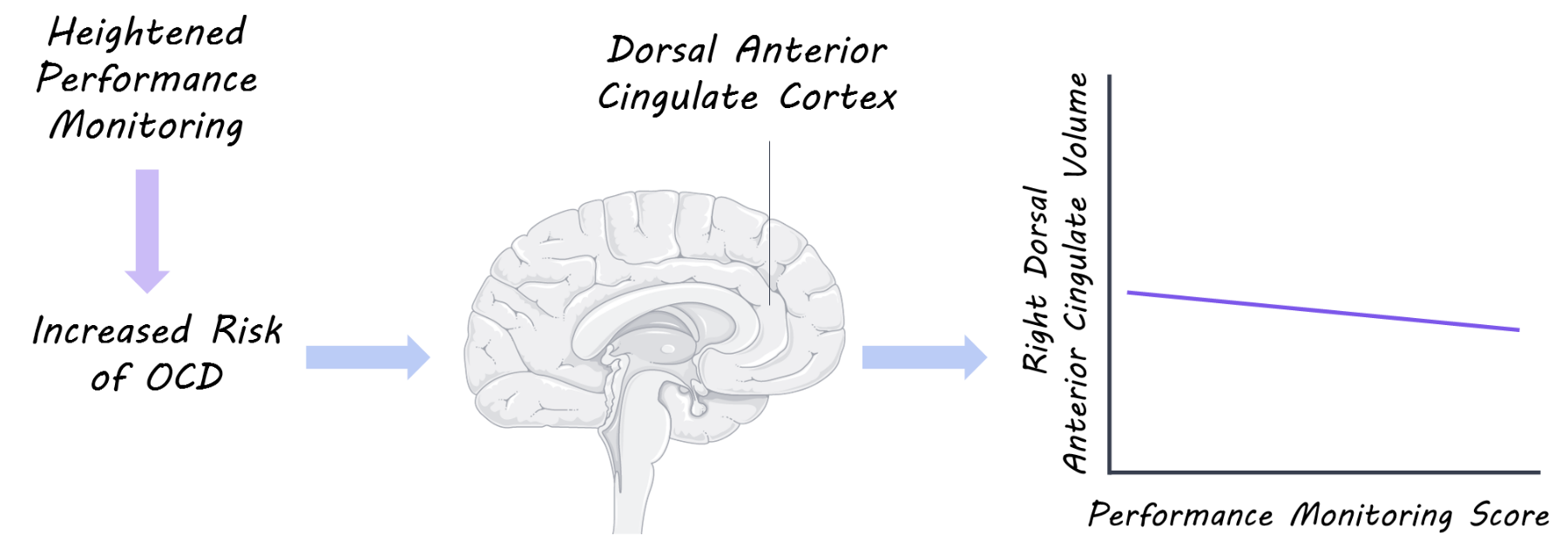
Obsessive-compulsive disorder (OCD) has been associated with heightened performance monitoring. Although monitoring one's performance on tasks can be beneficial, too much performance monitoring may affect daily function. The anterior cingulate cortex is a brain region known to be involved in performance monitoring. It is unknown whether elevated performance monitoring in early childhood predicts later development of OCD, and whether this is associated with structural changes in anterior cingulate cortex. Identifying early markers of OCD has important implications for public health. This week in JAMA Psychiatry Gilbert and colleagues investigate the association between performance monitoring, OCD risk and anterior cingulate volume in a longitudinal cohort of preschool-aged children.

How did they do it?

292 preschool-aged children who were part of a longitudinal depression study completed an observational task where they received negative evaluation (i.e. performance based). The child’s performance monitoring behavior was rated by blinded observers. Performance monitoring was scored as the average of a number of measures representative of performance monitoring, including frustration, deliberateness and care while drawing circles and observed self-criticism and intensity. The participants were then followed up annually for 12 years with clinical assessments and received 1-3 MRI scans throughout the follow-up. 133 completed the final behavioral follow-up and 152 completed MRI scans. The development of OCD was recorded over the 12-year period (using the DSM-V criteria). The authors used logistic regression to test whether performance monitoring was associated with increased risk of OCD. They also measured anterior cingulate cortex volume using MRI and used multi-level modeling (this method can model changes over time) to test whether performance monitoring was associated with anterior cingulate volume over time.

What did they find?

35 children in total developed OCD over the course of the follow-up. High performance monitoring of pre-school aged children (at initial assessment) was associated with a greater risk (2 times higher) of developing OCD later on after controlling for medication, clinical and demographic variables. This association was specific to OCD, meaning there was no association with performance monitoring and the development of other psychiatric disorders. High performance monitoring at baseline was also associated with reduced right dorsal anterior cingulate volume over time. Baseline anxiety was also associated with reduced right anterior cingulate volume. A follow-up exploratory analysis showed that high performance monitoring was also associated with larger left thalamus volume.

                                      Brain, Servier Medical Art, image by BrainPost, CC BY-SA 3.0

                                      Brain, Servier Medical Art, image by BrainPost, CC BY-SA 3.0

What's the impact?

This is the first study to demonstrate that performance monitoring in preschool-aged children is associated with later development of OCD. Further, heightened performance monitoring is also associated with reductions in anterior cingulate volume as children age. This study could help in the identification of children at high risk of developing OCD and furthers our understanding of the brain mechanisms involved.

OCDquote1800.png

Gilbert et al. Associations of Observed Performance Monitoring During Preschool With Obsessive-Compulsive Disorder and Anterior Cingulate Cortex Volume Over 12 Years. JAMA Psychiatry 2018.  Access the original scientific publication here.
A New Autoantibody involved in Neuropathic Pain

What's the science?

Neuropathic pain can be caused by conditions such as nerve injury, nerve demyelination, spinal cord injury, or stroke, and refers to pain due to injury or disease of the sensory system, according to the International Association for the Study of Pain (IASP). In particular, patients with multiple sclerosis can experience pain which may be due to inflammation of the spinal cord (myelitis). This inflammation may cause an immune response, and a potential mechanism of neuropathic pain could be due to autoantibodies, antibodies within the body’s own immune system which may somehow affect the nerves. This week in Annals of Neurology, Fujii and colleagues assessed autoantibodies in neuropathic pain patients to understand what role they might play in neuropathic pain.

How did they do it?

110 patients with a condition causing probable or definite neuropathic pain (IASP criteria for neuropathic pain) and 50 controls participated. Controls were comprised of 20 healthy individuals, 20 people with a neurodegenerative disease and 10 people with a collagen-vascular disease. Sera was extracted from blood from each individual. Immunofluorescence assays were performed, using sera from human study participants and tissue that had been removed from adult male mice (the dorsal root ganglia, the spinal cord, and skin). Human IgG antibodies bound to the tissue were detected using anti-human IgG antibodies. In the dorsal root ganglia (nerve root near the spinal cord) double immunostaining for both human IgG antibodies and neuronal markers was performed. Participants were classified as seropositive (IgG antibody binding to mouse tissues) or seronegative (no immunoreactivity). Each participant’s IgG subtype was also identified. Western blotting was performed to identify proteins/antigens that the autoantibody was bound to.

What did they find?

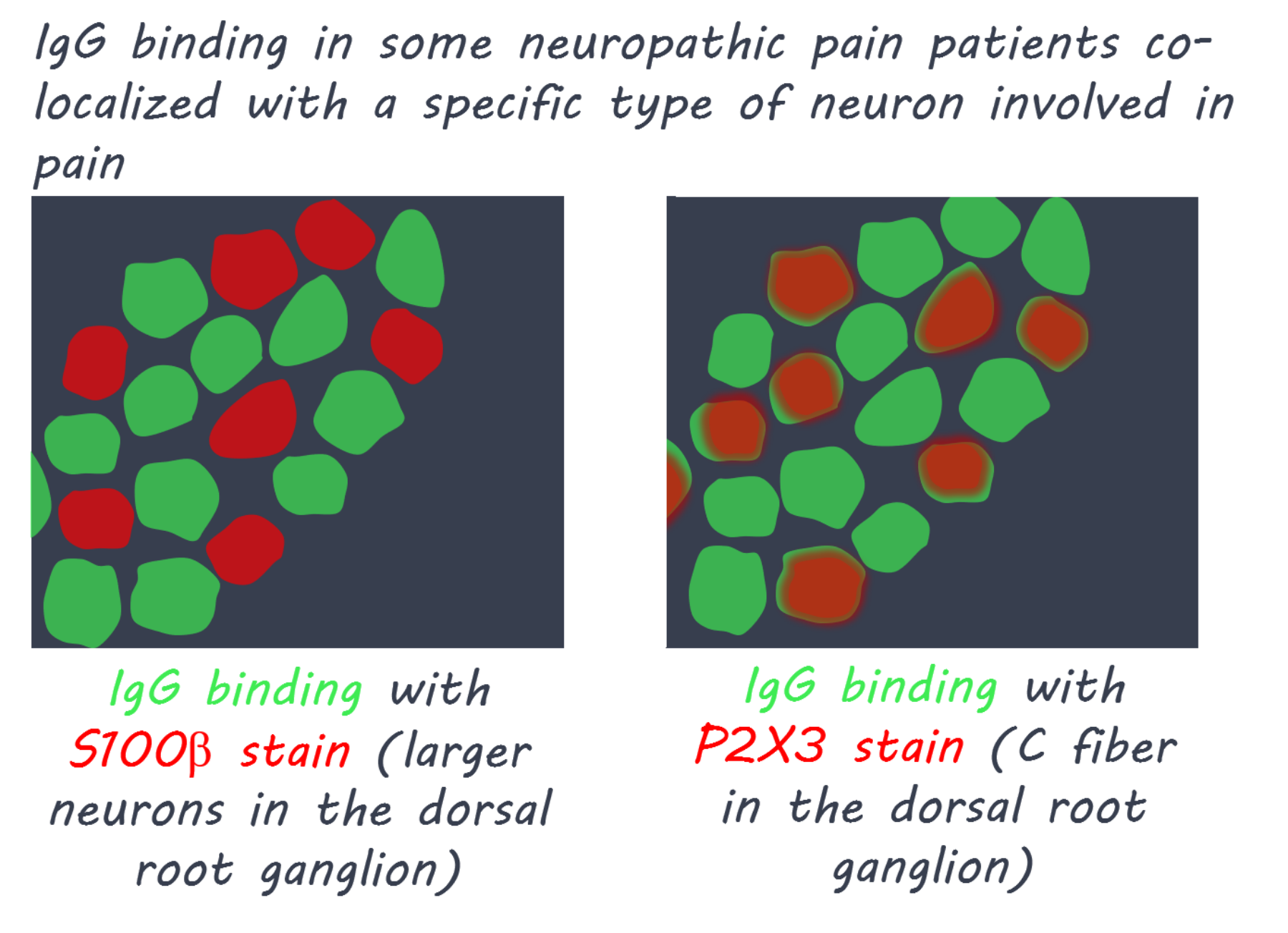
There was no immunoreactivity to the dorsal root ganglion neurons amongst controls, but serum IgG binding was positive in 11 neuropathic pain patients (seropositive patients). IgG subclass IgG2 was dominant in these seropositive patients. Using dual immunostaining, the authors identified that IgG antibody binding occurred most frequently at unmyelinated C fiber neurons (most commonly non-peptidergic). C fiber neurons are known to be involved in pain. When the authors performed dual staining for antibodies and two receptors known to be involved in pain (TRPV1 and P2X3), they found that antibodies were partially (TRPV1) or mostly (P2X3) co-localized with the receptors. The stain for IgG antibodies also co-localized with axon terminals in the spinal cord in lamina (layer) I and II (where C fiber neurons are known to terminate). The authors then characterized the autoantigen (that the autoantibody binds to) immunochemically using mass spectrometry, and found that it was likely to be plexin D1 (in mice). To characterize plexin D1 in humans, the authors performed immunostaining in tissue from two deceased human donors and observed co-localization of unmyelinated afferents and plexin D1 in the dorsal horn of the spinal cord. This finding suggests that the autoantibody was specific to neurons important for pain.

The 11 patients with auto-antibodies for small unmyelinated dorsal root ganglion neurons tended to be younger and female, and had burning or tingling pain with sensory impairment. Sera from patients with anti-D1 plexin antibodies was then applied to dorsal root ganglion neurons in mice, and cellular and nuclear swelling and increased permeability of the membrane was observed, suggesting cytotoxicity.

IgG1800.png

What's the impact?

This is the first study to identify human autoantibodies that bind to neurons known to be involved in pain in neuropathic pain patients. Autoantibodies were found to be specific to the plexin D1 protein, which plays various roles in the immune and nervous systems. This study could have important implications for the study of neuropathic pain and its response to immunotherapy.

IgGquote1800.png

Fujii et al. A novel autoantibody against plexin D1 in patients with neuropathic pain. Annals of Neurology. 2018.  Access the original scientific publication here.