A New Technique Using Holography and Optics to Precisely Control Neuronal Activity

What's the science?

Different information in the brain is encoded by the firing of specific neurons, but also by the timing, rate of that firing, and synchrony of firing with other neurons. Therefore, in order to understand and control neural activity, we must be able to control each of these parameters. The ideal experimental technique would have both high spatial and high temporal resolution over a large volume of brain tissue, and be able to create as well as remove existing activity. Two-photon optogenetics is a technique used to stimulate specific neurons: genes are inserted into neurons, which allows these neurons to produce light-sensitive proteins (opsins), and then light is shone on these neurons, generating action potentials. However, there are limitations to how precise the timing of stimulation, number of neurons stimulated and location of stimulation can be with optogenetics. This week in Nature NeuroscienceMardinly and colleagues engineered a new technique that allows for precise temporal and spatial control of neural activity using special opsins and holography (a technique that can illuminate the entire cell body/soma of a neuron) to ‘write’ neural activity, along with simultaneous volumetric calcium imaging to ‘read’ neural activity.

How did they do it?

They used an experimental setup that incorporated holography, which involves lasers and bending light to illuminate multiple specific neurons in 3D space, allowing for fast excitation of neurons at precise spatial locations.

Experiment Set 1 → First, they studied the characteristics of several opsins with the goal of developing two opsins: one that could generate large excitatory currents quickly to activate cells and one that generated large inhibitory currents to suppress cells. Using patch clamping (in anesthetized mice) and brain slice recording techniques in mice, they tested several opsins for the amplitude and kinetics of the photocurrent elicited. They mutated the chosen opsins to optimally generate or suppress activity. They then tested the precision and speed with which neurons with this opsin elicited action potentials.

Experiment Set 2 → Next, they used holography (to stimulate or suppress neurons) and calcium imaging (to ‘read’ (i.e. record) the resulting neural activity) at the same time. Mice who expressed neurons with both chosen opsins ran on a treadmill with their heads fixed in place, and neurons in the primary somatosensory cortex were activated or suppressed (depending on the opsin) using a holographic technique. Neurons were activated or suppressed one at a time, and later in random groupings, to test whether the activity of multiple different types of neurons could successfully be altered at the same time.
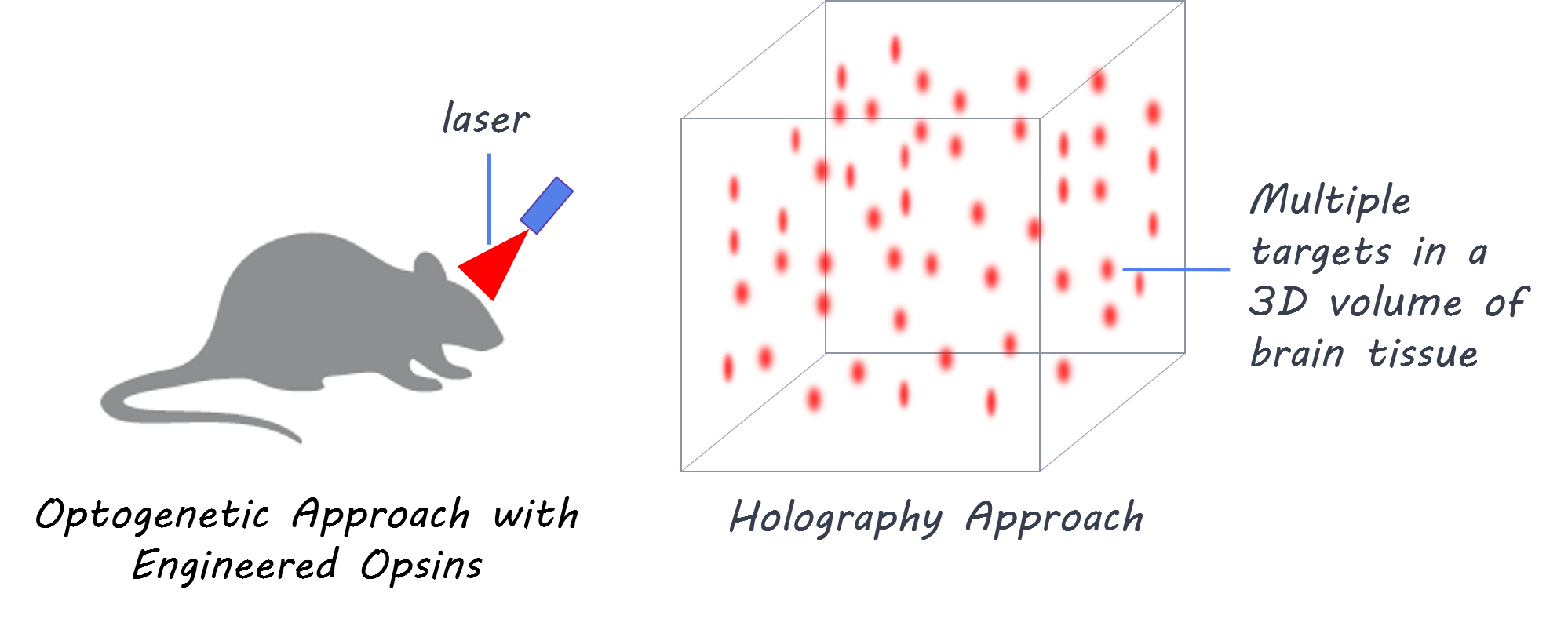
Optogenetic and holography approach to control neural activity

What did they find?

Experiment Set 1 → After testing several excitatory opsins, they mutated the fastest opsin tested to create a highly potent but still equally fast version, that they call ST-ChroME. After genetic mutation of this opsin they observed that it required low laser power (i.e. light shone) to produce action potentials with short latency and low temporal variability (which is desirable) during brain slice recordings. Using patch-clamp recordings, they found that neurons with ST-ChroME exhibited action potentials reliably (89% of the time). ST-eGtACR1 was the opsin found to be the most effective at suppressing neural activity. Using patch-clamp recording, the firing rate of neurons with ST-eGtACR1 was reduced to 8% of normal firing rate during holographic suppression.  

Experiment Set 2 → Next, mice ran on a treadmill and neuronal activity was simultaneously stimulated and recorded. Neurons (with ST-ChroME) activated one at a time produced reliable calcium signals, indicating they could be reliably activated in vivo. In vivo optical suppression resulted in a reliably reduced calcium response. Finally, when entire groups of neurons were stimulated, calcium signalling was as expected, indicating neurons of different sizes or functions can be activated simultaneously. Up to 50 neurons could be activated at the same time, allowing for thousands of light-evoked action potentials per second.

What's the impact?

In this study, optogenetic techniques (newly engineered opsins—proteins activated by light) were combined with holography (bending of light to be distributed over a 3D volume) to stimulate neurons precisely. By combining holography with calcium imaging, the authors facilitated spatially and temporally precise simultaneous stimulation and recording (‘write’ and ‘read’) of neuronal activity respectively. Holography allowed for specific neurons at various different locations in a 3D volume of the brain to be activated at the same time. This study expands on previous optogenetic techniques which lacked a high level of spatial and temporal precision and will help us to perform a wide variety of experiments where the activity of multiple neurons can be altered with high spatial and temporal precision.

hologrpahquote.png

A. R. Mardinly et al., Precise multimodal optical control of neural ensemble activity. Nature Neuroscience (2018). Access the original scientific publication here.

A Polymorphism in GAD65 Modulates Anxiety Vulnerability in Women

What's the science?

Anxiety disorders are common and debilitating and occur more frequently in women. Understanding the brain chemistry and genetic predisposition to anxiety will be critical for developing treatments. A brain region called the pregenual anterior cingulate cortex is known to be involved in anxiety and to regulate amygdala activity (another brain region involved in anxiety and emotion). The balance of neurotransmitters, GABA (inhibitory) and glutamate (excitatory), in the pregenual anterior cingulate is thought to be important for modulating brain activity and anxiety. Different genetics affecting the synthesis of GABA in the brain could affect anxiety, however this is not yet clear. This week in The Journal of Neuroscience, Colic and colleagues test whether a genetic polymorphism (change in the code of a gene) can alter GABA levels in the brain and also influence brain activity and anxiety.

How did they do it?

They sorted 105 healthy participants (mean age = 27) into two groups based on their genotype for the GAD65 gene (carriers vs. non-carriers of a G allele) which is responsible for GABA synthesis. Carriers of the G allele of this genotype are associated with drastic increases in GABA transcription (production) in peripheral cells. They scanned the participants (mean age of 27) using an imaging technique called MR Spectroscopy which can measure GABA/glutamate neurotransmitter ratios in the brain. They used resting state fMRI to measure brain activity at rest in the pregenual anterior cingulate cortex of these participants. They then tested a) the effect of genotype on brain activity, b) GABA/glutamate levels and c) whether there was any genotype by sex interaction (whether genotype affects these brain measures depending on sex) d) whether measured vulnerability to anxiety using a harm avoidance scale (correlates with anxiety) from the Temperament and Character Inventory was correlated with these brain measures.

What did they find?

Resting brain activity in the pregenual anterior cingulate was significantly lower in carriers of the G allele, but there was no interaction effect of GAD65 or sex on brain activity. However, there was a significant interaction between sex and genotype in the pregenual anterior cingulate on GABA/ glutamate levels, with female G allele carriers showing higher GABA levels. The level of reported harm avoidance was negatively correlated with the level of GABA in the pregenual anterior cingulate cortex in females (and not in males), suggesting that the lower GABA could be underlying anxiety vulnerability in females. To confirm the relationships between genotype, brain activity, GABA and harm avoidance they performed a ‘moderated mediation analysis’ including genotype as a predictor and harm avoidance as an outcome, brain activity and GABA as mediators, and sex as a moderator. Genotype significantly predicted harm avoidance, mediated by GABA/ glutamate levels in females only.

Brain, Servier Medical Art, image by BrainPost, CC BY-SA 3.0

Brain, Servier Medical Art, image by BrainPost, CC BY-SA 3.0

What's the impact?

This is the first study to show that a polymorphism in a gene producing GABA is associated with differences in GABA levels in the brain. Further, these polymorphisms affect anxiety in females (not in males), and this relationship is mediated by GABA levels in the brain. This study highlights the importance of studying genetic differences that could influence brain chemistry or activity and that these differences may differ depending on sex. We now know that female vulnerability to anxiety could be related to genetic predisposition and inhibitory neurotransmitter levels in the pregenual anterior cingulate cortex.

GABAquote.png

Colic et al., GAD65 promoter polymorphism rs2236418 modulates harm avoidance in women via inhibition/excitation balance in the rostral ACC. The Journal of Neuroscience (2018). Access the original scientific publication here.
Memory is Dependent on Synapses Between Engram Cells

What's the science?

Memory is thought to be encoded in the brain by a set or pattern of dispersed neurons in the brain called an ‘engram’. It has also been suggested that changes in the strength of the connections between neurons (i.e. synapses) in the brain is how memories are formed. This week in Science, Choi and colleagues used a new green fluorescent protein technique in mice to better understand how engram cells are connected in the brain and whether synaptic connections between engram cells underlie memory formation.

How did they do it?

Mice underwent a fear conditioning task, in which some mice received foot shocks (either weaker or stronger) during an experiment and some mice did not. Mice typically freeze due to fear when placed in a particular environment in which they remember experiencing something negative (such as a shock to their foot). Using doxycycline, they labeled the brain cells which were activated during the conditioning - these are referred to as the engram cells, because they are involved in memory during the fear conditioning task. Next, they designed a novel modified green fluorescent protein labelling technique called dual-eGRASP, which allows for visualization of the synapse between neurons, including identifying synapses formed by two separate groups of pre-synaptic (input) neurons as well as post-synaptic neurons. They then used this technique to visualize the connectivity (strength) of synapses in engram cells (labeled as active during fear conditioning) versus non-engram cells.

What did they find?

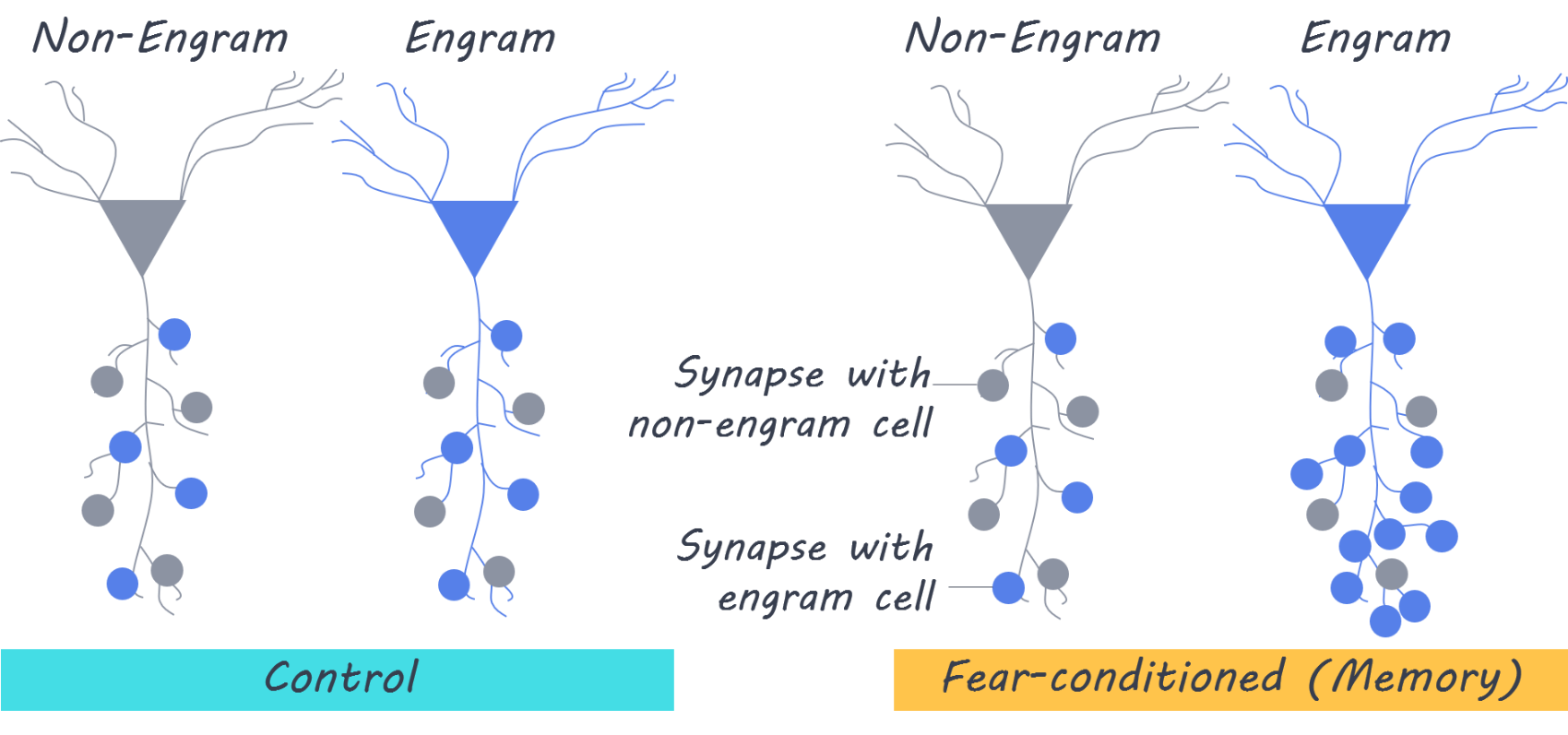
The dual-eGRASP technique successfully visualized synapses from separate populations of pre-synaptic neurons to hippocampal CA1 neurons from two different inputs, even when the synapses from the two populations were interspersed. When comparing engram-engram synapses versus synapses that involved non-engram cells (which were not labeled as active during fear conditioning), they found that dendritic spines were larger and more numerous on engram cells receiving input from other engram cells only. This indicates that synapses activated between engram cells during fear conditioning could cause synaptic connectivity between these cells to strengthen. When assessing the relationship between synaptic strength and memory, the authors found that synapses between engram cells were stronger and denser after receiving a stronger shock versus after receiving a weaker shock. This indicates that strength of a memory (due to strength of a foot shock) is related to synaptic connectivity and the strength of connections between engram cells in the hippocampus.

Synapses with engram and non-engram cells

What's the impact?

This is the first study to show that engram neurons that are activated during a learning task (fear conditioning) are more likely to have stronger, denser synaptic connections with each other. We now know that the, strength of connections between engram cells in the hippocampus underlies memory formation and strength.

Engram_quote.png

J. Choi et al., Interregional synaptic maps among engram cells underlie memory formation. Science (2018). Access the original scientific publication here.