
The Role of Self-Talk in Sports

Post by Shireen Parimoo

What is self-talk?

Self-talk refers to our inner dialogue, consisting of statements we say to ourselves, either in our mind or out loud. Most of us use self-talk in our lives, like giving ourselves a pep talk before a job interview or a date. This practice helps us appraise and regulate our thoughts and emotions and can help reduce stress and anxiety in certain situations. Athletes also engage in self-talk during training and in competition, saying things like, “keep going” and “focus on form”, or repeating mantras like, “I’m feeling strong”. In sports, self-talk can serve two functions:

  1. Boosting an athlete’s motivation and encouraging them to put in more effort.

  2. Directing attention to the relevant actions that the athlete must execute (“pass the ball”, “go faster”) to improve the quality of their movement or performance. This is thought to be more beneficial for sports requiring fine motor control, such as basketball, rather than gross motor control, such as running. 

Types of self-talk

Self-talk varies along many dimensions. For example, self-talk can be positive (“I’m ready”, “I feel good”), negative (“I’m too tired to continue”), verbally articulated, internal, a statement (“I’m a winner”), or a question (“Who’s a winner?”), to name a few. 

There are three broad categories of self-talk:

  1. Self-expression: self-talk can often be a spontaneous expression of our thoughts and feelings in the moment (“this is so exciting!” or “it is so hot”). 

  2. Interpretive: we can use our inner voice to explicitly think through emotion or experience (“I’m so nervous, but I always feel this way before a game” or “I’m so nervous, maybe I shouldn’t have signed up for another race.”). This is important because negative thoughts can be evaluated differently by different people and therefore have a different impact on performance.

  3. Self-regulatory: this is often used intentionally to guide behavior (“check your form”) or self-motivate (“Keep going, don’t stop now”).

The type of self-talk that someone uses depends on traits like motivation, self-esteem, skill level, as well as on the context, like competition level (e.g., self-talk during practice vs during a game), the type of sport, and its culture (individual or team-based), prior experience (e.g., have they ever won a game vs have they consistently won in the past?), and the audience or where the sport is played (e.g., home vs away game). 

Dual process theory and self-talk

Dual process theory proposes that two systems – System 1 and System 2 – underlie many thoughts and behaviors. Where System 1 is engaged in a rapid, automatic, and effortless manner, System 2 is slower, more effortful, intentional, and conscious in nature

Under the dual process framework, System 1 might give rise to the spontaneous, self-expressive form of self-talk, making the athlete more aware of their feelings in the moment. System 2 might then be engaged to interpret the content of their self-talk based on any of the several factors identified above, such as their self-esteem and context. In addition, since self-talk arising from System 2 processing is more intentional, it can be used to regulate subsequent behavior. 
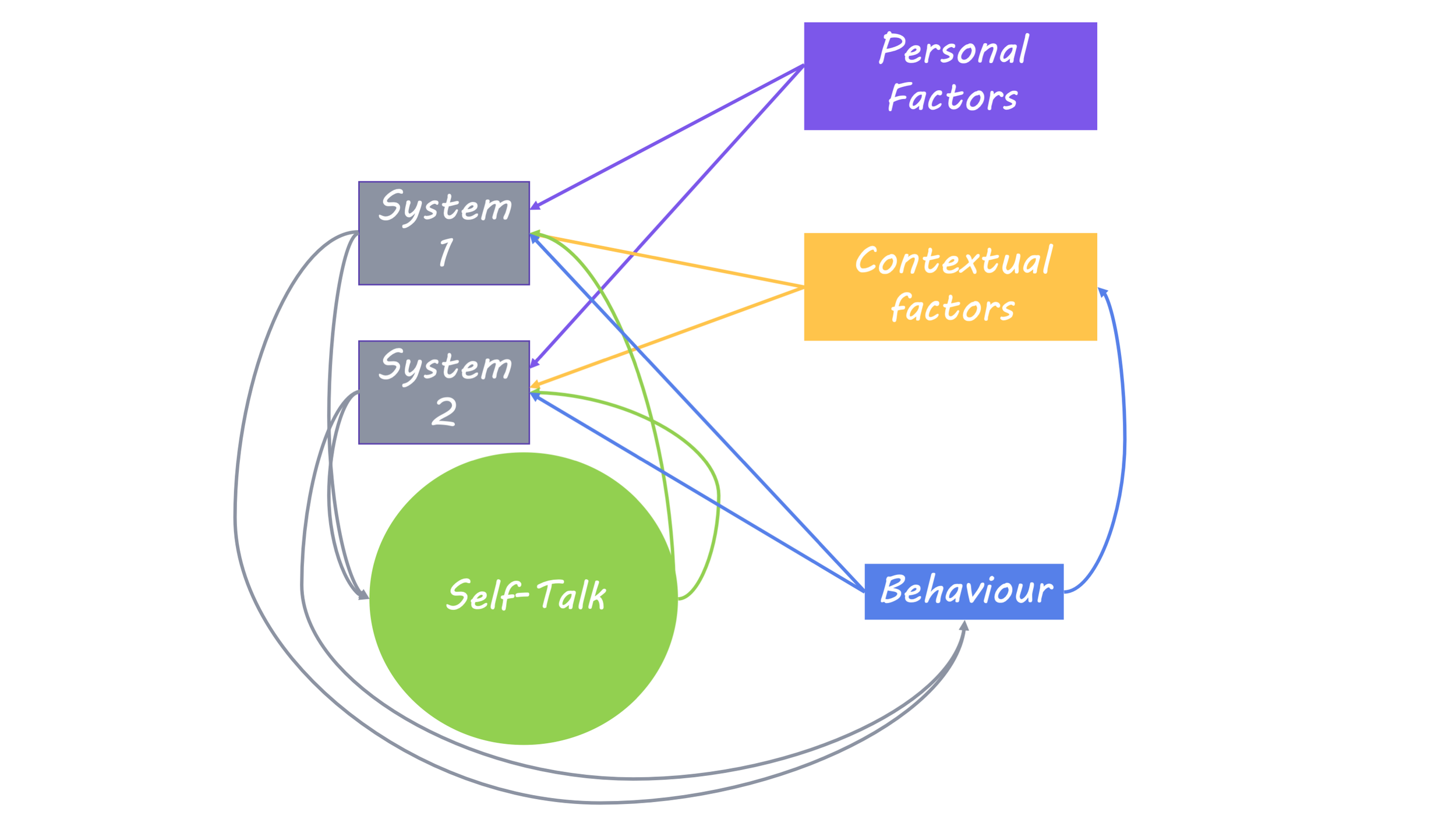
Self_talk_may18.png

Is self-talk effective?

A large body of research, as well as individual experiences of athletes and coaches, shows that self-talk is effective for improving athletic performance. The effectiveness of self-talk on performance depends on situational factors, the athlete, and the features of self-talk itself. For instance, some researchers suggest that instructional self-talk might be more beneficial during training because it helps the athlete finesse their skill, whereas motivational self-talk might boost performance in a competitive setting. Self-talk may primarily act by reducing performance-related anxiety among athletes, particularly when it is positive. Moreover, self-talk has been linked to greater enjoyment, self-confidence, and higher perceived self-competence. 

There is an active area of research geared toward identifying the most effective forms of self-talk. Though research shows that positive self-talk is most effective for performance, some individuals might improve more than others through negative self-talk due to individual differences in motivation and self-esteem. Additionally, in situations where the content of self-talk conflicts with the context or with an individual’s beliefs about themselves, the self-talk might have no effect or even negatively impact performance. For example, a runner might have a positive mantra that they repeat, like “I’ve got this”. However, if they are neck and neck with another runner, they might begin to doubt whether they trained adequately enough to outcompete them. If this doubt begins to conflict with their mantra, they might start to fall behind, and rather than boosting motivation to keep going, the mantra is rendered ineffective. An athlete who does not start doubting their training might instead use the same mantra to push themselves harder to win the race. 

Many self-talk intervention studies train athletes to use self-talk that engages System 2, the slower but more intentional type of self-talk. As described above, some forms of self-talk might rely more on System 2, but it may be difficult for someone to interpret or regulate their self-talk if this slower, more intentional system is maximally engaged by other thoughts. For example, a runner who is tired and doubting their training during a critical moment in a race might start to over-analyze their training and what they could have done better leading up to the race, leaving few cognitive resources to re-appraise the current situation. As a result, they might not be able to engage in motivational self-talk that would otherwise help push through the fatigue. Thus, a number of factors determine whether practicing self-talk has a beneficial effect on performance in any given situation. 

References

Hardy, J. (2006). Speaking clearly: A critical review of the self-talk literature. Psychology of Sport and Exercise, 7(1), 81-97. https://doi.org/10.1016/j.psychsport.2005.04.002

Hatzigeorgiadis, A., Zourbanos, N., Galanis, E., & Theodorakis, Y. (2011). Self-talk and sports performance: A meta-analysis. Perspectives on Psychological Science, 6(4), 348-356. https://doi.org/10.1177/1745691611413136

Hatzigeorgiadis, A., Zourbanos, N., Galanis, E., & Theodorakis, Y. (2014). Self-talk and competitive sport performance. Journal of Applied Sport Psychology, 26(1), 82-95. https://doi.org/10.1080/10413200.2013.790095

McCormick, A., Meijen, C., & Marcora, S. (2017). Effects of a motivational self-talk intervention for endurance athletes completing an ultramarathon. The Sport Psychologist, 32(1), 42-50. https://doi.org/10.1123/tsp.2017-0018

Park, S-H., Lim, B-S., & Lim, S-T. (2020). The effects of self-talk on shooting athletes’ motivation. Journal of Sports Science and Medicine, 19(3), 517-521. PMID: 32874104

Van Raalte, J. L. & Vincent, A. (2017, March 29). Self-Talk in Sport and Performance. Oxford Research Encyclopedia of Psychology. https://doi.org/10.1093/acrefore/9780190236557.013.157

Van Raalte, J. L., Vincent, A., & Brewer, B. W. (2016a). Self-talk interventions for athletes: A theoretically grounded approach. Journal of Sport Psychology in Action, 8(3), 141-151. https://doi.org/10.1080/21520704.2016.1233921

Van Raalte, J. L., Vincent, A., & Brewer, B. W. (2016b). Self-talk: Review and sport-specific model. Psychology of Sport and Exercise, 22, 139-148. https://doi.org/10.1016/j.psychsport.2015.08.004

Walter, N., Nikoleizig, L., & Alfermann, D. (2019). Effects of self-talk training on competitive anxiety, self-efficacy, volitional skills, and performance: An intervention study with junior sub-elite athletes. Sports, 7(6), 148. https://doi.org/10.3390/sports7060148

What Factors Impact Our Perception of Pain?

Post by Lani Cupo 

Do individuals perceive pain differently?

Describing how bad our headache is, how much our broken arm hurts, or what childbirth feels like are complex and nuanced exercises in communication. If you and your sibling both have your wisdom teeth removed, what factors determine whether one of you will be in enough pain to fill a prescription for medication and the other won’t?

Among humans, the perception of pain can vary dramatically among individuals. According to a biopsychosocial model of pain, the perception of painful stimuli are influenced by three main types of factors: biological, psychological, and social factors. This means that there is not necessarily a consistent correspondence between pain and pathology. In other words, the same stimulus — consider a broken bone for example — may correspond with high degrees of distress in some individuals while others barely register the break as painful.

How do sex and gender impact the perception of pain?

Two widely investigated, nuanced factors impacting pain perception and expression are gender identity and biological sex. Scientific studies repeatedly report that in comparison with men, women exhibit more robust perceptual responses to experimentally-induced pain. For example, women report lower thresholds and tolerances to stimuli such as heat and pressure. Nevertheless, recent research suggests that differences in pain perception are fairly subtle, and driven by context. Sex differences are in part explained by the way in which experiments are conducted, as women may be more sensitive to rapid or dynamic changes in noxious stimuli, such as when the stimulus begins or increases in intensity. In contrast, women have been shown to habituate or adapt faster than men when a painful stimulus is consistently applied. Further, it is important to note that women tend to be more perceptive in general than men across many sensory modalities, including temperature, smell, taste, and vision. It can be easy to misconstrue reported sex differences and view them with an archaic lens that portrays women as oversensitive or weak in the face of adversity.

In humans, it can be tricky to separate the impact of biological sex from the impact of sociological factors. Rodent studies can lend insight, where biological sex is considered at the exclusion of gender. Such studies also reveal sex differences in pain perception, but recent research suggests that there is an interaction between sex and background genetic strain in mice and rats, with some strains demonstrating increased sensitivity in females, others demonstrating the opposite, and still others showing no difference.

The causes underlying sex or gender differences in pain perception have yet to be fully investigated, however, there are several proposed mechanisms. One hypothesis states that gender roles may alter the perception of pain; women may feel it is more permissible to express and feel pain. From a biological viewpoint, sex hormones have been shown to alter nociceptive processing. Castration of male rats and androgenization of female rats in the first week of life has also been shown to reverse sex-dependent effects of pain perception, pointing to a role of gonadal hormones on altered perception.

How does age impact the perception of pain?

Another common factor that can alter pain perception is age. As humans age, the threshold for pain increases, meaning it takes a more intense noxious signal to alert an older individual that something is wrong. This increases the risk of injury in older adults. Contrarily, tolerance for pain usually decreases, with older participants withdrawing from painful stimuli sooner than younger participants in experimental settings. This could be in part due to increased perception of pain as unpleasant in older ages. Unpleasantness differs from intensity, with the former representing how bothersome the pain is and the latter representing how severe it is. Most studies in humans, however, neglect to report data on the changing perception of pain unpleasantness.

Aging is associated with degradations to both neurons themselves and connections between brain cells. Changes in brain regions involved in the processing of painful stimuli, such as the prefrontal cortex, primary and secondary somatosensory cortex, hippocampus, anterior cingulate, insula, and thalamus, may in part be responsible for the changes in pain perception over the lifetime.

How do psychosocial factors impact pain perception?

Mood is one of the major psychosocial factors investigated in relation to pain perception. In patients with chronic pain, negative mood, such as transient anxiety and depression, are associated with greater intensity of pain. Of course, more intense pain could also result in lowered mood, however, in studies examining acute pain stimulus in healthy individuals, negative mood has also been linked with greater pain sensitivity. In contrast, positive moods can relieve pain, with pleasant stimuli such as music, pictures, and funny movies reducing pain perception. While not all pain can be mitigated by distraction or a positive mood, the idea that positive affect can help reduce the valence of painful stimuli is very powerful, providing alternative routes of analgesia to individuals experiencing acute or chronic pain in some cases instead of pharmaceutical drugs. Finally, some studies have investigated the impact of brief mindfulness or meditative practices on the perception of acute pain in the lab, finding reductions in pain responses and inspiring further research on the topic.

What does it all mean for me?

While there is a robust body of literature suggesting the role sex, gender, and age have on perceptions of pain, individual differences can, of course, outweigh the impact of demographic variables, meaning some women may have a higher pain threshold than men, or some older individuals may have a higher tolerance than some teenagers. Because pain sensation is so subjective and can be extremely difficult to communicate, it is important to recognize that individual differences can affect how people cope with pain and even what they consider to be painful. The fact that psychological variables, such as mood, can ameliorate pain provides an exciting future avenue that has the potential to help some individuals mitigate the negative impact of both acute and chronic pain.

References

Bushnell et al. Cognitive and emotional control of pain and its disruption in chronic pain. Nature Reviews Neuroscience. (2015). Access the original scientific publication here. 

Diatchenko et al. Genetic basis for individual variations in pain perception and the development of a chronic pain condition. Human Molecular Genetics. (2004). Access the original scientific publication here.

Fillingim. Sex, gender, and pain: Women and men really are different. Current Review of Pain. (2000). Access the original scientific publication here.

Gibson & Farrell. A review of age differences in the neurophysiology of nociception and the perceptual experience of pain. Clinical Journal of Pain. (2004). Access the original scientific publication here.

Hashmi & Davis. Deconstructing Sex Differences in Pain Sensitivity. Journal of Pain. (2013). Access the original scientific publication here.

Mogil et al. Sex differences in thermal nociception and morphine antinociception in rodents depend on genotype. Neuroscience & Biobehavioral Reviews. (2000). Access the original scientific publication here.

Sandhu & Leckie. Orthodontic pain trajectories in adolescents: Between-subject and within-subject variability in pain perception. American Journal of Orthodontics and Dentofacial Orthopedics. (2016). Access the original scientific publication here.

Taenzer et al. Influence of psychological factors on postoperative pain, mood and analgesic requirements. The Journal of Pain. (1986). Access the original scientific publication here. 

Zeidan et al. The effects of brief mindfulness meditation training on experimentally induced pain. The Journal of Pain. (2009). Access the original scientific publication here.

How Does COVID-19 Impact Our Brain?

Post by D. Chloe Chung

What's the deal with COVID-19 and our brain?

Since the outbreak of human coronavirus disease 2019 (COVID-19) back in December 2019, countless lives have been lost. As of April 2021, it is projected that 140 million people have become infected by the 2019 novel coronavirus (2019-nCoV) that causes COVID-19 and about 3 million people have died from the disease globally. COVID-19 is primarily a highly contagious respiratory illness similar to severe acute respiratory syndrome (SARS) and Middle East respiratory syndrome (MERS) both of which are caused by different strains of coronavirus.

At the very beginning of this pandemic, healthcare professionals and researchers focused primarily on the respiratory symptoms of COVID-19, as symptoms include severe coughing, breathing difficulties, and pneumonia. However, it was soon discovered that COVID-19 entails multiple non-respiratory symptoms including anosmia (loss of smell and taste) as well as various short- and long-term psychiatric symptoms. For example, the “brain fog” that some COVID-19 patients experience during or after acute COVID-19 infection has been highlighted by the media and is characterized by substantial and persistent deficits in cognition or attention. Notably, SARS or MERS patients also experienced cognitive deficits such as memory decline and poor concentration. Neuropsychiatric symptom presentation varies widely across COVID-19 patients. In addition to brain fog, patients can experience neuropsychiatric symptoms such as psychosis, insomnia, depression, and anxiety. More severe but also rarer, some patients even suffer from severe strokes and suicidal thoughts. The biological mechanisms underlying the contribution of COVID-19 to psychiatric illness need to be investigated further.

The link between COVID-19 and neuropsychiatric issues

Many research studies — mostly retrospective — have been conducted to understand the critical association between COVID-19 and neurological symptoms. For example, a recent study that examined more than 60,000 COVID-19 patients in the United States reported that people who were infected and recovered from COVID-19 were significantly more likely to develop various psychiatric issues such as anxiety, dementia, and insomnia. Interestingly, the severity of these psychiatric issues was shown to be modestly associated with the severity of COVID-19: psychiatric symptoms tend to be more prominent if the patient suffered from a more severe case of COVID-19. This association suggests that these neurological symptoms could be at least partially induced by COVID-19-related pathobiology, such as the degree of inflammation or the amount of virus these patients contracted. Moreover, this study found that individuals with a history of psychiatric disorders were at a higher risk of being diagnosed with COVID-19, suggesting that psychiatric disorders can be a risk factor in addition to an outcome of the disease. A more recent study assessing the prevalence of neurological and psychiatric disorders 6 months after COVID-19 diagnosis in 236 000 patients found that 33% developed such a disorder in the 6 month period. This study also found that for most of the disorders studied, the chances of developing the disorder were higher post-COVID-19 infection compared to the risk for a control group recovering from other respiratory tract infections. Finally, a relationship between COVID-19 severity and the chances of developing of a neurological or psychiatric disorder was also noted.

Another study administered cognitive tests to people who were infected and recovered from COVID-19 and compared them to age-matched control participants who have never contracted the virus. From these tests, COVID-19 survivors showed worsened continuous and selective attention compared to controls. Of note, when blood samples collected from the study participants were analyzed for signs of inflammation, a positive correlation was found between the level of one of the inflammatory factors and the degree of impairment in attention. While further investigation is needed (this study was not longitudinal and had a small number of participants), it can be speculated that there could be an important link between inflammation and COVID-19-related psychiatric symptoms.

covid_img_april20.png

How does the novel coronavirus affect the brain?

As COVID-19 patients and survivors continue to report various psychiatric problems, researchers began to wonder how the novel coronavirus can affect our brain – is it possible that this virus enters the human brain? How might this virus damage our brain? Since the angiotensin-converting enzyme 2 (ACE2) has been discovered as the cellular receptor for the novel coronavirus, many researchers have tried to understand whether this receptor can facilitate the entry of the virus into the brain. While the role of the receptor in virus entry to the brain remains to be investigated, analyses of publicly available transcriptomics datasets revealed that ACE2 is widely expressed in both the human and mouse brain. Specifically, in the human brain, ACE2 was expressed in excitatory and inhibitory neurons as well as astrocytes and oligodendrocytes, while its expression level varied across different brain regions. These results collectively suggest that ACE2 in the brain could potentially serve as an entry point for the novel coronavirus into the central nervous system.

Further supporting experimental evidence was presented by a recent study that evaluated the possibility of the novel coronavirus invading the brain using multiple different experimental models. First, the study demonstrated using the human brain organoids that the virus can indeed infect neurons and increase their metabolism. Interestingly, the virus was found to replicate by hijacking the innate machinery of infected neurons, while depriving the oxygen supply of neighboring neurons which eventually leads to their death. Importantly, ACE2 was required for the novel coronavirus infection as blocking ACE2 essentially prevented the virus from infecting neurons in the organoids. Second, the study utilized a genetic mouse model that increases the expression of the human version of ACE2 to demonstrate that the novel coronavirus can invade the brain in vivo. On top of this “neuroinvasion”, the novel coronavirus was found to induce rearrangement of blood vessels in the infected brain region, suggesting that the novel coronavirus can damage the brain by changing brain blood supply and potentially resulting in damaging infarcts (tissue death caused by insufficient blood supply).

Another approach to studying neuroinvasion by the novel coronavirus, several studies have examined brain tissues of COVID-19 patients who passed away from severe complications directly. Specifically, in the study described above, patient tissues from different brain regions were stained with antibodies that can detect spike protein of the novel coronavirus. With this staining method, the virus was found in cortical neurons and endothelial cells of COVID-19 patient brain tissues, indicating that the novel coronavirus may be neurotropic. Another study that analyzed brain tissues from about 60 COVID-19 patients also reported infarcts as one of the most prominent pathological features in the brain. Microthrombi, or small blood clots, were also found to be associated with infarcts, consistent with blood clotting commonly reported in COVID-19 patients. High expression of ACE2 protein expression was notably found in blood vessels, which suggests that these endothelial cells may be targeted by the coronavirus, leading to subsequent damage to blood vessels and eventually neuropsychiatric symptoms

What can we do for “brain fog” and other neuropsychiatric symptoms?

It has been more than a year now since this devastating disease was named COVID-19 by the World Health Organization (WHO), and we are just at the beginning of understanding the impact of COVID-19 on our brain health. For the next few months or years, we will continue to learn what long-term neuropsychiatric effects are caused by the novel coronavirus, especially in individuals who have survived severe cases. Currently, treatment options suggested for brain fog and other neuropsychiatric issues associated with COVID-19 mostly focus on keeping healthy daily habits, such as sleeping well, eating a balanced diet, and exercising regularly. While adopting these healthy habits may be generally beneficial, there is potential for more tailored treatments. As we learn more about what happens in our brain during the disease course of COVID-19, future studies may find effective therapies against these symptoms and help alleviate the delayed onset of unexpected neuropsychiatric complications in COVID-19 survivors.

In addition to neuropsychiatric symptoms of COVID-19 discussed here, stress and anxiety from uncertainty, social isolation, and economic challenges during this pandemic have had a tremendously negative impact on mental health, even in those who were not directly infected by the virus. With COVID-19 vaccines becoming available to more people, there is further work to be done to prevent further global burden on mental health.

References

Zubair et al. Neuropathogenesis and Neurologic Manifestations of the Coronaviruses in the Age of Coronavirus Disease 2019: A Review. JAMA Neurology (2020).        Access the original scientific publication here.

Iadecole et al. Effects of COVID-19 on the Nervous System. Cell (2021). Access the original scientific publication here.

Taquet et al. Bidirectional associations between COVID-19 and psychiatric disorder: retrospective cohort studies of 62 354 COVID-19 cases in the USA. Lancet Psychiatry (2021). Access the original scientific publication here.

Bryce et al. Pathophysiology of SARS-CoV-2: the Mount Sinai COVID-19 autopsy experience. Modern Pathology (2021). Access the original scientific publication here.

Wu et al. The outbreak of COVID-19: An overview. Journal of the Chinese Medical Association (2020). Access the original scientific publication here.

Zhou et al. The landscape of cognitive function in recovered COVID-19 patients. Journal of Psychiatric Research (2020). Access the original scientific publication here.

Song et al. Neuroinvasion of SARS-CoV-2 in human and mouse brain. Journal of Experimental Medicine (2021). Access the original scientific publication here.

Chen et al. The Spatial and Cell-Type Distribution of SARS-CoV-2 Receptor ACE2 in the Human and Mouse Brains. Frontiers in Neurology (2021). Access the original scientific publication here.

Boldrini et al. How COVID-19 Affects the Brain. JAMA Psychiatry (2021). Access the original scientific publication here.

Lee et al. Microvascular Injury in the Brains of Patients with COVID-19. New England Journal of Medicine (2020). Access the original scientific publication here.

Taquet et al. 6-month neurological and psychiatric outcomes in 236 379 survivors of COVID-19: a retrospective cohort study using electronic health records. The Lancet (2021). Access the original scientific publication here.